Three Men that don’t know they’re in my life

1.The pioneering beggar

Every day I see an oval-faced man on Grafton Street holding an enormous wooden sign, which points you in the direction of the Sweet Emporium on Duke Street. He has been holding this sign day in, day out for many months. For years before that he sat slumped on the steps of the insurance building next to Hodges Figgis with a tin covered in chipped orange paint. His eyes were too sad and vacant to be those of a charity collector; he was a pioneering beggar. Somebody must have noticed him there and decided that if he was going to stay in the city centre looking for money all day, he might as well send people to the Sweet Emporium. Now he works double shifts because I’ve seen him back by the steps on Dawson Street at evening time. He’s been on my mind on and off for years. I wonder what we’d talk about, if I ever found the courage to introduce myself.

2. The Man with long, blonde hair

Since my schooldays, I’ve been passing an extremely tall man, with long blonde hair and thick pink lips. When he walks, his whole body jolts heavily forward and then bounces back, as if on a spring. He has a long, beige face, which blends in with the bewildered expression he wears. When I watch him, he seems to be looking at something beyond what I can see. I think he is the wildest and gentlest man I’ve ever seen and I also think that he is intellectually disabled. I feel sad when I see him, because of the way he moves, and because of the large blue pools which are his eyes. Every once in a while he puts on black, knee-high women’s boots and stumbles down the street in them. Sometimes I try to imagine his mother and father but I can’t because I can’t paint their pictures in my head.

3. The Opera Singer

He wears a smoking jacket and bow tie and sings to the crowds of shoppers as if he were on stage in an Italian opera house. He has a neat, tight face with symmetrical features and short, sandy brown hair. He could be from the Czech Republic or from Slovakia, but in fact he comes from our own shores. I’ve heard him speak; he asked a lady last week if he should sign her CD “To Anne with an E”.
His body language, coupled with his attire is highly comedic. I know this because once I was sitting by the window upstairs in Bewley’s watching him speak to a middle-aged lady, who happened to be a fan. He bent forward to touch her arm and tilted his head backward to laugh at what she had said. He used his hands constantly, flapping them politely in her direction and then mock-modestly at her wide-eyed praise. He’s a charmer.

These three men are in my life but I’m not in theirs.

American Diary:Part 3 Underground Culture

November 2nd was my birthday. It began at a subway station in New York when the digital time display switched from 23.59 to 00.00. I didn’t notice because I was transfixed to an old man, who was playing the flute. He had a hunchback, a grey moustache and sad eyes. I gave him a dollar.

LSB saw the time change though. He’d been watching it. “The first act of your birthday is a noble one: Typical Katzi”, he said, flattering me, because it was my birthday and because he is kind.

Subways in New York are grubby places. They are for poor people and for people who read large books with city library stamps printed on their spines.

They are full of crazy people and sad stories. At every stop you can see the same slumped figure: somebody with their arms folded around their knees and their head tucked into their chest, motionless. You can find them on benches or hidden away in the corners.

New York is a busy place so the forgotten people talk to themselves. I counted about half a dozen men – all black- who were having conversations with themselves. I even checked their ears to see if they had any fancy devices. They didn’t.

There are so many faces on the subway that it’s hard to remember any. I stared at one lady because she looked ordinary. I wondered if I’d recognise her face if I ever saw it again. She was middle-aged, with shoulder-length auburn hair. She had peach-brown skin and a round face. I don’t remember the colour of her eyes and I might not know her if I saw her again.

The rudest man in the world works at 103rd Street station. He sits in a plastic box. His job is to advise commuters who don’t know how to work the machines or who would like to purchase a ticket but don’t have the correct change.

If you want to talk to him, you have to speak into a little microphone through the screen, which means that everybody around can hear what you want to say.

This man is the rudest man in the world because when you approach him, he roars into his microphone “ASK”.

He doesn’t say “Hello” or “How can I help you” or even “Yes?”

When LSB approached him, he yelled “ASK”

LSB was a little taken aback. LSB is polite at all times.

He bent tentatively towards the microphone.

“I was wondering if it’s possible to get a one-day metro ticket”

“NO”, the man replied and banged his fist on the counter.

“Oh…” said LSB

The man snarled and yelled “SECOND QUESTION”.

He said it as a statement, not a question.

But LSB didn’t have a second question, because his first seemed to have caused grave offence.

“You’d never get that in Ireland” we said because Ireland is small and flat and as my mum says, it’s a good place to be an eejit.

At another subway stop one evening, a young musician was playing guitar. I didn’t give him any money but LSB did. LSB is quiet and noble. The rifs followed us onto the train. It was cold and dark outside but the carriage was musty and cramped.

I have another story about the underground, but that will have to wait, because LSB and I have something important to investigate.

American Diary Part 2 – Make poetry not paper hats!

In a shop on the banks of the Delaware river in Philadelphia I picked up a book with the title “Newspaper Blackout” by Austin Kleon. I thought it would be about the decline of print media but it wasn’t. It was a book of poems.

In 2008 Kleon was just out of college and living with his girlfriend. He was trying desperately to make it as a short story writer but he had writer’s block. His girlfriend had stacks of the New York Times at home and Kleon, struggling to find any of his own words, resorted to the papers, which had millions. Armed with a permanent marker, he began to read and to draw lines through the words he didn’t need. He was left with the realisation that although he’d “never wanted to be a poet, .. dang if they weren’t poems”.

He posted some of his poems on his blog. Over time, they began to get attention and it wasn’t long before his work was featured on NPR’s Morning Edition.

Kleon says “writing should be fun. Everyone can do it”. It something that I have to remind me of sometimes when I’m staring at a blank computer screen late at night.

I was teaching an advanced English class today and decided to give “newspaper blacking out” a go. There were only three students in the class: a girl from Saudi Arabia and two boys from Japan and Switzerland. We read a few of Kleon’s poems first and then I gave them each a chunky board marker so they could try their own.

I’d picked up three metroheralds on the way to work. We chose to work on the cover story – the guilty verdict in the Jackson doctor case. I gave them about five minutes to complete their poems. Three completely different pieces materialised: three unique ideas jumped from the same article.

I tried my own when I got home today. Not sure I’d really call them “poems” but it was fun to eliminate words at will. See if you can read them here:

What I like most about Kleon’s poems is that you feel part of the craft of writing. You have the sense that these words were chosen actively, by eliminating others. I wonder if this kind of crafting is at odds with the processes of writing creatively. One of the biggest differences is making newspaper blackout poems is that you’re not bound by the structure of the sentence, which usually ensnares you as you begin to write. This kind of writing allows you to draw pictures and to bounce ideas abound without worrying whether your sentence is grammatically and aesthetically pleasing.

Check out Kleon’s Work at http://www.austinkleon.com

American Diary Part 1: The Land of contradiction

Compensation Culture

Cruising down the highway on a megabus from New York to Philadelphia I am bombarded by a series of enormous billboards advertising attorneys. They feature pictures of balding men with captions like “Had an accident? Get compensation! Call 15800COMP”. The first thing I see on the Long Island railroad from JFK to Penn Station is a poster of a vacant-looking woman with the accompanying text “Suffering health complications as a result of vaginal mesh surgery? You may be entitled to compensation! Call 1800MONEYBACK to speak to a professional with a track-record of payouts”. “What is vaginal mesh surgery?” I whisper to LSB, who looks bewildered and uncomfortable, because he hasn’t seen the ad I am talking about. “I don’t know, Katzi”, he replies, shifting in his seat. Another morning LSB and I are watching an excellent episode of Family Feud only to be interrupted by yet more flashy ads for attorneys promising to ensure you BIG $ compensation and no fee unless successful”. They all look offensively shifty and everything that flashes on the screen is aggressive and in your face. I feel my televisual aura being invaded.

Commercialism

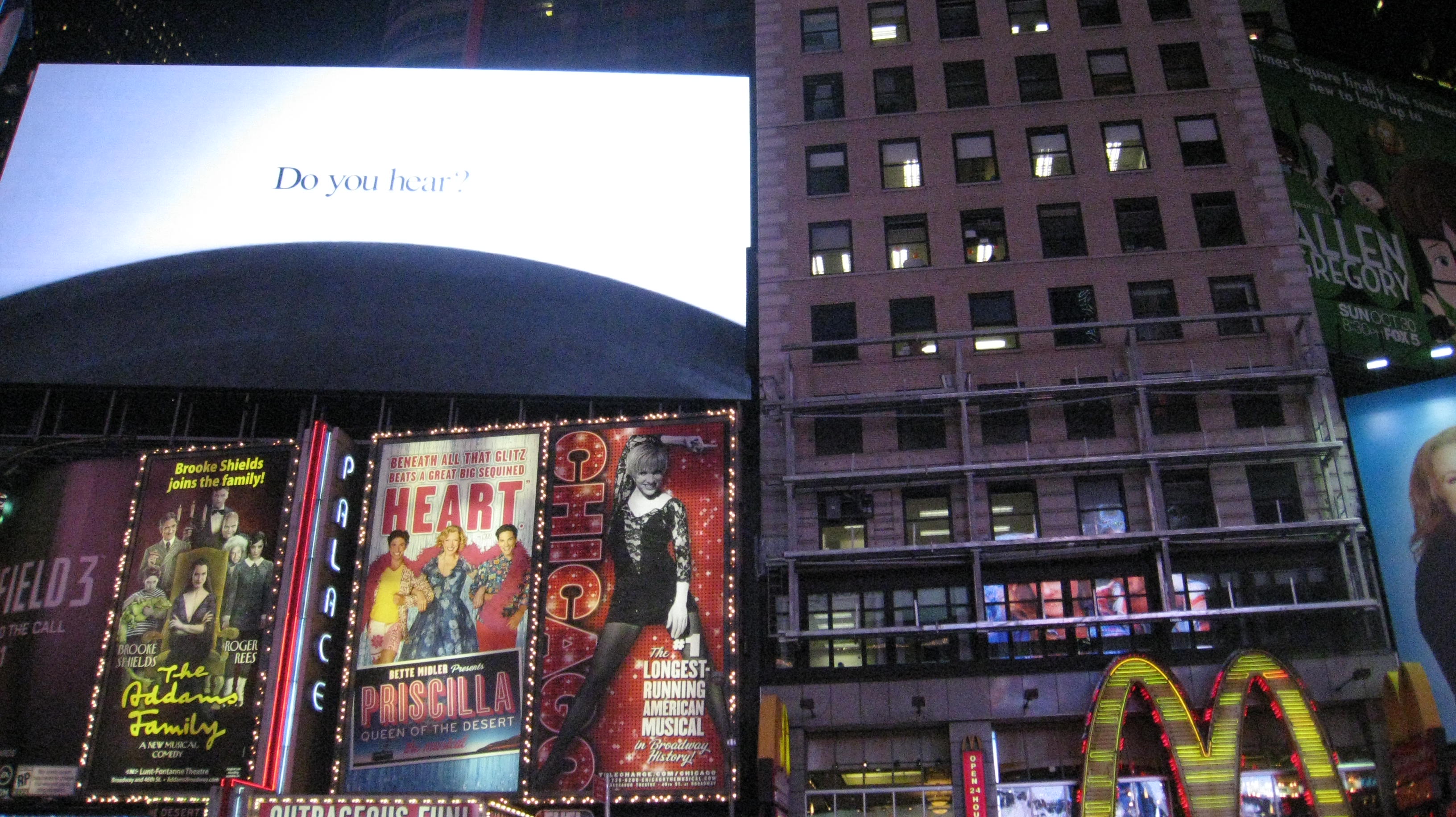
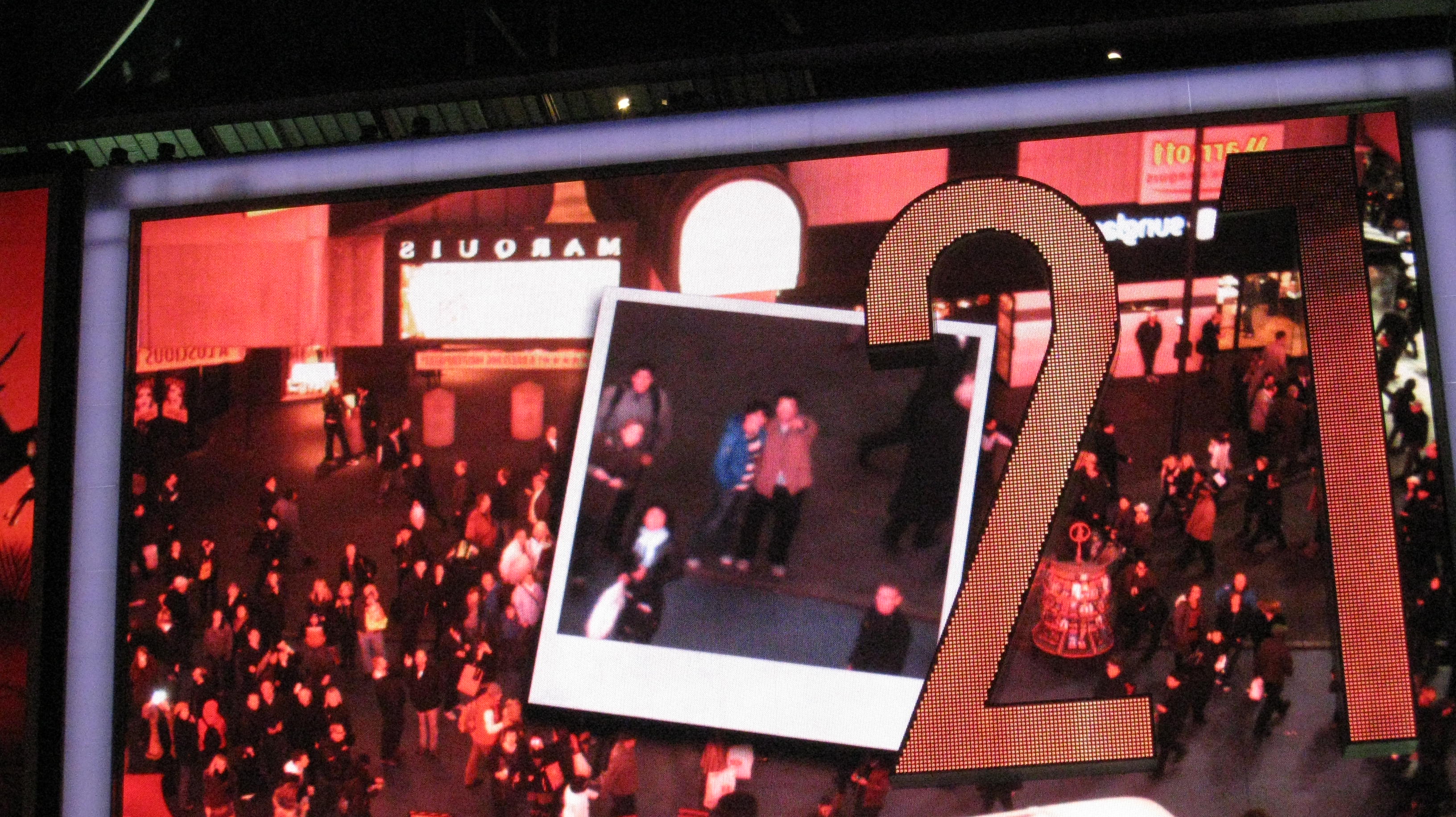
We walk a total of ninety-five blocks all the way from Central Park to the centre of Manhattan. We hit upon Time Square: lights, colours, enormity; everywhere. It conveys an overload of sensation and an adrenalin rush to the pit of my stomach. The changing colours of billboard lights make it instantly addictive. I stare stupefied at my surroundings, and like all the others, I whip out my camera and add to the numbifying flashes of lights. Each skyscraper in Time Square is servant to an enormous screen, which casts rapidly-changing images onto the ground, where we as tiny human creatures stand as awe-struck consumers of a world we are too tiny to control. It’s an enormously impressive place: its size, its lights, its sensations. Forever 21 there is open until 2 am each night. From the store-front an enormous screen shows a live video of the people passing by on the street below. This video provides the backdrop to a dancing model, who pops up between the little speckles of real people behind her. We stand underneath the screen for a while, searching for ourselves as if we were in a “Where’s Wally” page and then, predictably – find ourselves in the corner, point excitedly and pull out our cameras.

Brilliance and its victims

Forever 21's live video of crowds below

The ‘New’ in New York sure lives up to its name. The skyscrapers and omnipresent screens are like something from the future. Genius entrepreneurs like Steve Jobs, Mark Zuckerberg and Google’s Larry Page and Sergey Brin have changed the way in which we live. At the same time, they have created a culture of technological dependency and fuelled a society whose commerce feeds off a perpetual feeling of inadequacy, social comparison and greed. We have an accident and our immediate thought is: “I can make some money. Where is that Attorney’s number?” We want to look good all the time, so we vote with our feet and make it commercially successful to open a clothes store until 2am each night.
We ignore the little guy holding a hand-made globe on top of his head in Time Square to raise awareness about Climate Change because he doesn’t have flashing lights and isn’t tall enough to scratch the clouds. America is a story of brilliance and its victims.

#Occupydamestreet exposes what’s good about Ireland

I admire the Occupy Dame Street protesters. On a night like this, as the wind pounds on my window panes and the rain pours down, I imagine them huddled together discussing the agenda for the day ahead. They are a peaceful bunch, who have spent their days postering trees with quotes from Fight Club rather than hurling abuse at the workers whose premises they occupy.

In spite of my self-confessed lack of understanding of the economy, I don’t share their belief that bankers represent the evil 1% of the population and that 99% (the “rest of us”) are their unequivocal victims. It can’t be as simple as that. I’m also not sure whether the protest has any concrete aim but it is certainly drawing attention to the displeasure of many as a result of the actions of few.

What really interests me about this protest is how it exposes the Good in our society.

Here are a group of people occupying a central location and plastering around it slogans determined to undermine the country’s main financial institution.

And yet, it’s peaceful. No aggressive guard has entered the scene, and yelled “Hey, you angry hippy, move it or I’ll shoot”. No protester has screamed abuse at the passing bankers to which they attribute a decline in society’s moral code.

Instead, the public casts a glance, takes a look around, enjoys a talk with a protester about the meaning of life and ambles on, equipped to make its own mind up.

The Occupydamestreet movement tells me a lot about what’s right with this country; the assurances that we take for granted are those for which so many of the Arab Spring protesters have died for.

So inspired have I been by #occupydamestreet that I’m off to #occupywallstreet in the morning. I’m visiting my sister in Philadelphia. She emigrated there two years ago, but not before hosting an “emigrate-like-its-a-recession-party”. When I ask her about her job she tells me that she analyses butt samples but I have a funny feeling there might be a little more to the job of geneticist than that. I’m gutted to be missing the election. If there’s anybody apathetic enough to vote for my first choice I’d be most obliged. Mail me privately for my politics.

I intend to update you on my travels in the Free World but should that not be possible, I will record my thoughts in my little blue copy book and transcribe them at a later date. See you on the other side of the Atlantic!

Katekatharina’s Blog is one year old today!

Today Katekatharina’s Blog is one year old. To celebrate I am working late and going to my Arabic class. In my head though, I’m in a hammock clutching a yellow balloon with “Happy First Birthday” written on it in Comic Sans.

Blogging is terribly fun and at first it was terribly hard to keep up. I set up at least three different blogs on various sites before sticking with this one. WordPress’ format is foolproof. Believe me, I have tested it. It’s easy to use and it makes the things you write look quite pretty. The photographs you upload know intuitively where they should land and in what size they should appear. Critics say all our sites look the same: I say: “but look at the selection of themes we can choose from!”

This time a year ago, I was in the same bed I’m typing from now but in a different place. Then an indefinite void lay ahead of me whereas now I have an -albeit dangerously short-term- plan worked out.

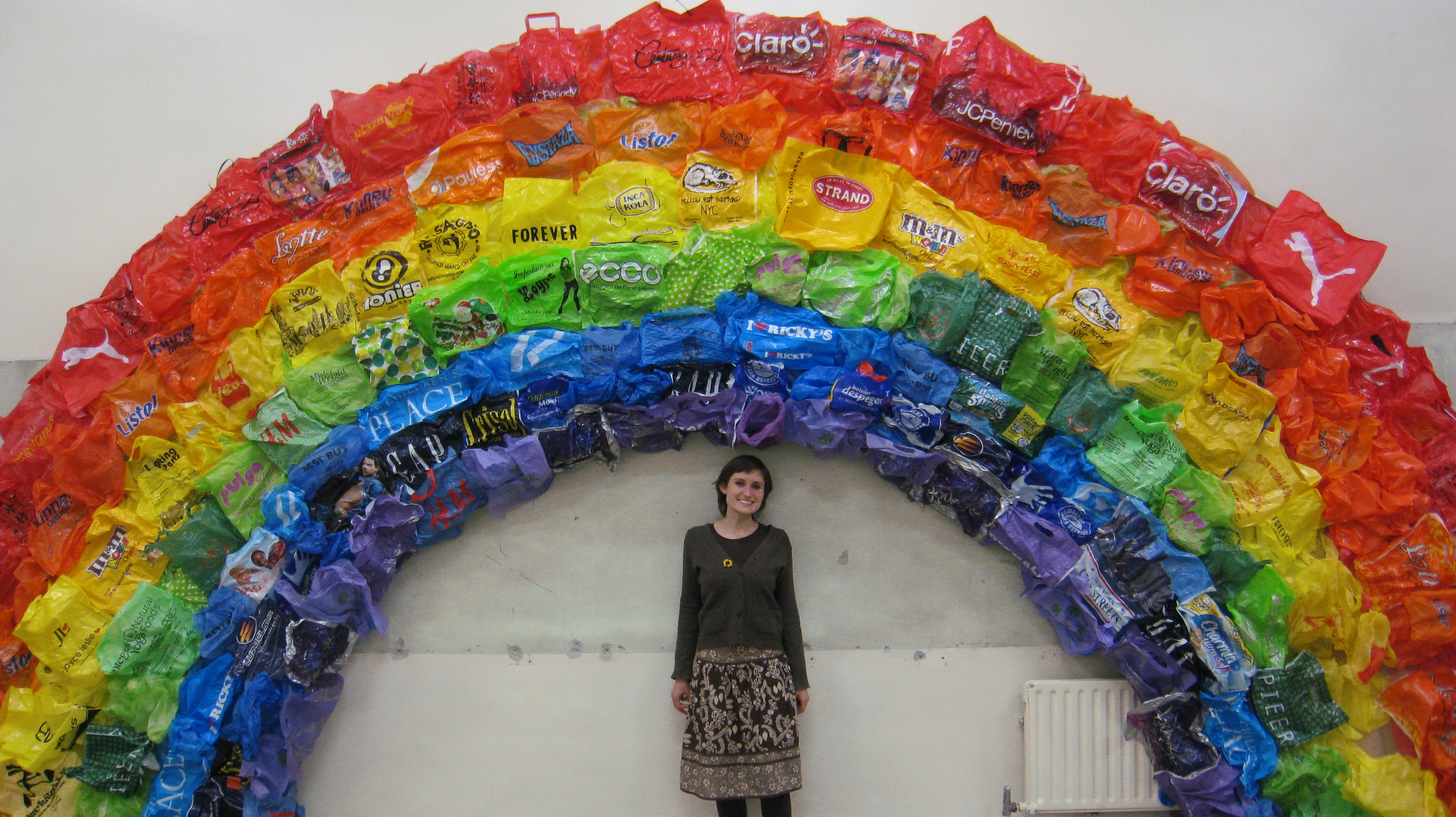
Birthday Rainbow from Dublin Contemporary


The best bit about blogging is when someone reads what you’ve written. That’s why people write on the internet. It’s not like a diary, where you reveal your innermost thoughts but it’s confessional all the same and looking back over a year’s worth of entries, I guess I can see some characteristic themes emerging.

I seem to write a lot about things I see. For me, images form an easier structure than the course of events. I think that’s why I favour feature writing over news reporting. I seem to like write a lot about language and quite a bit about LSB too. These are two of my favourite things I guess. My tone has become less formal in the last year too. My aspirations of maintaining a crisp and detached tone were tempered by the realisation that even very serious journalists enjoy copious use of the personal pronoun.

The most popular blog posts are not the ones that I have sweated over. They are the ones which were fastest to write and which were “tagged” with terms that searchengines were a fan of that day. I get a lot of referrals to a post I wrote about the closure of Waterstone’s Bookshop last February, a piece about brain plasticity, LSB’s Valentine Day surprise and my Confessions of a teacher. It is a great pleasure to skim the search terms upon which people are referred to my site. As I told you last week, a disproportionate amount of my hits come from people googling images of snails and phrases like “inappropriate teacher-pupil relationship”

I have a wonderful friend who lives in Bayreuth in Germany. Really, she’s my mum’s friend but I have applied for joint custody because I like her very much. She sent me an e-mail last week to let me know that she occasionally reads my blog. And on the same day, a boy I’ve never met dropped me a line from where he was too. We’d connected over our blogs a year ago only to discover we graduated from the same college in the same year and both wanted to get into writing. Things that like can transform your day.

Ironically, my first blog post was titled “A last resort” and was in fact taken from a column I had in Trinity College’s The University Times (then The Record). You can check it out here.

Happy Birthday to my wonderful readers, especially to you that has googled ‘snail’ again. Thank you so much for all your comments! Have a slice of cake sometime today for me. And please, let me know what you’d like to see on Katekatharina’s blog before she turns two. Got a challenge for me? Something you think I should investigate? Try out? Get over? Let me know.

Dundrum shoppers stunned by voices of Messiah

Shoppers in Dundrum Town Centre in south Dublin were surprised this morning by a large-scale and apparently spontaneous choral performance of the Hallelujah chorus from Handel’s Messiah. The twenty choirs which took part were positioned on three levels around the shopping centre with the conductor stationed on the top floor outside Frangos foodstore. The flashmob-style event occured at 12.40 pm and marked the culmination of RTE’s Big Music week. Aproximately 400 singers took part and were applauded by customers keen to join in the fun.

Are schooldays the best days of your life?

I wrote this piece 10 months ago, when I was still unemployed and feeling rather nostalgic about the time I spent at school. Luckily I’m now working fulltime and the prospect of writing “The Toilet Wall” for a living is that little bit closer than ever before.


The Fruits of Literature

“Imagine that you have found the most delicious-looking plums on your kitchen table”, Niall Mac Monagle began, in media res on the occasion of my very first English class. “You gobbled them up” he continued, “and now you must write a note to the rest of your family apologising for what you have done”. Luminous sheets of card fluttered onto our desks and twenty -six young fountain pens began to scrawl lines of contrition. “Time up”, yelled MacMonagle. “What have you, Ms Flaherty?” A scoff. “Erm.. Sorry I ate the plums”. MacMonagle beamed. “Excellent!” Then silence, then a poem. I have been hooked on language ever since, and were it not for the brilliance of this man, I would have neither studied English literature at university nor considered writing for life. I am imagining his humble cheeks turn rose petal pink upon reading this, and it gives me pleasure.

Emancipation or “On Covering the Calves”

The fight for girls to wear trousers was won in the summer of 2001, when I was thirteen and about to enter my second year at Wesley College. Clutching the uniform list triumphantly, I dragged my mother to Rita’s uniform shop in the ‘old’ Dundrum shopping centre, and we purchased a pair of over-sized, shapeless navy slacks, which I am waiting patiently to grow into, ten years and several hundred cupcakes later. The design was so ghastly that I was the only girl in the year to condescend to wear the garment and even at that, my resolve faded with the advent of spring.

A Changing World

I have the young and kindly music teacher, Mr Gifford to thank for my introduction to google. One afternoon in the computer room in the library, while my friend and I were typing up our entirely fabricated research project on Simon and Garfunkel, he bent his head tentatively between us and whispered, “There is a great new way to find information. It is called Google”. A rather silly name, I thought. Hardly one that will catch on.

I remember returning to my locker at 4 o’clock on September 11, 2001 and coming across a geeky classmate in a state of excitement. He was pounding his fists together to describe the trajectory of a plane’s crash into a skyscraper. I thought he was talking about a computer-game. Later, on the 48A bus home a lady spoke into her mobile phone, “who knows what will happen now; that Bush is a maniac”. By the time I got home, the TV was on, and the blown-apart pieces came together.

Breaking news and breaking ground

The very best bit of my time at Wesley College was my involvement with the establishment of a school newspaper, Fullstop. The editorial team consisted of seven people: six of my very best friends and myself. (It’s all about who you know in this country!). Tonight I reminisced over a coffee with David Kearney, then-editor-in-chief about some of the gems that the publication produced. The second issue, released on 26 January, 2004 featured a six-page interview with Graham Norton under the promising headline The Full Norty.

No area of school life was passed over by Fullstop: the controversy about the new swipe card attendance system was neatly summarised by the headline Swipe Strife! and tensions between prefects and non-prefects were explored under the provocative question: Prefects or Defects? My baby was a column on page 3 called The Toilet Wall, which is so full of righteous indignation that it makes me cringe with nostalgia.

Seeing the Woods for the Trees

On Thursday 18 November 2004, Fullstop ran an exclusive interview with the one and only Christopher Woods, after he was announced as the new principal of the college. The headline read Out of the woods and boasted an exclusive “fifteen-minute intensive grilling about Wesley, Africa and the secret to a good education”. Mr Woods mused that “ if I can look back in fifty years time when I’m old and grey and can say that everyone enjoyed their time in school and learned a lot … I’d be a very happy man”. It was a privilege, in my final two years at Wesley College to have a principal so dedicated and so interested in his pupils as individuals. I am sure that Mr Woods, old and grey will be a very happy man.

Now and Then

I studied English literature and Psychology at Trinity College, Dublin and now I spend much of my time at home googling jobs but all I can find are telesales positions requiring proficiency in Dutch. I do a little bit of teaching on the side which I enjoy but if I’m honest, what I really want to do is get paid to write The Toilet Wall. Wesley College inspired me to dream of great things and life since graduation has coupled that entitlement with a dollop of humility. The class of 2006 may have considered themselves the crème de la crème, but many of us are still sorry we ate the plums.

Wesley Women Celebrate 100 years

I spent the period between 2000 and 2006 in secondary school at Wesley College, Dublin. Wesley is a Methodist school, which takes its name from John Wesley who – as we were taught in our first year – at the age of five survived a fire in a rectory and henceforth considered himself to be “a brand plucked from the burning” and therefore destined to serve God.

Wesley was founded on the first of October 1845 on St Stephen’s Green and on that morning “At 9 o’clock the whole company sat down to breakfast joined by three boarders and nine day pupils. The Revd. Robert Masaroon presided.” In the years since, the annual Founders’s Day Service has commerated this day and the story of the college’s inception is recounted to students gathered together in “Assembly”.

An enormous landmark in the college’s history came in 1911 when the decision was made to admit girls. The significance of the move can be understood when compared to some facts relating to the period: Cambridge University didn’t award full degrees to women until 1947 and women in Ireland weren’t allowed to vote until 1922.

This year, a group of dedciated students under the guardianship of their English teacher, set about to collect the memories and stories of the girls who had passed through Wesley’s doors since 1911. They sent letters and e-mails to all corners of the world and made inquiries online and over the phone.

One such e-mail arrived in my inbox around Christmas time last year. It asked me whether I would contribute to a special book to celebrate 100 years of co-education at the school. Of course I was delighted to do so. My only problem was that when faced with the task of recounting my schooldays I didn’t know where to start and I didn’t know where to end. I managed to string a few thoughts together however and sent them back to the editorial team.

Last week, I attended the book launch. It was held in the National Gallery and was a momentous occasion. I couldn’t believe how many people had come. The expansive entrance hall of the Gallery was packed to the brim and as I looked around I saw many, many faces I did not recognise, but dotted between them, the unchanged appearance of my old teachers, whose mannerisms and expressions have remained constant since my departure.

The book, “Wesley Women” is a remarkable achievement. In all, 87 past pupils contributed. It’s full of amusing stories like girls ‘sealing’ holes in their tights with nail polish and filling balloons with hot water in order to survive the cold boarding house dorms. The earliest contributor left Wesley in 1912 and and there are several contributions from the 1920s and 1930s too. These stories are particualrly valuable as documentation of social and cultural history: Wesley did not live isolated from the world wars, the advent of rock and roll and of course the fight for women’s rights.

I’ll post my contribution later but must add that many of my memories are of people with whom many of you won’t be familiar. Still, I’d love to know, if you had to summarise your school days in 500 words, what would you mention and why?

KateKatharina’s Online Arabic Tutorial

I wish I could lie to you but I can’t. The Arabic alphabet has 28 letters, a large proportion of which change shape according to their position in the word. A select few are awkward and refuse to join with letters to their left. Many have the same shape when in the beginning or middle of a word but have a different number of dots above or below them. There’s a special symbol to let you know the absence of a vowel sound. In case you were, you know, in doubt.

I’m just back from my second class and am rather disappointed that there has been no opportunity to practise speaking, given that learning the alphabet seems to take an eternity. For this reason, I’m going to teach what I’ve learnt in the way I would have liked to learn it. I’m really not one to say a bad word about teachers (believe me, I’ve a vested interest) but as one of my classmates mumbled after class “she’s awful serious.. she’d want to ligthen up” and of the homework “It’d put you to sleep alright”.

To get us started, watch this. I dare you not to feel a smile creeping uponon your lips.

The only two things you need to remember from this video:
1.That little boy’s adorable voice (Bieber who?)
2.that Arabic has three vowels, which correspond loosely to ‘A’. ‘E’ and ‘U’. They’re a bit like fadas in Irish. For ‘A’ you put a dash above the letter; for ‘E’ below and for ‘U’ its a little sign that looks like a number 9 above the letter. That’s why in the song they sing ‘A, U, E, Be Bu Beey’ etc.

Okay, enough about the alphabet. (For my sake, not yours).

For those of you who don’t know me (I’m looking at the seven people who googled “smail” and were referred to my blog today. Though on second thought, perhaps it was was just one massively enthsiastic malacologist.)

“ismee Kate Katharina”

Say it.

Go on.

Now tell me who you are.

ismee= I

Your name=Your name

Easy Peasy Lemon Squeezy.

Now, Kayf- haluk? How’s life?

I’d hate to pre-empt you but are you feeling fine, thank God? And are you male? Then say this:

Tayeb al-hamdu lelah

Are you feeling fine thank God but worried, because you are female? Then say this:

Tayeba al-hamdu lelah.

Same? Nope. All adjectives (as here ‘fine’) have genders. How do we make an adjective feminine?

Add A.

Hmmm. There’s a problem, isn’t there?

Some of you are not fine. Some of you are tired. Fine. It’s a late blog post. You have an excuse.

Say this if you’re a man:
Ta-ban, which the stress on the ‘ban’.

If you’re female, say….???

Come on, you know this one.

Yes, you got it Ta-ban-a.

I (ismee) really am Ta-ban-na now..

So I guess I should take my leave from you and say

Mass-salama.

Go on, reply to me. It’d be rude not to.

*********************************************************************

PS- Remember ‘share the luv’ on bebo? Well my lovely blogger friend Clariice over at Reise meines Lebens has shared the luv by nominating me for a Liebster blogging award.
I’m not sure if this is an actual award or simply a way to get bloggers to share each other’s work but I’m going to take the opportunity to link you to some blogs that I really enjoy.

1. Comeheretome: UCD history students writing interesting short pieces about cultutal landmarks. They often include scans of really interesting historical documents they have access to. Warning: also write about football.
2. Inside the brain: Love this blog. Irish neuroscientist summarises latest research in his fields in layman’s terms
3.Broadside New York-based writer and author of Malled: my unintentional career in retail writes short, poignant pieces in beautifully crafted prose
4. Kat Richter: Serial-dater from Philadelphia. What more can I say? Addictive and witty.
5. Last but definitely not least: Clariice herself. She writes wonderful poetry in language that I love. It’s totally unique in that it’s sparse but also satisfyingly clunky. Her words are real, soulful and off-beat.