I had a dream the other night. Two soldiers were confronting each other; one had a gun pointed at the other´s forehead. The man with the gun was whispering threats. An act of unbearable cruelty was about to take place. Then I woke up.
I`ve never had a dream like that before, at least not one I`ve remembered. But I am pregnant with a boy now. He is the size of a mango, according to the app, and I can feel him bubbling and fluttering beneath my ribs. In a corner of my unconscious mind, I am wondering how I will be able to keep his body safe, once it`s in the world.
Others are having similar thoughts. At work last week, I was getting my makeup done before I went on-air. “I`m terrified about the Wehrdienst,” (conscription) the makeup artist said, as she spread powdered foundation across my cheeks. Her son is sixteen, and delicate. Germany hasn`t yet reintroduced compulsory military service, but the conversation is shifting that way.
“You`ll have to handle puberty,” I inform my husband, outlining all the ways in which I`m unqualified: I have no idea what it feels like to have a penis; to lose control of your voice when you are still half a child, the humiliating squeaks echoing against uncompromising classroom walls. To be expected to carry the heavier box.
I understand the objectification of the female body. Walking down Grafton Street in Dublin as an eighteen-year-old with my then boyfriend, we bumped into a classmate of his. I have never forgotten the sensation of that other boy scanning me from head to toe. It happened in a nanosecond, as fleeting and subtle as a packet of ham passing through a till. I still remember the clothes I was wearing; a figure-hugging sleeveless yellow shirt and black three-quarter-lengths. I passed his test.
In the following years, I sat in college tutorials talking about the male gaze and getting cross with headline writers who used passive constructions when reporting on male violence against women.
My knowledge of the male body and experience, on the other hand, is remedial. I was stunned to learn that baby boy fetuses are often identified in ultrasounds by their tiny erections. Instances, I’ve learned, of the nervous system practising its functions.
Now I am going to mother a boy, and am thinking about the myriad ways his body will be scanned for its worth. For every novel I read growing up in which women were the objects of desire, or limited to their domestic roles, he will encounter stories of boys and men in trenches, or down mines. For every billboard I saw of women with complexions and facial symmetry I could never achieve, he will see chiseled jaws and six-packs to aspire to. For every impenetrable algorithm that has made me feel less of a woman, there will be an equivalent Internet pathway, enhanced by AI, picking at his self-esteem.
He will be born into an extraordinary cultural moment. A time when the tide of moral progress is receding. A time when the current US president – democratically elected twice – is a man who brags about “grab[bing] women by the pussy” and whose response to a female reporter asking him about his connection to a serial sexual abuser is: “quiet, piggy.”
What will he make of it all, I wonder? How will our culture have evolved by the time he comes of age?
In the past decade, working in a Berlin newsroom, I experienced the sudden global awakening to women´s experiences that came with the #MeToo movement, and the resulting rush from management to introduce new directives on sexual harassment in the workplace. Even then it all seemed a little knee-jerk, as if implying that inappropriate behaviour had hitherto been acceptable, but must now be explicitly banned. When older male colleagues asked if they could still tell me I had nice hair, or a pretty dress, I responded with some version of: just use your common sense.
I think back particularly to one man, already counting down to retirement when we met. A former soldier, he´d ended up in journalism by accident. He had a reverence for the intellectual calibre of his colleagues that seemed rooted in the feeling that they came from the “right” background, and he did not. He talked to me a lot, and I listened.
He told me about a young woman in Thailand whose mortgage he was paying. “I`ll always take care of her,” he said, meaning to sound gallant, I think, but unaware of how deeply problematic it sounded to my ears. He was less interested in sex than he used to be, he clarified unprompted once – before reporting on a long-ago incident in a sauna, where a woman he knew tried to entrap him by titillating him.
Among my contemporaries, the prevailing feeling towards men like my colleague was contempt. There was no way he´d bombard a male colleague with his inappropriate anecdotes. Probably not an older woman, either. I knew all this, and still, somehow I couldn`t bring myself to tell him to stop.
The loneliness seeped out of him. I could almost see it, forming a puddle on the newsroom floor. I did not respond to his retirement email when it came. I was tired. But I wonder if he made it to Thailand, as he had dreamed, and how many mortgages and massages his pension might cover.
If I had been a slightly less empathetic person, and perhaps a little braver, a conversation with the “People” department could have seen my colleague canceled. But my total conviction in his complete lack of self-awareness made this seem like an unnecessarily cruel course of action. I thought of him as a young soldier sometimes and the reverence he had for the desk job he did now.
When I consider the regressive cultural shift we are experiencing now, what strikes me most about the form of wokeism I myself inhabited is how greatly it underestimated male fragility. It did this to such an extent that men became hysterically angry. Throughout history, we have accepted their bodies being sacrificed for the cause of nationhood, valour or economic sustenance. Finally then, a new age of reckoning arrived. But it offered neither relief nor reassurance.
Instead, it asked them to atone for crimes ranging from complimenting a haircut to committing rape. For those whose bodies were closest to the firing line, it was an unforgivable humiliation. For those whose bodies were furthest from it, like Donald Trump, it was an opportunity.
What we have got now is a dual casualty. If wokeism banished common sense, what has followed it is killing common decency. Both need to be mourned, then restored.
As a future mother to a boy, I have an interest in finding hope in the disarray.
It begins by accepting a truth which our culture has so far refused to reconcile: binaries are real, and they reside firmly on two ends of a spectrum. We can talk about male and female while accepting that most people are going to sit somewhere between the archetypal traits of both. This applies as much to politics: are you a liberal or a conservative, as it does to gender.
The boy inside of me might well be wired to prefer diggers to unicorns. He may end up physically stronger and less emotionally attuned than his older sister. But if he doesn`t, I will happily place a unicorn into his little hands. I will cradle both him and his sister close and hope that I am doing the only job that really matters: fostering decent, sensible human beings. Then I will close my eyes and hope that neither of them will end up collateral damage in a senseless culture war.
Choosing to mother again in an age of anxious ambivalence
The first time I mourned the idea of not having a second child was in the hours after the birth of my first. I was doubled over, shuffling towards the hospital toilet, in a dizzy haze after the assault of a 40-hour labour. The thought – intrusive and inappropriate – came with clarity: I can never do this again. I will never do this again. How could I? I had wanted to die.
Three months later, I took my baby to meet some friends for pizza. Some pandemic restrictions had been lifted, but the plague was not over. Bursting with pride, I passed my daughter round for cuddles. “Would you have another?” they asked. “I definitely wouldn`t rule it out,” I said. They seemed surprised.
(The fear that my daughter could have caught Covid during any of those cuddles haunted me later and until it was clear that she had not, I felt like the worst mother in the world).
Motherhood made me happier than anything in the world ever has. I had never doubted my capacity to love. But what I never expected was that in those early months, my insomnia would disappear, and I would sleep more deeply than I ever had before. That I would lay in a cocoon of duvets, breastfeeding my baby for hours on end and feel entirely fulfilled. Who would have thought, after all those agonizing years of wondering and fearing and second-guessing motherhood and how it would affect my career, that the truth was: this was better. At least, for a while. We had an unnaturally contented baby. The kind who smiled at strangers on the street and slept all night.
This was four years ago, before feminism and wokeness had been canceled. The idea that motherhood was not only more enjoyable but also more fulfilling than my job had been, felt like a thought that needed to be quashed, or at least rigorously questioned. I was mortified by the idea that my sentiment might be endorsed by some of the Internet’s vilest people. There was nothing ideological in my feelings. I didn`t care if other people wanted babies. I still wanted women in the highest positions of political and corporate power. But I was awe-struck by the little life I had created. She mattered more than anything. I couldn`t believe we all went through life paying such little attention to the mysteries and wonders of conception and childbirth.
And yes, I was definitely bored sometimes. I missed writing and feeling semi-important because I had a job on TV. I missed being alone. And I had no interest in any of the logistics of parenting: discussing pram brands or naptimes or what solids to start when. Those things left me cold. They still do.
Oh, but the love. It was intoxicating.
***
My daughter started daycare at 10 months old, early for Germany, late for other parts of the world. I went back to work and in the early weeks, found it exhilarating. Hours on end to research the decline of the liberal world order! Just for the sake of it, with no little life depending on me! Compared to parenting, it was a piece of cake. For a while anyway.
I did not realise it as it was happening but as my baby grew, I began to shrink. I was eating as heartily as ever but no amount of feasting could hold pace with the calories I was losing from breastfeeding.
I was lucky that feeding had come easily to me and that I could meet my baby`s voracious demand. I fed her before and after daycare and all night long.
The months went by. On her first birthday, I came to pick her up from daycare and found her sitting in a tiny chair at the head of a table of tiny people, wearing a paper crown. Around this time, I began to think again seriously about a second child. I had been almost 34 when she was born. I didn`t have unlimited time.
Then one day, my husband lost his job. A typical corporate layoff, it came with no warning and was executed with ruthless precision. By noon that day, a courier had arrived at our door with the letter of termination.
We live in a country with a generous social safety net. You pay in generously and when misfortune strikes, you get back what you gave. We were okay. But it was unsettling, and the economy was bad, especially for the creative industries. I put pressure on myself to work more. I fed my baby. But she wasn`t a baby anymore, she was a toddler. It was exhausting. But it was also sublime. It was both of those things, much of the time.
We didn`t own weighing scales at the time, but I did notice how loose my jeans were becoming. I bought a size down. In one of the video reports I made for work, some of the YouTube comments called me anorexic.
In the summer before my daughter turned two, we visited a friend in Austria. After our meeting she sent me a kind text. She had noticed how thin I had become and was concerned. She herself had a history of eating disorders. She was also a doctor, and had an eye for this stuff. Naturally I was defensive. I`ve never had an eating disorder. I was eating as I always had. But when I look back at pictures from that time, I can agree: I had become alarmingly gaunt. My abundant milk supply was eating away at my body fat, so incrementally that only people who hadn`t seen me for a while noticed.
***
My preternaturally “easy” baby turned into a remarkably difficult toddler, almost overnight. We were somewhat startled by the strength of will that emerged, which even the affectionate staff at her daycare conceded was off the charts.
“The world needs strong, difficult women!” my husband and I would agree – increasingly ironically – hours into trying to get her dressed in the morning, willing ourselves to believe that every time she ripped off her trousers again, a tiny layer of the patriarchy was crumbling.
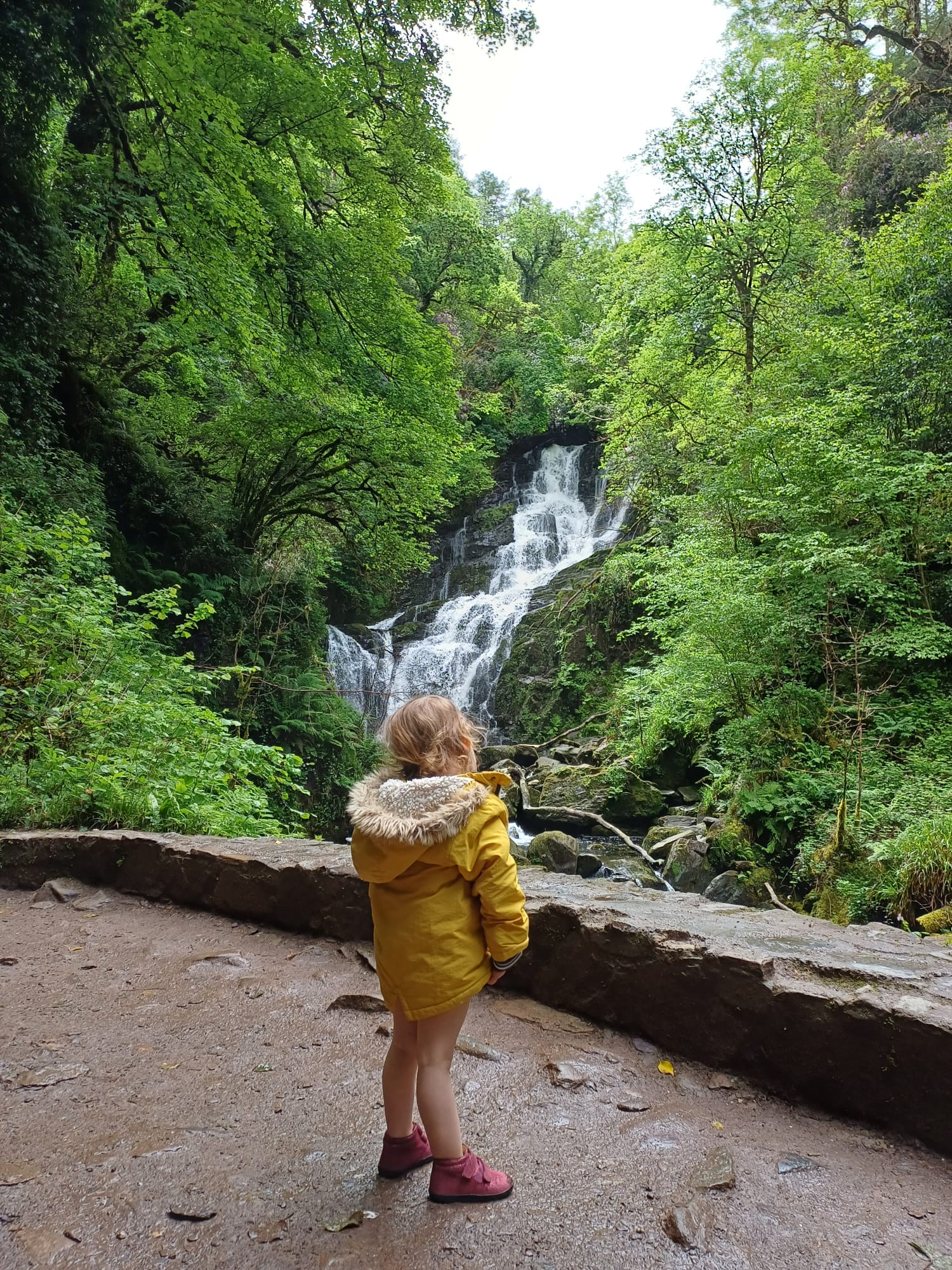
On a comically disastrous holiday to Ireland that summer, immortalized by a series of photos of my husband and me looking depleted while holding our furious, trouserless toddler at various sites throughout Killarney national park, I mourned the idea of a second child for a second time.
Our trouserless toddler
This was so hard, and we were so tired. Work no longer felt exhilarating, just exhausting. To make things more complicated, we were still coming to terms with my husband´s MS diagnosis, an illness that affects his walking and whose prognosis is unpredictable. The idea that our furious two-year-old would ever accept a sibling became laughable. It made me unbearably sad. I tried out telling people: we`re only having one. We couldn`t manage any more.
And how lucky we were to have one. Because as hard as it was, that love for our difficult, unyielding, deeply, deeply feeling, sensitive little person was only growing every day.
When she was two and a half, I had my first night away from her. The circumstances were the least restorative imaginable. Work was sending me to the industrial town of Leverkusen to interview the CEO of Bayer. I was very pleased to get the assignment, but I had to write an entire book for my daughter to prepare her for my absence. The “Leverkusen” book – bound in a purple ringbinder and featuring illustrations of domestic life juxtaposed with train travel – is still one of her favourites. The night before the interview, I didn`t sleep. Not even for a minute. I was super well-prepared, so I got through anyway. But when I watch that interview back, I see the exhaustion in my eyes, the toll of parenting and working written all over my face.
***
As much as I had mourned the second child that may never be, the truth was that I had not given up on the idea. The possibility stayed with me constantly, even in moments of great resignation. But the anxiety was great enough to mistake for ambivalence.
I scoured Reddit for stories of mothers grappling with the same question. I was searching for some kind of narrative that matched my experience entirely but never quite found what I was looking for. There were the happily “one-and-done” crew, advocating for the pleasures of a life with one child. Their arguments were highly convincing. There were those who regretted having a second. And there were those who couldn`t be happier they had taken the leap. Unfortunately, there was no one who was going to tell me what to do. My husband said it was up to me and no amount of interrogation revealed a hitherto concealed desire. He would go along with what I wanted.
I began following an account called “The Happy Caravan”, chronicling the life of Amber, a fundamentalist Christian and the mother of eleven musical children. All of them homeschooled, some have gone on to attend the prestigious Julliard music school in New York.
I became fascinated by her: eleven! From what we see online, the children all seem polite, and the atmosphere at home is reasonably calm. Of course, it`s likely that creepiness and darkness lurk beneath the surface. There are only so many hours in the day, and Amber manages to release far more videos than it would be plausible to make if you were actually looking after not only the emotional and material needs, but also the education of your eleven children. And things did fall apart, because New York prices ate them up and they had to leave in a giant trailer and move into a house in San Diego infested with termites.
But none of that erases this woman`s stunning feat: after experiencing the awesome love and responsibility and life-changing demands of having a child, she chose to do it ten more times. I studied her obsessively, trying to discern the source of her conviction. It was blind faith, obviously. But as she walked me through her gigantic Aldi hauls and chicken stew recipes, Amber, a stranger on the Internet unwittingly taught me a lesson: no amount of thinking or planning would change the fact that trying for a second child would be an enormous leap of faith.
***
I made an appointment with my gynaecologist, a tiny, 85-year-old man who frequently opens our conversations by expressing dismay at the decline of the Transatlantic relationship or with the provocative question of whether I have really read Ulysses (he knows I am a journalist and that I come from Ireland).
“We`re thinking of trying for a second child,” I told him nervously. “Machen Sie das!” (“Go for it!”) he said, without missing a beat. Then, looking right through me he added: “A child is the ultimate expression of hope for the future.”
I nearly cried when he said that.
***
My daughter had her last drink of my milk on the night before her third birthday. We had been discussing the moment for months and when it came to pass, it was seamless and beautiful. When she asked for bainne (the Irish word for “milk” my husband and I had been using as code but which she deciphered immediately because she is not only difficult but also brilliant) the following day, I reminded her that she was now three years old. “Oh,” she said giggling. “I forgot.”
I gained weight and my old jeans fit me again. As much as I had loved breastfeeding, regaining bodily autonomy was empowering. I felt freer again. The possibility of having a second child became a tiny bit less remote.
***
No one has ever told me to have children, at least not explicitly. In my industry, not having children is as common if not more than having them. I watch, sometimes enviously, as my friends travel the world, or take on exciting assignments. But I have never regretted motherhood. She is more interesting and more special than anything I have ever done at work. And because everything is both personal and political,I feel the need to add: there would be nothing wrong with it if I did have regrets. Plenty of mothers do. They might not tell you to your face, but they will confess to it in countless forums on the Internet.
It is hard to truly analyse the cultural expectations you grew up with. It requires a certain distance which by definition you do not have. As a millennial, I came of age with the arrival of social media. I know, rationally at least, that the platforms I did engage with, over years, must have held enormous sway over the formation of my identity.
When I was pregnant with my daughter nearly five years ago, I had a desire I would have denied then but can admit to now: I wanted to work and to mother performatively. I had relished the idea of displaying my big bump on air. I would post a clip on Twitter of me presenting the news with my huge belly. The implication would be that I was doing it all. I would package it into a clever humble brag.
As fate would have it, the only time I was pregnant on-air was in my first trimester, and my clearest memory of it is the genuine fear that I was going to throw up between segments. After that, I was banned from being in the studio because my workplace had a no-office policy for pregnant women during the pandemic.
***
In February of this year, I took a step that seemed momentous: I re-downloaded my period tracker app. My husband and I had decided to start trying to conceive in the summertime. I clicked the option that said “trying to conceive” and immediately my social media filled up with ads for fertility treatments.
I worried enormously that my cycles were no longer as regular as clockwork. I researched perimenopause and watched in horror as more of my hair grew grey. After all of my soul-searching, perhaps the decision had been taken away from me.
In June, the month our conception journey was to begin, my husband took a work trip. When he came back, our daughter turned into a monster, furious that the intensity of the time just with me had come to an end. We stayed inside for a whole weekend because her tantrums were so intense and her resistance to suncream so profound. It was 37 degrees outside. We sweltered inside. I imagined adding anything at all to the stress we were experiencing. Not this month, we agreed.
“Are we ever going to do this?” I asked my husband.
“Yes,” he said. “Just not right now.”
We knew this was an irrational way of going about things. But nothing about creating a new life is rational.
***
Autumn comes and it is more beautiful than ever. My daughter and I watch mesmerised as the orange leaves twirl off their branches under a clear blue sky. She scours the back yard for chestnuts, demanding I close my eyes so she can present them to me as gifts. She learns to ride a bike.
The videos on my feed change. What I see now are gender reveal parties and women speaking about miscarriages. My period app has communicated the news to the tech titans before I have to my family.
I can no longer close the button on any of my jeans and opening the fridge door is a hit-or-miss experience. I vomit when I exit the shower, a phenomenon ChatGPT tells me is likely to be due to an overactive vasovagal reflex caused by the shock of moving from hot to cold.
***
We were on holiday in Krakow when I found out. I took the test one morning in our palatial bathroom, which featured a faux-gold bathtub. The line appeared immediately. I called my husband. We took in the news quietly, and hugged. Like all life-changing moments, it felt both incredibly real and not real at all.
We went for breakfast with our daughter. Walking there, I felt a glow pass through me: I wanted this so badly and yet I could not believe it was happening. I breathed in the moment. When our food came, I insisted we take a selfie, so I would remember the hours after finding out, that secret time when your world changes and no one yet knows.
A week later, one of my favourite influencers, a woman who has been documenting her struggles with endometriosis and IVF for years, announced her pregnancy. I cried with joy for her; big, ugly messy mascara-tinted tears. Our pregnancy was only one week apart.
My daughter demands to see the video of the “woman crying and laughing with the stick in her hand.”
“Why did I not cry for us?” I ask my husband. “Why did we not cry for us?”
“It`s not our style,” he says. “We don`t scream on rollercoasters either.”
He is right. After so many years of agonizing over whether I could dare to indulge the deep and audacious desire to mother again, my joy was a quieter one, a creeping, cautious gratitude tinged still with an acute awareness that nothing can ever be taken for granted, especially not a safe pregnancy.
Our daughter, aware that something momentous is happening, is clinging to me more than ever. My fatigue is so extreme that I often fall asleep in her bed while reading her bedtime stories. When she wakes in the middle of the night and sees me there, a huge smile spreads across her face. I bundle her in my arms and kiss her hair.
“Maybe we should call our baby sheep,” she says. “Maybe,” I agree.
She lays her still tiny hand on my stomach.
“Your tummy is getting so big!” she says, adding “I also want to be a mama.”
“But also a bus driver,” I remind her.
She nods.
“You can be both,” I stress, remembering that everything is both personal and political. “How many children would you like?”
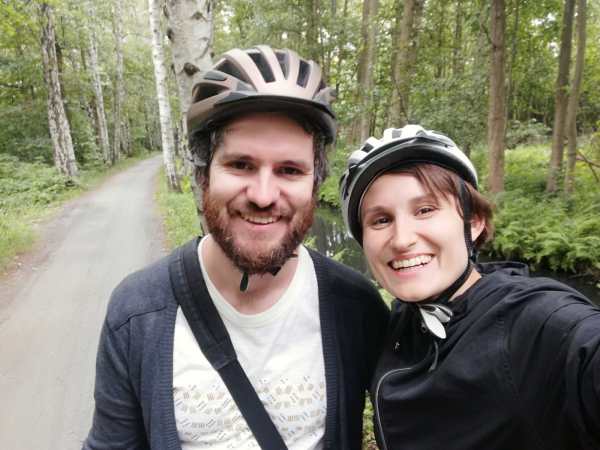
We brought our bikes on the train, and cycled to a campsite where we rented a wooden lodge with a lakeside view. There was a small shop nearby that sold gherkin beer. On our first evening, we cracked open a couple of bottles.
It’s not that bad.
LSH practically spat his out in disgust, but he was just being melodramatic. If you’re wondering, imagine a bog-standard lager with a cucumber floating in it, and you have the flavor.
We toasted to a restful and restorative weekend that would leave us ready to embrace the challenges of everyday life with a fresh sense of purpose.
Less than twenty-four hours later, we were back in the lodge, splayed on the couch with a pain known only to those who spend 364 days of the year sedentary and then cycle for ten hours straight.
We turned on the television – yes, we were glamping – with the innocent intention of unwinding briefly while we rested our weary limbs.
There was no way we could have known that we would spend the next several hours transfixed by the shopping channel and that I would return to Berlin not rested and restored but fixated on the idea of buying “WC Zauber Pulver,” an extraordinarily potent powder which turns into a magnificent blue foam when you pour it down the toilet.
Proper dweebs wear helmets in the Spreewald.
It was mesmerizing. I’d never seen anything like it! Just fifteen minutes, the woman said for a deep clean of your most poo-encrusted lavatory.
Well, she didn’t actually say the last bit, but it was heavily implied.
“Drop it all in in one swift motion,” she said, tipping the plastic cup into the toilet with all the confidence of a person who sells WC Zauber Pulver” for a living.
The transformation happened before our eyes.
“Why not deep clean the toilet brush while you’re at it?” she asked, popping it in.
As the foam filled the entire toilet bowl, an animation showed the deep cleaning taking place beneath the rim, too subtle for the naked eye to perceive.
“Just one bucket will last you a whole year,” the evangelist said. “And why stop at toilets? You can use WC Zauber Pulver to clean any kind of drainpipe!”
She popped some powder into a lonely free-standing sink in the middle of the studio.
“There’s nothing that cleans like it,” she said. “And available only today, for just €19.99, what are you waiting for? Pick up the phone. Oh no, stop! What’s my producer telling me? They’re going fast! We’re nearly sold out! If you want to get your hands on this product, you have got to act fast.”
The number on the screen was dropping faster than I could dial.
My heart was racing. In the background, the foam in the toilet had reached the rim.
“We need to get some WC Zauber Pulver.”
“No we don’t,” said LSH.
“We do.”
“We absolutely don’t.”
The woman returned to the toilet, and flushed. As if it had all been a dream, the foam disappeared, leaving the inside of the bowl as sparkling and pristine as freshly fallen snow.
“That’s incredible,” I said.
“You’re not actually serious?”
“I am deadly serious.”
“I can’t believe you’re falling for this.”
“It’s amazing!”
“Sleep on it.”
I did.
I still want to order an industrial-sized bucket of WC Zauber Pulver.
This is not a sponsored post.
I was much too enthralled by the WC Zauber Pulver demonstration to take a picture. But the shopping channel was also selling this worried-looking decorative monkey, which I thought to snap.
Words can’t describe the joy I felt when I discovered that First Dates Germany is a thing. It was yesterday, and my life hasn’t been the same since.
If you’re unfortunate enough never to have heard of this show, here’s a quick summary: strangers meet for a date at a restaurant owned by a flamboyant, semi-famous chef; the encounter is filmed and dissected by a snarky voice-over with a penchant for puns.
The Irish version debuted on RTE back in 2016 but tragically – while the episodes are available online – you can’t watch them from abroad.
That said, I have (obviously) seen enough episodes while back on the old turf to make a meaningful comparison with the German version.
Here, based on several glorious hours of binge-watching, are my first impressions of First Dates: Ein Tisch für Zwei:
The Teutonic reputation for bluntness and practicality? Firmly upheld. One woman praised her date for his attractive personality but rejected him on the basis that he simply wasn’t “optically” up to scratch. Another factored in the cost of the airfare that would be required for a long-distance relationship between Cologne and Zurich.
And when it comes to paying, there is far less beating around the bush. One young man leant back luxoriously when the bill came, waiting for his date to pay up. “I like to be treated,” he said simply, as if this was all that was required for a free dinner. It worked.
“Can I pay?” another man asked his date.
“Sure,” she said.
No “Ah, God no.” “Ah go on.” “No, we’ll split.” “No I insist.” “Oh go on then.” “Are you sure? Next one’s on me.” “If there is a next time: oh God. How presumptuous.” “Thanks ever so much. You’re too good.”
If you think it’s all about reason and logic on the German dating scene though: think again! These people are obsessed with star signs! In fact, asking prospective love interests their Zodiac sign appears to be a standard first-date question. This, of course, presents plenty of opportunities for some astrological banter too. Take last night – for example – when a Pisces (the German word for it is Fisch) ended up ordering – you guessed it – fish.
Staring blankly in the face of compliments is also common among participants in First Dates Germany. “You have lovely eyes,” one date said to another last night. No“ah stop” in response. No “yours aren’t bad either.” Not even an embarrassed glance to the side. Just silence and a long, impassive stare back at the admirer.
Altogether, First Dates Germany does not have the delicious appeal of the Irish version, with its self-deprecating and often highly witty participants. But the candor offered by the Germans offers its own unique comedy and charms.
It was the beginning of August and we were holidaying on the island of Rügen. Again.
Our third year in a row. Our second time staying at Apartmenthouse Anne, located ten minutes away from the beach and run by a straightforward but formidable woman whose disdain for small talk both impressed and alarmed us.
“We’ve become middle-aged,” I told LSB over dinner one night. An annual retreat to the Baltic Sea is the hallmark of habits belonging to German couples in their 50s.
“Maybe we should get married,” I suggested.
“Okay,” said LSB.
He was humouring me. In our decade together, we’d had multiple conversations about the institution, most of them featuring grand statements of our indifference. Our relationship defined itself, I would conclude. We didn’t need a ring, or a party, or somebody else’s blessing.
LSB agreed.
But over the past few months, something gravely unnerving had occurred: the idea of marriage was becoming less off-putting.
I couldn’t explain the phenomenon, so whenever anyone asked (which they would, quite often) I would respond in my usual way that marriage was an outdated tradition, which we were in no hurry to embrace.
As my arguments grew in force, so did the suspicion that I was protesting too much.
Restlessness had something to do with it, I suppose. My career was ticking along solidly but unremarkably, Berlin had become home and LSB and I were embracing the stage of life where spending a Friday night streaming Sabrina the Teenage Witch at home was envy rather than pity-inducing. Amid all this stability, the milestones I’d been conditioned to anticipate from life were becoming more opaque.
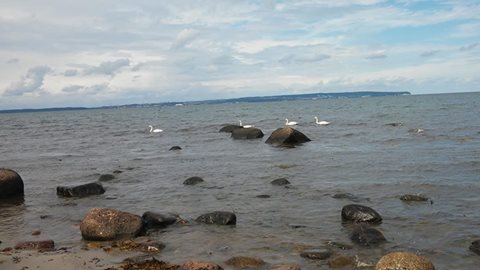
Because swans.
Pragmatism played a role too. The bank manager who told me in passing that it’d be easy to buy property with a husband but tricky with a partner had no idea what he was setting in motion.
Add to that the slowly-dawning realisation that if anything were to happen to either of us, the other would be a nobody in the eyes of the law.
By the time dessert came, LSB had raised no objections to my revised attitude.
The topic didn’t come up again until a day or two later, when we were walking along a wilder, stonier part of the beach on the far side of the island.
It was a grey day – the sky a patchwork of ominous clouds ready to erupt.
A family of swans drifted along the shore. Their feathers unruffled by the breeze, they appeared indifferent to the approaching inclemency.
Some couples have a song. Others have a meaningful place, where memories were born.
We have an animal. And it happens to be a swan.
I think LSB invented it but I can’t be sure.
If he did, it was to ward off questions like this:
human swans
“How do you know you REALLY want to be with me?” I would ask out-of- the-blue, sometimes out of boredom, sometimes out of insecurity and sometimes fishing for compliments.
I’d remind him that we were young when we met and that he hadn’t really had much opportunity to compare my charms to that of others. “How do I know you’re not just settling out of resignation, or a shortage of initiative?” I would ask, infuriatingly.
LSB would sigh, frustrated and answer: “Because swans.”
Swans: notoriously and unquestioningly monogamous. Unapologetic as they glide along, proudly navigating the world in pairs.
It always shut me up.
“Here,” said LSB, as the sky grew a shade darker and a clap of thunder sounded in the distance.
We moved towards a large rock and as their graceful silhouettes passed us by, we asked each other.
We said yes.
Then the sky opened up and it began to rain torrentially. We found cover at a bus stop and stood huddled together for half an hour.
That evening, to celebrate, we ate a meal at a superior restaurant, where they served us a plate of exquisite vegetables, the most succulent I have ever tasted, prepared sous vide.
The next day, back on the beach, I Googled the cooking technique and discovered that you can get special kitchen appliances for the purpose. We discussed extensively the possibility of purchasing one. In the end, we concluded it probably wasn’t worth it.
After all, one doesn’t have to say yes to everything.
Frau Bienkowski is anxious about LSB finding a job. He has been here for just five days. I told her that he was at home learning German.
“He’s diligent, is he?” she asked.
“He is,” I said. “He’ll find work. But for the moment, he needs to focus on learning the language.”
“Absolutely – there’s no point worrying about it this side of Christmas.”
Frau Bienkowsi says she pities young people out of work. It was the same in 1928, she told me. Unemployment was rampant.
Then Hitler rose and things changed. A man Frau Bienkowski knew had been out of work for ages. Then he got a job building a motorway. His wife was delighted.
Hitler re-built the army, even though he wasn’t allowed.
Men were kitted out in brown uniforms and had work again.
Frau Bienkowski got married just before the war broke out. She got pregnant, then her husband was conscripted. In 1940 her son was born.
“I prefer not to think of the time after the war,” she said. “It was so hard. We had no money.”
She will never forget the generosity of the Americans during the blockade.
“We gathered at Tempelhof airport,” she said. “And they dropped down packets of food for us.”
Then Frau Bienkowski wanted to talk about her winter clothes. They’re stuffed in a large box because her summer wardrobe takes up all the cupboard space.
We agreed to leave re-arranging the clothes until October in case of an Indian summer.
I told Frau Bienkowsi that LSB has complained about my many clothes taking up all the cupboard space and about how his t-shirts hang neatly, discontentedly from the top of the wardrobe door.
She laughed, her eyes lighting up with amusement, and told me to send him her love.
I grew up in a large, cold house. In the winter, I would curl up beside the gas heater until I became dizzy from the fumes. We didn’t have anything fancy like instant hot water. If you wanted to have a shower, you had to plan at least 40 minutes in advance. Waiting for the water to heat up was an opportunity to work on my juvenilia, or to stare at people on the street below.
It was character-building, nineteenth-century-style.
It was the kind of cold that seeps through to your bones. Sometimes my father would suggest I dip my blue-white fingers into boiling soapy water to get the blood flowing again. Other times my mother would enter the kitchen in mid-summer and drape a gigantic coat over my shivering frame.
Like in all good Victorian novels, love shone through in actions, not words.
Earlier when I was wracking my brains about how to write about love in a way that was not insufferable, a memory – one of my earliest- popped into my head.
I was a small child, well below school-going age. The house was, you guessed it, cold and I was waiting virtuously outside the toilet. My mother emerged and lifted me onto the pea-green seat.
She had pre-warmed it, like a mother hen.
That was love.
In my formative years, I continued to gravitate towards those providing warmth. I became enamoured by electric heater salesmen and canteen staff with large ladles of steaming hot soup.
Romantically too, I have favoured those offering to make me warmer. LSB’s shaggy hairstyle, spare coats and facial hair have proven to be a winning combination.
And I have to give it to him: LSB was quick to pick up on my requirements. Once in our early courtship, I was on a bus on the way to Crumlin. It was a dark and dreary night and we were going to a party. When I got off the bus, I found him waiting with a hot-water bottle.
That went down so well that on the New Year’s Eve just passed, he packed it again for our walk up Calton Hill.
A warm and fuzzy feeling, on demand.
Happy Valentine’s Day. This year, consider giving the gift of warmth.
“What does this mean?” I said, thrusting an official letter from the Federal German Post Office at my flatmate.
His eyes darted from left to right.
“You have to go to customs to collect a parcel,” he replied.
“Yes, but why?”
“I don’t know.”
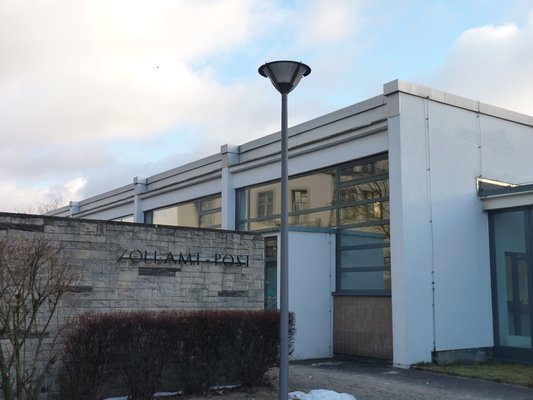
The customs office was far, far away. When I got off the train I saw a motorway, some industrial buildings and a pair of old ladies smoking. It was cold and damp.
As I approached the dreary concrete customs office and a wind began to blow, I began to feel more and more like I was at home. I joined the queue. Two men were working behind the desk. Another fifty or so people were sitting with little tickets, waiting for their number to be called. A waft of inefficiency filled the air.
It came to my turn. I handed the officer my documents. He had a crinkled orange face and a snide mouth. “Do you know the sender?” he asked.
I did. My lovely sister, who is a geneticist in Philadelphia and says she analyses butt samples for a living, had sent me a parcel back in April and was dismayed that it had not arrived yet.
“What’s in the parcel?” said the man gruffly.
…..
“I don’t know,” I replied. “It’s a gift.”
“Well I don’t know isn’t going to get you very far, is it?” he said.
“I’m sorry,” I said “but how am I to know what is inside the parcel?”
He narrowed his eyes. “We need to know what’s in the parcel.”
“Okay,” I said with false breeziness. “I’m sorry, but I’m not from Germany and I’m not familiar with this system. How does it work?”
His lips flickered with hatred.
“Do you think you’re the only one who needs to be served today? Look behind you. Look at the queue.”
He sighed and rolled his eyes.
“Okay,” I said. “I’m sorry, I just don’t know what’s in the parcel.”
“What could it be then?” he said with dull resignation.
I paused. He fumed.
“I’m sorry I don’t know. Maybe it’s a piece of clothing, or some chocolate. I really don’t know.”
He scribbled something down and issued me with a ticket. On it was printed the number 240.
“It’s a minimum two hour wait. Do you want to accept the parcel?”
“Of course!”
“Well sit down then.”
I took a seat beside a black man, who was swinging his legs with boredom.
I looked at the clock. It was twenty to four. “I’ll chance it,” I thought to myself.
I got out my phone and dialled my sister’s number.
“Hello?”
“Nothing has happened. There is no emergency. I’m sorry for calling so early.”
“Okay?”
My sister, who was settling into a day’s work in her laboratory listened patiently as I told her that I was in the middle of nowhere and that officials were demanding to know what was inside her parcel.
“It’s a handmade bag,” she said.
“Aw!” I said. “That’s so sweet! Thank you so much.”
“Way to ruin a surprise!”
“I know!”
I rejoined the queue.
This time I got the other official.
“Hello,” I said. “I was talking to your colleague earlier.” (The latter snorted over, “It’s true.”) “I have just called my sister in America. And I can reveal that there is a handmade bag in the package.”
He looked at me. Silently.
“Does this help you?”
“It is too late,”he said. “You have been issued with a number already. You must wait your turn. When your number is called, you will open the parcel with a knife in the presence of an official.”
I returned to my seat. Thankfully I had Greg Baxter’s book “The Apartment” with me.
Every thirty seconds my reading was interrupted by a ping announcing a number.
After some time, I became puzzled. The numbers were not being called in chronological order.
I glanced at the noticeboard directly in front of me. Pinned to it was a sign which said “Customers should note that due to our organisational system, numbers may not be called in chronological order.”
Pot luck, then.
One of the girls in the queue was being told that she had to pay €75 tax on clothing from America which she had bought online. She was confused and dismayed.
“That’s the rules,” said the official.
Suddenly there was a ping and the number “240” flashed on the display board. I jumped. Only one rather than two hours had elapsed since my confinement.
I rushed through a little white door and found myself in a large space full of long tables. I made my way to station number 5. The official with whom I had spoken to second was standing behind the table.
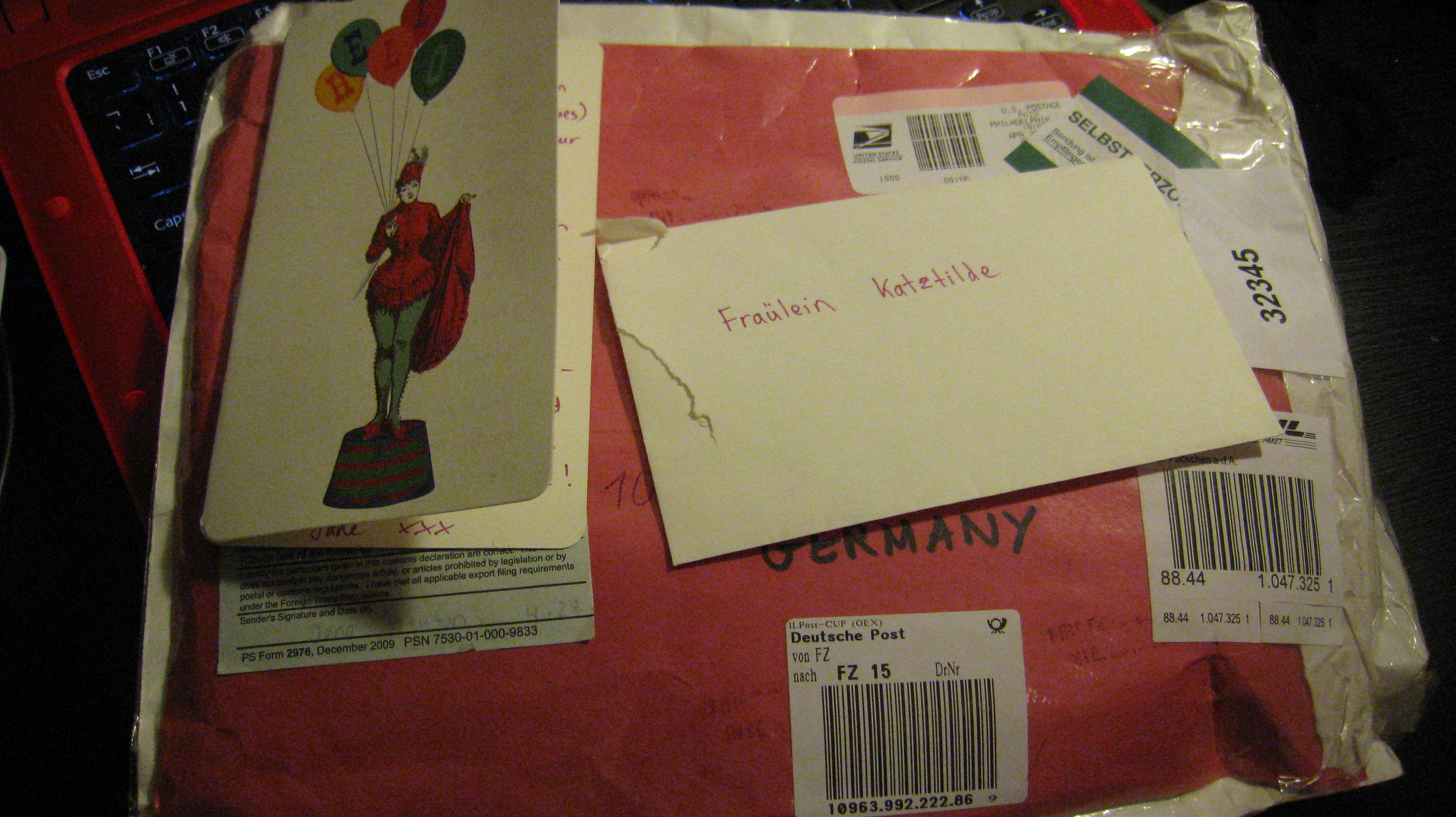
The table was the kind that you sit on with one or two others when you are in secondary school. On it was nothing but a tiny package with my sister’s characteristic handwriting on the front.
I let out a little squeal of excitement.
The official handed me a knife.
“Open it.”
I put the knife down and tore it upon with my bare hands.
An envelope and a little package covered in bubble wrap slid out.
I unwrapped the bubble wrap carefully.
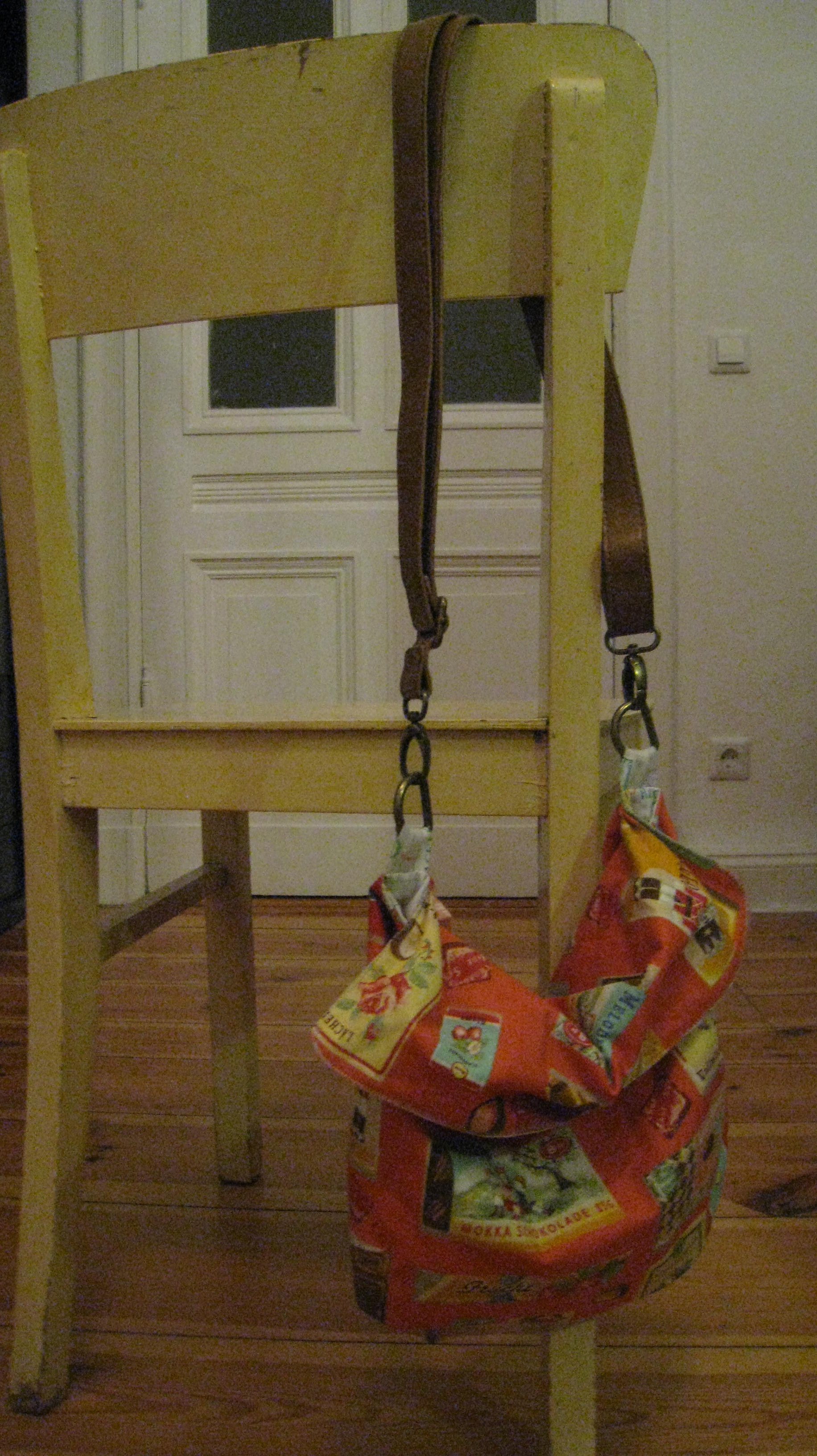
My heart skipped. In my hands was the most adorable and charming of cloth bags. It had a brown strap and buckle and the pattern was Berlin-themed. There were little green signs with the names of the city’s famous stations and scattered between them, were little pictures of umbrellas, clocks, suitcases and trains.
The official’s face changed.
He smiled. “That’s lovely.”
“My sister made it,” I said, still gasping.
Then he looked at the envelope. My sister had written “Fraulein Katztilde” on it in purple pen.
Urban U-Bahn Chic
“That’s sweet,” he said.
“I know!”
“No tax payable. Have a nice weekend.”
Chocolate Fesch
“Really!”
I didn’t wait for an answer and dashed outside clutching my precious bag.
I opened the envelope on the train. Apart from all the other lovely things she had written, my sister also finally provided unequivocal proof of her genius.
“I couldn’t decide which fabric was better so I made the bag reversible – just turn it inside out to go from urban U Bahn chic to traditional chocolate Fesch.”*
I looked at the red fabric on the inside of the bag, which featured lots of pictures of traditional German chocolate from times past.
Somehow, my sister, had created a two-sided magnet-drawn fastener which would allow me to sport two super-cool German-themed bags in a city known for both its trendiness and efficiency.
So, not only is she a talented analyser of butt samples, terribly witty, exceptionally attractive, kind, sweet and thoughtful, my sister is also a queen of crafts.
So, if you are reading, Jane Franziska, thank you so much. I absolutely love it. You’re a complete ledgeBAG.
*Fesch is a German word meaning something like “trendy,” which the Ferguson family finds amusing.
He had fine bone structure and an English accent. I put him a little short of his 40th birthday.
He waved a pair of sunglasses from his pocket.
“I’m so sorry to be rude,” he said, putting them on and obscuring half of his face, “but the sun is blinding me.”
“Not at all.” I said.
He was an IT teacher, a former diving instructor and the partner of a Swiss diplomat. Now he was learning German at a language school. It was difficult. He was a science and maths person.
We talked about teaching and travelling. He had a boyish wonder about him, a kind of naivety. He was softly spoken. He was kind. He had seen me alone and sat down beside me.
A lady came up to us. “Rupert!” she said. “I was trying to call you.”
“Oh, I’m sorry,” he said.
He turned to me. “Apologies, I don’t know your name.”
“Kate.”
“Kate, this is Georgia,” he said.
Georgia was dark, attractive, with black curly hair. Later, she told us that she was 43.
She was intelligent, expressive, sharp. She watched people carefully as she spoke to them.
The conversation meandered.
And came to sperm donation.
“You know, there was a story in The Spiegel a while ago about a Dutch serial sperm donator,” said Rupert.
“I edited it,” I said.
“You did? How funny!” said Georgia.
The man in question had fathered eighty-two children and ten more were on their way.
He didn’t just deliver his sperm in a container. He catered for women who wanted to conceive the natural way. He visited them, they made him dinner and paid for his transport and then they went to it. There were good and bad experiences. But really, he just wanted to make them happy.
“He wasn’t a looker,” said Rupert, “but by the sounds of it, he was at least of average intelligence.”
“Ha!” said Georgia.
“I have so many beautiful, successful friends in their late thirties,” Rupert went on. “And they’re all single.”
“But where do you meet men?” asked Georgia. “I mean… I’ve been with my husband for twenty years so it’s been a while since I’ve dated, but isn’t it hard to meet people?”
She turned to me.
“What’s your situation? I mean, are you single?”
“No,” I said. “but for me it was very simple really. I met my boyfriend in the university library.”
“Yeah, that’s easy,” she said.
Then Rupert told us the story about how he had met his partner.
“I was a diving instructor in Crete. And I know what you’re thinking… She was not my student.”
She was on holiday with her girlfriends. But what she didn’t know was that this was a “singles holiday.” She had brought a pile of books to read, but her friends said there were more important matters to investigate.
She talked to Rupert, who was used to being flirted with. It came with the job of diving instructor.
But she made him nervous.
“That’s how I knew,” he said.
They travelled around the island together. And now they move around the world, wherever her job takes her.
The story was winding to a close. Somebody started tapping on a wine glass.
My parents brought me running shoes when they visited me at Easter. Yesterday I tried them out. The day was mild and dewy.
I was looking for a park, but instead I ran into a graveyard.
Inside it was still; the birds were singing. Daffodils peeked out from under little heaps of earth. Leaves rustled. A red squirrel skirted past me.
Plastic pots and watering cans lay in a pile of withered flowers.
I passed some buried children; tiny mounds, close together. Words and prayers and a teddy bear.
A woman pushed her bicycle past the graves. The wheels crunched against the gravel.
Further on, I found enormous iron casts from the 1900’s. Whole families were resting there: soldier sons, an 18-year-old girl ripped away from her widowed mother. A family’s heartbreak documented into thick stone slabs. Always the same word: Unvergessen; “unforgotten.”
Then from the trees, slowly a withered old man pushed his Zimmerframe and got down on his knees to tend to a grave.
I watched his tiny frame crouched over a tombstone and his wrinkled hands shovelling the earth in little scoops.
My tears fell like unexpected rain. I was ashamed.
I turned and ran away, past the graveyard shop where they were selling over-priced potted plants, past the red-brick church on the roadside, past the cinema and grotty record store, past the kebab stand.
In the park, dogs bounded through the woodland, toddlers dipped their hands into the water fountain and families played catch. And the birds sang.








 Kate Ferguson