Leprechauns trade in gold as downturn hits the streets

On North Great George’s Street this morning I saw a woman pushing a buggy with her belly while using her hands to scrape a scratch card with a coin. I imagined the baby going flying as she raised her arms in jubilation but alas, it didn’t happen. This morning wasn’t her lucky day.

I enjoyed the image though, particularly as it happened right outside the tacky off-license at the corner where a few days ago I saw the homeless man who sits on O’Connell Bridge (with his rabbit and dog) buy booze. He stuffed his rabbit into his shopping trolley and held the dog under his arm while he rummaged for coins to buy his cans. He could have gone to Centra but he was looking for good value. Aren’t we all?

If these moments tell us anything about the Irish, it’s that we’re damn good at recessions. If it’s a quirky economic downturn you’re after, look no further than Dublin city centre.

Without a doubt the creature that has benefitted most from the downturn is the Leprechaun. This being, formerly associated with ancient folklore and American gullibility, (“Do you really have leprechauns in I-Ur lend?“) has experienced an unprecedented comeback in times of austerity. On Grafton Street you can find a man of about two and a half-foot who has painted his face orange, attached a ginger beard to his chin and placed a pot at his feet. He looks a little like an Oompa Lumpa from the original Charlie and the Chocolate Factory film. If you felt sorry for him I think the joke would be on you; he’s probably making a killing. Size matters.

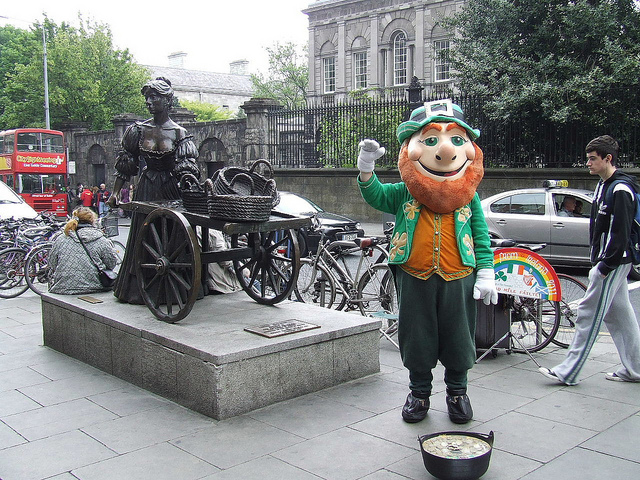
Size matters so much among opportunistic leprechauns that the one that hovers around the Molly Malone statue is enormous. His artificial head is about six times as big as his own. He waves his gigantic leprechaun arms awkwardly at passers-by and of late he has decorated his crock of gold with silver tinsel. The other day I saw him leaning against a lamppost on the phone, with his huge fake head under his arm. He didn’t look Irish, which made it all the more wonderful. He’s probably an economic downturn migrant from the BRIC area who’s heard that no one throws a recession session quite like the Irish.

It’s not all fun and games though. There are feuds on the streets; warring factions have developed. Resentment is building.

You can see why.

Way before economic opportunism was in fashion, an old man from Cavan had an idea. He decided to put on a tweed cap and a patchwork waistcoat and sit on Molly Malone banging on a badhrán. The tourists loved it. He’d motion to them to come sit beside him and encouraged them to take photographs. He even bought spare tweed caps for them to pose with in the pictures. Once, when I was in my first year of university, I pretended to be a German tourist just to get a picture with him. If somebody else tried to sit down on the statue beside him, he’d snarl at them and tell them to clear off. He had the kind of audacity I can only dream of.

The good old days


It may be easy to mark your territory when the property market’s booming but things have changed. A few weeks ago, I saw my tweed-capped friend outside River Island, patting his badhrán with a sour face. Two American tourists stopped to have a look at him and quick as lightning he beamed. After both of them had had a go of the badhrán and dropped a few euro into his cap, he pulled them closer to him. Pointing at the giant leprechaun parading around Molly Malone, he whispered conspiratorially, “See that leprechaun? Don’t bother with him; He’s a fake”.

Budgets aside, recessions in Ireland are pure Gold.

Also, if you find this post facetious, you can read a serious piece about my opinion of the Irish here.

Is your plumber a “drainage artist”?

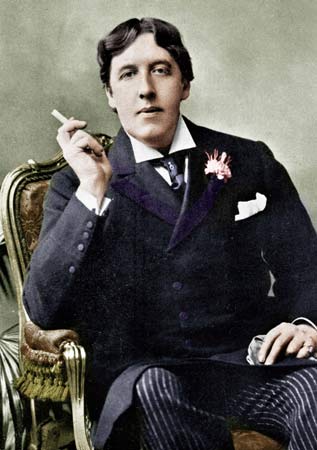
Oscar Wilde, who made a pretty living out of making subversive, witty and astute social observations said, “All art is entirely useless”. After all, he was one to know. Having written a handful of droll plays and a novel about a portrait taking over the life of its sitter, he was still bound by the tedium of life’s practical problems. His dirty dishes didn’t disappear when he flung a leather-bound poetry anthology at them, nor did the flat tyre of his carriage auto-inflate to the sound of Beethoven’s fifth symphony.

Oscar Wilde


Wilde’s facetiousness would have been reviled by Stephen Dedalus, the 22 year-old hero of Joyce’s Portrait and later of Ulysses.

Young Stephen takes art extremely seriously as did the many ‘greats’ before him. In the “Proteus” episode of Ulysses he’s strolling down Sandymount Strand and decides to close his eyes as he walks to see how far he can get in the ‘dark’. He takes a few steps but just before he opens his eyes again a suitably verbose thought strikes him: “Open your eyes now. I will. One moment. Has all vanished since? … Basta! I will see if I can see. See now. There all the time without you: and ever shall be, world without end.”
Stephen, self-absorbed and brilliant wants to know if the world continues to exist when he stops seeing it. Unfortunately of course, he will never find out because he can’t have his eyes open and closed at once.

Me being ridiculous on Sandymount Strand


Wilde’s idea that art was –in practical terms – absolutely useless and Stephen’s anxiety about the relationship of his senses to the outside world make for nice discussion points about the purpose and perception of art.

These days it’s not difficult to be classed as an artist. I’ve heard pedagogues described as “teaching artists” and people that roll dough as “pastry artists”. I’m all for it. The idea that there’s such a thing as an “artist” who exists on a plane of perception loftier than that of mere mortals is archaic and implausible. While the indiscriminate use of the term “artist” might be democratising and flattering to the individual, in effect it has now become a pleasant synonym for “skilled”.

Since it’s now acceptable to use the term “art” to refer to general skill rather than individual genius, Wilde – were he still here-would have to admit that “art” in its broadest understanding has become very useful indeed. I’m sure he would have delighted in calling in a “drainage artist” to unblock his toilet.

There’s something deeply unsatisfying about sealing off the definition of art as coterminous with “skill” though. To be skilled may be considered a favourable, functional quality leading generally to better prospects but doesn’t being an artist require something more than just know-how? A particular kind of sensibility perhaps? What happened to the image of the melancholic artist living in a hut penning poetry about his unrequited love? What about the assumption that pure art is “divinely” inspired?

Christopher Witcombe, Professor of Art History at Sweet Briar College, Virginia traces the emergence of the modern understanding of the artist back to the sixteenth century. He argues that during that period, “A work of art was believed to contain an extra indefinable spiritual essence”. This “divine” inspiration was impossible to explain and so the Italians referred to it as “un non so che” (I don’t know what), which was later taken up by the French, who called it the “je- ne-sais-quoi”.

People naturally became fascinated with the mysterious, god-like figures who created celestial masterpieces. Theories about their personalities and temperaments emerged and thinkers came to the consensus that the quality, which predestined an individual to become an artistic genius, was melancholia. It wasn’t a new idea; Aristotle had thought it before, and Hippocrates guessed that it occurred as a result of a build-up of black bile in the body.

Not much has changed. We’re still fascinated with the idea of “artists” today. And no, I’m not talking about the ones that teach our kids, roll our pastries and fix our toilets. Language is constantly changing, but no matter how loose the term “artist” has become, we still differentiate in our own way between those possessing a skill and those with an innate “genius” quality.

Present-day admirers, like their Renaissance counterparts, continue to elevate their artist heroes to deity status. One of the many adoring comments under a youtube video featuring the actress Natalie Portman claims “if you don’t like Natalie Portman you don’t like God”.

One of my students, a middle-aged French lady, once said that she considered Lady Gaga an artist in the “true sense”. I’m not sure how she justified it, but she reinforced the widespread assumption that ‘pure’ artistry actually exists.

Is Lady Gaga a "true" artist?


Luckily, we’re living in an era of relentless scientific inquiry and rather than accepting that true artists are born god-like to inspire us with awe, we can test the theory by removing some of the potential confounders.

Gene Weingarten of the Washington Post set out to do just that in 2007. He asked world-renowned concert violinist Joshua Bell to help him conduct an experiment to determine whether people would recognise the intrinsic value of art in the absence of relevant context. Bell was an ideal specimen for such an experiment. His playing had been famously described by Interview Magazine as doing “nothing less than tell human beings why they bother to live.”

Weingarten asked Bell to pick up his violin, dress up in jeans and a cap and perform for 45 minutes at a Washington metro stop during rush hour. Just days before, he’d sold out Boston’s Symphony Hall, with tickets $100 a piece.

During Bell’s performance, 1070 people hurried by without stopping, 27 gave money, and seven paused to listen for at least a minute. At no point did a crowd gather. One lady recognised the performer and gave him $20, which amounted to a significant portion of the total $32 and change he made that day.

So context matters. When people are in a rush, they’re not primed to recognise brilliance, or even as many describe Bell, genius. They’re not used to train stations playing host to maestros and anyway, they’re not really in the mood for “art”. The kids need to be picked up, and the laundrette closes at 2.

Knowledge matters too. The difference between a virtuoso violinist and an amateur is easy to identify if you’re a classical music enthusiast, or if you play yourself. Not so if you’ve never consciously listened to anything like it before.

Unless of course, a truly essential or “divine” quality really does exist, in which case, we should be able to identify it without prior knowledge or relevant context.

Which brings us right back to Sandymount Strand, where Stephen Dedalus, himself a wannabe artist is testing his own perception against the idea of an objective reality.
It’s a futile attempt because it’s impossible to escape the bounds of his own perception. Stephen can’t ‘see’ with his eyes closed and he can never be sure of what happens to the world when he shuts it out with darkness.

When I was at school, I found it strange that entire groups of friends seemed to like the same music. It confused me and sometimes it made me unsure of what I really liked and what I thought I should like. Was artistic appreciation a prerequisite for forming bonds? Or did people simply like the music their friends liked, because they were primed to see its value? It’s impossible to know really. Teenage sensibilities seemed to be invested heavily in film and music, and less so in visual art and writing. I couldn’t imagine lunchtime conversations featuring encyclopaedic knowledge and endless speculation about the direction of Irish sculpting or the American short story back then.

One of the most appealing attributes of art is that it evades definition. Is a well-placed mahogany chair “art”? What about a stickman figure Picasso may have penned when he was drunk? We delight in arguing about these questions because deep inside us, the idea of “art” as something pure and divinely inspired hasn’t vanished. We talk about skill, because it’s measurable: This genius savant has an IQ of ‘200’ and that performer could play the trickiest passages from Chopin at the age of seven.

New York Times columnist David Brooks
argues that the possibility to become an artistic genius lies in all of us. All it takes, he feels, is diligent practice, single-focus and proper mentorship. He reminds us that the brain is plastic, and that we “construct ourselves through behaviour”.

The Irish Times recently reported on a study that found that when subjects gazed at artwork they found particularly beautiful, they experienced a surge of Dopamine, (known as the “reward” neurotransmitter) through the brain at levels equivalent to gazing at a loved one.

In this experiment, the brain simply responds to a visual stimulus, which it has already categorised as beautiful. The Irish Times conclusion that “these findings have significant implications for Government policy” is a leap too far however. The study tested subjects with pre-existing notions of beauty. It did not explore other potential pleasure-stimuli, like a beautiful view, the smile from a stranger, a spontaneous meeting or the feeling of soft sand under your feet.

Dopamine pathways aren’t just activated by a masterpiece. They also play a key role in the progress of addiction as well as during eating and sex.

Society shouldn’t formalise art. It should encourage us to look more deeply at the world around us and to be creative in what we class beautiful. If you’ve lived all your life in a high-rise block of council flats littered with crisp bags and dirty runners, you might not be flooded with dopamine when you visit an art gallery. Maybe though, when you look outside your window and see a flower popping its head out of the box you planted it in, you will feel a rush of pleasure.

Oscar Wilde, who had “nothing to declare” but his own “genius”, fell victim to a society, which classified art into moral highs and lows. His love- surely the highest of all art forms-for another man landed him in prison in Paris, where he died a pauper’s death. Maybe it was this world of narrow definitions, which Stephen Dedalus was shutting out when he walked in darkness along Sandymount Strand.

High Art and Low Art don’t exist. Every one of us can experience moments of intense pleasure and awe. It can be at the taste of your first Lindt bunny after Lent, at the birth of your first child, or in the look in the eyes of your grandmother as she knits you a Christmas sweater. It can be in the middle of traffic in an ugly part of town or in the vast expanse of a city’s art gallery. It’s all around us.

Lindt Bunny Joy

Three Men that don’t know they’re in my life

1.The pioneering beggar

Every day I see an oval-faced man on Grafton Street holding an enormous wooden sign, which points you in the direction of the Sweet Emporium on Duke Street. He has been holding this sign day in, day out for many months. For years before that he sat slumped on the steps of the insurance building next to Hodges Figgis with a tin covered in chipped orange paint. His eyes were too sad and vacant to be those of a charity collector; he was a pioneering beggar. Somebody must have noticed him there and decided that if he was going to stay in the city centre looking for money all day, he might as well send people to the Sweet Emporium. Now he works double shifts because I’ve seen him back by the steps on Dawson Street at evening time. He’s been on my mind on and off for years. I wonder what we’d talk about, if I ever found the courage to introduce myself.

2. The Man with long, blonde hair

Since my schooldays, I’ve been passing an extremely tall man, with long blonde hair and thick pink lips. When he walks, his whole body jolts heavily forward and then bounces back, as if on a spring. He has a long, beige face, which blends in with the bewildered expression he wears. When I watch him, he seems to be looking at something beyond what I can see. I think he is the wildest and gentlest man I’ve ever seen and I also think that he is intellectually disabled. I feel sad when I see him, because of the way he moves, and because of the large blue pools which are his eyes. Every once in a while he puts on black, knee-high women’s boots and stumbles down the street in them. Sometimes I try to imagine his mother and father but I can’t because I can’t paint their pictures in my head.

3. The Opera Singer

He wears a smoking jacket and bow tie and sings to the crowds of shoppers as if he were on stage in an Italian opera house. He has a neat, tight face with symmetrical features and short, sandy brown hair. He could be from the Czech Republic or from Slovakia, but in fact he comes from our own shores. I’ve heard him speak; he asked a lady last week if he should sign her CD “To Anne with an E”.
His body language, coupled with his attire is highly comedic. I know this because once I was sitting by the window upstairs in Bewley’s watching him speak to a middle-aged lady, who happened to be a fan. He bent forward to touch her arm and tilted his head backward to laugh at what she had said. He used his hands constantly, flapping them politely in her direction and then mock-modestly at her wide-eyed praise. He’s a charmer.

These three men are in my life but I’m not in theirs.

The Mouse

One September morning in our poky kitchen, my father and I were enjoying an early brunch. He was spooning floating pineapple rings from a large glass bowl while I dipped some oatmeal biscuits into my peppermint tea. From the corner of my eye, I noticed something small and dark flitting across the floor, but the moment I turned in its direction, it was gone.

My father’s pineapple ring splashed unceremoniously back into its pool. “Did you see that?” he asked.

“See what?” I replied, wondering whether he was talking about the same thing.
“Something on the floor?”
“Yes! It was probably a Daddy Long Legs”, I told him.
He agreed and we laughed at my infantile terminology.

I thought nothing more of it and we continued to eat in amicable silence.

That September represented a new and unforeseen period of my life. I’d finished university the May before and was still at home, having failed in my attempts to travel and to find a job.

The upside to it all was that I was rather enjoying domestic life. I got to see a lot of my dad, and we’d developed our own little routines, like making mochas in the tiny steel pot which he’d had since university and listening to programmes on Radio 4.

Though I could sense myself regressing, I took solace from the fact that these moments at home were precious; that they wouldn’t last forever.

Throughout the summer, I had been indiscriminately applying for jobs but nobody would have me; the country was at a standstill. Then one day an enormous opportunity presented itself: The Irish Times was looking for an intern.

600 applied and I was in the final eight. I wasn’t holding my breath but I was devouring newspapers all the same and after a summer of uncertainty, a date for the final interview had at long last been set. Many of my conversations with my father went something like this:

“Dad, do you think I have a future?”
“Of course”, he said “You will become a literary lay-about just like me”

My father is the honorary editor of a history journal and spends much of his time cycling to and from the National Library to check if Major General so-and-so of the fifth battalion really did travel to Kinsale in 1752 as the Right Honourable Blogs’ diary of that date alleges. If he’s not doing that, he’s sitting in front of his laptop, painstakingly typesetting articles, which have arrived in his inbox from the eclectic collection of contributors he has garnered from around the world.

“Of course you won’t be rich”, he said, “but you will find a niche eventually”.

So went our conversations that summer and we revelled in the gentle irony with which we viewed our mundane daily existence.

Now that the summer had drawn to a close, the brunch we were enjoying in early September was my last before the final Irish Times interview, which was to take place the following day.

That evening, my father made an announcement.

“We have a mouse”.

“What?”, I said, already squirming.

He nodded solemnly. “Yes, I rather feared that’s what I saw in the kitchen this morning, but I didn’t want to scare you”.

“Ugh”, my mother sighed, from under her woollen blanket in the living room. “We’d better seal up the kitchen door so it doesn’t escape into the rest of the house”.

And so it began.

I refused point-blank to enter the kitchen the following morning and set off for my interview without breakfast.

I’m a vegetarian but that does not mean that I like to be invaded; particularly not by fast creatures, with long, thin tails, I told myself. After all, that’s why I chose to grow up with guinea pigs and hamsters rather than gerbils and rats. I further justified my over-reaction by telling myself that I was under enormous stress: what with a potentially life-defining interview ahead of me.

I arrived home that evening to bad news.

“We saw it in the living room”, my father said, grim-faced but full of resolve.
“It was incredibly fast”, my mother added gravely.

On the way upstairs, I quivered at every nook, convinced that the creature was about to emerge from hiding and crawl up my leg. I couldn’t bring myself to take out my furry slippers from under the hall table either, in case the mouse had taken refuge there. I shuddered and locked myself into my room.

I sat there and wondered about myself.

Two days later, things took a turn for the worse:

“It was in our bedroom”, my mother said “I saw it scamper behind the cupboard”.

She too was highly uncomfortable about the invasion.

Action had to be taken. My father got some traps.

My protest was pathetic: “Can’t we just capture it and free it humanely? Please

We could not, and I had some nerve if I thought that I could just sit there, being an hysterical and inert vegetarian, applying a guilt trip while they went to war on all our behalf.

Impractical, irrational and immature, I knew that I could neither see the mouse suffer nor capture it alone.

There had to be another way.

I made my way to the local hardware store, passing through shelves of creosote and weed-killer until I got to a section labelled “Pest Control”. Jumping with delight, I found exactly what I was looking for; I snatched it from the shelf and proceeded to the till.

I arrived home triumphant.

“I have a humane trap”, I declared.

“Huh?”

They weren’t nearly as enthusiastic as I was. They’d spent the day trying to catch the thing, which had now been spotted in several locations throughout the house, only to have me saunter back from my sojourn in the moral high-grounds, wielding a tiny cardboard box, which promised “easy capture and release”

They wouldn’t replace their multiple killer-traps with my one humane one, but agreed to use it as a supplement to their own.

The following day I spotted the mouse in my sock-drawer, and screamed.

I noticed though, that it was much smaller than I had expected.

It was a baby mouse, with a beautiful little face and a shorter-than-average tail.

I thought about the techniques for overcoming fears that psychologists recommend. One of them was called “mere exposure”: simply coming into contact with a fear can help alleviate it.

On Sunday morning my mother went to Church, having seen the mouse scuttle under her wardrobe.

By then our battle with the mouse was becoming somewhat of a farce; so much so that my father had placed our mouse-shaped pumice stone onto a trap in the living room the day before in order to startle me.

Fortified by courage and relaxed by the prepostrousness of the situation I entered the room. My father was in bed, reading a tatty book with a dull title.

“What’s the situation?”, I asked.

He lifted his nose reluctantly from under the book: “It has to be over there”, he said, motioning to the far corner of the room, “It definitely hasn’t left.”

With a sudden surge of courage, I ran to the kitchen and snatched the humane trap from where I had placed it just beside the door.

Returning upstairs, I opened the flap to the linen closet where scores of my mum’s dresses were hanging.

In the corner, half-concealed by a green velvet wrap, whiskers twitching and tiny ears erect, I saw it perched.

Any of the fear I had left drained from me in a flash. It was adorable.

We waved a scarf at it and it dashed. We dived and it squeezed past us in a blur. We put the hoover on and it didn’t move.

We laughed.

Mum came home and I retreated, expecting that we would have the little creature captured and released into the wild by lunchtime.

Later that day a voice called me from above.

“Kate, we have it!!! We’ve got it!! Come here!”

I rushed up, tripping on the pieces of cheese they had left in a trail across the floor.

My father, grinning, was holding the plastic box, where the mouse had become entrapped.

“There you go, it was your humane trap that did it in the end”, my mother conceded, smiling with a twinkle in her eye.

I took the box from my father and stared in at the little face, with its jet-black beedy black eyes peering back at me.

In those few minutes, as we sat there in my parents’ room, surrounded by traps, with clothes and cheese strewn around the floor and the tiny creature in our hands we felt closer to each other than we had for a long time. Somehow this little incident had brought us together: first through our nervous tension and then, when we saw the cute thing up close, in our shared appreciation of the ridiculous.

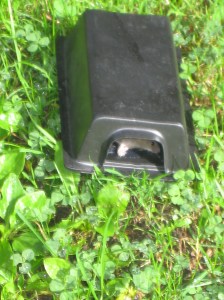
There was some sticky stuff on the base of the trap so the creature couldn’t run away.

“We’ll release it in the park across the road”, I cried, beaming at the idea.

“It won’t be long before it’s back!”, my father laughed as we were getting ready to go.

We were giddy with our success.

I ran upstairs to grab my camera so that I could record the moment of release. We got as far as the gate and I got my mother to take a shot of my father and me with our mouse friend.

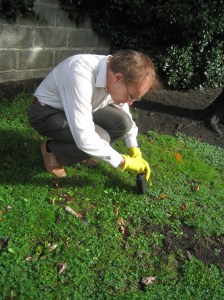
Once in the park, I returned the box to my dad, to do the honours. We’d brought a pair of kitchen scissors with us so we could remove the top of the box.

Gingerly, my dad cut through the roof. The mouse, impaled on the floor, did not look happy.

“Not long now”, I gushed over it, still frivolous and light-headed with our victory.

My father placed the plastic container down on the ground.

Suddenly from behind, an enormous labrador came bounding towards us, barking madly. He had smelt a rat.

My instincts suddenly aroused, I growled and ushered him away, becoming a little embarrassed as I turned and saw his ten-year-old owner watching me.

The dog gone, the park fell silent but for some leaves, which rustled in the distance. We must have been there for only a few seconds but suddenly an uncertainty engulfed the air.

My father stepped back to look at the motionless mouse, stuck to the base of the box and after a while, he asked my mother to get him a sand scraper from the house.

While she was gone, I bent down, and looked more closely at where the mouse was stuck.

Attached to the base of the box, were not just the four paws, as I had thought, but the entire belly of the mouse, rendering it utterly immobile.

My mother returned with the scraper. Dad picked up the box again. With gentleness that stirred me, he attempted to get it under the mouse’s tiny feet.

It didn’t work. The gluey goo was too deeply ingrained into its silky-thin fur.

My heart was beating more quickly now.

The little body was beginning to twist in pain. My father’s expression changed: scraper in hand, he too was twinging with discomfort.

As the mouse moved, more of its fur became dislodged.

I began to see blood.

“Stop”, I yelled, hopelessly.

I had to look away. My father’s eyes were full of pain, as he continued to scrape at the little body, wreathing in agony.

An autumn chill was in the air.

The last I saw of the creature was its outstretched neck and taut, mangled, tortured body being ripped away from the plastic box.

It haunts me still.

In the days, weeks and months that followed, nothing has invaded me like this image. We had some other mice after that which were killed, humanely by guillotine. I got a rejection letter from the Irish Times some weeks later and didn’t feel much. And for all the bloodshed I have seen in the news, and the depressing images of suffering on the streets around me, nothing disturbs me like that image, or sends a pang of guilt so accute gushing through my entire body.
American Diary:Part 3 Underground Culture

November 2nd was my birthday. It began at a subway station in New York when the digital time display switched from 23.59 to 00.00. I didn’t notice because I was transfixed to an old man, who was playing the flute. He had a hunchback, a grey moustache and sad eyes. I gave him a dollar.

LSB saw the time change though. He’d been watching it. “The first act of your birthday is a noble one: Typical Katzi”, he said, flattering me, because it was my birthday and because he is kind.

Subways in New York are grubby places. They are for poor people and for people who read large books with city library stamps printed on their spines.

They are full of crazy people and sad stories. At every stop you can see the same slumped figure: somebody with their arms folded around their knees and their head tucked into their chest, motionless. You can find them on benches or hidden away in the corners.

New York is a busy place so the forgotten people talk to themselves. I counted about half a dozen men – all black- who were having conversations with themselves. I even checked their ears to see if they had any fancy devices. They didn’t.

There are so many faces on the subway that it’s hard to remember any. I stared at one lady because she looked ordinary. I wondered if I’d recognise her face if I ever saw it again. She was middle-aged, with shoulder-length auburn hair. She had peach-brown skin and a round face. I don’t remember the colour of her eyes and I might not know her if I saw her again.

The rudest man in the world works at 103rd Street station. He sits in a plastic box. His job is to advise commuters who don’t know how to work the machines or who would like to purchase a ticket but don’t have the correct change.

If you want to talk to him, you have to speak into a little microphone through the screen, which means that everybody around can hear what you want to say.

This man is the rudest man in the world because when you approach him, he roars into his microphone “ASK”.

He doesn’t say “Hello” or “How can I help you” or even “Yes?”

When LSB approached him, he yelled “ASK”

LSB was a little taken aback. LSB is polite at all times.

He bent tentatively towards the microphone.

“I was wondering if it’s possible to get a one-day metro ticket”

“NO”, the man replied and banged his fist on the counter.

“Oh…” said LSB

The man snarled and yelled “SECOND QUESTION”.

He said it as a statement, not a question.

But LSB didn’t have a second question, because his first seemed to have caused grave offence.

“You’d never get that in Ireland” we said because Ireland is small and flat and as my mum says, it’s a good place to be an eejit.

At another subway stop one evening, a young musician was playing guitar. I didn’t give him any money but LSB did. LSB is quiet and noble. The rifs followed us onto the train. It was cold and dark outside but the carriage was musty and cramped.

I have another story about the underground, but that will have to wait, because LSB and I have something important to investigate.

#Occupydamestreet exposes what’s good about Ireland

I admire the Occupy Dame Street protesters. On a night like this, as the wind pounds on my window panes and the rain pours down, I imagine them huddled together discussing the agenda for the day ahead. They are a peaceful bunch, who have spent their days postering trees with quotes from Fight Club rather than hurling abuse at the workers whose premises they occupy.

In spite of my self-confessed lack of understanding of the economy, I don’t share their belief that bankers represent the evil 1% of the population and that 99% (the “rest of us”) are their unequivocal victims. It can’t be as simple as that. I’m also not sure whether the protest has any concrete aim but it is certainly drawing attention to the displeasure of many as a result of the actions of few.

What really interests me about this protest is how it exposes the Good in our society.

Here are a group of people occupying a central location and plastering around it slogans determined to undermine the country’s main financial institution.

And yet, it’s peaceful. No aggressive guard has entered the scene, and yelled “Hey, you angry hippy, move it or I’ll shoot”. No protester has screamed abuse at the passing bankers to which they attribute a decline in society’s moral code.

Instead, the public casts a glance, takes a look around, enjoys a talk with a protester about the meaning of life and ambles on, equipped to make its own mind up.

The Occupydamestreet movement tells me a lot about what’s right with this country; the assurances that we take for granted are those for which so many of the Arab Spring protesters have died for.

So inspired have I been by #occupydamestreet that I’m off to #occupywallstreet in the morning. I’m visiting my sister in Philadelphia. She emigrated there two years ago, but not before hosting an “emigrate-like-its-a-recession-party”. When I ask her about her job she tells me that she analyses butt samples but I have a funny feeling there might be a little more to the job of geneticist than that. I’m gutted to be missing the election. If there’s anybody apathetic enough to vote for my first choice I’d be most obliged. Mail me privately for my politics.

I intend to update you on my travels in the Free World but should that not be possible, I will record my thoughts in my little blue copy book and transcribe them at a later date. See you on the other side of the Atlantic!

“Hay” there: Arabic shit and how to put your foot in it

He sighs wistfully. “Ah my dear teacher, you need practise long time!” It’s Tuesday morning, the day after my first Arabic class and I’ve just greeted my student with “kayf halaka” (كيف حالك) or “howeyeah”. It’s not that he doesn’t appreciate my effort, but apparently, my ‘ks’ are too harsh and like most people, I can’t master the breathy ‘H’, which is unique to Arabic. They say it sounds like you’re breathing onto a pair of glasses as if to clean them, but given that I’m blessed with 20:20 vision and that my windows are filthy, it’s something that’s going to take time.

Another girl looks surprised and then disgusted when I say “tibn” (تبن) to her. “Teacher, that not good word”, she says.
“What, why?!” I ask.

I’m a little indignant. After all, it’s in Chapter 1 of Mastering Arabic and it means “hay”. Not the most essential word for a slick city dweller like myself, but on the other hand, it uses the three letters introduced on page 2.

“It not good in Arabic”, she repeats patiently.
A more outspoken classmate chimes in:
“Teacher, it mean shit”.

Oh. So on top of having to read backwards, learn a 28 letter alphabet whose letters change form depending on their position in the word, and bizarre sounds only the visually impaired can achieve, I also have to bear in mind that my precious beginner’s textbook isn’t forthcoming in differentiating between horsefood and horseshit. I love a good challenge I do.

Anyway, some time ago I asked you all to make suggestions for what you’d like to see in my Arabic posts. One loyal and lovely reader suggested more about culture and language, less about politics. I breathed (not the ‘soft, on glasses kind) a sigh of relief. I had appealed in that post for suggestions on a postcard, but stipulated that should I not be considered worthy of a stamp, I would also accept suggestions submitted electronically.

Well, guess what happened. Last Sunday evening, I came home to find a postcard through my door from a magical friend, who happens to have just forsaken me for life in London. She had been clearing out her room and found a postcard from San Francisco which she’d never sent. On her very last afternoon here, she wrote an adorable piece of prose, included a suggestion for my Arabic series, stuck a 55 cent stamp on the postcard, and hand-delivered it. I’ve attached it with a wooden peg to my “poetree”, a cluster of branches which I keep in a pot on my mantlepiece and which I decorate with meaningful paraphenalia.

My Poetree


In honour of the two loyal readers, who together made the response to my request “overwhelming”, I will post a summation of what I have learnt to date after my second Arabic class tomorrow. If you’re really stuck until then, just remember to keep your glasses clean, and to learn how to pronounce “shit” before you put your foot in it.

One Thief, one Casanova, two Carphone Warehouse Sales Assistants and a Citizen’s Arrest : Grafton Street, 2 pm

A round, red, sad, brutal, 40-year-old face charged by me in a blur. I turned, he stumbled and somebody in an orange carphone warehouse t-shirt caught up and grabbed him from behind. The thief struggled, kicked out and wrenched his arms free but out of nowhere, three more men appeared. While they were thrashing about, a Brown Thomas gift bag fell from the thief’s grip and tumbled strangely, prepostrously to his side.

He was pinned to the ground and fell silent. An enormous crowd had gathered about. Camera phones came out. A little boy held his father’s head and said again and again “Is da real, da?” “It is yeah”, the father replied. “That man was stealing and he’s been caugh’ and he doesn’t like everyone watching him now ’cause he looks like a muppet… ‘Cause he is one”. “Is it real though, da?”. “It sure is, son. The Police are gonna get him and he’s gonna go to jail”.

It was an uncomfortable scene. I wasn’t proud of myself for not being able to leave. I heard a woman remark that the man’s hands were turning white and a lady from the other side of the crowd approached the group and asked them to loosen their grip on his wrist. Suddenly the man let out a roar. “ASSAULT. I’m being ASSAULTED. HELP. HELP. HELP”

“He’s not being assaulted”, the Brown Thomas doorman muttered and asked me politely to stop blocking the entrance to the shop. The man let out another roar, and raised his head. A strong black hand pushed it down again.

The thief managed somehow to hurt the smallest of his captors, who hopped about in pain and blurted out “you scumbag”.

“I can’t breathe!” the man shouted, “I can’t fucking BREATHE. Would you let me breathe!”

At this point, something rather strange happened next to me.

A boy of about fourteen, a Casanova with a country accent, led a group of his friends through the throngs towards three similarly-aged girls who were standing beside me and grinning rather stupidly at the whole scene. “Hey you girls”, he drawled in his not-yet-broken voice. “These are some of my frinds here. Would you ladies be able to show us where Stephen’s Green is?”
The girls stared at him and pointed behind them. “Would you be able to show us like?” the boy continued.
They shrugged. “Stephen’s Green is right up there”, one said, shyly.
“Come on, would you not just show us like?” He smiled.
“I dunno..”.
“Ah go on..”

I was nearly going to offer. But there was a new arrival on the scene.

A younger, dosed-up man I recognised from hanging about town staggered up to where the men were holding down the thief. He looked confused.
“Hey! Leave him be”, he said beginning to tug at him for possession. “He’s not done nothing!” he slurred. “He was shoplifting”, one of the carphone warehouse sales assistants told him, still pressing down on his chest. The thief let out another roar. “I paid the bleeding money didn’t I?”.

Twenty minutes later the Police arrived and made a no-frills arrest. I watched the thief’s silouete disappear as the Garda car drove away. I wondered about what was in that Brown Thomas bag and about the day that abject, addicted, ageing man was born a baby in his mother’s arms.

Familienfest: Part 3

An altered version of the original article with deletions now appears following concerns voiced about privacy:

At 7.30 pm sharp the family made its way into the dining hall. I looked around, scouring the table-tops for my name card and couldn’t believe my eyes when I discovered that the seating plan was no longer arranged strictly according to age! Granted, broad generational trends had been observed: my Oma was at a table with her eldest children, and the male under 21s were placed together. But for the first time, I wasn’t beside Cousin Maximilian, who seemed to have progressed to an ‘older’ table, on the other side of the room (and this in spite of being two months younger than me).

No matter though. Any loss of identity I may have suffered from this departure from routine was immediately assuaged when I inspected the magnificent name tag that had been prepared for me by the very teenage cousins with whom I now shared my table. As you can see, my place card features an impressively sketched cartoon lady. Without schooling in German children’s entertainment, this particular choice may seem incidental. I immediately recognised the lady and her significance however. She is Karla Kolumna, a character in a German cassette series about a little witch called Bibi Blocksberg. Karla Kolumna is an eccentric and formidable reporter, who documents Bibi’s escapades and magical mishaps. My little, wonderful cousins had remembered both my fondness for Bibi and my journalistic aspirations. I couldn’t have been placed at a better table.

As soon as everybody was seated, the waitresses appeared with the starter (riveta-type bread with a selection of herbal dips). They were in traditional Bavarian barmaid attire, with low-cut diandels and had a friendly brusqueness to them. After the starter, they came back to the table with their notepads and turned to each person in turn with the question “Fish or Pork?” I was a little scared to ask them for a vegetarian option after Onkel Fritz reaction to my dietry requirements. “I’ll do it”, whispered my sister, ever a life-saver. They did wonders for me and presented me with a glorious platter of “vegetable bags”. Before we tucked in however, a glass began to clink.

Silence descended upon the room. Tante Renata got up and recited the first poem of the evening: an ode to Tante Rosemarie and a chronicle in verse of her life in Bavaria and subsequent move to Greece (like my mum, she married a man from abroad and moved to his country). The recital featured Rosemarie’s children (my cousins who had produced the nametags) teaching the whole Schultz clan isolated Greek words, which we repeated in unison enough times for the children to give our pronunciation the thumbs up.

As I was tucking into my vegetable bags (or Gemuse Taschen) I had a sudden sinking feeling: I had forgotten to pick up the bag of black sausages!.
“Do it now, quickly”, urged my sister. I took her advice and glided off toward the side door and into the corner of the little room, where I found them in a heap.

I was just in time. Dinner was wrapping up and Onkel Fritz was on his feet. Ever the gruff man in the face of ethical conceit, he had chosen to structure his speech around Onkel Gideon’s concern for the environment and in particular for energy efficiency. Gifts 1-6, which were presented by various members of the Schultz clan – including the youngest, at just under two- followed this theme exactly. Onkel Gideon received a solar-panelled radio, two metal devices which created a flame when rubbed together at a precise angle, a running jacket with the name of the house the nine Schultz children grew up in and a torch.

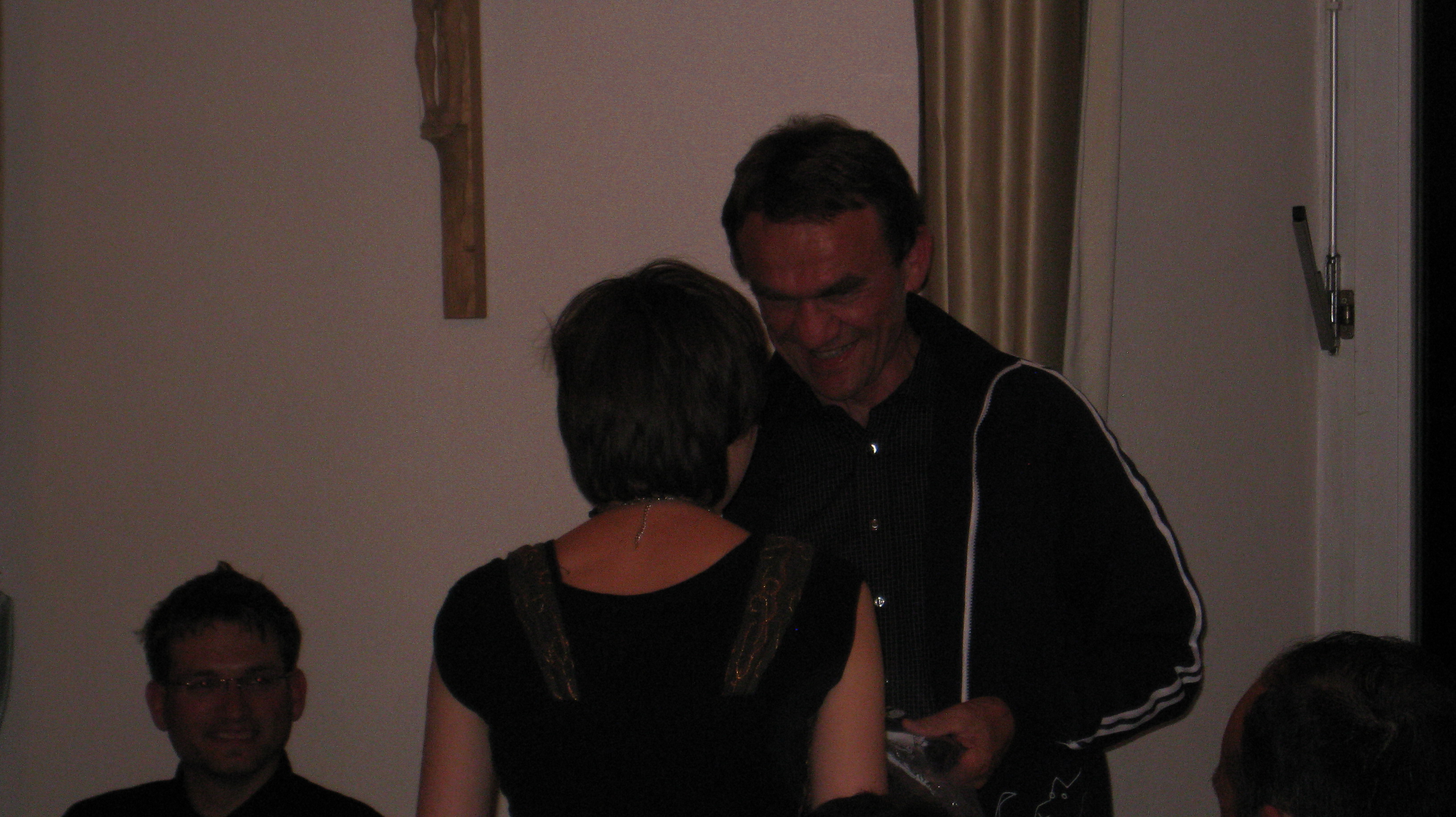
Onkel Gideon shows off his new running jacket


Gidi, as we call him, is a keen marathon runner. Onkel Fritz, who crunches numbers and calculates meat profits for a living (I think anyway) had managed to work out exactly how much energy the average marathon runner exerts and had weighed the bunch of black sausages to match the calories burned. I presented these to a beaming Gideon and to much applause.

Presentation of black sausages to Onkel Gideon


Pop by again soon for the Schultz Family Mass and perhaps a post- prandial trip to the Bavarian Glassman’s House.