Alone in Berlin: Part 1

At first it was exhilarating.

I wanted the hostel, where I stayed the first few nights, to be my home forever. I loved the anonymity of the place – the backpackers waiting for a leftover packet of pasta to boil, the discarded tea bags, the little laminated signs asking travellers to consider the environment before throwing away their rubbish.

There were two Asian-looking girls in the kitchen one evening. One had an American accent, the other was British. They had met at the hostel and now they were friends. The American wanted to go to “school” in Europe. The other nodded and made dinner.

Alone in Berlin, reading Alone in Berlin

In the evenings I bought a falafel sandwich or a slice of pizza on the main street which was soon to become my neighbourhood.

One morning — my first in Berlin, I took a bus tour of the city. On the top deck, a round lady with red-painted lips and peroxide hair gripped a microphone and gave a commentary of the city in English that was so broken that a tourist behind me muttered that he had more chance of understanding German. Her smile was fixed to her face like a stubborn mole, her face was wrinkled. If she had had no folds on her face, she would have looked like a doll. I knew she had grown up in east Germany. She learnt Russian at school. No west German tour guide would speak so little English.

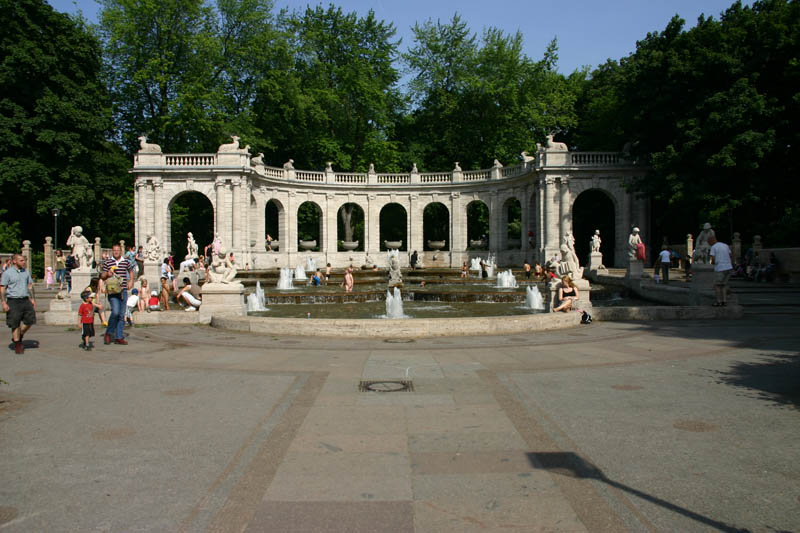
I scribbled down the names of places that looked interesting from the bus. I saw pink water pipes all over the city, the president’s house, the parks, and a beautiful square.

I found my workplace and my heart jumped when I saw that it was five minutes away from the Brandenburg Gate. I found a little photo booth and got a picture taken for my student travel card. I followed the instructions for getting a passport photograph taken. “Don’t smile” said the machine. “You must not tilt your head, or obscure your face with your hair.”

I look so stony in the picture that weeks later, when the secretary at Spiegel looked at the card she said “but you are so cross!”

After I checked into my hostel on that first night, I went out to try to find the apartment I would be moving in to.
It wasn’t far from the hostel. It was late February and it was dark. I approached the flat from a direction I never walk now. I found the shoe shop and the children’s book store that Google Maps had promised me. The street was quiet and I was alone.

Obeying The Machine

I found the number and glanced up at the building. It was too dark to see anything.

I walked past a church, back to the main street. Next to my hostel was a photocopying shop and a video store. All rentals one euro. There was a large adult movie section on display in the window.

The day before I moved into my new flat, I met a book vendor outside Humboldt University. He had wild white hair and a black hat. He said: “You don’t think I have mornings when I wake up and say ‘Fuck this shit. I don’t want to stand at this fucking table selling books all day? And then you know what? I see children laughing and playing and nothing matters any more.”

I nodded at him, I think I smiled. I thought we were the only two people in the city. The sky turned midnight blue and the TV tower was lit up in the distance. I bought a book called “Der Steppenwolf”. The cover is blue and there are bits of paper still stuffed inside a page in the middle of the book, where I stopped reading it.

As the lights came on and I got into a grubby underground train, something danced in my brain. Now I realise it was the taste of freedom.

A Tale of Domestic Disaster

Some people seem to think that my life in Berlin is all fun and games — that if I’m not grilling Angie in the Bundestag or accompanying a world-famous TV crew, I’m at the Brandenburg Gate having a laugh on the John Murray show.

Yesterday on my way home from shopping, a large carton of vanilla and blueberry ice cream melted in my bag, trickling through a crack in the lid, onto all the other food and covering my wallet and its contents in a sweet-scented white foam.

Then, as I was unpacking my shopping, my best buy, an enormous glass of Nutella (25% extra free), slid out of my hands and smashed into scores of pieces.

Shards of glass glittered on the kitchen tiles.

I used a tea spoon to separate the Nutella from the larger pieces of glass and after a quarter of an hour, was satisfied that the majority of the chocolate spread had been salvaged. I spooned it into an old jar that I found in my Recycle heap.

Then I realised that I was bleeding profusely.

A deep, clean gash had appeared in my middle finger.

Now I had ice cream on my jumper, Nutella in my hands and hair, and my blood was trickling onto the counter-top.

I took a deep breath, cleaned myself and tripped over a loose onion.

Then I boiled some millet. I was in a TV studio last week watching a health and fitness show being filmed and the guest doctor was advocating a low sugar wholegrain diet. I resolved to reform.

The millet bubbled over.

I added tomatoes, spring onions and a yellow pepper, but the taste of blandness was poorly disguised.

I ate the modest meal on my little balcony, listening to the birds sing and with the sun in my face.

I decided to go to the cinema.

I watched a French film about a couple whose baby has a brain tumour.

On my way home, I passed a fruit market. A Turkish vendor was crying hysterically “LAST OFFER!! ONE EURO FOR A PUNNET OF STRAWBEEEEEEEEEEEEEEEEEEEEEERIES”

I bought one.

When I got home, I dropped several strawberries on the kitchen floor.

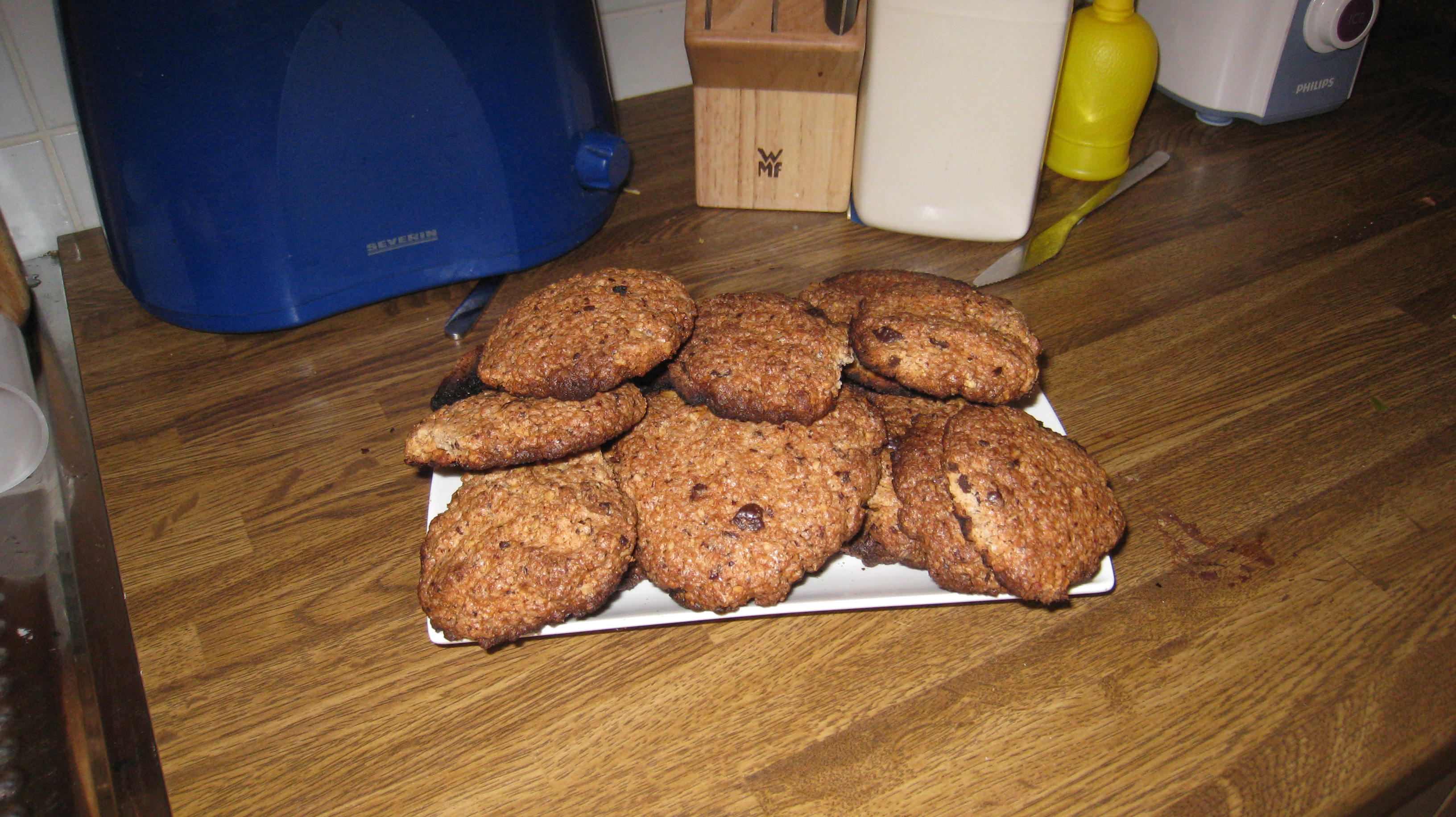
Later that evening, I decided to make German oatflake chocolate chip cookies. My father had kindly scanned an ancient page from my mum’s recipe book and I had all the ingredients to hand. I would have shown my national pride more traditionally by watching the match, but I could not figure out how to turn on my flatmate’s television.

My Mama’s Secret Recipe Revealed to the Masses

I weighed and mixed and stirred and ground and moulded the dough into little balls. I put them into the oven, cleaned the kitchen and breathed a sigh of relief.

I decided I deserved a treat.

I got out my vanilla and blueberry ice cream (all had not been lost there either), chopped up some strawberries and added a couple of scoops of Nutella.

The first mouthful was divine. Then I tasted glass and I had to spit out little shards, one at a time. This morning, I had two German oatflake chocolate chip cookies for breakfast. They were burnt.

Domestic Disaster

Burnt Biscuits

Why Grocery Shopping Is Better Than Therapy

While I was still living at home, grocery shopping was a pleasant diversion but it was always coloured by a faint association with futility. My parents stocked the fridge regardless and I just bought extra kidney beans to supplement my vegetarian diet.

Now that I am hungry and alone, grocery shopping has become a noble necessity. I could go so far as to say I couldn’t live without it.

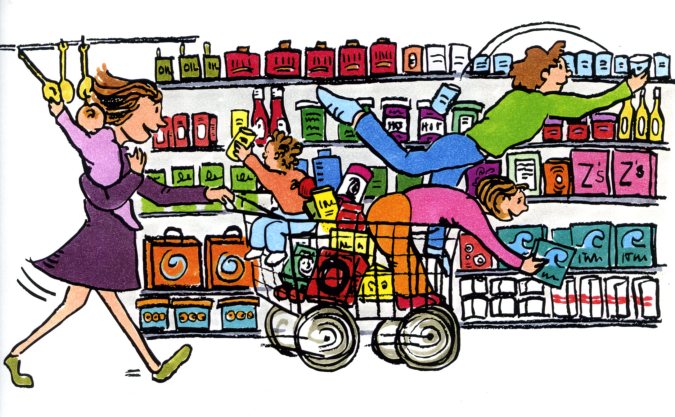
Every second day on my way home from work, I wander into my local branch of Netto and greet the three punks, who have inhabited the dirty pavement outside and spend their days drinking beer and enjoying banter with the store’s security guard. For the next twenty minutes, I forget my worldly problems as I navigate my way through bundles of asparagus, the weekly deal of a desktop printer and boxes of instant dumplings.

Image source: yestheyareallours.com

On the occasions that I have felt directionless, grocery shopping has restored a sense of purpose. There is no therapy like it.

While I am not one to write shopping lists, I do like to dash to my post box to snatch the latest promotional leaflet featuring upcoming deals at my local discounters.

It is an exercise in self-control not to rush at every offer of 19 cent bundle of radishes and toilet seats at just €19.99. With time, this kind of restraint may develop into a widely-applicable life skill.

And even if you do succumb to temptation, as I am apt to do when a 100 gram bar of Milka chocolate is offered at just 59 cent for one week only, buying superfluous groceries does not compare to the guilt associated with conventional retail therapy.

Grocery shopping melds our most primal needs with the more sophisticated cognitive processes of reasoning and restraint. We must learn to differentiate between the times when succumbing to temptation is a good thing (for example when Milka chcocolate is on special offer) and the instances when a purchase would be unhelpful (as in the case of the extra toilet seat). Such high-level strategy is rarely taught, let alone mastered at university level.

A tempting offer.
Image source: jonco48.com

For those under the impression that grocery shopping represents mere escapism: it has its challenges too. Sometimes you end up with an excessive quantity of toilet paper; and at other times you come too late for the marzipan-flavoured Milka bar.

Sometimes when I am in a queue, the customer before me places a little barrier in between their shopping and mine. Though such an action is ultimately self-serving, I always thank them profusely. Then they look at me in the bemused way to which I have become accustomed when behaving with excessive politeness. It is the same look I get when I thank a bus driver or wish the man selling me falafels a good day. I can’t help feeling a little peeved when I place a barrier between my shopping and another person’s and I do not even get the slightest hint of acknowledgement.

Such gritty reality must sadly be faced in the world outside and grocery shopping has equipped me with the necessary skills to cope.

None of the self books I used to borrow from Rathmines library taught me as much about the human condition as shopping for food has.

Despite the transformative power of shopping for groceries, I have met individuals that profess not to be advocates. I have even heard food shopping described as “boring” and “stressful”.

I hesitate to entertain the notion, but could I be alone in my enjoyment?

“Have you ever had a wet arse, Herr Schafner?”

The intercom on the slow train from Hof to Leipzig crackled. I slid my suitcase onto the seat next to me and took out my tattered book. A man’s voice spoke with perfect diction:

“For the attention of passengers recently boarded: Due to an act of vandalism, the lavatory at the back of the train is out of order for the foreseeable future.The damage has been caused by a blockage of material which is considered unsuitable for a toilet. Those passengers with the desire to make use of facilities must venture forth to the front of the train where an alternative lavatory is available. However, said lavatory may only be used while the train is stationary. Those with questions about this issue are advised to approach train personnel. I on behalf of Deutsche Bahn apologise for this minor inconvenience…”

The old lady across from me began to chuckle. The voice continued.

“To summarise, of the two available toilets on board, the one primarily intended for ordinary passengers is currently defective. An alternative loo may be used provided the train is not moving. Such a situation occurs at times when the train stops at stations along the route. I, on behalf of Deutsche Bahn apologise for this occurrence, which is the result of vandalism.”

Suddenly an enormous Saint Bernard, approximately the size of a small pony, bounded down the corridor. It paused briefly to greet my knee with its expansive snout.

“LOTTA,” a voice yelled behind the dog. A woman with a limp peroxide pony tail hanging from an otherwise shaven head stumbled past me. She was wearing dungarees and smelt strongly of beer.

“COME BACK, LOTTA,” she yelled. She clicked effectually and the gigantic hound returned. The woman grabbed it by the collar. Then she let out an almighty roar. “MY BEER!!!”

On the seat directly behind me, a bottle of beer had unturned. Liquid brew was seeping into the cover and a trickle of beer was making its way towards my feet.

The woman began to scream. “MY BEER. I PAID FOUR EUROS FOR THESE BOTTLES AND I’VE ALREADY LOST THREE. I FUCKING HATE DEUTSCHE BAHN. WHY ARE THEY DRIVING CRAZY LIKE THIS?I CAN’T BELIEVE THEY KNOCKED OVER MY BEER WITH THEIR CRAZY DRIVING. THOSE SONS OF BITCHES DON’T KNOW WHAT’S COMING TO THEM.”

The slow train continued gently through the rolling Franconian countryside.

Her drunken companion entered the carriage. If he had been cleaner and less intoxicated he could have passed as a hipster. He was barefoot, in blue jeans and black horned glasses. And he had a beard.

“Woah,” he said, holding on to their second dog,a kind of grey hound.

The woman with the rat’s tail stumbled to the toilet to get some tissues. A terrible scream followed.

“THIS TOILET IS BLOCKED. WHAT THE HELL? I NEED TO PISS”

This refrain (“Ich muss pissen” in the vernacular) became a recurring motif.

At this point, the old lady who had been chuckling made a tactical move which I was to envy for the next two hours.

She turned to them and said sweetly, “Would you like to sit here? My seat is nice and dry.”

They responded indecipherably in the affirmative. The old lady grabbed her bags and disappeared.

The woman with the rat’s tail sat on the wet seat and jumped up, disgusted. “MY TROUSERS ARE WET,” she yelled.

Her companion, who was bent over the more demure hound, who had managed to fall asleep, began to laugh.

“WHAT’S THERE TO LAUGH ABOUT?” she yelled, pressing her nose against his face. “DO YOU HAVE A NASSER ARSCH?” (wet arse)?”

He was silent.

“Well DO YOU?” she repeated.

He said nothing. She moved away, and summarised her plight.

“I HAVE A WET ARSE AND NO BEER AND I NEED TO PISS.” She took a breath. “Just wait until that conductor comes,” she said, seething.

For the next forty-five minutes, I pretended to read East of Eden while the intoxicated couple discussed sending a letter of complaint to Deutsche Bahn for not providing drinks holders. The woman said she would demand a reimbursement for her beer.The man said that the “welfare state” was retarded. And that the bastards were getting richer, while their welfare was going down.

“GENAU,” (“exactly”) cried the woman.

The woman said she had once been issued a handicapped pass. But that it was the System, rather than herself that was handicapped.

Image source: db-loks.de

The man blamed the System for not providing windows in the carriage that he could open. He took it personally and said “don’t they fucking trust me to open a window? That’s how far we’ve come. Germany is a joke”.

A little while later, a Schaffner with a neat haircut, a Deustche Bahn uniform and an emphatic walk made his way to our compartment. “Tickets please?” he said to the passengers down the way.

The Saint Bernard, who had been lapping up beer close to my feet bounded free again. The woman slunk away and the man said “HEY, LOTTA. Oh MANNO, Lotta not now.”

The Saint Bernard returned and the conductor pretended he had not noticed.

He approached the man with a hearty “Good Afternoon!” in the effusive manner which I too employ in an effort to mask my preconceptions.

The woman burst into the carriage and brought her red face very close to the conductor’s.

“What. the. FUCK is wrong with the toilet?” she screamed. Do you never need to TAKE A PISS?”

His lips flickered, indignantly.

“Madam. I made a clear announcement to the effect that one of our toilets was defective,” he said. “I explained that due to an act of vandalism, a blockage had occurred.”

I turned to the window to hide my laughter.

He continued.”To be more precise, some aluminium foil has been dropped down the toilet by unknown perpetrators. This led to the blockage of the system. It costs three thousand euro to get a Deustche Bahn toilet re-fitted.”

“I don’t give a shit,” said the woman. “Do you have a wet arse?”

“I believe you have a wet “arse,” as you refer to it because you have consumed an excessive amount of beer,” said the conductor, in the style of a revelation and with an accompanying satisfied smile.

The almost-hipster intervened.

“We really need to discuss the issue of drinks holders,” he said with tactful measure. “We’ve lost a lot of beer. And we spent four euro on it.”

“That seems like too much,” agreed the Schaffner.

The conversation meandered from the aggressive to the sublime. The Schaffner responded to queries about Deutsche Bahn’s “blatant discrimination” against those with invalid tickets and explained again about the aluminium foil.

The woman with the rat’s tail let out an occasional roar but was calming down, like both her hounds, who were now in a hazy stupor at her feet.

Her companion produced some kind of ticket, which the Schaffner accepted before moving on and wishing them a nice day.

Three minutes later, the intercom crackled. The Schaffner’s voice spilled once again into the carriage.

“For the attention of passengers recently boarded: Due to an act of vandalism, the lavatory at the back of the train is out of order for the foreseeable future.The damage has been caused by a blockage of material which is considered unsuitable for a toilet. Those passengers with the desire to make use of facilities must venture forth to the front of the train where an alternative lavatory is available. However, said lavatory may only be used while the train is stationary. Those with questions about this issue are advised to approach train personnel. I on behalf of Deutsche Bahn apologise for this minor inconvenience…”

“Fucking fat cats,” said the woman sleepily.
Daniel O’Donnell: Charms To Which I am Immune?

This morning, news reached Berlin that a Daniel O’Donnell museum had opened in Donegal, northern Ireland.

In an interview with the state broadcaster , Daniel said that the collection included “suits I would have worn through the years”, his “Donegal Person of the Year” trophy from 1989 and the school-bag he used 40 years ago.

At lunch I went to the bakery in the underground station beside my office and bought a latté from the woman that doesn’t know she’s in my life.

I sat down on a little red plastic seat and surrounded by the buzz of Berlin commuters, I began to think about Daniel O’Donnell.

I even took some notes.

If Daniel O’Donnell were to appear in fiction I decided, I would accuse his character of lacking credibility.

And that, perhaps is exactly what lies at the heart of his success.

Daniel is softly-spoken and meanders effortlessly about attempts to get a rise out of him. His eyes have the characteristic hazy, other-wordliness of an evangelical, but none of the accompanying conviction.

He is the ultimate wish-fulfilment of Irish women of a certain generation: he is the priest that croons, the priest that can marry, the priest that doesn’t tell you off.

Last year, when Ireland’s flagship late-night chat show dedicated an entire program to celebrating his 50th birthday, I thought that in spite of the comedic value of such an event, something extraordinary was happening in my country.

The Late Late Show had become Father Ted and nobody seemed to be batting an eye.

My father has a great phrase he uses to describe someone he knew long ago: “He was known for his humour;” dad says, pausing before he adds, “some of it conscious.”

The official Daniel O’Donnell fan page features what is described as “the perfect gift”: a digitally signed and personalized photograph of Daniel. Fans can choose a message and clever technology will re-master it to look like Daniel’s handwriting. The sample photograph reads: For Bev, the best mum in the world.x

Daniel’s website, which is run by his wife Majella, features a fact file similar to the ones you’d find in the “unofficial biographies” of 90’s pop groups like Steps or Five, which are directed at the pre-teen market. It looks like this:

Name: Daniel Francis Noel O Donnell
Date of Birth: 12th December 1961
Place of Birth: Dungloe, Co Donegal, Ireland
Mother: Julia O Donnell (nee McGonagle)
Father: Francis O Donnell
Siblings: John, Margaret (Margo), Kathleen and James
Colour of Eyes: Blueish Green
Colour of Hair: Brown
Height: 5ft 10in
Weight: 12st 13lbs (Too much!)
Marital Status: Married to Majella
Children: 2 Stepchildren – Siobhan 17yrs & Michael 15yrs
Currently Residing: Kincasslagh, Co Donegal, Ireland
Favourite Colour: Yellow
Favourite Foods: Mince and Potatoes and some Chinese dishes
Best-loved Artists: Loretta Lynn, Charlie Pride and Sir Cliff Richard
All time favourite Song: There are so many but I love “Miss you nights” by Sir Cliff Richard
Worst Habit: Now, would I have any bad habits??!!!
Best Habit: Where do I begin!
Worst Asset: My growing love handles!
Best Asset: My teeth
Pet Hates: Smoking followed by gossip
Favourite Passtime: Playing Cards and Golf
Fondest Memory: The first time I met Loretta Lynn. Wow!
Worst Memory: The night I lost my voice in December 1991
Favourite Holiday Destination: Tenerife
Favourite Movie: Gandhi, The Sound of Music and Calamity Jane
Favourite Saying: Up ya boy ya!
Happiest Day of my Life: 4th November 2002 – The day I married Majella

I have written before about the blend of wily opportunism and endearing naivety that characterises many an Irish success story.

I believe that beyond the softness of the Donegal lilt and the string of attractive clichés that bounces so effortlessly from his tongue, lurks a very shrewd man, trying to conceal his bemusement at the fact that the pile of stuff that he would otherwise have dumped into bags destined for Oxfam, will instead be displayed behind glass cases in a lucrative personal shrine. Or “visitors’ centre,” as he would have us call it.

You’ve got to hand it to Daniel: he has a fine appreciation of the ridiculous.

And as thousands rush to caress the fine silk tie that Daniel wore on tour once or queue up to marvel at the honorary MBE he was awarded in 2001, it’s fair to say that the joke’s on us.

Oh, Danny Boy.

As if I didn’t have enough reasons to come home.

Books in Berlin: Red wine, dim lighting, dignitaries and … katekatharina.

“Tap, tap, tap,” went the bookseller with big eyes and black skin, patting her spoon on the rim of a wineglass. “Let’s all gather inside.”

Rupert, Georgia and I got up and made our way through the glass doors of the balcony. Georgia found a seat at the far side of the room. Rupert and I were too slow. We had to stand.

“Sure we’ve been sitting all evening anyway,” whispered Rupert.

The bookseller and the author sat on two seats in the middle of the room. The sun was setting. A glorious red shone through the penthouse.

“I can’t stop gushing about this book,” said the bookseller. “It’s my favourite of the year.”

She talked for some time about The Apartment and a little bit about Greg Baxter.

He maintained the kind of blank expression that is necessary when you are naturally modest and somebody is praising you in front of others.

The bookseller had an organic enthusiasm, completely free of pretension. As she talked to Greg, she seemed to forget that there was a room full of people watching. They talked about art and America; about writing and reading.

“I like Chekhov but not for the reasons that most do,” said Greg. “Chekhov gives no answers. There is no resolution. We don’t know why or how. That’s what life is like. We don’t have neat explanations. That’s why I hate psychology. It always tries to categorise everything. She is this. He is that. It’s not real.”

Later on, when the conversation was drawing to a close, Greg said “I just realised I haven’t said a single interesting thing. You are all so bored.”

He was wrong.

I had been listening intently to everything that he had said and he had made me think.

But I had also used the opportunity to scan the room to see if I could guess who the editor who had invited me might be.

My eyes alighted on a man wearing a patterned shirt and a cartoonish countenance.

I had seen him before, at the launch of a wonderful book written by Molly McCloskey, who ran a creative writing course I took at college.

I knew they were friends.

I shuffled over. Approach behaviour is not my strong-point. I am part shy-and-retiring, part outrageous-and-cheeky but when it comes to imposing my presence upon the unknowing, I am stubbornly reluctant.

I asked him whether he was who he was.

“Yes,” he said.

He was friendly and introduced me to some other guests.

“Kate, have you met Greg?” he asked.

“No!” I said.

Greg was smoking on the balcony, like a deep-thinking author should. I considered whether to take up the habit for the sake of my career.

“This is Kate!”

“Hello Kate,” said Greg.

We talked a little.

“So you’re a journalist?” Greg asked.

“Erm, aspiring at best,” I said.

“I’m jealous that you’re bilingual,” Greg said.

It’s nothing compared with writing a book, I thought.

“We should meet for a coffee sometime,” he said.

“Yes!” I said.

The editor was feeling a little awkward. “There’s a restaurant booked,” he said. “But I’m not sure for how many people…”

“Oh, dear me,” I said. “I’ve no intention of staying. I have to go to work tomorrow!”

I slid away to buy the book.

Greg signed it. “Oh no!” he said as a drop of his red wine fell onto the cover page.

“It adds character” I said, which is a phrase I have borrowed from LSB.

I was introduced to some embassy people. One lady said “Here, let me give you my card.”

I thought I had made it in life.

By now it was dark. Red wine, dim lighting, dignitaries and … katekatahrina:cinematic and surreal.

I made my leave and walked down the hill. It was quiet now, and cooler. Droplets of rain began to fall.

The underground station was empty and silent but for the slow shuffle of a man dragging his bag along the platform.

Books in Berlin: “How do you meet men?”

Image source: salon.com

He had fine bone structure and an English accent. I put him a little short of his 40th birthday.
He waved a pair of sunglasses from his pocket.
“I’m so sorry to be rude,” he said, putting them on and obscuring half of his face, “but the sun is blinding me.”
“Not at all.” I said.

He was an IT teacher, a former diving instructor and the partner of a Swiss diplomat. Now he was learning German at a language school. It was difficult. He was a science and maths person.

We talked about teaching and travelling. He had a boyish wonder about him, a kind of naivety. He was softly spoken. He was kind. He had seen me alone and sat down beside me.

A lady came up to us. “Rupert!” she said. “I was trying to call you.”
“Oh, I’m sorry,” he said.
He turned to me. “Apologies, I don’t know your name.”
“Kate.”
“Kate, this is Georgia,” he said.

Georgia was dark, attractive, with black curly hair. Later, she told us that she was 43.

She was intelligent, expressive, sharp. She watched people carefully as she spoke to them.

The conversation meandered.

And came to sperm donation.

“You know, there was a story in The Spiegel a while ago about a Dutch serial sperm donator,” said Rupert.

“I edited it,” I said.

“You did? How funny!” said Georgia.

The man in question had fathered eighty-two children and ten more were on their way.

He didn’t just deliver his sperm in a container. He catered for women who wanted to conceive the natural way. He visited them, they made him dinner and paid for his transport and then they went to it. There were good and bad experiences. But really, he just wanted to make them happy.

“He wasn’t a looker,” said Rupert, “but by the sounds of it, he was at least of average intelligence.”

“Ha!” said Georgia.

“I have so many beautiful, successful friends in their late thirties,” Rupert went on. “And they’re all single.”

“But where do you meet men?” asked Georgia. “I mean… I’ve been with my husband for twenty years so it’s been a while since I’ve dated, but isn’t it hard to meet people?”

She turned to me.

“What’s your situation? I mean, are you single?”

“No,” I said. “but for me it was very simple really. I met my boyfriend in the university library.”

“Yeah, that’s easy,” she said.

Then Rupert told us the story about how he had met his partner.

“I was a diving instructor in Crete. And I know what you’re thinking… She was not my student.”

She was on holiday with her girlfriends. But what she didn’t know was that this was a “singles holiday.” She had brought a pile of books to read, but her friends said there were more important matters to investigate.

She talked to Rupert, who was used to being flirted with. It came with the job of diving instructor.

But she made him nervous.

“That’s how I knew,” he said.

They travelled around the island together. And now they move around the world, wherever her job takes her.

The story was winding to a close. Somebody started tapping on a wine glass.

Eye Candy

A few days ago I found a note from DHL in the letterbox. It said that a package had been left for me in the shoe shop next door. I had to wait until Saturday to pick it up as the store closed before I finished work. The package was from LSB. I think you’ll agree that it was worth the wait?

The Graveyard

My parents brought me running shoes when they visited me at Easter. Yesterday I tried them out. The day was mild and dewy.

I was looking for a park, but instead I ran into a graveyard.

Inside it was still; the birds were singing. Daffodils peeked out from under little heaps of earth. Leaves rustled. A red squirrel skirted past me.

Plastic pots and watering cans lay in a pile of withered flowers.

I passed some buried children; tiny mounds, close together. Words and prayers and a teddy bear.

A woman pushed her bicycle past the graves. The wheels crunched against the gravel.

Further on, I found enormous iron casts from the 1900’s. Whole families were resting there: soldier sons, an 18-year-old girl ripped away from her widowed mother. A family’s heartbreak documented into thick stone slabs. Always the same word: Unvergessen; “unforgotten.”

Then from the trees, slowly a withered old man pushed his Zimmerframe and got down on his knees to tend to a grave.

I watched his tiny frame crouched over a tombstone and his wrinkled hands shovelling the earth in little scoops.

My tears fell like unexpected rain. I was ashamed.

I turned and ran away, past the graveyard shop where they were selling over-priced potted plants, past the red-brick church on the roadside, past the cinema and grotty record store, past the kebab stand.

In the park, dogs bounded through the woodland, toddlers dipped their hands into the water fountain and families played catch. And the birds sang.

Can you remember the last time you got lost?

Three Women That Don’t Know They’re In My Life

1. The Prostitute

She has white-blonde hair and long, thin legs. She stands by the red-brick buildings of Hackesher Markt. She wears white leather hot pants, tan coloured tights and furry white snow boots. Her cleavage is pushed up by a skin-tight leather jacket, which she keeps half unzipped. She has red lips and cool, blue eyes. Last Saturday night, it snowed in Berlin. She watched a group of Italian men walk up the street. She stood in their way and smiled, casting her eyes up and down their bodies. First they were uncomfortable, then aroused. She put her arms around one and pushed her body towards his. She pressed her breasts to his chest. All the time, she took sidelong glances at his friends. The snowflakes were sticking to her hair. She was cold.

Berlin's Affluent Red Light District

2. The Girl at the Bakery

She sells sour dough bread and pastries at a bakery at an underground station and her red uniform includes a crumpled tie. She has an old-fashioned kind of face, which refuses to be offset by her hoopy silver earrings, lip piercing and the two thick black scrunchies, which hold back her wavy hair. When she serves customers, she is upbeat. There is something naive in her face which I am drawn to. I think she would flair up at injustice and I think that she is happy in her job. Once when I was eating a Nussecke and sipping on a latté at the bakery, I saw her chat quietly to a colleague. The tone was conspiratorial. It surprised me.

3. The “Tickets Please?” Girl

She could be a child but she is not. She is small and has big brown eyes and dark curly hair. She lives at the entrance to my underground station with homeless men and their giant dogs. Her voice rings in my ears. She says the same thing every day. “Tickets please?”. (Fahrscheine bitte?”). She says it like she is a bored train conductor, but really she is a bored homeless person collecting tickets to sell on. She’s not on drugs because her eyes, while large and droopy are alert. She wears puffy clothes from the 80s and she works much harder collecting tickets than her male friends.