A stitch in time

The last time I visited Frau Bienkowski I was wearing a red cotton skirt. The pattern featured lots of identical girls and boys holding hands and strolling past apple trees.

“What lovely material,” she said, motioning for me to come over so she could have a closer look.

“Yes, I love it,” I said. “But the problem is that the elastic at the waist has come loose and I’ve got into a terrible habit of tying it into an ugly knot to stop it falling down.”

“Bring it to me next week and I’ll sew it up.”

“Oh no..”

“Do. I can’t guarantee that it’ll be pretty but it’ll do the trick.”

I called my mother on Skype. I was deeply ashamed of my elastic knot. It stood for both incompetence and laziness.

“You should let her do it, Katzi,” my mother said. “I’m sure she’d love to do something for you.”

So last Friday I went to the Turkish market. And as well as purchasing six avocados and three mangos, I bought some elastic and a little sewing kit.

“Did you bring the skirt?” Frau Bienkowski asked the moment I entered her room last Saturday.

“I did. And pears too.”

“Good. Now, let me have a look.”

I handed her the skirt and rummaged in my bag for the sewing kit and the elastic.

“Can you thread me a needle?”

I tried but Frau Bienkowski wanted a double thread.

I tried again.

“Oh but that’s a little too short, Katechen,” she said.

I tried a third time. This time Frau Bienkowski approved.

“Good,” she said. “Now, how about you either read to me or tell me about your week while I get a start on this.”

I could have told her about my week, which was rather eventful, but I got distracted.

Frau B’s hands were flying. She tore out my ugly knot of elastic and started weaving stitches furiously. The waistband was restored in minutes.

Then she asked me to put my finger and thumb on the flap where she’d placed the last stitch and told me to come over to her armchair so she could measure my waist.

Her hands moved the elastic easily about my waist.

With a few marvellous swoops, she sewed it in. She wasn’t even looking at what she was doing. When she saw how astonished I was, she said: “But Katechen, this was my job. You never lose the feel for it.”

My red cotton skirt used to live at the bottom of a large wicker basket. It shared its home with an enormous plastic nose, several berets and a pair of bee’s wings. I used to match it with ugly purple beads when I pretended to be the Queen of England.
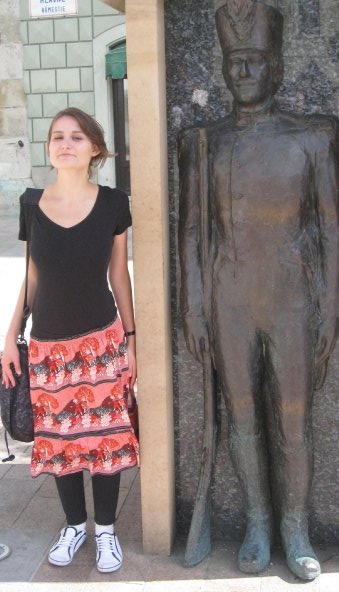
Wearing the skirt while inter-railing in the summer of 2009.

Wearing the skirt while inter-railing in the summer of 2009.

With the terrible dawn of adolescence, my dressing-up basket was cast into the bottom of a basement wardrobe.

Years later I re-discovered it and found that the skirt’s loose elastic made it a one-size fits all. The queen’s skirt had turned boho-chic.

I took it with me when I went inter-railing in 2009 because it was light and didn’t crumple easily. I also fancied myself as some kind of honorary gypsy in it; a fantasy I indulged in while gazing out the windows of the slow trains which hauled me through eastern Europe.

Frau Bienkowsi, her fingers moving like those of a master pianist across a keyboard, broke the silence.

“Katechen,” she said. “I don’t want you to say Sie to me any longer. “I’m not Frau Bienkowski any more. I am Lotta.”

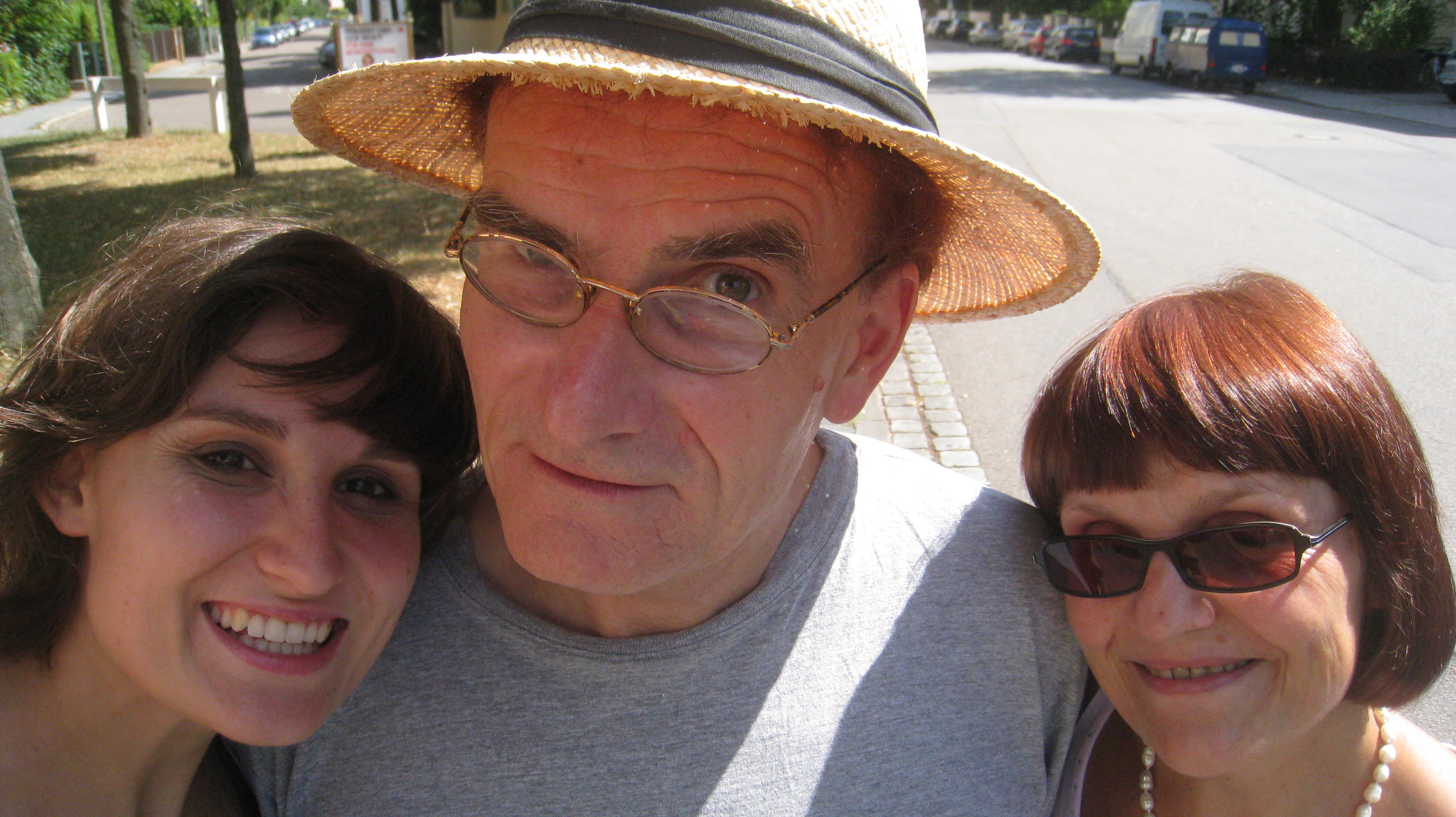
Familienfest 2013 Part 1

The train journey to Familienfest 2013 was hot and sticky. I got a seat in the bicycle carriage opposite a large dog with a sad, deformed paw.

My mother met me at the platform in Regensburg. She was so tanned that earlier, when she was in the health-food store buying vegetable spread, the cashier had asked her where she’d been.

“Ireland,” she’d said.

We ate mini dumplings for dinner and then my mother said, “Kate, we really need to rehearse.”

We darted into the next room and she took out some pages from a plastic pocket.

“These are yours,” she said, handing me three sheets containing typed verses. Beside every second one she’d written K, which stood for me.

We began to recite.

“You must speak slowly and dramatically,” my mother said.

I did.

“Excellent,” she said.

After all, it’s not every day you deliver the gift of Bavarian citizenship to your husband and father through rhyme.

Then we practised singing the Bavarian anthem in harmony.

In just a few hours, Familienfest 2013 would officially open and there would be no excuse for tumbling over words or singing off-key.

My father had been due to arrive any minute. But then I checked my phone to find he had texted to say his plane had failed to take off.

My mother’s faced dropped as the unspeakable possibility sunk in that he might not make it.

But all was well. It was just some technical fault. They changed planes. All going well, he would be in Regensburg by midnight.

We killed time by examining our props.

image:www.katekatharina.com

image:www.katekatharina.com

“Getting an abortion in 1953 wasn’t that easy.”

In 1953 Frau Bienkowski’s friend, who was having an affair with a married man, got pregnant. Though she’d had abortions before, she couldn’t get one this time. She had a baby daughter.

The man left his wife. Frau Bienkowski advised her friend not to marry the man. But she did.

After a few years they moved from Berlin to the south of Germany, where his family was from. Frau Bienkowski didn’t like the man. He wasn’t very nice and he drank a lot. He had other children too. Frau Bienkowski and her friend fell out over him for a while.

A few weeks ago, when it was Frau Bienkowski’s birthday, the woman called her.

She’s 89 now and her husband is dead. But the daughter grew up to be a wonderful woman.

“I said to her,” said Frau Bienkowski, prodding her fork into her kiwi cake, “I said, you went through a terrible few years. But look what you’ve got now. A wonderful daughter.”

It all turned out for the best, Frau Bienkowski said. Now she has a diligent daughter – a medical assistant – to take care of her in old age.

Frau Bienkowski and I talked about abortion. I told her it was illegal in Ireland. She had heard about the case of Savita Halappanavar.

Even though her friend now has a lovely daughter to take care of her in old age and her own beloved son died, Frau Bienkowski, 94, and I, seventy years her junior, agreed that Ireland should legalise abortion, and not just if a woman tells three doctors she’s suicidal.

When Frau Bienkowski was young, the pill wasn’t available. “You had to be really careful,” she said.

I told her that when my mother came to Ireland, people went to Georgian houses where doctors illicitly provided them with condoms.

“Contraception is probably still forbidden in Ireland,” Frau Bienkowski said, laughing.

I assured her that, thankfully, it was not.

But I told her that women go to England to get abortions. “Oh, is it legal there?” Frau Bienkowski asked. For her, England and Ireland are pretty much one.

“I’m surprised there’s such a demand for abortion these days though,” Frau Bienkowski said. “With so much contraception available.”

Frau Bienkowski and I talked about men. She knew several who were serially unfaithful.

I said I didn’t like people who wanted to have an exclusive partner and also lots of secret ones. I said I could understand people wanting to have sex with lots of different people, and liking open relationships. But that deceit drove me up the wall.

Frau Bienkowski agreed.

Then she asked: “So how are things with Andrew? What’s the story with his plans?”

“I have good news,” I said.

She looked intently at me. “Yes?”

“He’s moving to Berlin!” I said.

“That’s to my advantage,” she said.

Here eyes were sparkling. “That means you’re staying!”

“It sure does,” I said. “I’m not going anywhere for a while.”

“That’s to my advantage,” she said again.

The wheelchair man

A couple of weeks ago, I decided it was warm enough to wear the pretty party dress my sister gave me for my birthday.

I arranged an evening to go with my outfit.

LSB put on a shirt and tie. I squirted on some perfume and off we went.

We chased each other down the street. We got ice-cream that came in giant cones. We went to see a movie.

Afterwards I told LSB I was taking him to a bar in the east of the city called Madame Claude.

just before we encountered the man in the wheelchair

just before we encountered the man in the wheelchair

I didn’t tell him about Madame Claude’s alluring gimmick : the furniture there hangs upside down, fixed to the ceiling.

I’d seen pictures on the Internet and it made me think of the Mad Hatter’s Tea Party or of the scene in Mary Poppins where everyone laughs so much they float up to the ceiling.

On our way up to the station platform, we passed a big, dirty man in a wheelchair with his trousers down, defecating.

I caught his smell. We went on up the stairs.

When we got to the top, we took a glance back down.

The man’s wheelchair had overturned.

It was a busy night. Some people were rushing for the train. The man lay on his side, his trousers still down.

LSB and I pushed back against the stream of people going the other way.

I moved towards to the man and said stupidly, “Are you okay?”

Another lady stopped.

She had round eyes and her lips were pursed.

She tugged the man on the arm and tried to haul him up. Then another man came along. He was a friend of the man on the ground. He had a grey beard and dark eyes.

The lady held the wheelchair steady while the man’s companion hoisted him back into his seat.

He landed in a lump. His friend bowed his head in thanks and ushered us away with a few polite waves of his hand.

He didn’t want our help.

On our way back up the stairs, I asked the lady if we should have called an ambulance.

She looked tired, her face was full of resignation. “No,” she said. “Not against his will.”

Madame Claude

Madame Claude

LSB and I went to the upside-down bar. A French band was performing an intimate gig in a dimly-lit basement back-room. They played long, instrumental songs that sounded like beautiful, sad landscapes. In between, they spoke to the little crowd in formal, polite English. After the show I bought their CD.

LSB and I got a drink. Above our heads, tables, chairs, vases, and a pair of slippers were glued firmly to the ceiling.

It was a novelty.

But if our perspective did shift that night, it was down to a big and dirty man, his proud friend and the still image of a wheelchair turned on its side.

Two little girls and a monster

Last Saturday evening I was walking down the creepy stretch that leads from the train station to my flat when I was accosted by two little girls in distress.

“Have you seen our Kater?” the older asked.

“Your Kater?

“Yes!”

“Kater” means male cat. I hadn’t seen one.

The little girl bit her lip. “I am in so much trouble. So much trouble.”

“What does it look like?”

“Like any Kater!” she snapped.

It was a quarter to nine. The girls had big brown eyes and dark hair. The older one was about seven and the younger one no more than four.

“It’s all my sister’s fault,” the older one blurted out. “She started messing and ran away.” She smacked her little sister over the head. “It’s all your fault!”

“Hey!” I said. “Don’t do that! You are NOT allowed to hit.”

The younger sister didn’t flinch but stared ahead with her big brown eyes.

“Look,” I said. “Can you tell me what happened?”

“We went to the shop to buy the Kater,” the older girl said, fighting back tears. “And then my little sister started messing and I went after her and now the Kater is gone.”

I got the impression she was not taking about a cat.

In fact, she was talking about a “Karte,” which means “card.”

“Did you mum or dad send you out to buy the Karte?”

“Yes!” she cried, more hysterical. “Our mum did. I can’t go home. You’ve no idea the trouble I’ll be in.”

“What kind of card is it?” I asked. “What is it for?”

“For a mobile phone!”

The little girls had lost a top-up voucher.

“Did you buy it in the shop at the station?” I asked.

“Yes!”

“And have you checked the pavement?”

“We can’t find it. Please help us. I’m in so much trouble.”

“Okay,” I said. “Have you already looked across the road, just outside the station?”

“No, it’s too dark, we’re scared.”

It is dark and scary there. It’s dimly-lit and there are bushes. Once my heart almost stopped when a man emerged suddenly from urinating in the hedge.

We crossed over and began to scour the pavement. It was full of cards advertising taxi companies.

Suddenly the younger one pointed at something that looked like a receipt and picked it up.

“Is this it?” I asked.

The older girl snatched it and said. “I can’t see. I need to find some light.”

We moved under the dull glow of an orange street lamp.

It was a top-up card. For €10.

“Brilliant! Well done!” I said to the littler girl.

They were not as relieved as I’d expected them to be.

“Where do you live?” the older girl asked.

I told her I lived at the end of the road.

“Can I take your hand?” the little one asked.

I paused for about half a second.

“Sure,” I said and she clutched it.

I was trying to weigh up my chances of defence against a kidnapping charge. Circumstantial evidence was not in my favour.

“Will you take us up the steps?” the older girl asked.

“What?”

“PLEASE.”

“I’m sorry, I don’t understand you. What steps?”

“In our house.

In your house?”

“Yes. Please, please, please. I’m so scared. The monster has already killed the lady.”

“What lady?”

“The lady who used to live there. She’s dead because of the monster.”

“There are no such things as monsters.”

“Yes there are!” the two girls shouted, infuriated.

“No they’re not,” I said. “They are only in stories. So they can be in your head, but not in real life.”

“The worst monsters are in Romania,” said the younger girl.

“I’ve seen the monster,” said the older one.

“Oh really?” I asked. “What did it look like?”

“Big.”

“What was its hair like?”

She moved her hands apart as if she were making clouds in the air. “Like this.”

“And what colour eyes did it have?”

She faltered.

“You see,” I said. “Sometimes people just tell you stories to frighten you. It doesn’t mean they’re real.”

She was unconvinced.

“Please come in with us.”

“I can’t come into your house,” I said. “I’m sorry.”

“PLEASE” they both cried.

They came to a stop outside an apartment block.

“Is this where you live?”

“Yes,” they said. “Please, please, please don’t go.”

They clung to me.

Suddenly a woman’s face popped out of the window.

She had a pony-tail and she was staring at us.

“Is that your mum?” I asked them.

They nodded.

“Look,” I said loudly, pointing up at their mother. “There’s mum, everything is okay. There’s no need to be frightened””

The woman continued to watch us.

“Look,” I said, even more loudly. “Hallo mama!” I waved stupidly.

She didn’t budge.

Neither did they.

“You have to go inside now,” I told them.

“You have to come with us. PLEASE.”

“I can’t,” I said. “Look, your mum is right up there. You’re safe now!”

They held onto me.

Their mother was still at the window.

We were in a stand-off.

“Okay fine,” I said.

They pushed open the door.

Inside the entrance hall was a concrete staircase. A few steps led downwards to an open cellar, which appeared like a gaping hole.

I could imagine a monster there.

Their mother came to the door. I turned as fast as I could, pushing the two little girls gently in front.

“Bye!”

“Thanks,” the woman with the pony-tail called after me.

I rushed out of the building and when I got home, I thought about whom they had got their stories about monsters from. And why the woman with the pony tail had not budged from the window. And about what my curfew was when I was seven. And about what will happen the next time they cling to a stranger on the street.

Frau Bienkowski’s three fried eggs

Frau Bienkowski was wrapped in a blanket, wearing a nightie.

“I’m not at all well. My nose is blocked, I lay awake all night and I keep breaking out in sweats.”

“Oh no!” I said.

I moved closer, and placed a large box wrapped in orange paper on her lap. “I’m sorry I couldn’t see you on Tuesday,” I said. “But Happy Birthday!”

Her face changed.

“Oh no, Katechen, you weren’t to do that.”

“Open it,” I said.

“But it’s so big!”

“Go on.”

She tugged gingerly at a piece of Selotape. “I’m going to keep the paper.”

As she worked on the other corner she said, “I think I might know what this is.”

image source: www.amazon.com

image source: http://www.amazon.com

“Well, you just wait and see if you’re right.”

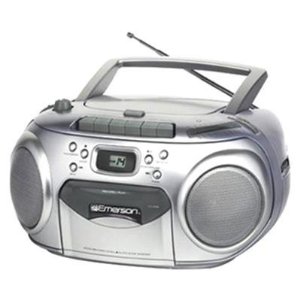
She lifted the sheet covering the top of the box to reveal the radio CD player I’d bought in Media Markt just a few hours earlier.

She blinked. “But it’s such a big present. I need to give you some money.”

“Nonsense,” I said.

“But Katechen…”

Keine Widerrede! Now, tell me about your birthday party.”

She paused.

“Well,” she said finally, “Seven of us met downstairs for coffee and I got lovely flowers. They came from the Internet. Nowadays, you can get everything on the Internet.”

“It’s true!”

“Anyway,” she continued. “On my birthday, they said I could choose to have any meal I liked. And I knew exactly I wanted.”

“Really?” I asked. “What did you want?”

“A fried egg,” she said. “I crave them so much.”

“And did you get one?”

“I got three!” said Frau Bienkowski. “You might think that’s a lot, but they were tiny; this small,” she said, and made a little circle with her forefinger and thumb.

“And were they good?”

“They were delicious.”

“Do you not usually get eggs here?”

“Oh, just scrambled,” she said. “But I’m sick to death of scrambled.”

I remarked that this seemed a happy kind of home.

“Well,” she said. “Maybe for a year or two. But I’ve been here for five. You’re not supposed to be here that long. Most people arrive and die after a year or two. But me – I’m still here.”

“I had one good friend here for two years,” she continued. “But then she had a stroke and died. You do grieve…”

“Of course,” I said.

I took out some photographs of LSB and my family, which I’d promised to show Frau Bienkowski.

LSB and I before a college ball

LSB and I before a college ball

She reached for her magnifying glass and turned on the light.

The first was a picture of my family at the legendary Familienfest last year.

She moved her magnifying glass over each of our faces. “These are my sisters,” I said. “And that’s my mum, and this is my dad.”

She lingered over my father’s face, examining it carefully. He was wearing his trademark scowl, which he reserves for people with cameras and for reading electricity bills.

“He’s handsome,” she said. “I might have fallen for him too.”

“He’d be delighted to hear that!” I said.

My family at Familienfest 2012

My family at Familienfest 2012

Next up was a picture of LSB and me all done up before going to our college ball a few years ago. “He has such brown eyes,” she said. “Like you. Your children will have even darker eyes again.”

Frau Bienkowski looked at another picture of my sisters and me and asked for our ages.

“And they’re not married either? None of you?”

“Nope, none of us!” I said. “Maybe some day.”

Frau Bienkowski remarked on how nice it was to have such a big family. She herself, had just one son. But he and his girlfriend died in a car crash more than thirty years ago.

“At least I have memories,” she said. “People who never had children have none.”

I provided a clunky translation of the English expression Don’t cry because it’s over, laugh because it happened.

“It’s true,” said Frau Bienkowski. I nodded, and we were silent for a little while.

“By the way,” she said later. “That drink you got last time..”

“My latte?”

“Yes!” she said. “I heard a report about it on the radio. Next time we go down to the café, I want to get one. It sounds very nice!”

“We will absolutely get you a latte next time,” I said.

Frau Bienkowski knows all about LSB. She even knows that he’s coming to visit me soon.

“You’ll bring him here, won’t you?” she said.

“Oh yes, he’d love to meet you! “But you’ll have to help me teach him some German words.”

She smiled. “I will!”

I took the CD player out of its box and plugged it into a socket.

I placed an audio book CD into the player.

A man’s voice filled the room.

“Can you hear that?” I asked.

“Yes,” said Frau Bienkowski. She looked happy.

When I got up I had to step over a cord attached to the lamp on the table between us.

“The bulb blew the other day,” Frau Bienkowski said. “And the type of bulb the lamp uses has been discontinued. Luckily, Frau Brein once got me a batch of ten, which will last me until I die.”

Freshly Pressed

For most people, “freshly pressed” means a glass of orange juice with pleasing bits of pulp, possibly accompanied by a croissant or lakeside view.

But for bloggers at WordPress, “freshly pressed” is an accolade.

It means that a WordPress employee has decided to feature one of your posts on their homepage, exposing you to lots of other bloggers, some of whom decide to “follow” your blog and a few who take the time to leave you kind and thoughtful comments.

Image source: www.ulaola.com

Image source: http://www.ulaola.com

For an introvert, it’s like winning a year’s supply of networking.

It’s like being at a writers’ conference, with sweaty palms, about to approach a stranger with an awkward, self-deprecating introduction, only for the entire spiel suddenly to be rendered completely unnecessary, paving the way for a return to the happy corner where you were munching a canapé and starting at animated people self-promoting.

Today, I was “Freshly pressed.” It made me very happy indeed.

It also made me think about encouragement and success.

I’m no neuroscientist, but sometimes I wish I were.

When I am sad or frustrated or overjoyed, I like to imagine the neurons in my brain squirting coloured impulses, which travel across convoluted chemical tracks at reckless speeds.

When some one says something kind or complimentary to me, a little cluster somewhere behind my forehead ignites,like a flickering light bulb finally screwed in right. I might respond awkwardly, by fumbling with my hands or countering with disproportionate (but heartfelt) praise.

But all the while, inside a little squirt of something which I’ll call adrenalin for want of an MRI, has begun to gush about my head, leaving me feeling unusually motivated.

Kate Katharina poses as an introvert suddenly relieved of the duty to self-promote.

Kate Katharina poses as an introvert suddenly relieved of the duty to self-promote.

It’s like magic, really.

Except it’s magic that anyone can perform, any time.

Encouraging people is deeply satisfying. My mother is so good at it, that she could probably turn professional.

My favourite people to encourage are humble types, whose faces immediately display a strange guilt when you tell them that they are wonderful and who can’t think of any words to say back.

Or people who have a secret dream that isn’t quite so secret and whose faces melt strangely when you casually remark that they could achieve something they’ve never admitted to desiring.

Fortunately, you don’t need a top hat or a bunny to encourage, though in some cases either or both could come in useful.

You can encourage with words or gesture, or even by keeping your dissent silent.

And like an alchemist, you can cause a little light to go on in someone’s mind, giving them the energy necessary to finish a painting, or take an exam, or learn to swim or ride a bicycle or sing a song.

Thanks to all my readers, old and new, for encouraging me to cultivate this little patch of blogosphere.

I wish I could say that being “freshly pressed” hasn’t gone to my head, but I’ve already told you all about the little light bulb that lives behind my forehead.

“Freshly pressed” or not, I promise I’ll try to keep my writing free of pulp.

**********************************************************************************************************************

If you want to join in the fun on Facebook you can find Kate Katharina here.

And if you’re more of a Twitter-er, you can find links to my latest posts here.

From Tolstoy to Twitter

Edinburgh is just the place for thrifty, book-loving odd-balls.

Many areas, like Bruntsfield, Marchmont and Waverly sound like settings that Jane Austen has fabricated.

There is even a Bingham Park and, while I’ve yet to come across a Darcy Drive or a Wickham Way, it’s only a matter of time before mindful town planners restore the literary balance.

I suspect the city was designed by a brilliant, absent-minded professor of literature, who approached the task like the writing of an essay.

There are examples of sublime beauty, like the Balmoral hotel, the Walter Scott monument and of course Edinburgh castle, but they are clumsily linked by several hills, which pepper the city indiscriminately. The effect is similar to the reward felt by a reader who huffs and puffs their way through stodgy prose, wondering where it is all going, only to stumble suddenly on something quite profound.

Edinburgh

Edinburgh

On Thursday, I stumbled across the St John’s charity bookshop in Stockbridge. A poster in the window said “Clearance! Everything 50 pence” and I was inside as fast as my little legs could carry me.

It was cluttered and reassuringly musty. Bookish types sporting oversized anoraks and tufty hair browsed stealthily, building discerning piles of poetry, murder mysteries and natural history.

While I prowled the store, several dismayed customers asked the elderly couple behind the counter why everything must go.

“We haven’t got enough volunteers to keep it going,” said the man.

“Now where am I going to go for my books?” asked one lady and sighed. “If only I’d known, I would’ve given up a few hours,” said an English man, who blinked a lot and bought the collected works of Oscar Wilde.

“Well, get stocking up,” said the old lady. “Anything that isn’t sold will go into recycling.”

I didn’t need to be told twice. Some of the titles I had been perusing were so promising that the thought of them condemned to shredding alongside household bills and letters from the bank sent a shiver coursing down my spine.

I was tragically limited by the confines (56 x 45 x 25cm including wheels) of my hand baggage allowance. Nevertheless, I managed to add six books to my collection. It only set me back £3, which is about the cost of a glossy magazine offering to make me beautiful and thin.

I am now the proud owner of: The Personality of Animals by the appropriately named H Munro Fox, The Childhood of Animals by Sir Peter Chalmers Mitchell, Know Your Own IQ by H.J. Eyesenck, The Common Reader by Virginia Woolf, The Hill of Devi by E.M. Forster and most promisingly of all: The Intelligent Woman’s Guide to Socialism, Capitalism, Sovietism and Fascism Volume 2 by Bernard Shaw.

I opened the most humble-sounding of them, Virginia Woolf’s The Common Reader on the plane earlier. I kept it open on the bus and then on the underground and even brought it to bed with me.

Roger Fry's painting of Virginia Woolf Image source: http://en.wikipedia.org/wiki/File:Roger_Fry_-_Virginia_Woolf.jpg

Roger Fry’s painting of Virginia Woolf Image source: http://en.wikipedia.org/wiki/File:Roger_Fry_-_Virginia_Woolf.jpg

We travelled well together. Ms Woolf seemed to understand the dilemmas of contemporary blogging as early as 1925.

In her chapter “Modern Fiction,” she asks what about and why and how we should be writing. Baffling questions that the amateur blogger faces every day.

Sometimes I steal snatches of conversations I’ve had and slap them onto the blogosphere. Other times I talk about love or meat or peeing audibly.

Occasionally I think about weighty things like politics or God and think I should write about these things too, yet I can find nothing more to say.

And then there are the times I dream of invention. I wonder whether my paltry life experience could ever be transformed and trapped within the dusty covers of a big fat book.

It’s worth remembering that unless you’re an academic, Woolf’s chapter title doesn’t age well. “Modern fiction” is by nature a relative term. But what she says about the dilemmas of writing may apply to anything from Tolstoy to Twitter. She asks us to:

Examine for a moment an ordinary mind on an ordinary day. The mind receives a myriad impressions — trivial, fantastic, evanescent, or engraved with the sharpness of steel. From all sides they come, an incessant shower of innumerable atoms; and as they fall, as they shape themselves into the life of Monday or Tuesday, the accent falls differently from of old; the moment of importance came not here but there; so that, if a writer were a free man and not a slave, if he could write what he chose, not what he must, if he could base his work upon his own feeling and not upon convention, there would be no plot, no comedy, no tragedy, no love interest or catastrophe in the accepted style, and perhaps not a single button sewn on as the Bond Street tailors would have it. Life is not a series of gig lamps symmetrically arranged; life is a luminous halo, a semi-transparent envelope surrounding us from the beginning of consciousness to the end.

Sometimes I get stuck inside the semi-transparent envelope. I know I’m there when words fail me, or I lose the desire to write. It takes a hilly city, with rough cobble-stoned streets, place names that make me feel like I am Elizabeth Bennet and charitable book-sellers to break the seal.

“You’re not thinking of marriage, no?” asked Frau Bienkowski.

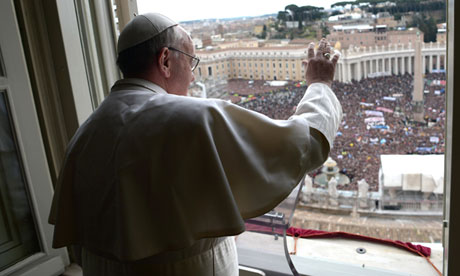
“So we have a new pope,” Frau Bienkowski said, as I handed her the bag of medium-sized apples and two packets of sugar-free sweets she’d ordered.

“He could have been a black man,” she continued. “It wouldn’t have mattered.”

“No!” I said.

“But there was something irregular about Benedict’s resignation, wasn’t there? Popes don’t just resign!”

I agreed it wasn’t their custom.

“Could you get us some coffee?” she asked, pushing her stroller over to me. “You can put the cups at the front!”

I pushed the Zimmerframe down the corridor and passed three ladies in wheelchairs. One of them had a remarkable face, like a gazelle. They were staring straight ahead. One of them was saying, “You could write a novel about a life, if you just think back to all your encounters. You could write a novel. You really could.”

I placed Frau Bienkowski’s cup in front of her, and she pushed one of her sugar-free sweets towards me.

“So tell me, how has work been this week?”

I told her I’d been busy and that the new pope was creating a lot of work for us.

“It’s good you’ve got work,” Frau Bienkowski said, “especially as you’ve booked flights to see your boyfriend!”

“I couldn’t agree more,” I said.

“You’re not thinking of marriage, no?”

“Well, it would be difficult logistically since we live in different countries,” I said, apologetically.

She nodded. A few weeks ago she’d told me that she thought German president Joachim Gauck really ought to marry his long-term partner, since she travelled with him in an official capacity.

A little later, we got talking about Germany. “We’ll never escape our past,” she said and paused.

“They could have just removed the Jews from official positions. But there were good Jewish doctors, good workers. Sending them to concentration camps, killing them was wrong.”

For the first time, I felt uncomfortable around Frau Bienkowski.

“Of course it was,” I said.

Frau Bienkowski presented me excitedly with a fashion catalogue. “Look what I got in the post!” she said.

We spent some time leafing through the pages and commenting on the clothes.

“I like that,” I’d say, pointing at a blue and white striped cardigan.

“Yes,” she’d reply, “It’s pretty, but look at the pattern on that blouse .. it’s a bit much, isn’t it?”

We looked at a model in high-heeled shoes. “Do you like them?” I asked.

“Oh yes,” she said.

“Did you wear such high shoes when you were younger?”

“Oh yes!”

“And could you walk in them?”

She smiled. “If you wear them, you walk in them!”

We read some more of the story about the cantankerous 100 year-old living in an Irish convent.

I apologised that I wouldn’t be able to see her next week.

“Don’t you worry!” she said. “This should never be an obligation. And tell Andrew I say hello!”

Blogileaks: Kate Katharina rocked by sell-out scandal

If you want to be rich and famous, you should definitely start a blog. It’s the only way to keep up with the Mark Zuckerbergs of this world.

Katekatharina.com is a case in point.

From the beginning, my sober treatment of issues such as my talent for gibberish, my reputation as a creep and my savant boyfriend left readers crying for more.

I had to purchase extra electronic storage to cope with all the fan mail I was getting. I rejected several offers to write for renowned publications on the principle that Katekatharina.com was a more reputable source than say, The New York Times.

After some time, it became impossible to walk the streets of Dublin without being accosted by an admirer of my prose. The effort of gazing at my feet modestly every time a particularly apt turn of phrase was repeated to me by a stranger became too great. I decided to move to Berlin, where I thought I could descend into relative obscurity and focus on my art.

A rare moment of calm from the crowds as I climb a tower in the early days of my time in Berlin.

A rare moment of calm from the crowds as I climb a tower in the early days of my time in Berlin.

But it was not to be. Here too, passengers on the underground tap me nervously on the shoulder and say “If you don’t mind me saying so, you look really like Kate Katharina from Katekatharina.com. Others are more aggressive, pushing through crowds to thrust a pen and a print-out of my latest post into my hands, crying “Bitte, bitte, ein Autogramm fuer mein krankes Kind.”

Yes, my route to fame and fortune has been paved with widgets and clusters of html.

Or possibly, it’s been a bit more like this:

I’ve written over 200 posts here. Sometimes I spend hours writing a serious piece contemplating the meaning of art, or describing a tiny dead mouse whose death still haunts me, while other times I chronicle my developing relationship with a 93 year-old woman or defend pigeons.

The mouse that haunts me still

The mouse that haunts me still

The effort has paid off. Last summer the embassy of a wealthy middle eastern country offered to pay me to write a piece outlining – among other facts – the wisdom of its ruler and the progress the country has made in the areas of human rights and gender equality. When I replied saying that I did not feel I could write an impartial piece given the requirements, they promptly reassured me that I could be “reasonable and objective,” as if I were simply displaying modesty.

They’d found my contact details through a referral to the blog from an article I’d written for The Journal. That particular article paid me handsomely in… exposure (?) and afforded me the pleasure of trawling through a host of comments, most of which misinterpreted my article to conclude I was a Paparazzi fiend.

A more recent success occurred when the Past Pupils Union of my secondary school read a post I had written reminiscing about audible peeing in the school bathroom. They posted it onto their page and my hits rocketed.

I rejected numerous offers from prestigious publications

I rejected numerous offers from prestigious publications

And then recently, someone working on behalf of the company X contacted me, offering me a modest sum in exchange for linking to their site.

I had a drink with my friend, another freelance journalist in Berlin.

“You’ll be compromising yourself,” she said. “And for €80?”

A niggling part of me thought she was right. “But,” I argued, “They said I could write about anything; I just have to link to their site.. I mean I link to sites all the time, many of them happen to be commercial! And Y is not immoral!”

“And,” I continued, ever more desperate. “Every time I want to watch a video showing death and destruction on the BBC website, I first have to watch a stupid ad telling me to ‘invest in reMARKable Indonesia.'”

“I know,” she sighed. “It’s terrible the Beeb does that.”

So, here I am, “selling out” for the first time. The compensation is €80 (I hope!) which will pay for my monthly transport. For the amount of hours I’ve spent thinking about how NOT to make this read like a sponsored post, it’s pittance.

If I were living in a time when people still paid for writing, I’d have earned a couple of hundred for this 800 odd-word piece.

But I’m not. I was born into the digital revolution.

So, for all the would-be bloggers out there, the most important piece of advice I can give you is to take yourself excessively seriously. Just like me.

Otherwise, the attention from the fans can get too much, and you begin to crave the days when your blog had a small, loyal readership and when you deliberated for days over whether to post a link to a website offering to help people see again.