I almost gave up on a second child

Choosing to mother again in an age of anxious ambivalence 

The first time I mourned the idea of not having a second child was in the hours after the birth of my first. I was doubled over, shuffling towards the hospital toilet, in a dizzy haze after the assault of a 40-hour labour. The thought – intrusive and inappropriate – came with clarity: I can never do this again. I will never do this again. How could I? I had wanted to die. 

Three months later, I took my baby to meet some friends for pizza. Some pandemic restrictions had been lifted, but the plague was not over. Bursting with pride, I passed my daughter round for cuddles.  “Would you have another?” they asked. “I definitely wouldn`t rule it out,” I said. They seemed surprised. 

(The fear that my daughter could have caught Covid during any of those cuddles haunted me later and until it was clear that she had not, I felt like the worst mother in the world). 

Motherhood made me happier than anything in the world ever has. I had never doubted my capacity to love. But what I never expected was that in those early months, my insomnia would disappear, and I would sleep more deeply than I ever had before. That I would lay in a cocoon of duvets, breastfeeding my baby for hours on end and feel entirely fulfilled. Who would have thought, after all those agonizing years of wondering and fearing and second-guessing motherhood and how it would affect my career, that the truth was: this was better. At least, for a while. We had an unnaturally contented baby. The kind who smiled at strangers on the street and slept all night.  

This was four years ago, before feminism and wokeness had been canceled. The idea that motherhood was not only more enjoyable but also more fulfilling than my job had been, felt like a thought that needed to be quashed, or at least rigorously questioned. I was mortified by the idea that my sentiment might be endorsed by some of the Internet’s vilest people. There was nothing ideological in my feelings. I didn`t care if other people wanted babies. I still wanted women in the highest positions of political and corporate power. But I was awe-struck by the little life I had created. She mattered more than anything. I couldn`t believe we all went through life paying such little attention to the mysteries and wonders of conception and childbirth. 

And yes, I was definitely bored sometimes. I missed writing and feeling semi-important because I had a job on TV. I missed being alone. And I had no interest in any of the logistics of parenting: discussing pram brands or naptimes or what solids to start when. Those things left me cold. They still do. 

Oh, but the love. It was intoxicating. 

***

My daughter started daycare at 10 months old, early for Germany, late for other parts of the world. I went back to work and in the early weeks, found it exhilarating. Hours on end to research the decline of the liberal world order! Just for the sake of it, with no little life depending on me! Compared to parenting, it was a piece of cake. For a while anyway. 

I did not realise it as it was happening but as my baby grew, I began to shrink. I was eating as heartily as ever but no amount of feasting could hold pace with the calories I was losing from breastfeeding. 

I was lucky that feeding had come easily to me and that I could meet my baby`s voracious demand. I fed her before and after daycare and all night long. 

The months went by. On her first birthday, I came to pick her up from daycare and found her sitting in a tiny chair at the head of a table of tiny people, wearing a paper crown. Around this time, I began to think again seriously about a second child. I had been almost 34 when she was born. I didn`t have unlimited time.  

Then one day, my husband lost his job. A typical corporate layoff, it came with no warning and was executed with ruthless precision. By noon that day, a courier had arrived at our door with the letter of termination. 

We live in a country with a generous social safety net. You pay in generously and when misfortune strikes, you get back what you gave. We were okay. But it was unsettling, and the economy was bad, especially for the creative industries. I put pressure on myself to work more. I fed my baby. But she wasn`t a baby anymore, she was a toddler. It was exhausting. But it was also sublime. It was both of those things, much of the time. 

We didn`t own weighing scales at the time, but I did notice how loose my jeans were becoming. I bought a size down. In one of the video reports I made for work, some of the YouTube comments called me anorexic. 

In the summer before my daughter turned two, we visited a friend in Austria. After our meeting she sent me a kind text. She had noticed how thin I had become and was concerned. She herself had a history of eating disorders. She was also a doctor, and had an eye for this stuff. Naturally I was defensive. I`ve never had an eating disorder. I was eating as I always had. But when I look back at pictures from that time, I can agree: I had become alarmingly gaunt. My abundant milk supply was eating away at my body fat, so incrementally that only people who hadn`t seen me for a while noticed. 

***

My preternaturally “easy” baby turned into a remarkably difficult toddler, almost overnight. We were somewhat startled by the strength of will that emerged, which even the affectionate staff at her daycare conceded was off the charts. 

“The world needs strong, difficult women!” my husband and I would agree – increasingly ironically –  hours into trying to get her dressed in the morning, willing ourselves to believe that every time she ripped off her trousers again, a tiny layer of the patriarchy was crumbling. 

On a comically disastrous holiday to Ireland that summer, immortalized by a series of photos of my husband and me looking depleted while holding our furious, trouserless toddler at various sites throughout Killarney national park, I mourned the idea of a second child for a second time. 

Our trouserless toddler

This was so hard, and we were so tired. Work no longer felt exhilarating, just exhausting. To make things more complicated, we were still coming to terms with my husband´s MS diagnosis, an illness that affects his walking and whose prognosis is unpredictable. The idea that our furious two-year-old would ever accept a sibling became laughable. It made me unbearably sad. I tried out telling people: we`re only having one. We couldn`t manage any more. 

And how lucky we were to have one. Because as hard as it was, that love for our difficult, unyielding, deeply, deeply feeling, sensitive little person was only growing every day. 

When she was two and a half, I had my first night away from her. The circumstances were the least restorative imaginable. Work was sending me to the industrial town of Leverkusen to interview the CEO of Bayer.  I was very pleased to get the assignment, but I had to write an entire book for my daughter to prepare her for my absence. The “Leverkusen” book – bound in a purple ringbinder and featuring illustrations of domestic life juxtaposed with train travel – is still one of her favourites. The night before the interview, I didn`t sleep. Not even for a minute. I was super well-prepared, so I got through anyway. But when I watch that interview back, I see the exhaustion in my eyes, the toll of parenting and working written all over my face. 

***

As much as I had mourned the second child that may never be, the truth was that I had not given up on the idea. The possibility stayed with me constantly, even in moments of great resignation. But the anxiety was great enough to mistake for ambivalence. 

I scoured Reddit for stories of mothers grappling with the same question. I was searching for some kind of narrative that matched my experience entirely but never quite found what I was looking for. There were the happily “one-and-done” crew, advocating for the pleasures of a life with one child. Their arguments were highly convincing. There were those who regretted having a second. And there were those who couldn`t be happier they had taken the leap. Unfortunately, there was no one who was going to tell me what to do. My husband said it was up to me and no amount of interrogation revealed a hitherto concealed desire. He would go along with what I wanted. 

I began following an account called “The Happy Caravan”, chronicling the life of Amber, a fundamentalist Christian and the mother of eleven musical children. All of them homeschooled, some have gone on to attend the prestigious Julliard music school in New York. 

I became fascinated by her: eleven! From what we see online, the children all seem polite, and the atmosphere at home is reasonably calm. Of course, it`s likely that creepiness and darkness lurk beneath the surface. There are only so many hours in the day, and Amber manages to release far more videos than it would be plausible to make if you were actually looking after not only the emotional and material needs, but also the education of your eleven children. And things did fall apart, because New York prices ate them up and they had to leave in a giant trailer and move into a house in San Diego infested with termites. 

But none of that erases this woman`s stunning feat: after experiencing the awesome love and responsibility and life-changing demands of having a child, she chose to do it ten more times. I studied her obsessively, trying to discern the source of her conviction. It was blind faith, obviously. But as she walked me through her gigantic Aldi hauls and chicken stew recipes, Amber, a stranger on the Internet unwittingly taught me a lesson: no amount of thinking or planning would change the fact that trying for a second child would be an enormous leap of faith. 

***

I made an appointment with my gynaecologist, a tiny, 85-year-old man who frequently opens our conversations by expressing dismay at the decline of the Transatlantic relationship or with the provocative question of whether I have really read Ulysses (he knows I am a journalist and that I come from Ireland). 

“We`re thinking of trying for a second child,” I told him nervously. “Machen Sie das!” (“Go for it!”) he said, without missing a beat. Then, looking right through me he added: “A child is the ultimate expression of hope for the future.”

I nearly cried when he said that. 

***

My daughter had her last drink of my milk on the night before her third birthday. We had been discussing the moment for months and when it came to pass, it was seamless and beautiful. When she asked for bainne (the Irish word for “milk” my husband and I had been using as code but which she deciphered immediately because she is not only difficult but also brilliant) the following day, I reminded her that she was now three years old. “Oh,” she said giggling. “I forgot.”

I gained weight and my old jeans fit me again. As much as I had loved breastfeeding, regaining bodily autonomy was empowering. I felt freer again. The possibility of having a second child became a tiny bit less remote.  

***

No one has ever told me to have children, at least not explicitly. In my industry, not having children is as common if not more than having them. I watch, sometimes enviously, as my friends travel the world, or take on exciting assignments. But I have never regretted motherhood. She is more interesting and more special than anything I have ever done at work. And because everything is both personal and political,I feel the need to add: there would be nothing wrong with it if I did have regrets. Plenty of mothers do. They might not tell you to your face, but they will confess to it in countless forums on the Internet. 

It is hard to truly analyse the cultural expectations you grew up with. It requires a certain distance which by definition you do not have. As a millennial, I came of age with the arrival of social media. I know, rationally at least, that the platforms I did engage with, over years, must have held enormous sway over the formation of my identity. 

When I was pregnant with my daughter nearly five years ago, I had a desire I would have denied then but can admit to now: I wanted to work and to mother performatively. I had relished the idea of displaying my big bump on air. I would post a clip on Twitter of me presenting the news with my huge belly. The implication would be that I was doing it all. I would package it into a clever humble brag. 

As fate would have it, the only time I was pregnant on-air was in my first trimester, and my clearest memory of it is the genuine fear that I was going to throw up between segments. After that, I was banned from being in the studio because my workplace had a no-office policy for pregnant women during the pandemic. 

***

In February of this year, I took a step that seemed momentous: I re-downloaded my period tracker app. My husband and I had decided to start trying to conceive in the summertime. I clicked the option that said “trying to conceive” and immediately my social media filled up with ads for fertility treatments. 

I worried enormously that my cycles were no longer as regular as clockwork. I researched perimenopause and watched in horror as more of my hair grew grey. After all of my soul-searching, perhaps the decision had been taken away from me. 

In June, the month our conception journey was to begin, my husband took a work trip. When he came back, our daughter turned into a monster, furious that the intensity of the time just with me had come to an end. We stayed inside for a whole weekend because her tantrums were so intense and her resistance to suncream so profound. It was 37 degrees outside. We sweltered inside. I imagined adding anything at all to the stress we were experiencing. Not this month, we agreed. 

“Are we ever going to do this?” I asked my husband. 

“Yes,” he said. “Just not right now.” 

We knew this was an irrational way of going about things. But nothing about creating a new life is rational.

***

Autumn comes and it is more beautiful than ever. My daughter and I watch mesmerised as the orange leaves twirl off their branches under a clear blue sky. She scours the back yard for chestnuts, demanding I close my eyes so she can present them to me as gifts. She learns to ride a bike. 

The videos on my feed change. What I see now are gender reveal parties and women speaking about miscarriages. My period app has communicated the news to the tech titans before I have to my family. 

I can no longer close the button on any of my jeans and opening the fridge door is a hit-or-miss experience. I vomit when I exit the shower, a phenomenon ChatGPT tells me is likely to be due to an overactive vasovagal reflex caused by the shock of moving from hot to cold. 

***

We were on holiday in Krakow when I found out.  I took the test one morning in our palatial bathroom, which featured a faux-gold bathtub. The line appeared immediately. I called my husband. We took in the news quietly, and hugged. Like all life-changing moments, it felt both incredibly real and not real at all.  

We went for breakfast with our daughter. Walking there, I felt a glow pass through me: I wanted this so badly and yet I could not believe it was happening. I breathed in the moment. When our food came, I insisted we take a selfie, so I would remember the hours after finding out, that secret time when your world changes and no one yet knows. 

A week later, one of my favourite influencers, a woman who has been documenting her struggles with endometriosis and IVF for years, announced her pregnancy. I cried with joy for her; big, ugly messy mascara-tinted tears. Our pregnancy was only one week apart.

My daughter demands to see the video of the “woman crying and laughing with the stick in her hand.” 

“Why did I not cry for us?” I ask my husband. “Why did we not cry for us?”

“It`s not our style,” he says. “We don`t scream on rollercoasters either.”

He is right. After so many years of agonizing over whether I could dare to indulge the deep and audacious desire to mother again, my joy was a quieter one, a creeping, cautious gratitude tinged still with an acute awareness that nothing can ever be taken for granted, especially not a safe pregnancy. 

Our daughter, aware that something momentous is happening, is clinging to me more than ever. My fatigue is so extreme that I often fall asleep in her bed while reading her bedtime stories. When she wakes in the middle of the night and sees me there, a huge smile spreads across her face. I bundle her in my arms and kiss her hair. 

“Maybe we should call our baby sheep,” she says. “Maybe,” I agree. 

She lays her still tiny hand on my stomach. 

“Your tummy is getting so big!” she says, adding “I also want to be a mama.”

“But also a bus driver,” I remind her. 

She nods. 

“You can be both,” I stress, remembering that everything is both personal and political. “How many children would you like?” 

“Ten,” she replies. 

Our surreal breakfast in Krakow

Money talks but I’m not buying it (review of JT Foxx mega speaker event published on Deutsche Welle)

UPDATE: You can keep track of  JT Foxx’s encounters with US tax authorities at the following link: https://ustaxcourt.gov/UstcDockInq/DocketSheet.aspx?DocketNo=18008342 

You can always search for updated material by searching for the case number 008 342-18 here: https://www.ustaxcourt.gov/UstcDockInq/Default.aspx?DocketNumber

Here is an overview of cases filed to date.

You can get further insights into the JT Foxx’s business practices at the JT Foxx Information pageon Facebook.

Deutsche Welle has kindly given me the permission to reproduce this article below:

He describes himself as the world’s number one wealth coach, a friend of celebrities and a billionaire in the making. But despite his cunning-sounding surname and the gravity implied by the two initials that precede it, JT Foxx doesn’t even have a Wikipedia page to his name.

The free “Mega Speaker” event in Berlin was held on June 8 in a hotel beyond the city’s Schönefeld airport. It was part of a world tour that kicked off in May and runs until early July. Organizers claim to be looking for people “who want to be known, remembered and significant.”

Who on earth, I wondered, attends such events? I signed up.

JT Foxx (Facebook/JT Foxx) JT Foxx announces his tour dates on Facebook


I prepared for it by watching a poorly produced and comically absurd promotional documentary titled “JT Foxx: A Biography: The Untold Story of a Millionaire Underdog.” It includes awkwardly-staged endorsements from Eric Trump, son of the US President, Apple co-founder Steve Wozniak and actor Al Pacino. The video claims to have been produced by “Hollywood Kingmaker Films,” an impressive-sounding entity I can’t find mention of anywhere else on the internet.

The walk from the train station to the hotel takes you past fields and down roads decidedly off the beaten track. It wasn’t long before I met others going the same way.

The dress code was the giveaway. The men were in suits and carried briefcases. The women were wearing dresses and heels. One told me she was a musician from London. She’d just brought out an album but needed to make some money. Speaking, she’d thought, could be the way.

At 9 AM the doors opened and we were ushered into a nondescript conference room. The opening act was a man called Reggie Batts. Tall, attractive and self-assured, he told us there were two types of people in the world: “right-brainers” and “left-brainers.”

The former act impulsively, the latter think first. Right-brainers always barge in and sit at the front. Left-brainers wait for the others to shuffle in, and then take their seats at the back. In the front row, a middle-aged woman in a headscarf nodded along enthusiastically, frequently blurting out “yes!”

JT Foxx’s own entrance was underwhelming. Less charismatic than the support act and sporting two pins on his lapel (one the American flag, the other the German) he opened with a rant about Berlin’s airports.

In the hours that followed, JT Foxx fed the 167 people gathered a cocktail of hyperbole concerning his fame and wealth, vacuous clichés masquerading as business advice and menacing sales pitches.

JT Foxx (DW/K. Ferguson) The Berlin hotel where JT Foxx held his free event


He made no secret of the fact that he pays celebrities tens of thousands of dollars to appear on stage with him. He claims to pay John Travolta half a million dollars for a joint appearance. His connection with the Hollywood A-lister apparently earns him enough street cred to multiply the money he invested several times over.

He described an instance when he annoyed Travolta by going off script, putting him on the spot and making him perform a song from Grease during a paid appearance. It was part of a plot engineered to generate more clicks online. He said it worked, though the relationship with Travolta soured as a result. (Footage of that event can be seen here.)

“He’s never quite forgiven me,” Foxx said. “Would I do it again? Definitely.”

The first product JT Foxx tried to sell seemed harmless enough: a set of CDs, apparently featuring business advice he himself had paid a former coach $250,000 for. The catch was that there were only 15 copies available. They would be for sale at the back of the room during the first break. The woman in the headscarf was among several people who joined the line to buy.

As the rest of us filed out, I was desperate to find out how the rest of the crowd felt about JT Foxx.

“He sure knows how to close,” a middle-aged man said in German. “You could learn something from him.”

“I don’t like his way of selling,” a young man said, to which an older woman who frequently attends events like these retorted: “You’ve got the wrong mindset.”

Things took a more sinister turn after the break, when JT Foxx began speaking about women. “Most women can’t sell,” he said, claiming that they “love telling their sad stories.”

This led to an anecdote about a first date with a beautiful woman who told him 36 minutes in that she’d been raped. This proved a massive turn-off for JT, who told us that: “No one cares about your problems. They only care about themselves.” Further enlightened views about women included boasting about his connections with Miss Cape Town 2016 and that he was considering “buying the pageant.”

The purpose of the rest of the event was to “select” people to turn into “mega speakers.” As it turned out, this meant anyone who was willing to spend between 4,000 and 20,000 euros on the spot.

JT Foxx (DW/K. Ferguson) We were given a sheet of paper with four ‘options’


This is how it happened: We were given a sheet of paper with four “options.” Our job was to write down the usual prices and then JT Foxx would announce the incredible, one-day-only-just-for-Berlin offer.

Option 1: A day of one-on-one coaching or four days of group coaching with JT Foxx. The cost: 4,000 euros.

Option 2: Getting coached at one of JT’s mansions, in either Florida or Thailand, costing just 8,000 euros.

Option 3: The opportunity to speak for 15 minutes in front of a large crowd at the “Money, Wealth and Business” conference in South Africa, for 12,500 euros. A unique opportunity to build your brand.

Option 4: The once-in-a-lifetime, career-enhancing opportunity to interview either Al Pacino or Mark Wahlberg for only 20,000 euros.

Not less than eight people chose at least one of the options. Most of them were young women. They were then taken out to the lobby for one-on-one interviews with members of JT Foxx’s team.

It wasn’t long before their credit cards came out and JT Foxx, once again, became tens of thousands of euros richer overnight.

Before the Berlin event, JT Foxx had held similar workshops in Singapore, Dublin, Manchester, London, Birmingham, Stockholm, Edinburgh, Glasgow and Amsterdam. The second leg of the tour sees him speaking in four US cities, as well as Dubai, Kuala Lumpur, Singapore and Adelaide.

And each time, he is likely to get what he needs: a handful of people willing to gamble away their savings for a shot at stardom.

Nothing but the tooth

When it comes to wisdom teeth, the world is divided into haves and have-nots. Those that have suffer stoically while those that have-not continue on, blissfully unaware of their good fortune.

Sometimes the have-nots playfully roll their tongues to the back of their mouths and say: “Oh, I don’t think I’ve got any! But I’m honestly not sure!”

You’d know, trust me.

Not only have I got a wisdom tooth, I’ve also got a wisdom tooth infection. Just in time for Christmas.

Arriving home to my parental home in poor condition has become a festive tradition. Last year I spent Christmas wrapped in a blanket hogging the sofa nursing Lemsips.

This year I came in dental agony, prompting fears that I am in fact poorly all-year around.

Having never experienced intense, shooting pain like it before, I asked my mother tearily how she ever managed to give birth.

“Your toothache might be worse than giving birth!” she said modestly. “At least with childbirth you know it’s going to be over in a while.”

My father took me to a dentist in Sandymount.

image source: Wikimedia Commons

image source: Wikimedia Commons

“Oh, you poor pet,” the dentist said, looking into my mouth.

Then she sent me to stand in an X Ray machine, clasping a piece of plastic in my mouth.

“Your tooth needs to come out,” she said. “But it’s too risky for me to do, as it’s right on this nerve.”

My nerve is a long white snake stretching from my tooth to my ear. Pain has been shooting along it for days now. I will probably need to go to a German hospital to get my tooth pulled. My way of dealing with that eventuality is to ignore it.

My father came with me to Rathmines to pick up some antibiotics and intense painkillers.

I paid for them using my VISA card. Then I went into the hairdresser’s to book an appointment.

Last night my father said: “I marvelled at the debonair confidence with which you sailed through your errands in Rathmines earlier.”

I blinked at him.

“You remind me of your sister (the one in America)” he said. “She also pays with plastic.”

“How do you pay?” I asked him.

“I pay with cash,” he said nostalgically.

“Yes, but what do you do when you don’t have enough?”

“I write cheques,” he said. “A dying art.”

My father opposes change of any kind. As long as we avoid talking about politics, it’s not much of a problem.

In fact, as an emigree, the certainty that nothing will change at home can be reassuring.

My father’s constancy is primarily associated with food.

Therefore, I can be absolutely assured that no matter what time of year I return home, there will be a bowl full of soaking butterbeans on the kitchen table and a half-open packet of Lidl cream crackers.

Yesterday my mother made her trademark exquisite celeriac soup. Later she hung up our walnut baby Jesus on the Christmas tree.

In the evening we watched a poorly-dubbed version of Ceclia Ahern’s “PS Ich liebe dich” on German television.

And I curled up wrapped in a blanket munching Dominosteine on one side of my mouth.

There’s no place like home.

Familienfest 2013 Part 1

The train journey to Familienfest 2013 was hot and sticky. I got a seat in the bicycle carriage opposite a large dog with a sad, deformed paw.

My mother met me at the platform in Regensburg. She was so tanned that earlier, when she was in the health-food store buying vegetable spread, the cashier had asked her where she’d been.

“Ireland,” she’d said.

We ate mini dumplings for dinner and then my mother said, “Kate, we really need to rehearse.”

We darted into the next room and she took out some pages from a plastic pocket.

“These are yours,” she said, handing me three sheets containing typed verses. Beside every second one she’d written K, which stood for me.

We began to recite.

“You must speak slowly and dramatically,” my mother said.

I did.

“Excellent,” she said.

After all, it’s not every day you deliver the gift of Bavarian citizenship to your husband and father through rhyme.

Then we practised singing the Bavarian anthem in harmony.

In just a few hours, Familienfest 2013 would officially open and there would be no excuse for tumbling over words or singing off-key.

My father had been due to arrive any minute. But then I checked my phone to find he had texted to say his plane had failed to take off.

My mother’s faced dropped as the unspeakable possibility sunk in that he might not make it.

But all was well. It was just some technical fault. They changed planes. All going well, he would be in Regensburg by midnight.

We killed time by examining our props.

image:www.katekatharina.com

image:www.katekatharina.com

Two little girls and a monster

Last Saturday evening I was walking down the creepy stretch that leads from the train station to my flat when I was accosted by two little girls in distress.

“Have you seen our Kater?” the older asked.

“Your Kater?

“Yes!”

“Kater” means male cat. I hadn’t seen one.

The little girl bit her lip. “I am in so much trouble. So much trouble.”

“What does it look like?”

“Like any Kater!” she snapped.

It was a quarter to nine. The girls had big brown eyes and dark hair. The older one was about seven and the younger one no more than four.

“It’s all my sister’s fault,” the older one blurted out. “She started messing and ran away.” She smacked her little sister over the head. “It’s all your fault!”

“Hey!” I said. “Don’t do that! You are NOT allowed to hit.”

The younger sister didn’t flinch but stared ahead with her big brown eyes.

“Look,” I said. “Can you tell me what happened?”

“We went to the shop to buy the Kater,” the older girl said, fighting back tears. “And then my little sister started messing and I went after her and now the Kater is gone.”

I got the impression she was not taking about a cat.

In fact, she was talking about a “Karte,” which means “card.”

“Did you mum or dad send you out to buy the Karte?”

“Yes!” she cried, more hysterical. “Our mum did. I can’t go home. You’ve no idea the trouble I’ll be in.”

“What kind of card is it?” I asked. “What is it for?”

“For a mobile phone!”

The little girls had lost a top-up voucher.

“Did you buy it in the shop at the station?” I asked.

“Yes!”

“And have you checked the pavement?”

“We can’t find it. Please help us. I’m in so much trouble.”

“Okay,” I said. “Have you already looked across the road, just outside the station?”

“No, it’s too dark, we’re scared.”

It is dark and scary there. It’s dimly-lit and there are bushes. Once my heart almost stopped when a man emerged suddenly from urinating in the hedge.

We crossed over and began to scour the pavement. It was full of cards advertising taxi companies.

Suddenly the younger one pointed at something that looked like a receipt and picked it up.

“Is this it?” I asked.

The older girl snatched it and said. “I can’t see. I need to find some light.”

We moved under the dull glow of an orange street lamp.

It was a top-up card. For €10.

“Brilliant! Well done!” I said to the littler girl.

They were not as relieved as I’d expected them to be.

“Where do you live?” the older girl asked.

I told her I lived at the end of the road.

“Can I take your hand?” the little one asked.

I paused for about half a second.

“Sure,” I said and she clutched it.

I was trying to weigh up my chances of defence against a kidnapping charge. Circumstantial evidence was not in my favour.

“Will you take us up the steps?” the older girl asked.

“What?”

“PLEASE.”

“I’m sorry, I don’t understand you. What steps?”

“In our house.

In your house?”

“Yes. Please, please, please. I’m so scared. The monster has already killed the lady.”

“What lady?”

“The lady who used to live there. She’s dead because of the monster.”

“There are no such things as monsters.”

“Yes there are!” the two girls shouted, infuriated.

“No they’re not,” I said. “They are only in stories. So they can be in your head, but not in real life.”

“The worst monsters are in Romania,” said the younger girl.

“I’ve seen the monster,” said the older one.

“Oh really?” I asked. “What did it look like?”

“Big.”

“What was its hair like?”

She moved her hands apart as if she were making clouds in the air. “Like this.”

“And what colour eyes did it have?”

She faltered.

“You see,” I said. “Sometimes people just tell you stories to frighten you. It doesn’t mean they’re real.”

She was unconvinced.

“Please come in with us.”

“I can’t come into your house,” I said. “I’m sorry.”

“PLEASE” they both cried.

They came to a stop outside an apartment block.

“Is this where you live?”

“Yes,” they said. “Please, please, please don’t go.”

They clung to me.

Suddenly a woman’s face popped out of the window.

She had a pony-tail and she was staring at us.

“Is that your mum?” I asked them.

They nodded.

“Look,” I said loudly, pointing up at their mother. “There’s mum, everything is okay. There’s no need to be frightened””

The woman continued to watch us.

“Look,” I said, even more loudly. “Hallo mama!” I waved stupidly.

She didn’t budge.

Neither did they.

“You have to go inside now,” I told them.

“You have to come with us. PLEASE.”

“I can’t,” I said. “Look, your mum is right up there. You’re safe now!”

They held onto me.

Their mother was still at the window.

We were in a stand-off.

“Okay fine,” I said.

They pushed open the door.

Inside the entrance hall was a concrete staircase. A few steps led downwards to an open cellar, which appeared like a gaping hole.

I could imagine a monster there.

Their mother came to the door. I turned as fast as I could, pushing the two little girls gently in front.

“Bye!”

“Thanks,” the woman with the pony-tail called after me.

I rushed out of the building and when I got home, I thought about whom they had got their stories about monsters from. And why the woman with the pony tail had not budged from the window. And about what my curfew was when I was seven. And about what will happen the next time they cling to a stranger on the street.

Familienfest: The Ferguson Sisters’ Moment of Truth

“Keep your gaze fixed at the back of the room,” LSB had said, against the conventional wisdom of imagining your audience naked.

I instinctively disregarded his counsel, and fixed my eye creepily on a number of individuals I believed would be sympathetic. I looked most often at my mother, who had abandoned her high-heels in favour of a pair of sensible sandals.

Given that I often fail to entertain myself, the prospect of commanding the attention of the entire Schultz family and even attempting a few quips along the way was rather daunting.

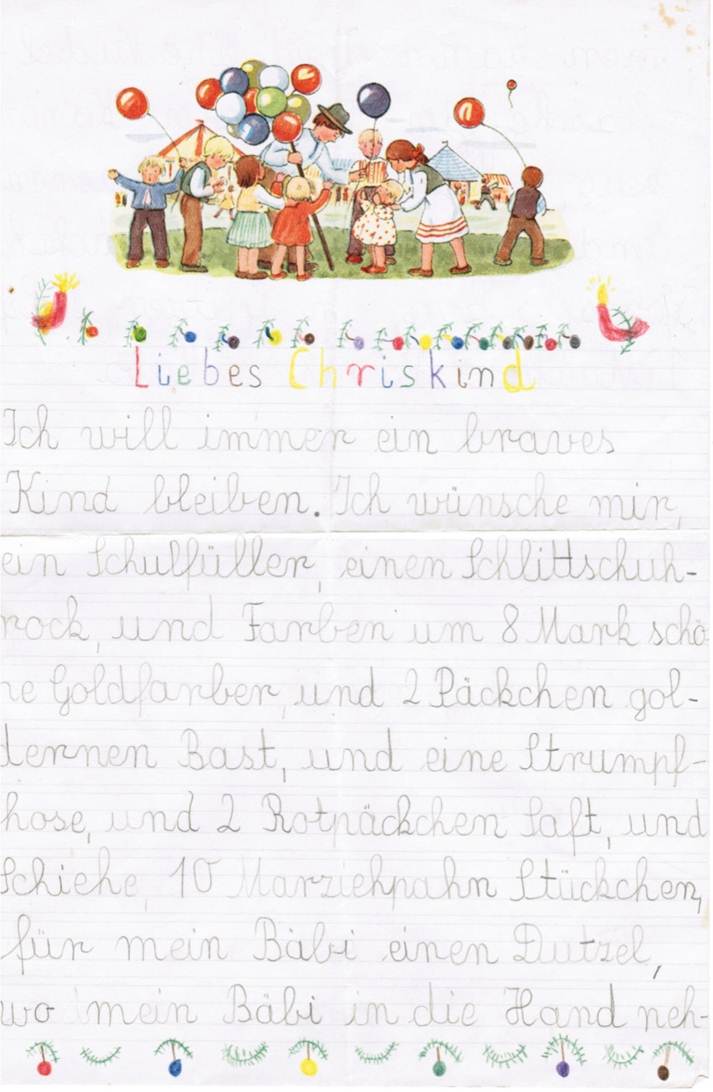
My mama’s letter to the Christ Child

However, there I was standing in my black graduation dress with all the Schultzs staring at me, desperate to figure out what the Irish contingent had come up with this year. I decided the best thing to do was to start speaking.

“When our mother was a little girl,” I began (in German) “and adults asked her what she wanted to be when she grew up, her answer was always the same.”

I paused for effect and a Schultz baby (third generation) began to cry. Unable to decide whether it was in empathy or disgust I continued:

“She wanted to be a martyr.”

The baby wailed again. My sister clicked the next slide and a picture of my mother as a child beside a stock image of Martin Luther (the reformer) appeared.

I regaled my audience with a hilarious anecdote about my mother challenging an irate nun in class. The Schultz family laughed politely. The baby demanded to leave the room.

Before I knew it, it was time for the first theatrical performance.

As part of the research into our mother’s past, we had stumbled across a letter she had written to the “Christkind” when she was a little girl.

While the Christkind fulfils the same role in Germany as Santa Claus does in this part of the world, there are notable differences between the two. For one, the Christkind is an angel, rather than a Coca-Cola-inspired fat man, and according to my mother, genderless. He/she flies from the heavens on Christmas Eve and deposits presents under the trees of good children.

My mother made modest demands of the Christkind. She asked for a pair of tights, a bottle of Rotbaeckchen juice and a fountain pen.

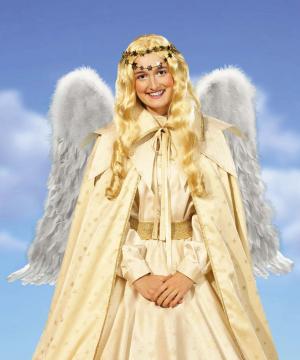
The Christkind

I acquired these items in Regensburg and decided that a cameo appearance from the Christkind simply had to feature as part of the presentation. Having mentally auditioned the entire younger generation of Schultzs, I finally cast my 17-year-old cousin in the role. She is a natural Child of Christ, waif-like with long blonde hair and an angelic countenance.

She fashioned herself a golden costume featuring an enormous pair of glittery wings and to complete the transformation, LSB had the ingenious idea of covering our Frisbee with tinfoil to make a halo.

Shortly before the presentation (we were interrupted by the Family Song) the Christ Child and I briefly rehearsed what cue she would need in order to fly to my mother at just the right time. She had prepared to hide in a little adjoining room until the time was right.

Up to that point –all things considered — my performance had been without major hitch. I was fair-minded enough to put the baby’s reaction down to the stress of his first ever introduction to the Schultz family and accounted for his disappointment at the standard of my opener by diagnosing a case of precociousness.

When I spoke the Christ Child’s cue (“To show our mother that dreams really can come true, we have invited the Christ Child here today to lavish her with gifts”), nothing happened.

No Christ Child flew in, bearing fruit juice, a pair of tights and a fountain pen.

I paused and spoke again.

Still no Christchild.

The Schultzs were quiet. No baby cried now.

I paused a while.

In spite of my meticulous preparation for this event, I had not tested the acoustics of the room next door.

I became increasingly desperate.

“Christchild,” I yelled. “CHRISTCHILD.”

There was a flutter of wings at the door and the Christchild flew in to a great cheer from the Schultzs.

My mother was overwhelmed by her winnings and immediately asked the Christchild to pose for a photograph.

The public’s positive reaction to the Christ Child’s appearance was unprecedented and I relaxed in the confidence that the next theatrical performance would go down just as well.

It did.

My Greek cousins re-enacted my parents’ first dance with rare and delicate sensibility. My research had revealed that my father and mother had communicated in French when they first met and that my father was an exceptionally poor dancer. My male cousin, dressed in an afro wig similar to my father’s hairstyle of the time, grabbed his sister around the neck and stepping on her toes, misdirected her in an unfortunate and entirely graceless waltz around the room. She, a method actor in turn, called out “Oh la la,” and “Fais les petits pas” in what came across as very genuine desperation.

Here’s a picture of us all that Onkel Fritz took it just before the presentation. Do we look nervous?

Having completed the first section of the presentation, I breathed a sigh of relief, let my sisters take over and took a seat in front of the laptop. On my way, I managed to catch LSB’s eye. He couldn’t give me the thumbs-up because he was holding his camera at arm’s length (much to the mortification of my sisters) but he winked encouragingly at me.

At this point in the story, perhaps I should offer some insight into the background to this curious presentation. This might be of particular interest to my mother, who at time of writing, remains in the dark.

The Ferguson sisters are like any series of collectables. We are essentially the same but we each have some nice individual characteristics to recommend us to the peculiarly attentive.

When we were little, our father used to invent stories featuring my sisters and me in a parallel ancient Greek world. So that they don’t beat me up, I’m going to refer to them by the names our dad invented for us. My oldest sister, Penelope is the DIY extraordinaire and one not to libel, the middle child, Hermione is the scientist and bag-maker in Philadelphia and you all know me, Persephone as the youngest, least accomplished one that isn’t quite sure what she’s doing with her life.

In preparation for the presentation, Penelope scoured the family archives (dusty boxes in the basement) for photographs, Hermione compiled them into a Powerpoint file and I, Persephone wrote the accompanying text.

In the weeks leading up to the Familienfest we encountered a series of artistic differences, which were fortunately tempered by the great physical distance between us.

On the day however, as I watched Penelope and Hermione present our mother finally with a magnificent home-made medal (a speed limit sign with the number “60” within it) and I closed our speech with reference to her love of etymology (the word “martyr” is related to “memory…”) I realised that no matter how far apart, the Ferguson sisters are a bizarre force to be reckoned with.

Belated Happy Birthday, Mama. Hope you liked the juice.

My left-leaning Christmas tree from Crumlin

If there is an awkward, complicated way of accomplishing an easy task, the Ferguson family has found it. At Christmas, this means leaving buying a tree until very late and then refusing to bring the car out to transport it home. And of course refusing to buy one close by, because they can be found more cheaply further away.

This year was no different. Given that it’s only four days until Christmas, today seemed like the appropriate time to acquire a tree.

“Dad, we should get a tree”, I said stuffing a potato waffle into my mouth.
“Righteo. Let’s go”
“What, now? I’m eating!”
“We’ll leave in five.”
“FINE.”

Grabbing my coat and boots, I found my dad at the door.
“I’m cycling. Will you accompany me?”
“Nyee… No.I’m wearing a skirt.. and these boots aren’t suitable. You can wheel your bike there and then we’ll carry the tree on it in on the way home.”

He seemed to be okay with this.

Until we were making our way down the canal and he cycled off, leaving me trotting behind, fuming, resentful and futile. I chased him all the way around Harold’s Cross but we found none of the usual haunts open for business.

Dejected, we parted. I dared him to return home without a Christmas tree.

Sure enough, an hour later, I heard the gate creak open and caught a glimpse of my father’s head bopping between a mass of bushy branches.

We argued about the best way to fit the tree through the door. He heaved it all the way into the dining room, where he dumped it unceremoniously against the bookcase. “Got it in Crumlin”, he boasted before announcing he had to dash out again.

Alone now, I took a look at the specimen before me. An absolute beauty. Totally symetrical, full-bodied and tall, with a well-endowed base. This was the Beyoncé of all trees. My Papsi had done well.

The rest of my day went something like this:

I went to the garden and found a large green pot full of earth but without signs of vegetation. Armed with an enourous spade, I emptied it out and marvelled at the reflexive movements of the pinkish-blue worms which resembled varicose veins. Then I boiled several kettles of water and washed it down. My favourite part of the day happened next.

While I returned to the kitchen, I left the pot on the grass. I’d poured in some boiling water and a little cloud of steam was rising from it. When I came back, I found a robin perched at the edge of the pot, with its little red breast all puffed up and its head errect, enjoying a sauna.

I spent a long time cleaning that pot and making the acquaintance of a number of worms, who didn’t seem to want to engage in small talk with me and even, on a few occasions, phsyically recoiled with fear.

When I had finally finished, I brought the pot inside, and lined it with a collonade of bricks, which we happen to keep in our garden.

I took a firm hold of the tree and lugged it over to the window. Employing every ounce of strength my small and under-exercised frame would allow, I lifted it up and tried to jam it into the pot. It didn’t fit.

I breathed in deeply, turned on Mooney Goes Wild and relined my pot. This time it slipped in seemlessly, and, while it is now stable, it leans slightly to the left, which is a position I can identify with.

I was so happy alone in the house today, carrying one box of German Christmas decorations after the other up the stairs and unpacking it all to find it all just as I had packed it away last year. I whiled away six or seven hours dressing my full-bodied, left-leaning tree from Crumlin.

My heart did a little skip when I found my favourite decoration again. It is a little baby (probably Jesus) wrapped in a pink blanket, sleeping inside a walnut shell.

I am incredibly attached to the walnut baby. I would dispense with all our straw stars, our wooden horses, our glass presents and our golden baubles just to save this little one. It’s so simple, so lovely, so constant.

I hung it up on a protected branch near the top of the tree and this evening, in my armchair sipping a glass of spiced apple wine, I watched it swing slightly under a white light and thought that the best moment of Christmas was passing before my eyes.

The Mouse

One September morning in our poky kitchen, my father and I were enjoying an early brunch. He was spooning floating pineapple rings from a large glass bowl while I dipped some oatmeal biscuits into my peppermint tea. From the corner of my eye, I noticed something small and dark flitting across the floor, but the moment I turned in its direction, it was gone.

My father’s pineapple ring splashed unceremoniously back into its pool. “Did you see that?” he asked.

“See what?” I replied, wondering whether he was talking about the same thing.
“Something on the floor?”
“Yes! It was probably a Daddy Long Legs”, I told him.
He agreed and we laughed at my infantile terminology.

I thought nothing more of it and we continued to eat in amicable silence.

That September represented a new and unforeseen period of my life. I’d finished university the May before and was still at home, having failed in my attempts to travel and to find a job.

The upside to it all was that I was rather enjoying domestic life. I got to see a lot of my dad, and we’d developed our own little routines, like making mochas in the tiny steel pot which he’d had since university and listening to programmes on Radio 4.

Though I could sense myself regressing, I took solace from the fact that these moments at home were precious; that they wouldn’t last forever.

Throughout the summer, I had been indiscriminately applying for jobs but nobody would have me; the country was at a standstill. Then one day an enormous opportunity presented itself: The Irish Times was looking for an intern.

600 applied and I was in the final eight. I wasn’t holding my breath but I was devouring newspapers all the same and after a summer of uncertainty, a date for the final interview had at long last been set. Many of my conversations with my father went something like this:

“Dad, do you think I have a future?”
“Of course”, he said “You will become a literary lay-about just like me”

My father is the honorary editor of a history journal and spends much of his time cycling to and from the National Library to check if Major General so-and-so of the fifth battalion really did travel to Kinsale in 1752 as the Right Honourable Blogs’ diary of that date alleges. If he’s not doing that, he’s sitting in front of his laptop, painstakingly typesetting articles, which have arrived in his inbox from the eclectic collection of contributors he has garnered from around the world.

“Of course you won’t be rich”, he said, “but you will find a niche eventually”.

So went our conversations that summer and we revelled in the gentle irony with which we viewed our mundane daily existence.

Now that the summer had drawn to a close, the brunch we were enjoying in early September was my last before the final Irish Times interview, which was to take place the following day.

That evening, my father made an announcement.

“We have a mouse”.

“What?”, I said, already squirming.

He nodded solemnly. “Yes, I rather feared that’s what I saw in the kitchen this morning, but I didn’t want to scare you”.

“Ugh”, my mother sighed, from under her woollen blanket in the living room. “We’d better seal up the kitchen door so it doesn’t escape into the rest of the house”.

And so it began.

I refused point-blank to enter the kitchen the following morning and set off for my interview without breakfast.

I’m a vegetarian but that does not mean that I like to be invaded; particularly not by fast creatures, with long, thin tails, I told myself. After all, that’s why I chose to grow up with guinea pigs and hamsters rather than gerbils and rats. I further justified my over-reaction by telling myself that I was under enormous stress: what with a potentially life-defining interview ahead of me.

I arrived home that evening to bad news.

“We saw it in the living room”, my father said, grim-faced but full of resolve.
“It was incredibly fast”, my mother added gravely.

On the way upstairs, I quivered at every nook, convinced that the creature was about to emerge from hiding and crawl up my leg. I couldn’t bring myself to take out my furry slippers from under the hall table either, in case the mouse had taken refuge there. I shuddered and locked myself into my room.

I sat there and wondered about myself.

Two days later, things took a turn for the worse:

“It was in our bedroom”, my mother said “I saw it scamper behind the cupboard”.

She too was highly uncomfortable about the invasion.

Action had to be taken. My father got some traps.

My protest was pathetic: “Can’t we just capture it and free it humanely? Please

We could not, and I had some nerve if I thought that I could just sit there, being an hysterical and inert vegetarian, applying a guilt trip while they went to war on all our behalf.

Impractical, irrational and immature, I knew that I could neither see the mouse suffer nor capture it alone.

There had to be another way.

I made my way to the local hardware store, passing through shelves of creosote and weed-killer until I got to a section labelled “Pest Control”. Jumping with delight, I found exactly what I was looking for; I snatched it from the shelf and proceeded to the till.

I arrived home triumphant.

“I have a humane trap”, I declared.

“Huh?”

They weren’t nearly as enthusiastic as I was. They’d spent the day trying to catch the thing, which had now been spotted in several locations throughout the house, only to have me saunter back from my sojourn in the moral high-grounds, wielding a tiny cardboard box, which promised “easy capture and release”

They wouldn’t replace their multiple killer-traps with my one humane one, but agreed to use it as a supplement to their own.

The following day I spotted the mouse in my sock-drawer, and screamed.

I noticed though, that it was much smaller than I had expected.

It was a baby mouse, with a beautiful little face and a shorter-than-average tail.

I thought about the techniques for overcoming fears that psychologists recommend. One of them was called “mere exposure”: simply coming into contact with a fear can help alleviate it.

On Sunday morning my mother went to Church, having seen the mouse scuttle under her wardrobe.

By then our battle with the mouse was becoming somewhat of a farce; so much so that my father had placed our mouse-shaped pumice stone onto a trap in the living room the day before in order to startle me.

Fortified by courage and relaxed by the prepostrousness of the situation I entered the room. My father was in bed, reading a tatty book with a dull title.

“What’s the situation?”, I asked.

He lifted his nose reluctantly from under the book: “It has to be over there”, he said, motioning to the far corner of the room, “It definitely hasn’t left.”

With a sudden surge of courage, I ran to the kitchen and snatched the humane trap from where I had placed it just beside the door.

Returning upstairs, I opened the flap to the linen closet where scores of my mum’s dresses were hanging.

In the corner, half-concealed by a green velvet wrap, whiskers twitching and tiny ears erect, I saw it perched.

Any of the fear I had left drained from me in a flash. It was adorable.

We waved a scarf at it and it dashed. We dived and it squeezed past us in a blur. We put the hoover on and it didn’t move.

We laughed.

Mum came home and I retreated, expecting that we would have the little creature captured and released into the wild by lunchtime.

Later that day a voice called me from above.

“Kate, we have it!!! We’ve got it!! Come here!”

I rushed up, tripping on the pieces of cheese they had left in a trail across the floor.

My father, grinning, was holding the plastic box, where the mouse had become entrapped.

“There you go, it was your humane trap that did it in the end”, my mother conceded, smiling with a twinkle in her eye.

I took the box from my father and stared in at the little face, with its jet-black beedy black eyes peering back at me.

In those few minutes, as we sat there in my parents’ room, surrounded by traps, with clothes and cheese strewn around the floor and the tiny creature in our hands we felt closer to each other than we had for a long time. Somehow this little incident had brought us together: first through our nervous tension and then, when we saw the cute thing up close, in our shared appreciation of the ridiculous.

There was some sticky stuff on the base of the trap so the creature couldn’t run away.

“We’ll release it in the park across the road”, I cried, beaming at the idea.

“It won’t be long before it’s back!”, my father laughed as we were getting ready to go.

We were giddy with our success.

I ran upstairs to grab my camera so that I could record the moment of release. We got as far as the gate and I got my mother to take a shot of my father and me with our mouse friend.

Once in the park, I returned the box to my dad, to do the honours. We’d brought a pair of kitchen scissors with us so we could remove the top of the box.

Gingerly, my dad cut through the roof. The mouse, impaled on the floor, did not look happy.

“Not long now”, I gushed over it, still frivolous and light-headed with our victory.

My father placed the plastic container down on the ground.

Suddenly from behind, an enormous labrador came bounding towards us, barking madly. He had smelt a rat.

My instincts suddenly aroused, I growled and ushered him away, becoming a little embarrassed as I turned and saw his ten-year-old owner watching me.

The dog gone, the park fell silent but for some leaves, which rustled in the distance. We must have been there for only a few seconds but suddenly an uncertainty engulfed the air.

My father stepped back to look at the motionless mouse, stuck to the base of the box and after a while, he asked my mother to get him a sand scraper from the house.

While she was gone, I bent down, and looked more closely at where the mouse was stuck.

Attached to the base of the box, were not just the four paws, as I had thought, but the entire belly of the mouse, rendering it utterly immobile.

My mother returned with the scraper. Dad picked up the box again. With gentleness that stirred me, he attempted to get it under the mouse’s tiny feet.

It didn’t work. The gluey goo was too deeply ingrained into its silky-thin fur.

My heart was beating more quickly now.

The little body was beginning to twist in pain. My father’s expression changed: scraper in hand, he too was twinging with discomfort.

As the mouse moved, more of its fur became dislodged.

I began to see blood.

“Stop”, I yelled, hopelessly.

I had to look away. My father’s eyes were full of pain, as he continued to scrape at the little body, wreathing in agony.

An autumn chill was in the air.

The last I saw of the creature was its outstretched neck and taut, mangled, tortured body being ripped away from the plastic box.

It haunts me still.

In the days, weeks and months that followed, nothing has invaded me like this image. We had some other mice after that which were killed, humanely by guillotine. I got a rejection letter from the Irish Times some weeks later and didn’t feel much. And for all the bloodshed I have seen in the news, and the depressing images of suffering on the streets around me, nothing disturbs me like that image, or sends a pang of guilt so accute gushing through my entire body.

My scrapes with the violin and the crushes that never go away

When I was young, I learnt to play the violin at the College of Music in Chatham Row, just around the corner from Stephen’s Green. In my later years, it was renamed “The Conservatory” but the Fergusons – staunch Conservatives – continue to refer to it simply as “the College”.

My teacher, a middle-aged eastern European was quirky and sober in equal measure. He was so confident of his methods that he invited parents in to observe his lessons.

Most declined politely: but my mama certainly didn’t. So great was her love for me that every Thursday afternoon for years she endured the hostile scratching of my bow as it glided gracelessly across the four strings to produce sounds that can only be imagined -and excused- when I explain the meaing of: intonation exercises.

Unfortunately the noble purpose of intonation exercises is disguised by their horrendous sound. You see, the thing is: to play violin, you need a pretty good ear. It’s not like piano, where you just bang on a given key to produce a sound. With violin – as with all stringed instruments – you have to find the sound. And in order to do this, you need to be familiar to the very last quarter tone, of the location of each sound on the finger board.

Intonation exercises consist of playing two given notes at once and then slowly, repeadly changing the position of one of your fingers by roughly half a tone up and down to produce a clash which resonates and aims to cement in memory the correct position of your hand. To really make them useful, you have to repeat them over and over and over again….

This level of endurance represents just one of the ways in which my mama is a hero. I could write a pamphlet on her other feats. She deserves at least a series of blogs in her honour.

The best part of Thursdays was right after the violin lesson ended. Mum and I would hurry out into the wind and rain and make ourselves to the newsagent on Camden Street where we treated ourselves to a packet of Sour Cream Hunky Dorey’s each. We kept them in our coat pockets so that we could have a look around the various charity clothes shops on the way home. Sometimes, when mum was looking at blouses in Age Action, I would sneak a crisp or two from her coat pocket, just to be devious.

When we got home, we would have dinner and then get ready for Kommissar Rex. If you know me, you know all about Kommissar Rex. If you don’t you should get informed. Kommissar Rex is a TV series about a detective and his police dog “Rex”, who sleuth around Vienna solving crimes in scenic locations. I’m an enormous fan and the actor that played the detective in my day remains my only celebrity crush. LSB doesn’t like the twinkle that appears in my eye when I talk about Gedeon Burkhard, or indeed the way, when I spotted him playing a minor role in Inglorious Basterds, I nigh jumped from my seat with excitement.

Kommissar Rex is moderately scary and featured a rather disturbing scene of a man trapped in an over-heated sauna which I have never forgotten. When LSB and I were in Vienna, I finally bought the series on dvd. One night, having stocked up on Croatian beer and strawberry cake, we knocked on some Kommissar. I was right back home again, curled up beside my mama, reaping the reward of intonation exercises.

Watching Kommissar in a hostel in Zagreb

Familienfest The Finale

Coming soon!!