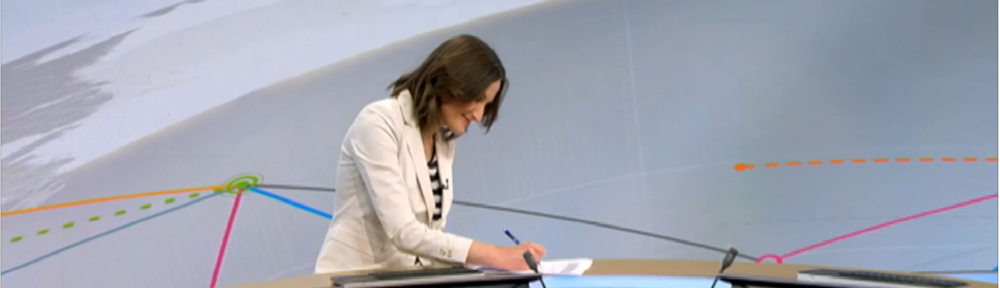
Why people stop blogging

You can spot them miles away.

Blogs that have been abandoned by the successful.

As the days and months go by, the posts became sparser.

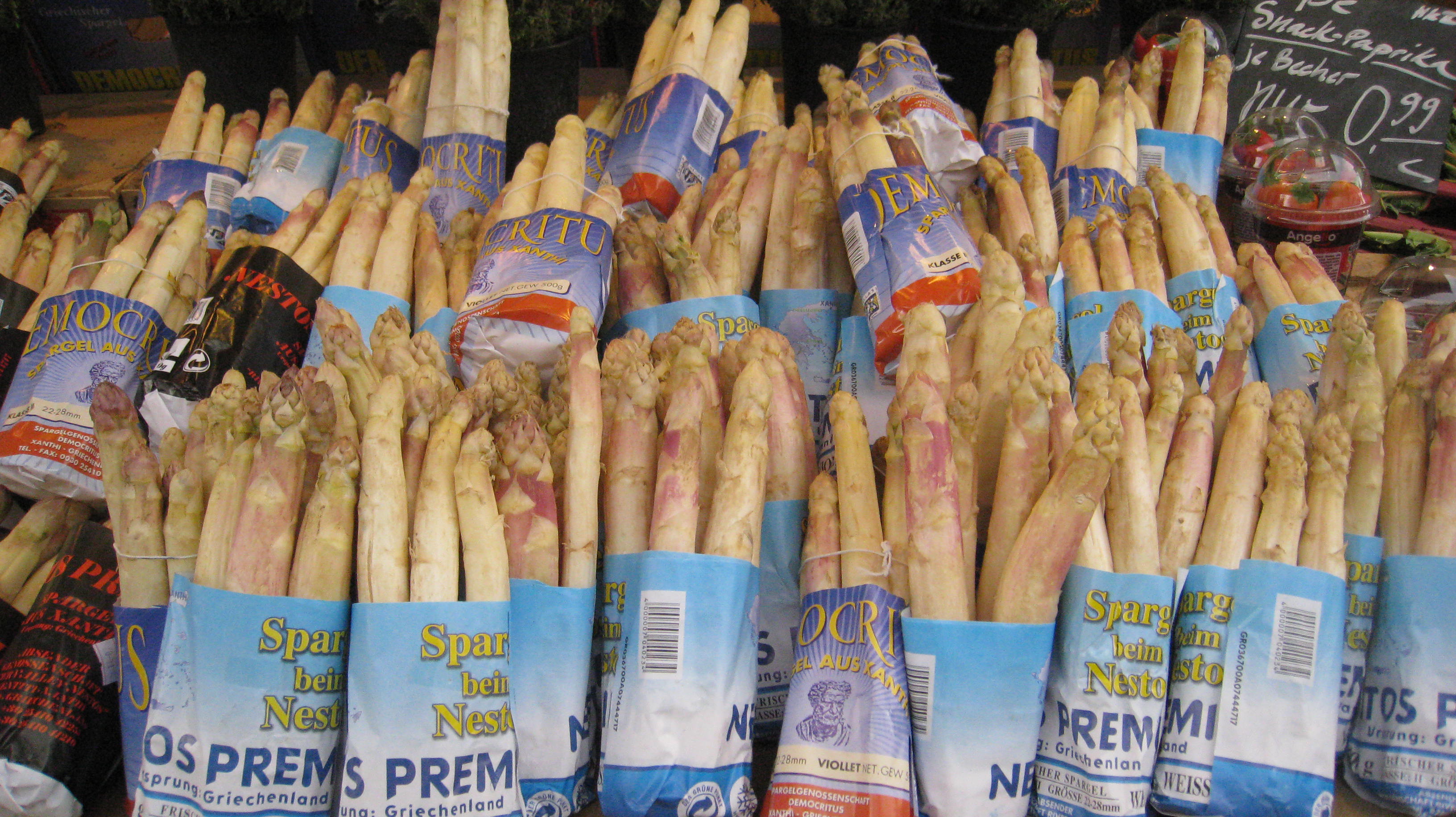
A dig through the archives reveals evidence of more humble times – detailed descriptions of trips to the supermarket, unsolicited critiques of films,dramatic confessions that nobody really cares about, anecdotes about odd family gatherings and photographs of asparagus.

Posts become weightier. Themes like politics and history rear their ugly heads.002
Success becomes a legitimate reason to write a blog post.

Out with the grainy pictures of home-made jam and in with shiny pictures of cook book launches.

Links to appearances in more well-read publications begin to appear, like acid being poured on a wilting flower.

Enough, I say.

I’m sorry I haven’t blogged in a while.

But don’t worry. I haven’t become a massive success.

I’m just guilty of benign neglect.

And I’ve also been surprisingly busy.

And, alright, if you MUST know, I’ve been writing quite a lot for other publications.

Sickening, I know.

But I haven’t forgotten where I came from.

I’m still Kate Katharina, creep supreme and number 1 fan of the lampsilis mussel.

Last month, I interviewed a 49-year-old woman whom I met in a homeless shelter.

She spoke to me in fluent English.

Every day, she goes to a café run by a homeless charity, where she sits, smoking and writing Final Fantasy 7 fan fiction.

I’m planning an entire post dedicated to that encounter soon.

Last week, I went down to Bernauer Strasse, where Michelle Obama and the girls were visiting remnants of the Berlin wall.

In the blistering heat, I interviewed a few people who had gathered to welcome them.

One of them was Ruben, a Dutch civil servant, who had driven all the way from Holland for the Obama visit.

His enthusiasm was infectious.

After I’d taken his photograph and the Obamas had departed, he asked me whether there was a loo anywhere in the area.

I wasn’t sure if this was off-the-record.

As the road was closed off and most of the cafes on the street were shut, I took him back to the little three-person office where I freelance and presented him to my colleague as “Ruben, a Dutchman who is going to use our facilities.”

I’ve also been working on- www.berlinab50.com which is a blog aimed at Berliners in the 50-or-over category. I’m guessing that doesn’t include most of my present readers.

And I’ve been visiting Frau Bienkowski, who has vowed never to let slip again that she was invited to dine on asparagus in palatial surroundings.

Rivalry in the home can become quite intense.

And LSB was over for a few days too.

I took him up in a giant air balloon and fed him with falafel.

And we had our first ever experience with a disposable grill set.

And on that intriguing note, let me leave you with a link to an article I wrote last night for an Irish paper.

the promise to do my very best to blog more regularly again.

Legs

“So many beautiful young women’s legs are wasted by wearing trousers,” said Frau Bienkowski.

I nodded sympathetically. I was in an asymmetrical chequered skirt and thick brown tights.

“Your hair looks very nice today,” she said. “Is it freshly-washed?”

“I washed it this morning though that’s not unusual. But I’ve been out in the rain.”

She nodded. “That could explain it; it’s sitting very nicely.”

I wheeled the Zimmerframe down the corridor and picked up two cups of coffee.

“Here, have this 200 gram-bar of chocolate,” Frau Bienkowski said.

“Oh, I couldn’t possibly..”

“They’re putting me on a diet, I’m getting too fat!”

“Oh, if you insist!”

Outside the rain pelted down. The sky was white and grey. The trees swayed sadly and their leaves hung limp.

“Weren’t we waiting for a rainy day to clear out the cupboard?” I asked.

“Oh, but it’s Sunday.. are you sure?”

image source: centralavenuepub.wordpress.com

image source: centralavenuepub.wordpress.com

“Sure as can be.”

“Why don’t you use that walking stick to pull out all the stuff at the bottom?”

I fetched the dark mahogany stick and poked absurdly around the bottom of the cupboard, pulling out piles of clothing, carrier bags, cardboard boxes and four rolls of kitchen paper.

We made several piles: too big, too small, keep, discard.

I held up some wide navy trousers.

“They’re for hospital,” she said. “My only pair! Put them in the hospital bag.”

Later, we continued reading from Una Troy’s book about the cantankerous Irish nun.

I read a passage detailing the monotony of convent life. Frau Bienkowski nodded the whole way through.

“Just like here,” she said.

Afterwards I asked her whether she’d listened to the audio book.

“No, Katechen” she said. “I’m so listless and uninterested in life. I sit here and keep my eyes closed.”

“But you could just try it out for five minutes,” I insisted.

“Yes,” she said. “I could. But I am depressed. Well, I don’t know whether I am. But the weather doesn’t help. Every day is the same.”

“You have a lively mind,” I said. “You need more stimulation.”

“The friend I told you about last time,” she said. “She was a year younger than me. We used to bet about who would die first. I said since she was younger it’s only right that I would go first. But she died last year.”

“Anyway, Katechen. How is Andrew?”

“He’s well. Working diligently on his dissertation.”

“And when are you next free?”

“I’ll check my diary.”

“Now, I don’t want you to…”

“Enough, Frau Bienkowski.”

She smiled.

“Thursday?”

“Thursday.”

She came with me to the lift.

“Thank you, Katechen.”

“Thank you.”

The doors slid closed but her eyes were sparkling and she was smiling before she disappeared from view.

How to be a hit among your chosen demographic

If, like me, your natural disposition is ill-suited to the modern-day rat race, I would recommend infiltrating a group of seniors. After extensive exposure, I discovered age to be the single greatest factor affecting my personal popularity.

In fact, among the over-65s, I enjoy close-to-celebrity status.

Here’s how you could too.

1. Develop a permanently pleasant and attentive expression

For years I thought that when people said I was a good listener, they were being kind about me being a poor speaker. But it turns out that years of pretending to listen to people who bored me allowed me to develop a highly attentive expression and an uncanny ability to match my face to the appropriate tone of the conversation, despite not being consciously aware of the topic under discussion.

This makes you appear wholesome and respectful, two of the most coveted characteristics among the over-65s.

2. Use your nationality to your best advantage

After tricking seniors into liking me with my pleasant and attentive expression, I tell them that I’m Irish. They use this information to justify their positive first impression. “Oh, Ireland,” they say. “So lovely and green!” Once when I gave up my seat for an old lady on the train, she said “I bet you are not German! They have no manners any more.” When I confirmed that I was, in fact, Irish she said “I knew it!”

3. Start a blog and employ an unusual marketing strategy

As well as visiting Frau Bienkowski, I’ve started volunteering at a seniors’ club. It is an incredible place and I have started counting down the days until I am old enough to sign up to all the activities offered there, from herb-tasting and cooking classes to tango dancing and Chinese conversation. Along with four other lovely volunteers, I’ve set up a blog called Berlin ab 50 where there’ll be articles, podcasts, videos and more catering to the over-50’s living in Berlin. If you’re over 50 or German or reading this right now, you should check it out!

If you follow and adapt these handy tips, you too could become instantly popular among your chosen demographic.

“Getting an abortion in 1953 wasn’t that easy.”

In 1953 Frau Bienkowski’s friend, who was having an affair with a married man, got pregnant. Though she’d had abortions before, she couldn’t get one this time. She had a baby daughter.

The man left his wife. Frau Bienkowski advised her friend not to marry the man. But she did.

After a few years they moved from Berlin to the south of Germany, where his family was from. Frau Bienkowski didn’t like the man. He wasn’t very nice and he drank a lot. He had other children too. Frau Bienkowski and her friend fell out over him for a while.

A few weeks ago, when it was Frau Bienkowski’s birthday, the woman called her.

She’s 89 now and her husband is dead. But the daughter grew up to be a wonderful woman.

“I said to her,” said Frau Bienkowski, prodding her fork into her kiwi cake, “I said, you went through a terrible few years. But look what you’ve got now. A wonderful daughter.”

It all turned out for the best, Frau Bienkowski said. Now she has a diligent daughter – a medical assistant – to take care of her in old age.

Frau Bienkowski and I talked about abortion. I told her it was illegal in Ireland. She had heard about the case of Savita Halappanavar.

Even though her friend now has a lovely daughter to take care of her in old age and her own beloved son died, Frau Bienkowski, 94, and I, seventy years her junior, agreed that Ireland should legalise abortion, and not just if a woman tells three doctors she’s suicidal.

When Frau Bienkowski was young, the pill wasn’t available. “You had to be really careful,” she said.

I told her that when my mother came to Ireland, people went to Georgian houses where doctors illicitly provided them with condoms.

“Contraception is probably still forbidden in Ireland,” Frau Bienkowski said, laughing.

I assured her that, thankfully, it was not.

But I told her that women go to England to get abortions. “Oh, is it legal there?” Frau Bienkowski asked. For her, England and Ireland are pretty much one.

“I’m surprised there’s such a demand for abortion these days though,” Frau Bienkowski said. “With so much contraception available.”

Frau Bienkowski and I talked about men. She knew several who were serially unfaithful.

I said I didn’t like people who wanted to have an exclusive partner and also lots of secret ones. I said I could understand people wanting to have sex with lots of different people, and liking open relationships. But that deceit drove me up the wall.

Frau Bienkowski agreed.

Then she asked: “So how are things with Andrew? What’s the story with his plans?”

“I have good news,” I said.

She looked intently at me. “Yes?”

“He’s moving to Berlin!” I said.

“That’s to my advantage,” she said.

Here eyes were sparkling. “That means you’re staying!”

“It sure does,” I said. “I’m not going anywhere for a while.”

“That’s to my advantage,” she said again.

The wheelchair man

A couple of weeks ago, I decided it was warm enough to wear the pretty party dress my sister gave me for my birthday.

I arranged an evening to go with my outfit.

LSB put on a shirt and tie. I squirted on some perfume and off we went.

We chased each other down the street. We got ice-cream that came in giant cones. We went to see a movie.

Afterwards I told LSB I was taking him to a bar in the east of the city called Madame Claude.

just before we encountered the man in the wheelchair

just before we encountered the man in the wheelchair

I didn’t tell him about Madame Claude’s alluring gimmick : the furniture there hangs upside down, fixed to the ceiling.

I’d seen pictures on the Internet and it made me think of the Mad Hatter’s Tea Party or of the scene in Mary Poppins where everyone laughs so much they float up to the ceiling.

On our way up to the station platform, we passed a big, dirty man in a wheelchair with his trousers down, defecating.

I caught his smell. We went on up the stairs.

When we got to the top, we took a glance back down.

The man’s wheelchair had overturned.

It was a busy night. Some people were rushing for the train. The man lay on his side, his trousers still down.

LSB and I pushed back against the stream of people going the other way.

I moved towards to the man and said stupidly, “Are you okay?”

Another lady stopped.

She had round eyes and her lips were pursed.

She tugged the man on the arm and tried to haul him up. Then another man came along. He was a friend of the man on the ground. He had a grey beard and dark eyes.

The lady held the wheelchair steady while the man’s companion hoisted him back into his seat.

He landed in a lump. His friend bowed his head in thanks and ushered us away with a few polite waves of his hand.

He didn’t want our help.

On our way back up the stairs, I asked the lady if we should have called an ambulance.

She looked tired, her face was full of resignation. “No,” she said. “Not against his will.”

Madame Claude

Madame Claude

LSB and I went to the upside-down bar. A French band was performing an intimate gig in a dimly-lit basement back-room. They played long, instrumental songs that sounded like beautiful, sad landscapes. In between, they spoke to the little crowd in formal, polite English. After the show I bought their CD.

LSB and I got a drink. Above our heads, tables, chairs, vases, and a pair of slippers were glued firmly to the ceiling.

It was a novelty.

But if our perspective did shift that night, it was down to a big and dirty man, his proud friend and the still image of a wheelchair turned on its side.

The Devil you don’t know

My last visit to Teufelsberg

My last visit to Teufelsberg

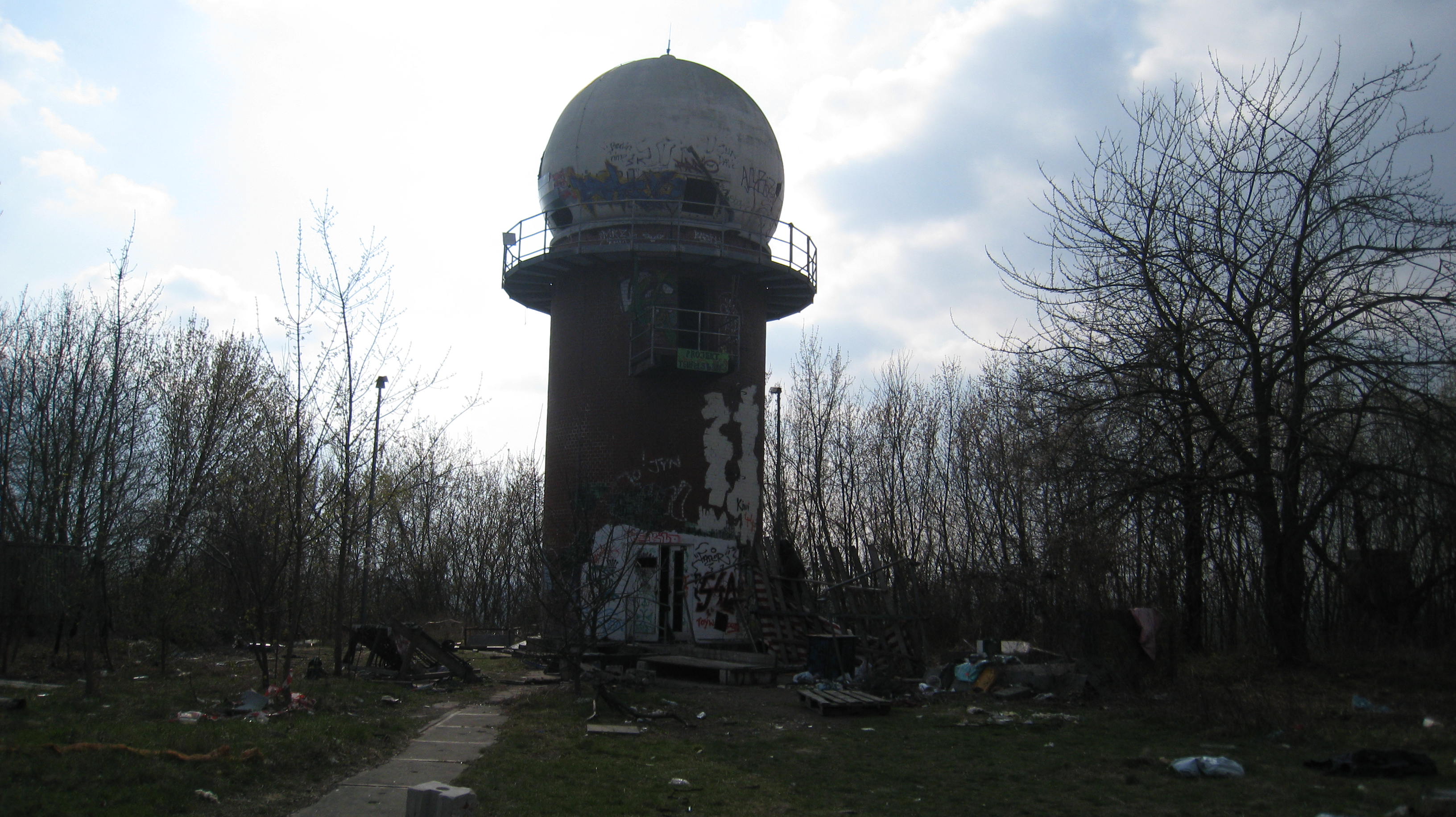
I thought LSB might be missing Edinburgh’s hills, so I decided to take him up “Teufelsberg,” or “The Devil’s Mountain,” to see a Cold War spy station that is crumbling to pieces.

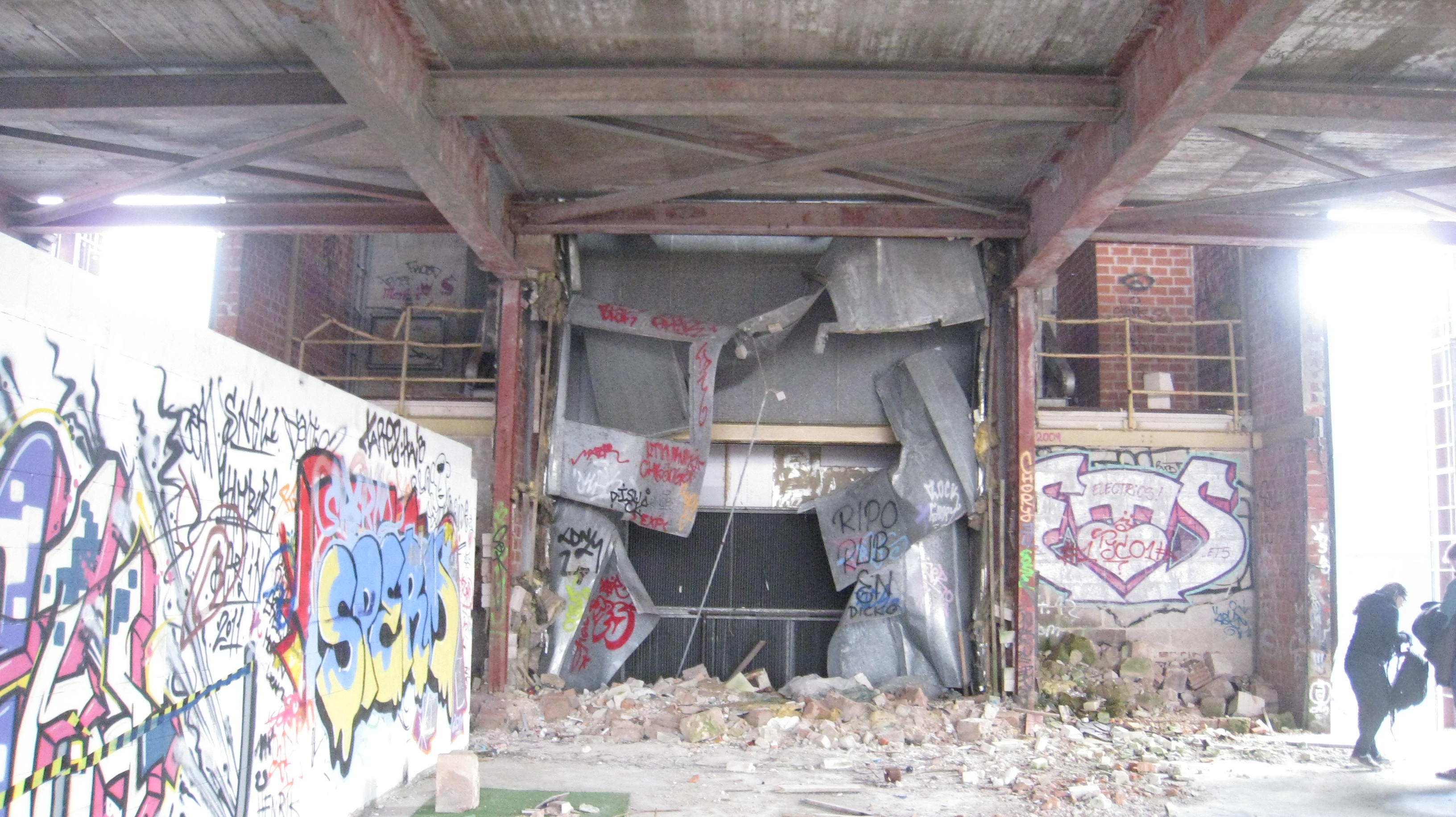
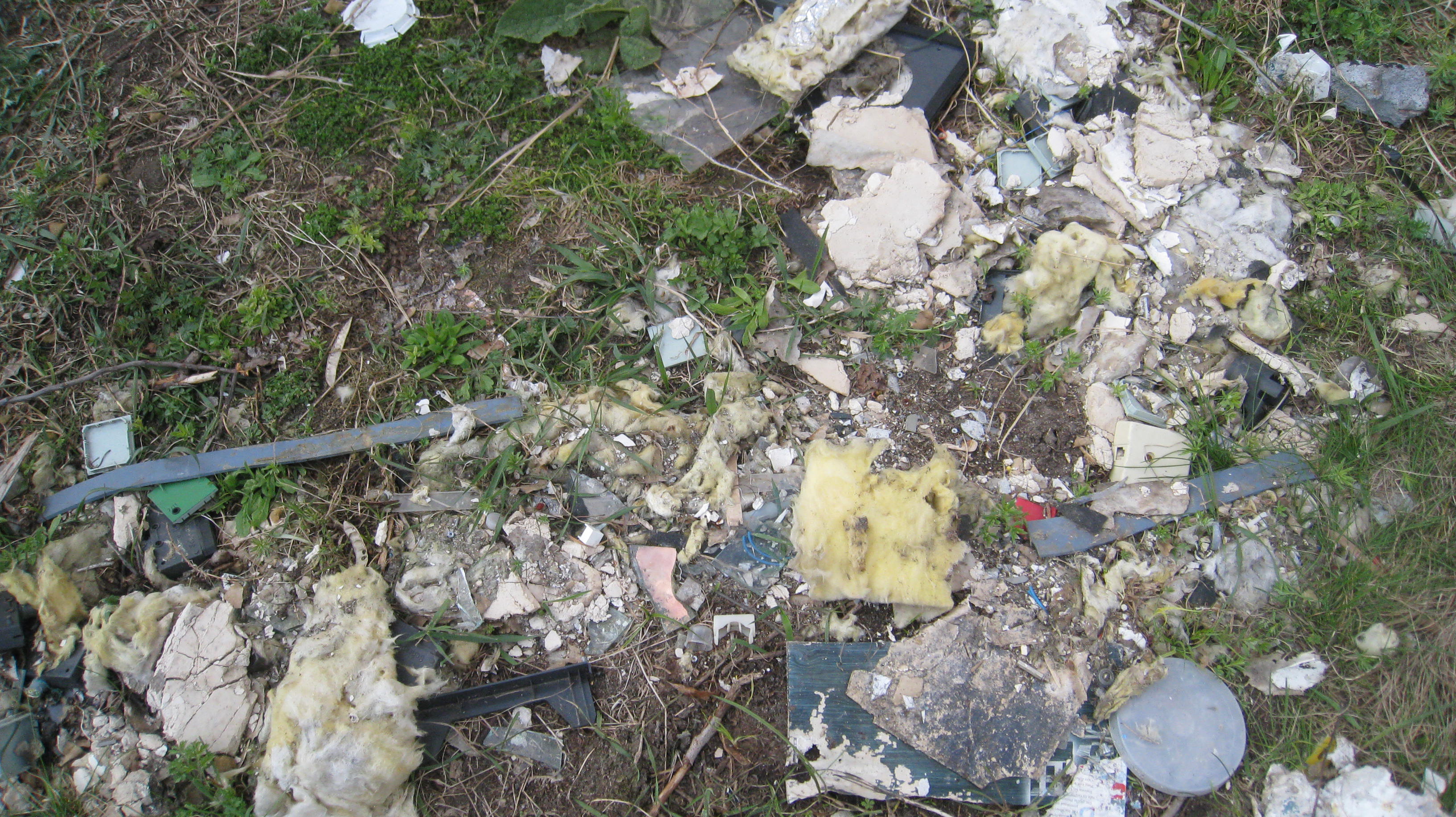
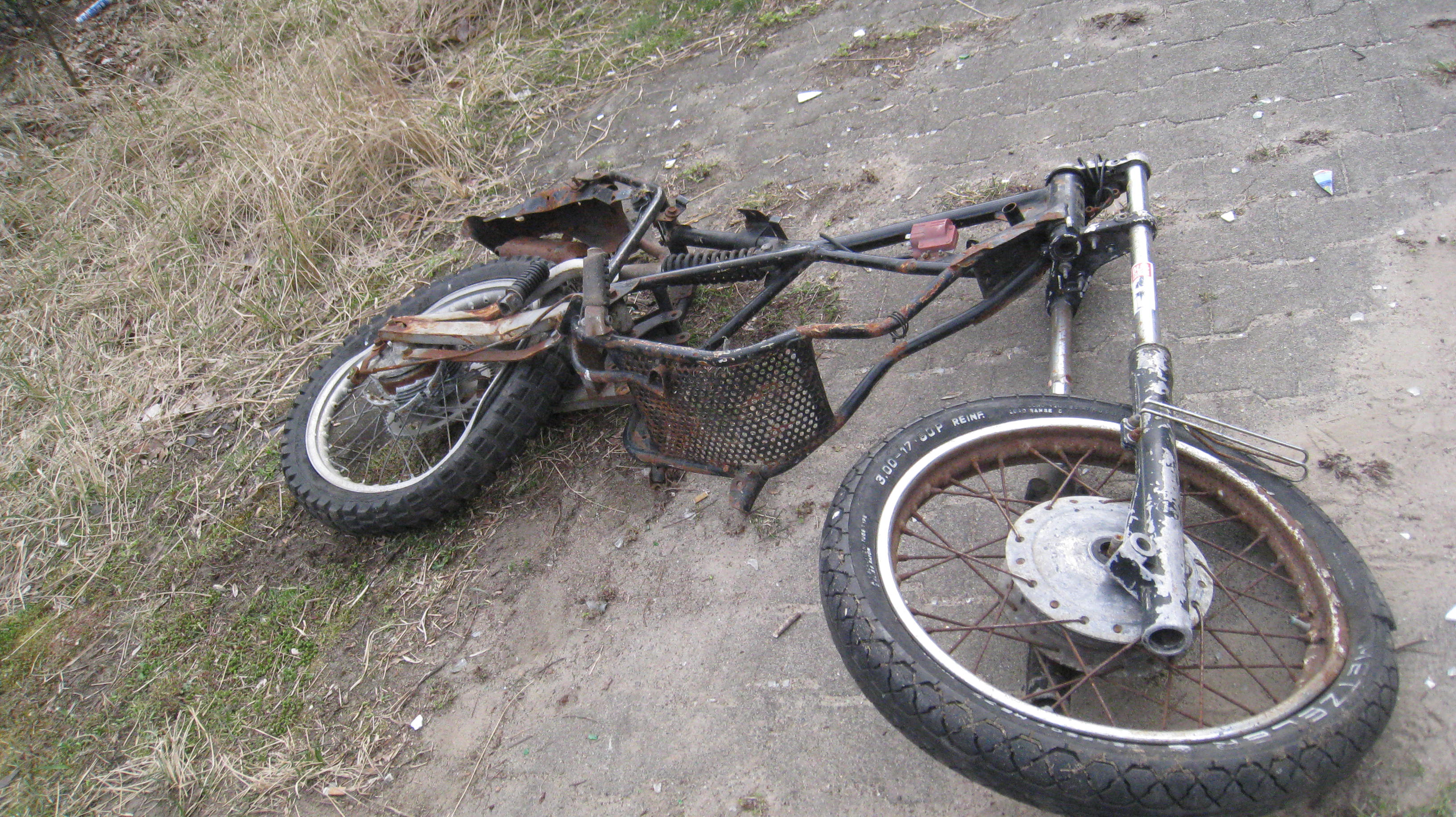
The station is surrounded by a fence. Last time I was there, I clambered through a hole in it. Inside there was a vast spy column and a huge building, both falling apart. And graffiti, everywhere. And gaping holes in the concrete floors. Yellow felt lining and rusty bicycles lay strewn on the ground.

This time, all the holes in the fence were closed up. We walked around and around and thought about making our own.

My last visit to Teufelsberg

My last visit to Teufelsberg

Suddenly we encountered a commotion.

There’s nothing I like more than a commotion.

A man dressed in camouflage gear and a green beret was standing by steel gates, barring entry to the facility. He had his chest puffed out.

A group of tourists were standing by the fence, fretting. Their friend was inside the facility and he was not answering his phone.

“Oh my God, we need to get him out,” said one.

“Dude, don’t worry, he’s out of battery,” said another.

“Hi,” I said, “what’s going on?”

“These guys won’t let us in unless we pay €7,” one of them told me. “But we think they’re dodgy.”

I took a closer look. Three men were stationed in a triangle outside the gates.

Apart from the one with the green beret, there was a lad of about nineteen. He was wearing baggy jeans and a cap. Another man in a brown jacket was standing very still and watching us from a tree.

Our conversation took place in English.

“This is complete bullshit,” said one of the tourists. “These guys are just trying to make money.”

“I like the guy’s beret,” said another. “He’s sure playing the part.”

The man in the green beret kept his chest puffed out and gazed ahead with steely resolve. When he was asked why we couldn’t enter without paying he said “It’s patented.”

My last visit to Teufelsberg

My last visit to Teufelsberg

I’ve never been in a fight but something in the air felt like one was brewing.

I caught the eye of the youngster in the cap. He had a harmless, roguish face. I took a liking to him though I suspected he was a criminal. He didn’t speak much English. He struggled to explain that the facility was now managed by a really cool dude and that it wasn’t safe to go inside, but for €7, we could take a tour.

I startled him by breaking into German.

“What’s the deal?” I asked. “Why can’t we go in like before?”

“Dude,” he said. “I know it kind of blows but you see, it’s not really safe to go in.”

“Really?” I said. “But it’s safe if you pay?”

He looked sheepish.

“No you see, you go in for a tour,” he said finally.

“I see,” I said. “How did you get this ‘job’?”

“I’m friends with these guys you see. I used to come here all the time and I loved it. And now I’m training to be a gardener and this cool guy is doing up the place and that’s how I got involved.”

“Who is this guy?”

My last visit to Teufelsberg

My last visit to Teufelsberg

“Shalmon Abraham.”

“And he is your boss?”

“Um, yeah.”

“Can I Google him?”

“Oh, I never said that,” he said, looking at my feet. “By the way, I really love your shoes.”

“Thanks,” I said. (I got them in a vintage store in Rathmines.)

We chatted some more. My new criminal friend had been to Ireland. He said he liked the sheep and had visited Belfast.

Meanwhile, there was more commotion. The group of tourists said they were calling the police but the man in the green beret said he would call them first.

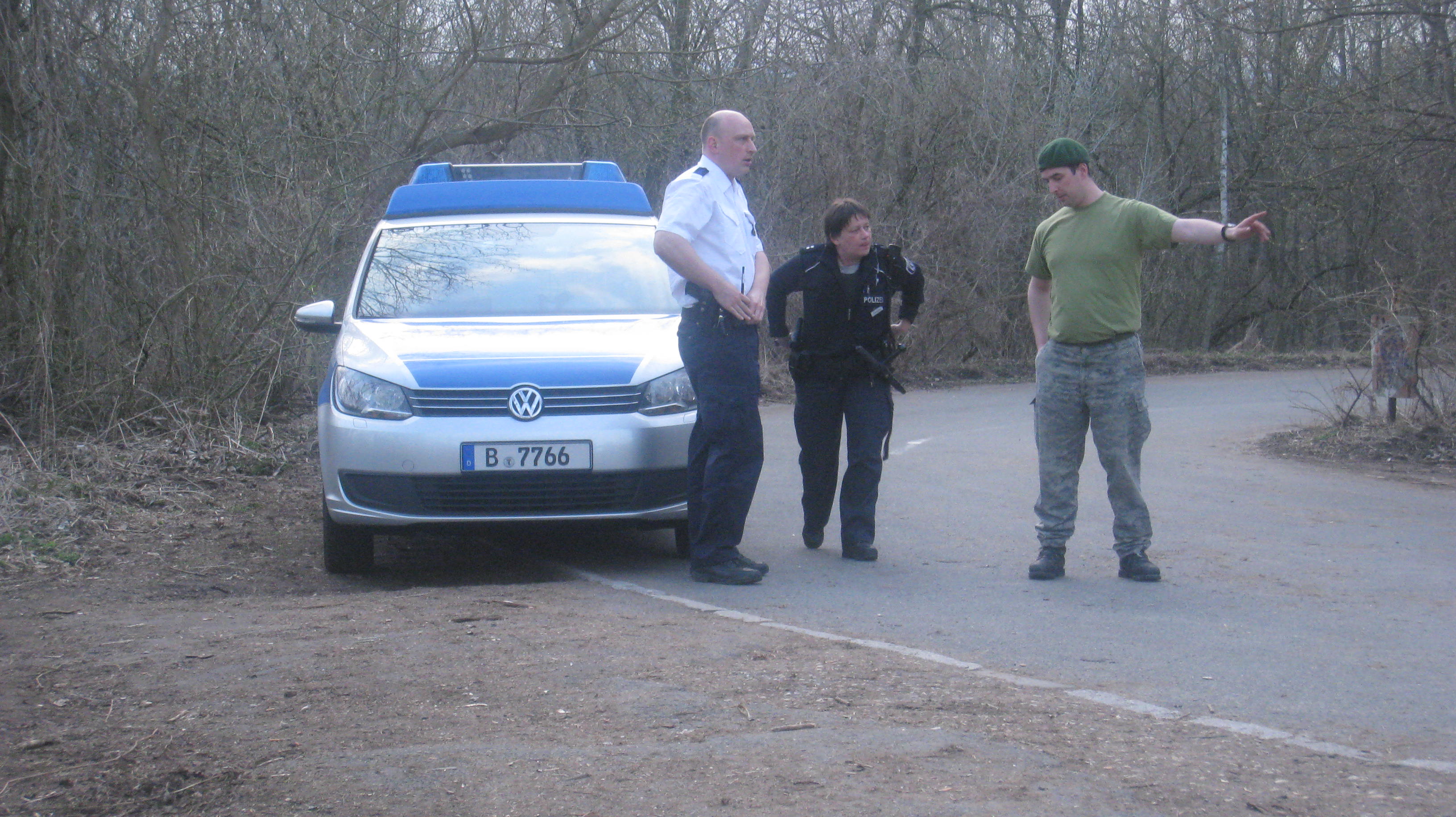
Police arrive and speak to man in green beret

Police arrive and speak to man in green beret

So he did.

LSB and I stayed on scene, chatting to the tourists and to the youngster from the other camp who had admired my shoes.

“You know, I really did use to like coming here to hang out too,” he said. “I’m just kind of on the other side now.”

It was like Romeo and Juliet.

Suddenly a man and a little girl walked out of the facility, accompanied by a petite, gamine French girl.

'Shalmon Abraham' speaks to two film-makers and French 'tour guide'

‘Shalmon Abraham’ speaks to two film-makers and French ‘tour guide’

“Hey man,” my possibly-criminal friend said to the man. “How’d you enjoy the tour?”

“She didn’t say a word,” the man said, motioning to the girl. “Barely even when I asked her a question!”

A little while later, a police car drove up the hill.

I decided this was a breaking news situation so I retreated close to a hedge to take some pictures.

A policewoman got out of the car and had a talk with Mr Green Beret. A policeman talked to the tourists, whose friend had meanwhile emerged unharmed from the facility.

Then a man in a white body suit appeared.

“That’s Shalmon Abraham,” said my new friend.

Shalmon Abraham did not take off his mask when talking to the police.

Police talk to tourists

Police talk to tourists

I asked the policewoman if the facility was really “patented.” She said it was.

I asked her when. She told me years ago.

I said I had been here a year ago and had encountered no unofficial looking men dressed in military gear barring my entrance.

She said that was strange.

I took some more pictures. Then LSB and I climbed another hill.

When we got to the top, he said “Let’s charge €6.50. We’ll undercut them!”

At home, we Googled Shalam Abraham. He exists (under is nuclear power suit). He’s a 28 year-old artist. And evidently, he has friends in high places.

Frau Bienkowski meets LSB

“Are you alone?” Frau Bienkowski asked as I poked my face through the door.

“No,” I said. “I’ve brought somebody for you to meet.”

LSB was on his best behaviour. Earlier, he’d been fretting about the propriety of his shoes and had asked how he would know the appropriate time to shake hands.

Wandering through the streets of Berlin in the past few days, we’d rehearsed the following sentence ad nauseam:

Es freut mich, Sie zu treffen. Ich habe schon viel von Ihnen gehoert. (=It’s nice to meet you. I’ve heard a lot about you)

LSB is a fast-learning savant but word order is not his forté.

Frau Bienkowski held out her hand. LSB smiled nervously and got ready for his moment.

But he wasn’t quick enough.

“Es freut mich, Sie zu treffen. Ich habe schon viel von Ihnen gehoert,” Frau Bienkowski said.

LSB gaped at her. “Freut mich, freut mich,” he said.

I had already recommended LSB’s services as a wheelchair driver, which meant that for the first time, we could venture outside the grounds.

Frau Bienkowski had the afternoon all planned out. She had a plastic bag full of laundry which we were to drop off at the dry-cleaners before going to the coffee shop next door.

Frau Bienkowski wanted a pot of coffee and a small treat. LSB and I decided to share an enormous piece of Zupfkuchen, a decadent chocolate-cheese cake of Russian descent.

When we brought it to the table, Frau Bienkowski looked disgusted.

“You are to have a cake each” she said. “On no account will you be sharing.” She turned to LSB, who looked bewildered and bemused. “Get yourself your own,” she said. “Go on.”

I translated for LSB. He waved his arms about ineffectually. Frau Bienkowski became sterner and LSB got back up to examine the cakes on display.

“I wish he were that obedient to me,” I said as we watched him choosing a pastry. Frau Bienkowski laughed. “You are too young to be sharing cake. It’s ridiculous.”

From the window of the café Frau Bienkowski could see the neighbourhood where she grew up. “There used to be a tram on this street,” she said. I asked her whether she remembers horses and carriages.110

“Yes,” she said. “There used to be a track for horses.” But it, along with the tram was abolished when Hitler came to power.”

“Why?”

“They widened all the roads,” she said. “For the rallies.”

She said she remembered watching them as a girl.

“What were they like?”

She paused. “They were exciting.”

Frau Bienkowski asked us to take her back to the old people’s home through the park.

The sun was out and the birds were singing.

“After the war,” Frau Bienkowski said, “there were no trees here. Everything had to be used for fuel. There was nothing left.”

Back in her room, I asked Frau Bienkowski if I could show LSB the photograph of her family.

“Yes,” she said. “Take it down from the wall so he can see better.”

I asked LSB to guess which child was Frau Bienowski.

He chose a toddler with wispy hair looking to the side.

But it wasn’t Frau Bienkowsi. She was the little girl kneeling on the bottom left, with short hair and buckled shoes.

Two little girls and a monster

Last Saturday evening I was walking down the creepy stretch that leads from the train station to my flat when I was accosted by two little girls in distress.

“Have you seen our Kater?” the older asked.

“Your Kater?

“Yes!”

“Kater” means male cat. I hadn’t seen one.

The little girl bit her lip. “I am in so much trouble. So much trouble.”

“What does it look like?”

“Like any Kater!” she snapped.

It was a quarter to nine. The girls had big brown eyes and dark hair. The older one was about seven and the younger one no more than four.

“It’s all my sister’s fault,” the older one blurted out. “She started messing and ran away.” She smacked her little sister over the head. “It’s all your fault!”

“Hey!” I said. “Don’t do that! You are NOT allowed to hit.”

The younger sister didn’t flinch but stared ahead with her big brown eyes.

“Look,” I said. “Can you tell me what happened?”

“We went to the shop to buy the Kater,” the older girl said, fighting back tears. “And then my little sister started messing and I went after her and now the Kater is gone.”

I got the impression she was not taking about a cat.

In fact, she was talking about a “Karte,” which means “card.”

“Did you mum or dad send you out to buy the Karte?”

“Yes!” she cried, more hysterical. “Our mum did. I can’t go home. You’ve no idea the trouble I’ll be in.”

“What kind of card is it?” I asked. “What is it for?”

“For a mobile phone!”

The little girls had lost a top-up voucher.

“Did you buy it in the shop at the station?” I asked.

“Yes!”

“And have you checked the pavement?”

“We can’t find it. Please help us. I’m in so much trouble.”

“Okay,” I said. “Have you already looked across the road, just outside the station?”

“No, it’s too dark, we’re scared.”

It is dark and scary there. It’s dimly-lit and there are bushes. Once my heart almost stopped when a man emerged suddenly from urinating in the hedge.

We crossed over and began to scour the pavement. It was full of cards advertising taxi companies.

Suddenly the younger one pointed at something that looked like a receipt and picked it up.

“Is this it?” I asked.

The older girl snatched it and said. “I can’t see. I need to find some light.”

We moved under the dull glow of an orange street lamp.

It was a top-up card. For €10.

“Brilliant! Well done!” I said to the littler girl.

They were not as relieved as I’d expected them to be.

“Where do you live?” the older girl asked.

I told her I lived at the end of the road.

“Can I take your hand?” the little one asked.

I paused for about half a second.

“Sure,” I said and she clutched it.

I was trying to weigh up my chances of defence against a kidnapping charge. Circumstantial evidence was not in my favour.

“Will you take us up the steps?” the older girl asked.

“What?”

“PLEASE.”

“I’m sorry, I don’t understand you. What steps?”

“In our house.

In your house?”

“Yes. Please, please, please. I’m so scared. The monster has already killed the lady.”

“What lady?”

“The lady who used to live there. She’s dead because of the monster.”

“There are no such things as monsters.”

“Yes there are!” the two girls shouted, infuriated.

“No they’re not,” I said. “They are only in stories. So they can be in your head, but not in real life.”

“The worst monsters are in Romania,” said the younger girl.

“I’ve seen the monster,” said the older one.

“Oh really?” I asked. “What did it look like?”

“Big.”

“What was its hair like?”

She moved her hands apart as if she were making clouds in the air. “Like this.”

“And what colour eyes did it have?”

She faltered.

“You see,” I said. “Sometimes people just tell you stories to frighten you. It doesn’t mean they’re real.”

She was unconvinced.

“Please come in with us.”

“I can’t come into your house,” I said. “I’m sorry.”

“PLEASE” they both cried.

They came to a stop outside an apartment block.

“Is this where you live?”

“Yes,” they said. “Please, please, please don’t go.”

They clung to me.

Suddenly a woman’s face popped out of the window.

She had a pony-tail and she was staring at us.

“Is that your mum?” I asked them.

They nodded.

“Look,” I said loudly, pointing up at their mother. “There’s mum, everything is okay. There’s no need to be frightened””

The woman continued to watch us.

“Look,” I said, even more loudly. “Hallo mama!” I waved stupidly.

She didn’t budge.

Neither did they.

“You have to go inside now,” I told them.

“You have to come with us. PLEASE.”

“I can’t,” I said. “Look, your mum is right up there. You’re safe now!”

They held onto me.

Their mother was still at the window.

We were in a stand-off.

“Okay fine,” I said.

They pushed open the door.

Inside the entrance hall was a concrete staircase. A few steps led downwards to an open cellar, which appeared like a gaping hole.

I could imagine a monster there.

Their mother came to the door. I turned as fast as I could, pushing the two little girls gently in front.

“Bye!”

“Thanks,” the woman with the pony-tail called after me.

I rushed out of the building and when I got home, I thought about whom they had got their stories about monsters from. And why the woman with the pony tail had not budged from the window. And about what my curfew was when I was seven. And about what will happen the next time they cling to a stranger on the street.

Frau Bienkowski’s three fried eggs

Frau Bienkowski was wrapped in a blanket, wearing a nightie.

“I’m not at all well. My nose is blocked, I lay awake all night and I keep breaking out in sweats.”

“Oh no!” I said.

I moved closer, and placed a large box wrapped in orange paper on her lap. “I’m sorry I couldn’t see you on Tuesday,” I said. “But Happy Birthday!”

Her face changed.

“Oh no, Katechen, you weren’t to do that.”

“Open it,” I said.

“But it’s so big!”

“Go on.”

She tugged gingerly at a piece of Selotape. “I’m going to keep the paper.”

As she worked on the other corner she said, “I think I might know what this is.”

image source: www.amazon.com

image source: http://www.amazon.com

“Well, you just wait and see if you’re right.”

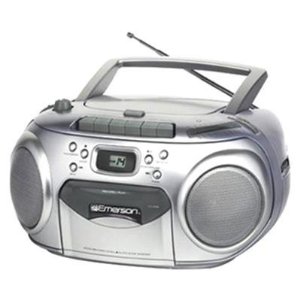
She lifted the sheet covering the top of the box to reveal the radio CD player I’d bought in Media Markt just a few hours earlier.

She blinked. “But it’s such a big present. I need to give you some money.”

“Nonsense,” I said.

“But Katechen…”

Keine Widerrede! Now, tell me about your birthday party.”

She paused.

“Well,” she said finally, “Seven of us met downstairs for coffee and I got lovely flowers. They came from the Internet. Nowadays, you can get everything on the Internet.”

“It’s true!”

“Anyway,” she continued. “On my birthday, they said I could choose to have any meal I liked. And I knew exactly I wanted.”

“Really?” I asked. “What did you want?”

“A fried egg,” she said. “I crave them so much.”

“And did you get one?”

“I got three!” said Frau Bienkowski. “You might think that’s a lot, but they were tiny; this small,” she said, and made a little circle with her forefinger and thumb.

“And were they good?”

“They were delicious.”

“Do you not usually get eggs here?”

“Oh, just scrambled,” she said. “But I’m sick to death of scrambled.”

I remarked that this seemed a happy kind of home.

“Well,” she said. “Maybe for a year or two. But I’ve been here for five. You’re not supposed to be here that long. Most people arrive and die after a year or two. But me – I’m still here.”

“I had one good friend here for two years,” she continued. “But then she had a stroke and died. You do grieve…”

“Of course,” I said.

I took out some photographs of LSB and my family, which I’d promised to show Frau Bienkowski.

LSB and I before a college ball

LSB and I before a college ball

She reached for her magnifying glass and turned on the light.

The first was a picture of my family at the legendary Familienfest last year.

She moved her magnifying glass over each of our faces. “These are my sisters,” I said. “And that’s my mum, and this is my dad.”

She lingered over my father’s face, examining it carefully. He was wearing his trademark scowl, which he reserves for people with cameras and for reading electricity bills.

“He’s handsome,” she said. “I might have fallen for him too.”

“He’d be delighted to hear that!” I said.

My family at Familienfest 2012

My family at Familienfest 2012

Next up was a picture of LSB and me all done up before going to our college ball a few years ago. “He has such brown eyes,” she said. “Like you. Your children will have even darker eyes again.”

Frau Bienkowski looked at another picture of my sisters and me and asked for our ages.

“And they’re not married either? None of you?”

“Nope, none of us!” I said. “Maybe some day.”

Frau Bienkowski remarked on how nice it was to have such a big family. She herself, had just one son. But he and his girlfriend died in a car crash more than thirty years ago.

“At least I have memories,” she said. “People who never had children have none.”

I provided a clunky translation of the English expression Don’t cry because it’s over, laugh because it happened.

“It’s true,” said Frau Bienkowski. I nodded, and we were silent for a little while.

“By the way,” she said later. “That drink you got last time..”

“My latte?”

“Yes!” she said. “I heard a report about it on the radio. Next time we go down to the café, I want to get one. It sounds very nice!”

“We will absolutely get you a latte next time,” I said.

Frau Bienkowski knows all about LSB. She even knows that he’s coming to visit me soon.

“You’ll bring him here, won’t you?” she said.

“Oh yes, he’d love to meet you! “But you’ll have to help me teach him some German words.”

She smiled. “I will!”

I took the CD player out of its box and plugged it into a socket.

I placed an audio book CD into the player.

A man’s voice filled the room.

“Can you hear that?” I asked.

“Yes,” said Frau Bienkowski. She looked happy.

When I got up I had to step over a cord attached to the lamp on the table between us.

“The bulb blew the other day,” Frau Bienkowski said. “And the type of bulb the lamp uses has been discontinued. Luckily, Frau Brein once got me a batch of ten, which will last me until I die.”

Freshly Pressed

For most people, “freshly pressed” means a glass of orange juice with pleasing bits of pulp, possibly accompanied by a croissant or lakeside view.

But for bloggers at WordPress, “freshly pressed” is an accolade.

It means that a WordPress employee has decided to feature one of your posts on their homepage, exposing you to lots of other bloggers, some of whom decide to “follow” your blog and a few who take the time to leave you kind and thoughtful comments.

Image source: www.ulaola.com

Image source: http://www.ulaola.com

For an introvert, it’s like winning a year’s supply of networking.

It’s like being at a writers’ conference, with sweaty palms, about to approach a stranger with an awkward, self-deprecating introduction, only for the entire spiel suddenly to be rendered completely unnecessary, paving the way for a return to the happy corner where you were munching a canapé and starting at animated people self-promoting.

Today, I was “Freshly pressed.” It made me very happy indeed.

It also made me think about encouragement and success.

I’m no neuroscientist, but sometimes I wish I were.

When I am sad or frustrated or overjoyed, I like to imagine the neurons in my brain squirting coloured impulses, which travel across convoluted chemical tracks at reckless speeds.

When some one says something kind or complimentary to me, a little cluster somewhere behind my forehead ignites,like a flickering light bulb finally screwed in right. I might respond awkwardly, by fumbling with my hands or countering with disproportionate (but heartfelt) praise.

But all the while, inside a little squirt of something which I’ll call adrenalin for want of an MRI, has begun to gush about my head, leaving me feeling unusually motivated.

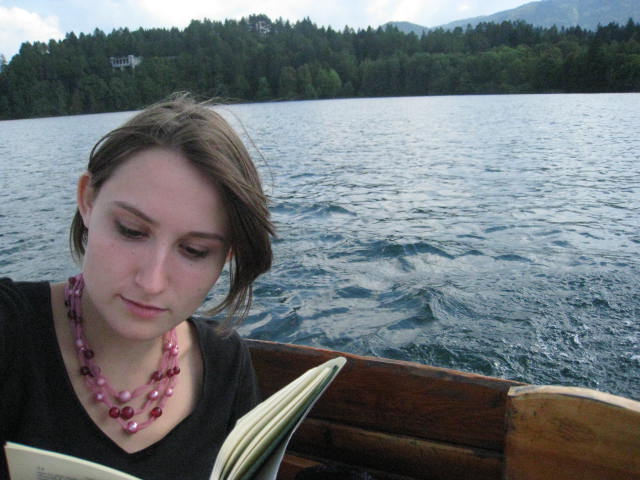
Kate Katharina poses as an introvert suddenly relieved of the duty to self-promote.

Kate Katharina poses as an introvert suddenly relieved of the duty to self-promote.

It’s like magic, really.

Except it’s magic that anyone can perform, any time.

Encouraging people is deeply satisfying. My mother is so good at it, that she could probably turn professional.

My favourite people to encourage are humble types, whose faces immediately display a strange guilt when you tell them that they are wonderful and who can’t think of any words to say back.

Or people who have a secret dream that isn’t quite so secret and whose faces melt strangely when you casually remark that they could achieve something they’ve never admitted to desiring.

Fortunately, you don’t need a top hat or a bunny to encourage, though in some cases either or both could come in useful.

You can encourage with words or gesture, or even by keeping your dissent silent.

And like an alchemist, you can cause a little light to go on in someone’s mind, giving them the energy necessary to finish a painting, or take an exam, or learn to swim or ride a bicycle or sing a song.

Thanks to all my readers, old and new, for encouraging me to cultivate this little patch of blogosphere.

I wish I could say that being “freshly pressed” hasn’t gone to my head, but I’ve already told you all about the little light bulb that lives behind my forehead.

“Freshly pressed” or not, I promise I’ll try to keep my writing free of pulp.

**********************************************************************************************************************

If you want to join in the fun on Facebook you can find Kate Katharina here.

And if you’re more of a Twitter-er, you can find links to my latest posts here.