Ich bin angekommen!

So here I am alone in a hostel in east Berlin, munching on Rittersport (Knusperkeks flavour) chocolate. The original plan was to sit alone drinking beer, but when I checked in I was presented with a formidable list of “Hausregeln” (or “House Rules”). One of them said that drinking alcohol in the dorms was prohibited. Dejected, I scrawled “Kate Katharina” in the appropriate place and signed my humble plan away.

So now it’s just me, the single square of chocolate that’s left and a potted plant with spindly leaves, which greeted me from the window sill when I arrived.

Earlier when I got off the plane and into the arrivals hall at Schönefeld, I set eyes on a peculiarly tall youngster. He was dressed all in white – in a baggy tracksuit and matching pristine cap (which he was wearing backwards). He was holding an artificial bunch of roses upside down. I thought he might have jumped out of one of Eminem’s music videos, but then it occurred to me that it might be LSB in disguise.

Given his tendency towards deceit and his elaborate plan to surprise me for Valentine’s Day again this year, I thought it was reasonably plausible that he had taken a night flight after we parted ways yesterday (underneath Ranelagh Luas Bridge) in order to welcome me in Berlin.

I looked over expectantly but the rapper-romancer was oblivious to me. There was nothing for it but to continue my journey to the Airport train station.

My going-away gifts for LSB


Schönefeld airport reminded me much more of Ireland than the swanky Terminal 2 in Dublin. It’s a modest building, and you collect your luggage from a sluggish conveyor belt in cramped space. While you’re waiting for it, entertainment comes on a screen which shows the three-day weather forecast, the business news and an advertisement for a back massage clinic in continuous rotation. It had a charming higgledy-piggledy feel which made me feel right at home.
While I was yanking my unobliging cases through the walkway on the way to the trains, I passed a man lurking about holding a sign that read “Need ticket” in neat black biro print. Some kind lady stopped to give him change. I wondered how he had landed there.

I was happily prepared to soak up my first impressions of Berliners on the S9 to Friedrichshain. I even asked the train driver, a man in his fifties with half his face taken up by a magnificent curly grey beard, if I was on the right line. I was. When I asked if he stopped at Frankfurter Allé, he paused dramatically, so that I might think I was way off.

Then he grinned and said “Ja, da fahre ich hin”.

I could have been on Dublin bus.

My mum told me that Berliners are known to have a sharp sense of humour, that can be cutting at times. It’s called the “Berliner Schautze” (the Berlin Snout). More of that in future posts.

Having taken a seat on the S9, I stared at the people around me, as I have the bad habit of doing. Opposite me sat a lady with a nest of red hair that concluded in a limp tail that looped around her left shoulder. She was wearing sunglasses and orange and blue snow boots and got off at a stop which translates as “Tree School”.

I paused to consider what kind of things young saplings might need to learn but was stumped after I came up with dendrochronology.

An Australian lady with wavy blonde hair and a nose piercing was reading an academic paper with the title “The roots of gender inequality in Government”. She was marking the important bits with a yellow highlighter.

Unfortunately, my desire to get an authentic flavour of Berlin was thwarted by a group of noisy Irish students who had also been on my flight. They were talking loudly about who they were “shifting”, about the strapless tops they’d bought in Penneys and about the RTE player.

I sighed.

When I got off, I was immediately confronted by a murmuring drug addict looking for money. On the way to the hostel I passed a man lying on a few blankets with a broken shopping trolley and two large dogs for company. A few yards up a homeless woman, her face distorted by drug use, was muttering to herself. It was surreal to hear the language of drug abuse and poverty being spoken in German. I don’t know what I expected. They couldn’t all have a flat Dublin drawl.

It was far from the fairytale villages I know from Bavaria but it was exciting, with cars whizzing by, darkness beginning to descend and the scores of pizzerias and kebab shops tempting me to dinner.

As I type my eyes are becoming heavy. I’m installed cosily beside a radiator at a desk nestled in the corner of my little private room, which is attached to a four-bed dorm. Impressively, I’ve already made a friend. We met in the kitchen. I had my mouth full of falafels when he walked in.

His name is Tom. He’s forty-six and I saved him from burning his stew. He’d popped out of the hostel kitchen muttering something about “missing the vital ingredient” and left the pot unattended.
When he came back bearing a bottle of wine, I was dealing with the cauldron, where bubbles had begun to burst at the brim.
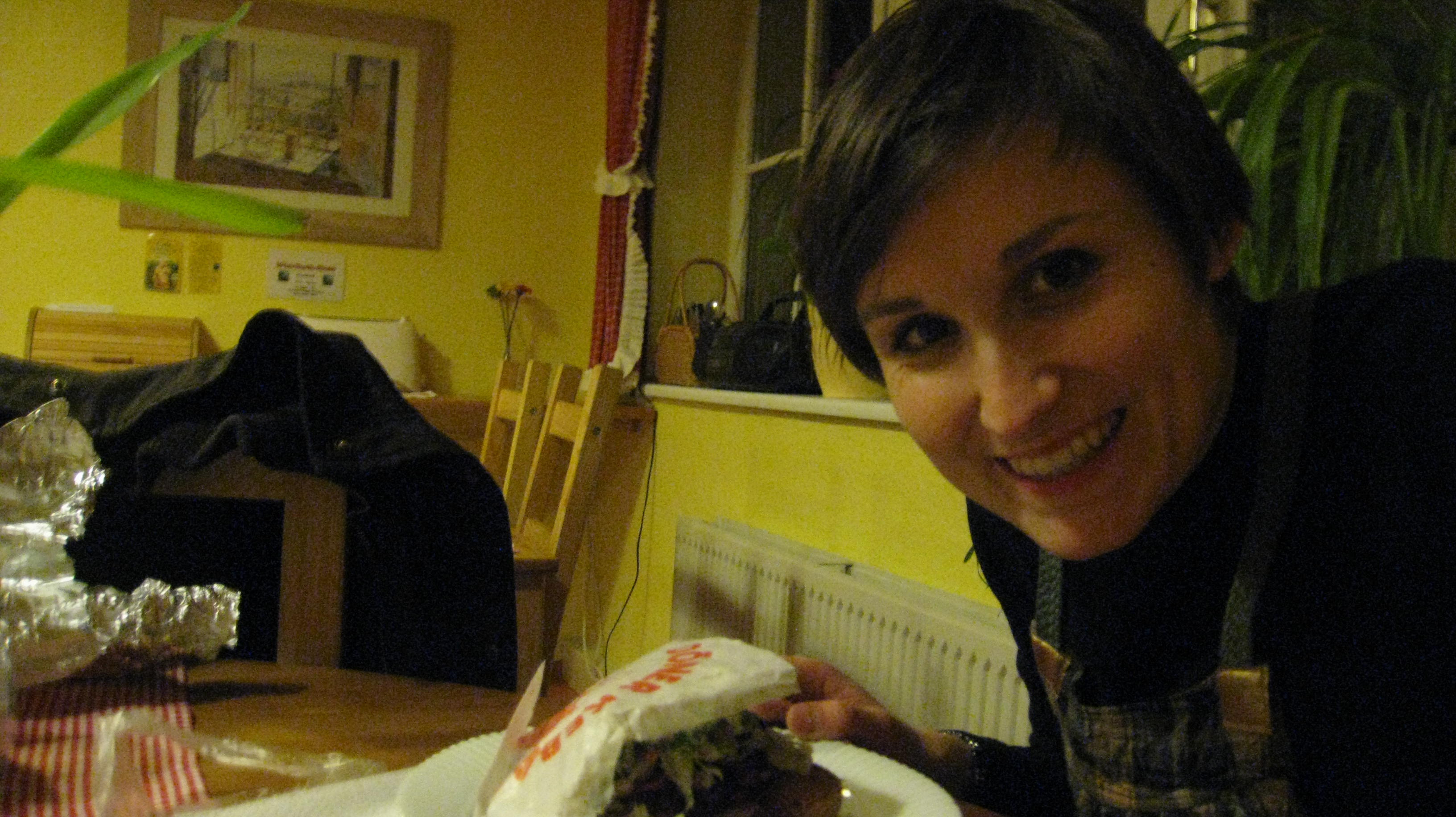
Me and my falafel.

So we had a chat over dinner and he told me that I had a distinct gypsy vibe. My eyes and the shape of my face, he said. I lauded his perception. After all, I recently found out that all of the women in my family have rare mitochondrial DNA associated with the Roma tribe. He said that he definitely wouldn’t have put me as either Irish or German. Russian perhaps, or Polish.

Just as well I’m living in east Berlin, I suppose. My guidebook charmingly describes Friedrichshain as “a traditionally rather dowdy working-class district which is increasingly being discovered by the well-to. I’ve a feeling I’ll fit right in.

Now, where can I recycle my Rittersport Knusperkeks wrapper?

Big Issue: Small change

The man that sells the Big Issue outside Trinity College has one brown beard, two blue-white tired eyes and five or six wrinkles folded down his cheeks.

His head and shoulders slope to the right so it seems as if he is suspended in the middle of collapsing. He never carries more than three or four copies of the magazine but the little bundle he has got he clutches tightly in his right hand, which he keeps raised in the air, like the Statue of Liberty and her torch. He has a vacant stare which usually points in the direction of Front Arch.

image source: atp.cx

I bought the December issue from him. The cover featured a photograph of a spectacled man in a Santa Claus costume and inside you could read about the origins of the song Have Yourself a Merry Little Christmas and about a day in the life of Garda Pauline Sheehan.

When I approached him, his face flashed alive, as if a switch had turned his eyes on.

“Hello, I’d like a copy please”, I began redundantly.
I had two €2 coins ready.
“Yes, love”, he replied, huskily, “yes love. Just a moment.”

I handed him the coins, adding cheerfully, “that’s four euro for you there”, to compensate for the sadness I felt for him, as a long trickle of snot began to drip from his nose.

The Big Issue costs €3. Half that goes to the vendor.

He fumbled for change in the dirty corduroy pocket of his pants. I made a pointless remark about the cover so that he would think I hadn’t noticed the large tear of snot reaching his lips.

He dug slowly inside his pocket until he found a euro among a handful of coppers.
I thanked him.
“Happy New Year, Love. Happy New Year. Happy New Year to you”.
“And to you too!”

I came back for the January issue. It contained a feature about Ireland’s only real-life pet detective.
“Hello Love. Happy New Year”, he said.
This time I had the exact change.
“God bless, love. Happy New Year to you. Happy New Year now”.

Last week I walked past him again. I was sure he was watching me as I went by. I scolded myself for self-absorption. But I could feel his eyes digging into the side of my face as I passed. The sensation overwhelmed me and I turned back.

He was looking me right in the eye.

I retraced my steps.

I was impulsively apologetic.

“I’ve got that issue already”, I said as if I were guilty of something indefensible.

He grabbed my arm. I could feel the force of his thumb on a vein through my coat.
“I love seeing you”, he said. “I love seeing you go by. It’s lovely seeing you. Happy New Year, Love. It’s so nice when you go by”.

I thought about him later that evening; standing in front of Trinity College with snot dripping down his nose searching for a euro to give me back and it came to me that it was one of the most dignified things I have ever seen.

Ireland’s Big Issue is street journalism at its best and I hope there’ll never ever be an app for it.

Armpit hair or the Eurozone crisis? The writer’s dilemma

I met a girl once who let her armpit hair grow nice and bushy so that she could weed out the guys that were more interested in her grooming habits than her intellect. I thought of her yesterday as I was killing time flicking through the bestsellers in Easons. I’d picked up Caitlin Moran’s How to be a woman and happened upon a passage outlining the importance of maintaining a fine balance between the cultivation and removal of excess pubic hair. Apparently, girls as young as 12 are now seeking full body waxes. Furthermore, young boys’ exposure to porn means that they’re unfamiliar with the follicle reality of the female anatomy, which shocks them upon their first real encounter with it.

The things you learn.

I was conscious that it had been nearly a week since my last post and even though popular science dictates that the third week in January presents the greatest statistical probability of lapsing on your New Year’s Resolutions, I was determined to buck the trend and continue blogging.

So I thought about writing about bodily hair; about how I’ll be damned if I shave my legs in the winter, or about how I got my eyebrows threaded last June and that though it was very painful and my eyes were watering like a hose, when the beautician asked me if I was alright I answered that I was doing just fine and that the streaks of mascara decorating my cheeks were intentional.

But I thought the better of it. After all, there are more important things to be worrying about than the state of the nation’s armpits. I resolved to educate myself on a more sober theme.

As a result, I spent much of today in solitary confinement; having decided that I wanted to be someone who writes about the things that matter, rather than the colonies that fester in secret under our nation’s arms.

It didn’t take me long to find a suitable treatise.

With the stealth of a long-repressed id, the Eurozone crisis reared its ugly head from the back of my mind, where I had shoved it to avoid returning to the shameful and possibly unalterable fact that I don’t understand economics.

I began by googling promising terms like “Eurozone crisis”, “structure of European banking system” and “austerity”.

I decided it would be only right to set myself a plausible-sounding essay title to focus my enquiries.

I came up with “Outline the causes of the Eurozone crisis and discuss potential outcomes of Government measures to tackle the crisis”, which I thought sounded promising.

Like most academic titles, it was embedded with the code “Write anything you know about this theme and don’t forget to reference several bizarrely named academics to make the whole process a bit more bearable”.

I skimmed through a few generalities and familiarised myself with key Eurozone celebs like Hosé Manuel Barosso, Christine Lagarde and Evangelos Venizelos. I even recorded the duller-sounding names in a notebook for future perusal.

image source: guardian.co.uk


I thought I’d hit the jackpot when I happened upon the BBC’s Crisis Jargon Buster. I rushed downstairs to make myself a cup of mint tea, took a deep breath, then spent the entire day reading the list of terms and taking notes, which I intend to copy into the desktop folder I have called “My general betterment”.

As it turns out, the crisis is not without its gratifying terms. So much so, that when LSB picked me up this evening, we whiled away a pleasant half hour making economy-related puns over our cappuccinos.

I asked him if he could guess what my new favourite cereal was. Though he’s a savant, he was stumped. He knew that it used to be Aldi’s own-brand strawberry crisp but I told him that was old news.

My morning victual of choice was now … “Credit crunch”.

His groan was nothing on the one I had let out when I reached the letter “H” in the jargon buster glossary. Wedged defiantly between “Glass-Steagall” and “Hedge fund” was the word “haircut”.

And it didn’t refer to armpits.

Such are the dilemmas I’m facing as I embark on another year of blogging. Do I write about my savant boyfriend, who generates hundreds of hits, or about the war in Iraq or the meaning of “art” , which fewer people want to read about?

Should journalists give the public what it should want, or what it does want? Is it more important to inform or to entertain?

What do you think?

How the Iron Lady boils an egg: why private moments matter in politics

If I learnt just one thing from watching The Iron Lady, it’s that despite popular belief, politicians are people too. Margaret Thatcher might have sent missile ships to the Falklands and vowed never to negotiate with terrorists, but she still boils an egg, fills black sacks for Oxfam and asks her daughter to fasten the catch at the back of her dress which she can’t reach.

The snippets of Maggie’s domestic life are definitely the most moving parts of the film (which, in case you are wondering I would highly recommend). It’s impossible not to feel something as you watch the forgetful but resolute old lady plonked awkwardly on the floor in an uncomfortable cotton dress, trying to prise open a DVD case and twitching as she eavesdrops on conversations her daughter has with her carer.

It made me think that if Britain has its iron lady in ‘Maggie’, then Germany has found her equivalent in ‘Angie’.

Like Thatcher, Merkel is frequently portrayed as emotionless and inexpressive and ultimately, as Maggie was, “out of touch”.

A recent article published on Spiegel Online seeks to redress the balance. In it, journalist Dirk Kurbjuweit, who has spent many years accompanying Merkel on her trips, documents a series of moments, unrelated to the financial crisis, nuclear power, or the future of the Euro, in which Merkel shows herself as something more than a political machine.

As a Human Being in fact.

They are ordinary moments.

Once, she laughed uncontrollably and snorted while telling a story about the Lithuanian Prime Minister, who was detained by the Belarusian police while out cycling disguised as a tourist.

Another time, after her defence minister Guttenberg resigned following revelations that he had plagiarised passages of his doctoral thesis, she made an uncharacteristically emotional speech. During it, she kept tugging at a loose thread on her sleeve.

She makes her husband breakfast every morning.

Some, especially the French, might inquire as to why on earth it matters what a politician does behind closed doors. Can they not sew their buttons in peace? Have they not got the right to entertain several lovers without the world having to know about it?

The French media in particular thinks personal privacy is sacrosanct.

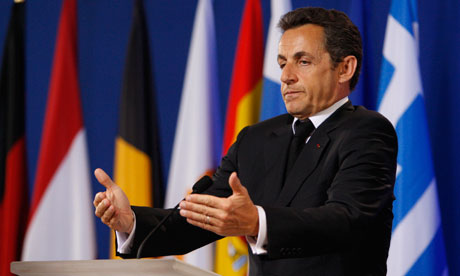
Back in November, at the G20 summit Obama and Sarkozy were having a chat. The Israeli Prime Minister came up in conversation.

“I can’t stand him anymore, he’s a liar”, said Sarkozy, to which Obama replied, “You may be sick of him, but me, I have to deal with him every day!”

The problem with the conversation was that their mikes were on. A couple of journalists heard the whole thing. Instead of rushing to their editor with their enormous scoop, they stayed quiet, in the belief that this was a private conversation, and would be damaging to report.

Nothing was said for a few days until the French website Arret sur Images published their remarks. As soon as international journalists got their hands on the clip, it went global and the mainstream French media reported it too.

Why is this important?

Because it reinforces the point that politics is a drama encompassing the full spectrum of human emotions.

We must never forget that it’s the behind-the-scenes conversations over strong cups of coffee and dog-eared files that end up directing events on the world stage.

Political decisions, like any other are made on the spur of the moment, and under the influence of powerful personalities. If your leader is more eager to be liked than to do what’s right, it matters. If they are impulsive or inexpressive or icy, it will affect their governance. Personality counts.

It’s one thing to believe in protecting private comments from the public glare but it’s another to detach entirely the personal from the political.

Research has shown that politicians get elected on the strength of their personality rather than on their policies.

It’s not surprising.

People are interested in people. They are less interested in policies. Policies may be more important, but ultimately it’s people, not machines that make them.

It’s futile to remove the personal from the political. We can rationalise emotions but we can’t remove them. Margaret Thatcher’s style of governance was probably affected a great deal more by the values of her stiff-upper lip upbringing than by the pages of briefs and pieces of advice she got from various channels during her premiership.

The media have a choice to make between objectifying and subjectifying. Objectifying is talking about Hillary Clinton’s bum, while subjectifying is telling us how her mouth twitched when her daughter failed a maths test.

The future of journalism is uncertain: the overwhelming speed at which news now travels has eliminated much of what the job used to entail.

There is a new opportunity though and it requires us to slow down, to reflect and to write with insight rather than haste.

Demanding of our journalists to be emotionally astute as well as politically sharp will lead to a more complex picture of what is anything but a straightforward job: making decisions that affect millions of lives and the future of our planet.

Journalism may sustain its integrity into the future by maintaining a fine balance between the personal and the political. When it comes to reporting from the private realm, it must replace sensationalism with psychological realism.

It’s what’s missing in the constantly updated, hyper-evolving virtual media landscape.

Unless we begin to privilege the mundane everyday, politicians will stay “out of touch” with it, and the public will continue to see them as little more than worn out political machines; inanimate and inept.

How Maggie boils an egg matters, but you’d really better go and see the film to find out.

On being a creepface

I have the unfortunate habit of staring for long periods of time at strangers I find interesting. Conditions in early childhood encouraged the practice. My bedroom was at the very top of the house facing a busy park and a bus stop. From there I could observe ladies in leggings and ear muffs making their way to the shops and groups of children trying in vain to retrieve shuttlecocks they had misfired into trees.

Sometimes I would sit for so long by the window that I could see the ladies return with their Dunnes Stores shopping bags. It always gave me satisfaction to note the details, like that they’d removed their ear muffs and bought a stick of French bread or two packets of toilet paper.

Some people are interested in living life but I am surprisingly content just to look at it. When I was young, I used to find it fascinating to watch my sister play with her playmobil. She’d set up her toy ambulance, or farmhouse or schoolroom and assign names to each of the playmobil figurines, which she recorded in a special little book which I have preserved for posterity.

She became a scientist; I studied Psychology.

I don’t watch much television because my parents are always watching the Bavarian news or German documentaries about the Pope. When I get the chance though I love to watch people watching television.

My favourite person to watch is my mother.

When she has time, my mother watches sentimental German films, which feature families that seem to making a wholesome livelihood milking cows and running hotels in the Alps, but inwardly battling with deep-seated problems like long-lost loves and corruption in the bovine trade.

In the last thirty minutes of such dramas, my mother’s face changes. As conflicts reach their climax, and true thoughts are expressed, her lips begin to move a little, her eyes grow bigger and she can’t stop the tears that begin to roll one-by-one down her cheeks.

When I turn to look at her, she gets embarrassed and flashes me a sheepish smile. I pretend I haven’t noticed even though she should really know by now that her indiscriminate display of empathy is among the billions of things I admire about her and that her compassion for villagers in complicated love triangles is endearing.

My father’s expression becomes exceptionally benign when he watches trains bounding through glorious British countryside and stuffy antique shows where soft-spoken elderly males evaluate the worth of a 1786 gold-plated pocket watch.

In a domestic context, my bad habit doesn’t get me into too much trouble. Apart from the odd bus passenger sitting on the top deck, whose eye I catch as he’s looking out the window into my bedroom, I seem to keep my creeping quite covert.

It’s different when you’re on the luas though, or taking the bus. That’s a riskier business altogether. There you have to be careful. You see, I find observing people on public transport an indescribabe, insatiable delight. I frequently select my seat on the basis of maximum viewing potential.

The other day a south Dublin boy with a voice several decibels louder than the roar of the engine was making arrangements with his friend on the phone.

“Get us a mixer for tonishe will you”, he yelled. “I’ve got lieke three bottles of vodka but I toshally forgot the OJ in Londis. Ish’s going to be SUCH a laugh tonishe…. Definitely. You’re a star…Definitely. Such a laugh.”

He was speaking with such affectation and lack of self-consciousness that a man at the front of the bus turned around in disgust and stared at him for the duration of his entire conversation, and then again when his friend Lola rang back.

Unfortunately the man who turned had spotted me giggling into my scarf and tried to catch my eye. I didn’t want to catch his eye in case he thought I was only laughing because I wanted to share a special moment with him alone.

Once I was coming home on the last Luas and a group of drunk youngsters were amusing me with their unfathomable babble.

I was the tiniest bit tipsy so my subtlety was at an all-time low. I was caught.

“How are you tonight?” the one sporting a pink shirt with an upturned collar asked me.
“Very well”, I beamed.
“ Where are you from”, he asked.
“Bavaria”.
“Is that in Australia?”
“Yes! How did you know?”
“I’ve been there. It’s a beautiful place”
“It is! I love it there”
“People from there are so sound”
“I know, they so are! – Sorry, this is my stop”
“BYE darling! See you in Bavaria!”
“Bye now!”

When I got home, I turned off the bedroom light. As I was closing the curtains, I took a steely glance out at the quiet street below. I saw a couple kissing by the park railings. And I watched a man cycling by, singing to himself.

My left-leaning Christmas tree from Crumlin

If there is an awkward, complicated way of accomplishing an easy task, the Ferguson family has found it. At Christmas, this means leaving buying a tree until very late and then refusing to bring the car out to transport it home. And of course refusing to buy one close by, because they can be found more cheaply further away.

This year was no different. Given that it’s only four days until Christmas, today seemed like the appropriate time to acquire a tree.

“Dad, we should get a tree”, I said stuffing a potato waffle into my mouth.
“Righteo. Let’s go”
“What, now? I’m eating!”
“We’ll leave in five.”
“FINE.”

Grabbing my coat and boots, I found my dad at the door.
“I’m cycling. Will you accompany me?”
“Nyee… No.I’m wearing a skirt.. and these boots aren’t suitable. You can wheel your bike there and then we’ll carry the tree on it in on the way home.”

He seemed to be okay with this.

Until we were making our way down the canal and he cycled off, leaving me trotting behind, fuming, resentful and futile. I chased him all the way around Harold’s Cross but we found none of the usual haunts open for business.

Dejected, we parted. I dared him to return home without a Christmas tree.

Sure enough, an hour later, I heard the gate creak open and caught a glimpse of my father’s head bopping between a mass of bushy branches.

We argued about the best way to fit the tree through the door. He heaved it all the way into the dining room, where he dumped it unceremoniously against the bookcase. “Got it in Crumlin”, he boasted before announcing he had to dash out again.

Alone now, I took a look at the specimen before me. An absolute beauty. Totally symetrical, full-bodied and tall, with a well-endowed base. This was the Beyoncé of all trees. My Papsi had done well.

The rest of my day went something like this:

I went to the garden and found a large green pot full of earth but without signs of vegetation. Armed with an enourous spade, I emptied it out and marvelled at the reflexive movements of the pinkish-blue worms which resembled varicose veins. Then I boiled several kettles of water and washed it down. My favourite part of the day happened next.

While I returned to the kitchen, I left the pot on the grass. I’d poured in some boiling water and a little cloud of steam was rising from it. When I came back, I found a robin perched at the edge of the pot, with its little red breast all puffed up and its head errect, enjoying a sauna.

I spent a long time cleaning that pot and making the acquaintance of a number of worms, who didn’t seem to want to engage in small talk with me and even, on a few occasions, phsyically recoiled with fear.

When I had finally finished, I brought the pot inside, and lined it with a collonade of bricks, which we happen to keep in our garden.

I took a firm hold of the tree and lugged it over to the window. Employing every ounce of strength my small and under-exercised frame would allow, I lifted it up and tried to jam it into the pot. It didn’t fit.

I breathed in deeply, turned on Mooney Goes Wild and relined my pot. This time it slipped in seemlessly, and, while it is now stable, it leans slightly to the left, which is a position I can identify with.

I was so happy alone in the house today, carrying one box of German Christmas decorations after the other up the stairs and unpacking it all to find it all just as I had packed it away last year. I whiled away six or seven hours dressing my full-bodied, left-leaning tree from Crumlin.

My heart did a little skip when I found my favourite decoration again. It is a little baby (probably Jesus) wrapped in a pink blanket, sleeping inside a walnut shell.

I am incredibly attached to the walnut baby. I would dispense with all our straw stars, our wooden horses, our glass presents and our golden baubles just to save this little one. It’s so simple, so lovely, so constant.

I hung it up on a protected branch near the top of the tree and this evening, in my armchair sipping a glass of spiced apple wine, I watched it swing slightly under a white light and thought that the best moment of Christmas was passing before my eyes.

The only Iraqi man I’ve ever met.

I wrote this piece on Tuesday night/Wednesday morning when news of the withdrawal was still in the headlines. Today I clicked on to BBC news to see that co-ordinated bomb attacks in Bagdhad had killed 63 and injured around 185.

A couple of years ago, I sat opposite an Iraqi man while he cursed at me. I was volunteering with an asylum-seeker mentorship programme and I was supposed to be teaching him English. He was showing me video images of bombings in his town that he’d taken on his mobile phone. He had a brutal glare and I was scared of him. He was hissing something at me that I can’t recall. I remember his eyes were lit up and that I didn’t know what to say. There was another student at the table, fidgeting.

I thought of him when the war in Iraq was declared over last week. And then again when I listened to a commentator on Pat Kenny talk about how the withdrawal of American troops was muted, because the operation hadn’t been a success.

In 2006 the UN estimated that over one hundred Iraqi civilians a day were being killed. In the end the number for that year turned out to be 34,000, amounting to 93 per day. On a single day in November, 200 died in an attack on Baghdad. According to antiwar.com, 4484 US soldiers lost their lives since the invasion of Iraq in 2003. The last fatality was on November 14, just before Thanksgiving.

And there was the suicide of David Kelly in July 2003. I remember watching the coverage of the Hutton Inquiry in my pyjamas and wondering what a “sexed-up” dossier was.

In 2006 I was starting university. I counted balancing writing essays on Jane Austen with late nights out as one of my greatest concerns. I didn’t lose sleep over the 93 a day.

And yet, like everyone else, one of my biggest fears is losing somebody I love. It’s impossible to imagine the suffering of war, the little dominoes of grief tumbling as one life after another falls to pieces.

I follow the official blog of the British troops in Afghanistan. They use a WordPress account, like this one. Every few days the death of a soldier is announced, with a short bio, featuring his or her military rank and how their death occurred. You can leave comments. People do.

It makes me realise how little I know about the world, how, against the odds, my life has occurred in a peaceful place at a peaceful time. I don’t give thanks for this often enough.

I’ve no idea if the Iraqi was granted asylum. Most likely, he’s still in a centre somewhere, awaiting his hearing and measuring his life out in insipid cantine meals.

Is your plumber a “drainage artist”?

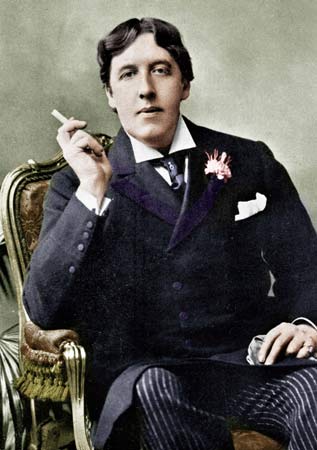
Oscar Wilde, who made a pretty living out of making subversive, witty and astute social observations said, “All art is entirely useless”. After all, he was one to know. Having written a handful of droll plays and a novel about a portrait taking over the life of its sitter, he was still bound by the tedium of life’s practical problems. His dirty dishes didn’t disappear when he flung a leather-bound poetry anthology at them, nor did the flat tyre of his carriage auto-inflate to the sound of Beethoven’s fifth symphony.

Oscar Wilde


Wilde’s facetiousness would have been reviled by Stephen Dedalus, the 22 year-old hero of Joyce’s Portrait and later of Ulysses.

Young Stephen takes art extremely seriously as did the many ‘greats’ before him. In the “Proteus” episode of Ulysses he’s strolling down Sandymount Strand and decides to close his eyes as he walks to see how far he can get in the ‘dark’. He takes a few steps but just before he opens his eyes again a suitably verbose thought strikes him: “Open your eyes now. I will. One moment. Has all vanished since? … Basta! I will see if I can see. See now. There all the time without you: and ever shall be, world without end.”
Stephen, self-absorbed and brilliant wants to know if the world continues to exist when he stops seeing it. Unfortunately of course, he will never find out because he can’t have his eyes open and closed at once.

Me being ridiculous on Sandymount Strand


Wilde’s idea that art was –in practical terms – absolutely useless and Stephen’s anxiety about the relationship of his senses to the outside world make for nice discussion points about the purpose and perception of art.

These days it’s not difficult to be classed as an artist. I’ve heard pedagogues described as “teaching artists” and people that roll dough as “pastry artists”. I’m all for it. The idea that there’s such a thing as an “artist” who exists on a plane of perception loftier than that of mere mortals is archaic and implausible. While the indiscriminate use of the term “artist” might be democratising and flattering to the individual, in effect it has now become a pleasant synonym for “skilled”.

Since it’s now acceptable to use the term “art” to refer to general skill rather than individual genius, Wilde – were he still here-would have to admit that “art” in its broadest understanding has become very useful indeed. I’m sure he would have delighted in calling in a “drainage artist” to unblock his toilet.

There’s something deeply unsatisfying about sealing off the definition of art as coterminous with “skill” though. To be skilled may be considered a favourable, functional quality leading generally to better prospects but doesn’t being an artist require something more than just know-how? A particular kind of sensibility perhaps? What happened to the image of the melancholic artist living in a hut penning poetry about his unrequited love? What about the assumption that pure art is “divinely” inspired?

Christopher Witcombe, Professor of Art History at Sweet Briar College, Virginia traces the emergence of the modern understanding of the artist back to the sixteenth century. He argues that during that period, “A work of art was believed to contain an extra indefinable spiritual essence”. This “divine” inspiration was impossible to explain and so the Italians referred to it as “un non so che” (I don’t know what), which was later taken up by the French, who called it the “je- ne-sais-quoi”.

People naturally became fascinated with the mysterious, god-like figures who created celestial masterpieces. Theories about their personalities and temperaments emerged and thinkers came to the consensus that the quality, which predestined an individual to become an artistic genius, was melancholia. It wasn’t a new idea; Aristotle had thought it before, and Hippocrates guessed that it occurred as a result of a build-up of black bile in the body.

Not much has changed. We’re still fascinated with the idea of “artists” today. And no, I’m not talking about the ones that teach our kids, roll our pastries and fix our toilets. Language is constantly changing, but no matter how loose the term “artist” has become, we still differentiate in our own way between those possessing a skill and those with an innate “genius” quality.

Present-day admirers, like their Renaissance counterparts, continue to elevate their artist heroes to deity status. One of the many adoring comments under a youtube video featuring the actress Natalie Portman claims “if you don’t like Natalie Portman you don’t like God”.

One of my students, a middle-aged French lady, once said that she considered Lady Gaga an artist in the “true sense”. I’m not sure how she justified it, but she reinforced the widespread assumption that ‘pure’ artistry actually exists.

Is Lady Gaga a "true" artist?


Luckily, we’re living in an era of relentless scientific inquiry and rather than accepting that true artists are born god-like to inspire us with awe, we can test the theory by removing some of the potential confounders.

Gene Weingarten of the Washington Post set out to do just that in 2007. He asked world-renowned concert violinist Joshua Bell to help him conduct an experiment to determine whether people would recognise the intrinsic value of art in the absence of relevant context. Bell was an ideal specimen for such an experiment. His playing had been famously described by Interview Magazine as doing “nothing less than tell human beings why they bother to live.”

Weingarten asked Bell to pick up his violin, dress up in jeans and a cap and perform for 45 minutes at a Washington metro stop during rush hour. Just days before, he’d sold out Boston’s Symphony Hall, with tickets $100 a piece.

During Bell’s performance, 1070 people hurried by without stopping, 27 gave money, and seven paused to listen for at least a minute. At no point did a crowd gather. One lady recognised the performer and gave him $20, which amounted to a significant portion of the total $32 and change he made that day.

So context matters. When people are in a rush, they’re not primed to recognise brilliance, or even as many describe Bell, genius. They’re not used to train stations playing host to maestros and anyway, they’re not really in the mood for “art”. The kids need to be picked up, and the laundrette closes at 2.

Knowledge matters too. The difference between a virtuoso violinist and an amateur is easy to identify if you’re a classical music enthusiast, or if you play yourself. Not so if you’ve never consciously listened to anything like it before.

Unless of course, a truly essential or “divine” quality really does exist, in which case, we should be able to identify it without prior knowledge or relevant context.

Which brings us right back to Sandymount Strand, where Stephen Dedalus, himself a wannabe artist is testing his own perception against the idea of an objective reality.
It’s a futile attempt because it’s impossible to escape the bounds of his own perception. Stephen can’t ‘see’ with his eyes closed and he can never be sure of what happens to the world when he shuts it out with darkness.

When I was at school, I found it strange that entire groups of friends seemed to like the same music. It confused me and sometimes it made me unsure of what I really liked and what I thought I should like. Was artistic appreciation a prerequisite for forming bonds? Or did people simply like the music their friends liked, because they were primed to see its value? It’s impossible to know really. Teenage sensibilities seemed to be invested heavily in film and music, and less so in visual art and writing. I couldn’t imagine lunchtime conversations featuring encyclopaedic knowledge and endless speculation about the direction of Irish sculpting or the American short story back then.

One of the most appealing attributes of art is that it evades definition. Is a well-placed mahogany chair “art”? What about a stickman figure Picasso may have penned when he was drunk? We delight in arguing about these questions because deep inside us, the idea of “art” as something pure and divinely inspired hasn’t vanished. We talk about skill, because it’s measurable: This genius savant has an IQ of ‘200’ and that performer could play the trickiest passages from Chopin at the age of seven.

New York Times columnist David Brooks
argues that the possibility to become an artistic genius lies in all of us. All it takes, he feels, is diligent practice, single-focus and proper mentorship. He reminds us that the brain is plastic, and that we “construct ourselves through behaviour”.

The Irish Times recently reported on a study that found that when subjects gazed at artwork they found particularly beautiful, they experienced a surge of Dopamine, (known as the “reward” neurotransmitter) through the brain at levels equivalent to gazing at a loved one.

In this experiment, the brain simply responds to a visual stimulus, which it has already categorised as beautiful. The Irish Times conclusion that “these findings have significant implications for Government policy” is a leap too far however. The study tested subjects with pre-existing notions of beauty. It did not explore other potential pleasure-stimuli, like a beautiful view, the smile from a stranger, a spontaneous meeting or the feeling of soft sand under your feet.

Dopamine pathways aren’t just activated by a masterpiece. They also play a key role in the progress of addiction as well as during eating and sex.

Society shouldn’t formalise art. It should encourage us to look more deeply at the world around us and to be creative in what we class beautiful. If you’ve lived all your life in a high-rise block of council flats littered with crisp bags and dirty runners, you might not be flooded with dopamine when you visit an art gallery. Maybe though, when you look outside your window and see a flower popping its head out of the box you planted it in, you will feel a rush of pleasure.

Oscar Wilde, who had “nothing to declare” but his own “genius”, fell victim to a society, which classified art into moral highs and lows. His love- surely the highest of all art forms-for another man landed him in prison in Paris, where he died a pauper’s death. Maybe it was this world of narrow definitions, which Stephen Dedalus was shutting out when he walked in darkness along Sandymount Strand.

High Art and Low Art don’t exist. Every one of us can experience moments of intense pleasure and awe. It can be at the taste of your first Lindt bunny after Lent, at the birth of your first child, or in the look in the eyes of your grandmother as she knits you a Christmas sweater. It can be in the middle of traffic in an ugly part of town or in the vast expanse of a city’s art gallery. It’s all around us.

Lindt Bunny Joy

Three Men that don’t know they’re in my life

1.The pioneering beggar

Every day I see an oval-faced man on Grafton Street holding an enormous wooden sign, which points you in the direction of the Sweet Emporium on Duke Street. He has been holding this sign day in, day out for many months. For years before that he sat slumped on the steps of the insurance building next to Hodges Figgis with a tin covered in chipped orange paint. His eyes were too sad and vacant to be those of a charity collector; he was a pioneering beggar. Somebody must have noticed him there and decided that if he was going to stay in the city centre looking for money all day, he might as well send people to the Sweet Emporium. Now he works double shifts because I’ve seen him back by the steps on Dawson Street at evening time. He’s been on my mind on and off for years. I wonder what we’d talk about, if I ever found the courage to introduce myself.

2. The Man with long, blonde hair

Since my schooldays, I’ve been passing an extremely tall man, with long blonde hair and thick pink lips. When he walks, his whole body jolts heavily forward and then bounces back, as if on a spring. He has a long, beige face, which blends in with the bewildered expression he wears. When I watch him, he seems to be looking at something beyond what I can see. I think he is the wildest and gentlest man I’ve ever seen and I also think that he is intellectually disabled. I feel sad when I see him, because of the way he moves, and because of the large blue pools which are his eyes. Every once in a while he puts on black, knee-high women’s boots and stumbles down the street in them. Sometimes I try to imagine his mother and father but I can’t because I can’t paint their pictures in my head.

3. The Opera Singer

He wears a smoking jacket and bow tie and sings to the crowds of shoppers as if he were on stage in an Italian opera house. He has a neat, tight face with symmetrical features and short, sandy brown hair. He could be from the Czech Republic or from Slovakia, but in fact he comes from our own shores. I’ve heard him speak; he asked a lady last week if he should sign her CD “To Anne with an E”.
His body language, coupled with his attire is highly comedic. I know this because once I was sitting by the window upstairs in Bewley’s watching him speak to a middle-aged lady, who happened to be a fan. He bent forward to touch her arm and tilted his head backward to laugh at what she had said. He used his hands constantly, flapping them politely in her direction and then mock-modestly at her wide-eyed praise. He’s a charmer.

These three men are in my life but I’m not in theirs.

American Diary:Part 3 Underground Culture

November 2nd was my birthday. It began at a subway station in New York when the digital time display switched from 23.59 to 00.00. I didn’t notice because I was transfixed to an old man, who was playing the flute. He had a hunchback, a grey moustache and sad eyes. I gave him a dollar.

LSB saw the time change though. He’d been watching it. “The first act of your birthday is a noble one: Typical Katzi”, he said, flattering me, because it was my birthday and because he is kind.

Subways in New York are grubby places. They are for poor people and for people who read large books with city library stamps printed on their spines.

They are full of crazy people and sad stories. At every stop you can see the same slumped figure: somebody with their arms folded around their knees and their head tucked into their chest, motionless. You can find them on benches or hidden away in the corners.

New York is a busy place so the forgotten people talk to themselves. I counted about half a dozen men – all black- who were having conversations with themselves. I even checked their ears to see if they had any fancy devices. They didn’t.

There are so many faces on the subway that it’s hard to remember any. I stared at one lady because she looked ordinary. I wondered if I’d recognise her face if I ever saw it again. She was middle-aged, with shoulder-length auburn hair. She had peach-brown skin and a round face. I don’t remember the colour of her eyes and I might not know her if I saw her again.

The rudest man in the world works at 103rd Street station. He sits in a plastic box. His job is to advise commuters who don’t know how to work the machines or who would like to purchase a ticket but don’t have the correct change.

If you want to talk to him, you have to speak into a little microphone through the screen, which means that everybody around can hear what you want to say.

This man is the rudest man in the world because when you approach him, he roars into his microphone “ASK”.

He doesn’t say “Hello” or “How can I help you” or even “Yes?”

When LSB approached him, he yelled “ASK”

LSB was a little taken aback. LSB is polite at all times.

He bent tentatively towards the microphone.

“I was wondering if it’s possible to get a one-day metro ticket”

“NO”, the man replied and banged his fist on the counter.

“Oh…” said LSB

The man snarled and yelled “SECOND QUESTION”.

He said it as a statement, not a question.

But LSB didn’t have a second question, because his first seemed to have caused grave offence.

“You’d never get that in Ireland” we said because Ireland is small and flat and as my mum says, it’s a good place to be an eejit.

At another subway stop one evening, a young musician was playing guitar. I didn’t give him any money but LSB did. LSB is quiet and noble. The rifs followed us onto the train. It was cold and dark outside but the carriage was musty and cramped.

I have another story about the underground, but that will have to wait, because LSB and I have something important to investigate.