The Ladybird

I once started crying in a falafel joint  in Philadelphia because I saw a father upbraid his son for not doing well at school.  He spat when he spoke, his wife pursed her lips and his sister said “I’d help you if I were in big kid school.” It was too much for me to watch. A couple of tears landed in my hummus.

And on Tuesday night, just outside the opera house in Vienna, I gave money to a woman on a crutch who told me she had lost her wallet, had already reported it to the police and just needed a fare to get the train home. I suspended disbelief.

If that wasn’t enough, when I went to see the King’s Speech with LSB, I was in such a state afterwards that I refused to leave the cinema in case I met somebody I knew.

You see, I have a delicate sensibility.

I also like ladybirds, a lot.

So you can imagine my reaction when one landed on my toe last Sunday afternoon. I was sitting on a  bench in a beautiful Viennese park. The sun was scalding me, my eyes were closed and I felt something brush against my toe.  I was preparing to flick the offending creature away when LSB said “Look, Katzi!”

The ladybird that landed on my foot

I looked down and squealed with delight. There it was – a beautiful, well-rounded specimen with chunky spots and a confident crawl. I watched it and asked LSB to take a picture to preserve for posterity.

After some time, it ambled away contentedly to a stretch of pathway. I watched it go a little sadly. Then all of a sudden a wave of people passed by directly in front of me, completely obscuring my view of the ladybird.

“Oh no, no, no, no!” I cried.

LSB winced. “Don’t look, Katzi.”

I had to.

It had been trodden on but it was still alive, flailing.

I rushed to it. Some of its legs were crushed. I tried to encourage it onto a newspaper in my hand. It would not move.

I stayed there a while. I felt I was being watched but I didn’t feel like looking up.

Then a woman’s voice said to me, “The newspaper won’t work. Try your finger!”

I looked up to find a middle-aged lady with brown curls and a loose blouse peering down at me.

I took her advice but it didn’t work. I told her that the ladybird had been stepped on.

“Oh well that’s the end of him then,” she said, smiling apologetically before walking away.

I returned to the bench and watched the bug. It had stopped moving.

“I don’t think there’s anything we can do, Katzi,” said LSB sadly. “But it wasn’t your fault.”

I got down on my knees and looked at it again carefully.

The lady came back. She licked her finger, scooped the ladybird up and plopped it in my hand.

“That’s how you do it,” she said.

I was startled but grateful. LSB laughed a little.

The ladybird moved.

“It’s alive!” I cried.

It began to push forward with its two undamaged legs.

I set it down on a leaf at the edge of a lawn. It moved forward a little and then toppled over onto its back. I turned it back over.

This happened a few times. Then LSB said, “Katzi, this time let it try on its own.”

That was wisdom and my first insight into my shortcomings as a future parent.

It managed to turn itself over. There was no guarantee that it would master the concrete ledge onto the lawn. But it was time to go.

“It wasn’t your fault,” said LSB again.
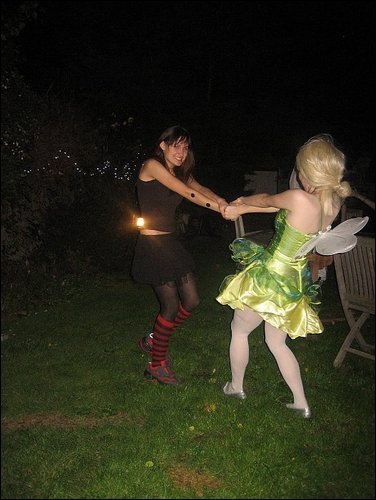
Spinning in my ladybird costume, Halloween 2008 with a charming Tinkerbell

Since then I have seen several crushed ladybirds on the pavement.

But yesterday, while I was swimming in the Danube, I spotted a ladybird in the water.

Without thinking, I scooped it up into both my hands and brought it to safety.

Even more impressively, today I ate a falafel sandwich and nothing about it or my surroundings offended my sensibilities.

Alone in Berlin: Part Two

In late February Berlin was brown and the air was cool. I saw a Chinese man standing by the bin at the entrance to my underground station every morning. He had a blank face and kept a neat shoulder bag slung over his body. At first, I wondered who he was waiting for. Then I learnt that he sold cigarettes, which he kept in tight plastic packaging in the bottom of his bag.

He never moved, but some days when he was feeling bold, he would line up three or four packets of Marlboro on the edge of the bin to eliminate any doubt about why he was there.

His brazen passivity intrigued me. I developed the involuntary habit of staring him right in the eye as I turned to go down the steps to the platform.

I sat in a corner on the eighth floor of a silent office. It was a five-minute walk from the Brandenburg Gate. When it became warmer, I would sit by the Spree at lunchtime and watch the tourist boats go by. Sometimes I would read or listen to music, but mostly I just sat.

One night my flatmate came home and said “We’re going out.” It was shortly before midnight. He took me to a rundown sports hall. Inside it was dark. Illuminated figures were racing across a badminton field, firing glow-in-the-dark shuttlecocks at each other. It smelt of sweat and alcohol. Even the nets glowed. Afterwards, a girl offered me a sip of bubble tea. It tasted like lentils and bath salts. Now I’m on the mailing list for “Spedminton,” a sport you play in the dark, while drunk.

Another time, I went to the punk bar down the road. Men and women in their forties, wearing leather jackets and vacant expressions, sat in clouds of smoke. They drank beer and had conversations about life and sometimes death. In the corner of the bar, completely out-of-place, was a foozeball table. My flatmate directed me towards it. I played so badly that his friend told me I must be tired. I thought I was at the top of my game.

At the weekends I went walking in the city. I watched teenagers nodding their heads to beat boxes, homeless men reaching into bins and Roma girls with clipboards approaching tourists, always with the same high-pitched greeting, “Speak English?”

My flatmate asked me to wipe the tiles dry after I showered. He had a special scraper for it. I would stand there, naked and dripping, pretending I was a window cleaner. A few weeks later, in a moment of rebellion, I simply stopped.

Overnight, I became a journalist. I made phone calls to surly trade unionists, government representatives and natural history museums, from a little sound-proof glass box, where my colleagues couldn’t hear me.

Once I met a man who thought I was more important than I was. He invited me to his office, which overlooked the Brandenburg Gate and he said, “So are you going to become a TV presenter?” I looked at him incredulously. And he said “You have the personality for it. You’re charming.” I told him that I was shy and didn’t want to be famous.

The dizzy feeling of accomplishment I got from publication made me afraid. I learnt that I am equally scared of success as I am of failure. Sometimes to atone, I would buy a newspaper from the crippled homeless man on Friedrichstrasse. I made a point of reading it on the way home, in case the emptiness of achieving my dream overcame me.

Alone in Berlin: Part 1

At first it was exhilarating.

I wanted the hostel, where I stayed the first few nights, to be my home forever. I loved the anonymity of the place – the backpackers waiting for a leftover packet of pasta to boil, the discarded tea bags, the little laminated signs asking travellers to consider the environment before throwing away their rubbish.

There were two Asian-looking girls in the kitchen one evening. One had an American accent, the other was British. They had met at the hostel and now they were friends. The American wanted to go to “school” in Europe. The other nodded and made dinner.

Alone in Berlin, reading Alone in Berlin

In the evenings I bought a falafel sandwich or a slice of pizza on the main street which was soon to become my neighbourhood.

One morning — my first in Berlin, I took a bus tour of the city. On the top deck, a round lady with red-painted lips and peroxide hair gripped a microphone and gave a commentary of the city in English that was so broken that a tourist behind me muttered that he had more chance of understanding German. Her smile was fixed to her face like a stubborn mole, her face was wrinkled. If she had had no folds on her face, she would have looked like a doll. I knew she had grown up in east Germany. She learnt Russian at school. No west German tour guide would speak so little English.

I scribbled down the names of places that looked interesting from the bus. I saw pink water pipes all over the city, the president’s house, the parks, and a beautiful square.

I found my workplace and my heart jumped when I saw that it was five minutes away from the Brandenburg Gate. I found a little photo booth and got a picture taken for my student travel card. I followed the instructions for getting a passport photograph taken. “Don’t smile” said the machine. “You must not tilt your head, or obscure your face with your hair.”

I look so stony in the picture that weeks later, when the secretary at Spiegel looked at the card she said “but you are so cross!”

After I checked into my hostel on that first night, I went out to try to find the apartment I would be moving in to.
It wasn’t far from the hostel. It was late February and it was dark. I approached the flat from a direction I never walk now. I found the shoe shop and the children’s book store that Google Maps had promised me. The street was quiet and I was alone.

Obeying The Machine

I found the number and glanced up at the building. It was too dark to see anything.

I walked past a church, back to the main street. Next to my hostel was a photocopying shop and a video store. All rentals one euro. There was a large adult movie section on display in the window.

The day before I moved into my new flat, I met a book vendor outside Humboldt University. He had wild white hair and a black hat. He said: “You don’t think I have mornings when I wake up and say ‘Fuck this shit. I don’t want to stand at this fucking table selling books all day? And then you know what? I see children laughing and playing and nothing matters any more.”

I nodded at him, I think I smiled. I thought we were the only two people in the city. The sky turned midnight blue and the TV tower was lit up in the distance. I bought a book called “Der Steppenwolf”. The cover is blue and there are bits of paper still stuffed inside a page in the middle of the book, where I stopped reading it.

As the lights came on and I got into a grubby underground train, something danced in my brain. Now I realise it was the taste of freedom.

Why Grocery Shopping Is Better Than Therapy

While I was still living at home, grocery shopping was a pleasant diversion but it was always coloured by a faint association with futility. My parents stocked the fridge regardless and I just bought extra kidney beans to supplement my vegetarian diet.

Now that I am hungry and alone, grocery shopping has become a noble necessity. I could go so far as to say I couldn’t live without it.

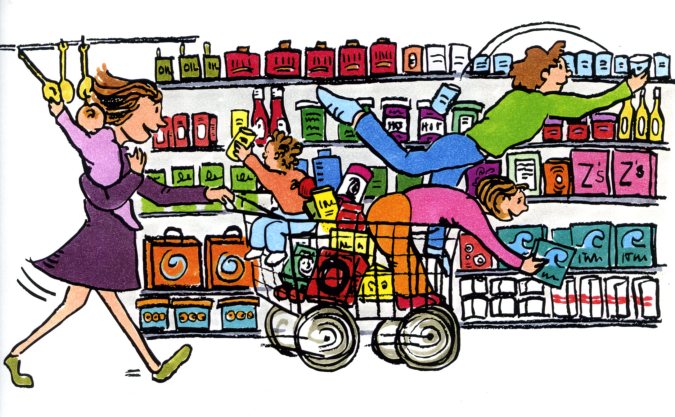
Every second day on my way home from work, I wander into my local branch of Netto and greet the three punks, who have inhabited the dirty pavement outside and spend their days drinking beer and enjoying banter with the store’s security guard. For the next twenty minutes, I forget my worldly problems as I navigate my way through bundles of asparagus, the weekly deal of a desktop printer and boxes of instant dumplings.

Image source: yestheyareallours.com

On the occasions that I have felt directionless, grocery shopping has restored a sense of purpose. There is no therapy like it.

While I am not one to write shopping lists, I do like to dash to my post box to snatch the latest promotional leaflet featuring upcoming deals at my local discounters.

It is an exercise in self-control not to rush at every offer of 19 cent bundle of radishes and toilet seats at just €19.99. With time, this kind of restraint may develop into a widely-applicable life skill.

And even if you do succumb to temptation, as I am apt to do when a 100 gram bar of Milka chocolate is offered at just 59 cent for one week only, buying superfluous groceries does not compare to the guilt associated with conventional retail therapy.

Grocery shopping melds our most primal needs with the more sophisticated cognitive processes of reasoning and restraint. We must learn to differentiate between the times when succumbing to temptation is a good thing (for example when Milka chcocolate is on special offer) and the instances when a purchase would be unhelpful (as in the case of the extra toilet seat). Such high-level strategy is rarely taught, let alone mastered at university level.

A tempting offer.
Image source: jonco48.com

For those under the impression that grocery shopping represents mere escapism: it has its challenges too. Sometimes you end up with an excessive quantity of toilet paper; and at other times you come too late for the marzipan-flavoured Milka bar.

Sometimes when I am in a queue, the customer before me places a little barrier in between their shopping and mine. Though such an action is ultimately self-serving, I always thank them profusely. Then they look at me in the bemused way to which I have become accustomed when behaving with excessive politeness. It is the same look I get when I thank a bus driver or wish the man selling me falafels a good day. I can’t help feeling a little peeved when I place a barrier between my shopping and another person’s and I do not even get the slightest hint of acknowledgement.

Such gritty reality must sadly be faced in the world outside and grocery shopping has equipped me with the necessary skills to cope.

None of the self books I used to borrow from Rathmines library taught me as much about the human condition as shopping for food has.

Despite the transformative power of shopping for groceries, I have met individuals that profess not to be advocates. I have even heard food shopping described as “boring” and “stressful”.

I hesitate to entertain the notion, but could I be alone in my enjoyment?

On Carving Your Niche

There is a men’s magazine called Beef! available at all good news stalls in Berlin.

“Beef” is not a euphemism for female flesh or motor sports: this publication is entirely devoted to men looking for the latest tips in cooking, marinating and serving cow. It advertises itself as “the magazine for men with taste.”

A couple of months ago, while I was weathering my quarter-life crisis I read some encouraging advice from a journalist whose name I promptly forgot. He said: stop trying to please, do what you love to do. And wait for others to come to you.

In a journalistic context, this goes against conventional wisdom. If you are a nobody, like Katekatharina, you should devour the publications you’re interested in writing for, you should find out what they like, you should obsessively pitch to try to meet their wants.

Pitching articles for publications who already have a surplus of highly talented writers can be soul-destroying.

The best antidote I have found to this kind of trauma is to start a blog.

A couple of months ago, I wrote a blog post about education. I argued that evaluation was a much less important feature of the system than we acknowledge. And that constantly aligning ourselves to a standard which we had no part in setting can confine our creative thinking.

If you are suitably self-critical, your own standards might be those that best help you to improve.

At Katekatharina, I write for an editor who is her own worst enemy. But she has little moments, where she’s proud of the little home she’s created on the outskirts of the inter-web.

Recently, I’ve had some small successes in getting work which originated at Katekatharina published.

If there is space in the market for a male magazine just about beef, then maybe we all have little spaces to discover where we can thrive. It’s just a matter of “carving” the right one.

Books in Berlin: Red wine, dim lighting, dignitaries and … katekatharina.

“Tap, tap, tap,” went the bookseller with big eyes and black skin, patting her spoon on the rim of a wineglass. “Let’s all gather inside.”

Rupert, Georgia and I got up and made our way through the glass doors of the balcony. Georgia found a seat at the far side of the room. Rupert and I were too slow. We had to stand.

“Sure we’ve been sitting all evening anyway,” whispered Rupert.

The bookseller and the author sat on two seats in the middle of the room. The sun was setting. A glorious red shone through the penthouse.

“I can’t stop gushing about this book,” said the bookseller. “It’s my favourite of the year.”

She talked for some time about The Apartment and a little bit about Greg Baxter.

He maintained the kind of blank expression that is necessary when you are naturally modest and somebody is praising you in front of others.

The bookseller had an organic enthusiasm, completely free of pretension. As she talked to Greg, she seemed to forget that there was a room full of people watching. They talked about art and America; about writing and reading.

“I like Chekhov but not for the reasons that most do,” said Greg. “Chekhov gives no answers. There is no resolution. We don’t know why or how. That’s what life is like. We don’t have neat explanations. That’s why I hate psychology. It always tries to categorise everything. She is this. He is that. It’s not real.”

Later on, when the conversation was drawing to a close, Greg said “I just realised I haven’t said a single interesting thing. You are all so bored.”

He was wrong.

I had been listening intently to everything that he had said and he had made me think.

But I had also used the opportunity to scan the room to see if I could guess who the editor who had invited me might be.

My eyes alighted on a man wearing a patterned shirt and a cartoonish countenance.

I had seen him before, at the launch of a wonderful book written by Molly McCloskey, who ran a creative writing course I took at college.

I knew they were friends.

I shuffled over. Approach behaviour is not my strong-point. I am part shy-and-retiring, part outrageous-and-cheeky but when it comes to imposing my presence upon the unknowing, I am stubbornly reluctant.

I asked him whether he was who he was.

“Yes,” he said.

He was friendly and introduced me to some other guests.

“Kate, have you met Greg?” he asked.

“No!” I said.

Greg was smoking on the balcony, like a deep-thinking author should. I considered whether to take up the habit for the sake of my career.

“This is Kate!”

“Hello Kate,” said Greg.

We talked a little.

“So you’re a journalist?” Greg asked.

“Erm, aspiring at best,” I said.

“I’m jealous that you’re bilingual,” Greg said.

It’s nothing compared with writing a book, I thought.

“We should meet for a coffee sometime,” he said.

“Yes!” I said.

The editor was feeling a little awkward. “There’s a restaurant booked,” he said. “But I’m not sure for how many people…”

“Oh, dear me,” I said. “I’ve no intention of staying. I have to go to work tomorrow!”

I slid away to buy the book.

Greg signed it. “Oh no!” he said as a drop of his red wine fell onto the cover page.

“It adds character” I said, which is a phrase I have borrowed from LSB.

I was introduced to some embassy people. One lady said “Here, let me give you my card.”

I thought I had made it in life.

By now it was dark. Red wine, dim lighting, dignitaries and … katekatahrina:cinematic and surreal.

I made my leave and walked down the hill. It was quiet now, and cooler. Droplets of rain began to fall.

The underground station was empty and silent but for the slow shuffle of a man dragging his bag along the platform.

Books in Berlin: “How do you meet men?”

Image source: salon.com

He had fine bone structure and an English accent. I put him a little short of his 40th birthday.
He waved a pair of sunglasses from his pocket.
“I’m so sorry to be rude,” he said, putting them on and obscuring half of his face, “but the sun is blinding me.”
“Not at all.” I said.

He was an IT teacher, a former diving instructor and the partner of a Swiss diplomat. Now he was learning German at a language school. It was difficult. He was a science and maths person.

We talked about teaching and travelling. He had a boyish wonder about him, a kind of naivety. He was softly spoken. He was kind. He had seen me alone and sat down beside me.

A lady came up to us. “Rupert!” she said. “I was trying to call you.”
“Oh, I’m sorry,” he said.
He turned to me. “Apologies, I don’t know your name.”
“Kate.”
“Kate, this is Georgia,” he said.

Georgia was dark, attractive, with black curly hair. Later, she told us that she was 43.

She was intelligent, expressive, sharp. She watched people carefully as she spoke to them.

The conversation meandered.

And came to sperm donation.

“You know, there was a story in The Spiegel a while ago about a Dutch serial sperm donator,” said Rupert.

“I edited it,” I said.

“You did? How funny!” said Georgia.

The man in question had fathered eighty-two children and ten more were on their way.

He didn’t just deliver his sperm in a container. He catered for women who wanted to conceive the natural way. He visited them, they made him dinner and paid for his transport and then they went to it. There were good and bad experiences. But really, he just wanted to make them happy.

“He wasn’t a looker,” said Rupert, “but by the sounds of it, he was at least of average intelligence.”

“Ha!” said Georgia.

“I have so many beautiful, successful friends in their late thirties,” Rupert went on. “And they’re all single.”

“But where do you meet men?” asked Georgia. “I mean… I’ve been with my husband for twenty years so it’s been a while since I’ve dated, but isn’t it hard to meet people?”

She turned to me.

“What’s your situation? I mean, are you single?”

“No,” I said. “but for me it was very simple really. I met my boyfriend in the university library.”

“Yeah, that’s easy,” she said.

Then Rupert told us the story about how he had met his partner.

“I was a diving instructor in Crete. And I know what you’re thinking… She was not my student.”

She was on holiday with her girlfriends. But what she didn’t know was that this was a “singles holiday.” She had brought a pile of books to read, but her friends said there were more important matters to investigate.

She talked to Rupert, who was used to being flirted with. It came with the job of diving instructor.

But she made him nervous.

“That’s how I knew,” he said.

They travelled around the island together. And now they move around the world, wherever her job takes her.

The story was winding to a close. Somebody started tapping on a wine glass.

The Graveyard

My parents brought me running shoes when they visited me at Easter. Yesterday I tried them out. The day was mild and dewy.

I was looking for a park, but instead I ran into a graveyard.

Inside it was still; the birds were singing. Daffodils peeked out from under little heaps of earth. Leaves rustled. A red squirrel skirted past me.

Plastic pots and watering cans lay in a pile of withered flowers.

I passed some buried children; tiny mounds, close together. Words and prayers and a teddy bear.

A woman pushed her bicycle past the graves. The wheels crunched against the gravel.

Further on, I found enormous iron casts from the 1900’s. Whole families were resting there: soldier sons, an 18-year-old girl ripped away from her widowed mother. A family’s heartbreak documented into thick stone slabs. Always the same word: Unvergessen; “unforgotten.”

Then from the trees, slowly a withered old man pushed his Zimmerframe and got down on his knees to tend to a grave.

I watched his tiny frame crouched over a tombstone and his wrinkled hands shovelling the earth in little scoops.

My tears fell like unexpected rain. I was ashamed.

I turned and ran away, past the graveyard shop where they were selling over-priced potted plants, past the red-brick church on the roadside, past the cinema and grotty record store, past the kebab stand.

In the park, dogs bounded through the woodland, toddlers dipped their hands into the water fountain and families played catch. And the birds sang.

Can you remember the last time you got lost?

Three Women That Don’t Know They’re In My Life

1. The Prostitute

She has white-blonde hair and long, thin legs. She stands by the red-brick buildings of Hackesher Markt. She wears white leather hot pants, tan coloured tights and furry white snow boots. Her cleavage is pushed up by a skin-tight leather jacket, which she keeps half unzipped. She has red lips and cool, blue eyes. Last Saturday night, it snowed in Berlin. She watched a group of Italian men walk up the street. She stood in their way and smiled, casting her eyes up and down their bodies. First they were uncomfortable, then aroused. She put her arms around one and pushed her body towards his. She pressed her breasts to his chest. All the time, she took sidelong glances at his friends. The snowflakes were sticking to her hair. She was cold.

Berlin's Affluent Red Light District

2. The Girl at the Bakery

She sells sour dough bread and pastries at a bakery at an underground station and her red uniform includes a crumpled tie. She has an old-fashioned kind of face, which refuses to be offset by her hoopy silver earrings, lip piercing and the two thick black scrunchies, which hold back her wavy hair. When she serves customers, she is upbeat. There is something naive in her face which I am drawn to. I think she would flair up at injustice and I think that she is happy in her job. Once when I was eating a Nussecke and sipping on a latté at the bakery, I saw her chat quietly to a colleague. The tone was conspiratorial. It surprised me.

3. The “Tickets Please?” Girl

She could be a child but she is not. She is small and has big brown eyes and dark curly hair. She lives at the entrance to my underground station with homeless men and their giant dogs. Her voice rings in my ears. She says the same thing every day. “Tickets please?”. (Fahrscheine bitte?”). She says it like she is a bored train conductor, but really she is a bored homeless person collecting tickets to sell on. She’s not on drugs because her eyes, while large and droopy are alert. She wears puffy clothes from the 80s and she works much harder collecting tickets than her male friends.

Why I am becoming a punk

Having been in Berlin for almost two weeks, I’ve decided to become a punk. I’ve been spying on them like a creepface since I got here, and am now planning the transformation.

I was only thinking the other day that it was time to rid myself of my squeaky clean image. The conversion would be quick and easy and wouldn’t require more than the purchase of a dog and a new wardrobe.

Plus, the lifestyle seems a lot less stressful than that of a journalist. Here are some notes I’ve made in advance of my conversion:

Punks in Berlin tick all the boxes. They have to – after all, they are German punks.

Most sport at least one stylish luminous spike, which bears a keen resemblance to a rhinoceros horn. Colours can vary, but red and green are preferred.

Piercings are mandatory. At least one nose ring is essential, as is a leather jacket with metal accessories. Spikey collars and patchwork black denim are encouraged but not proscribed.

Punks in Berlin are required to own dogs. These are unusually large hounds with leather collars, who, foaming at the mouth, are taught to snarl at conformist passers-by.

Berlin punks are early-risers. In the mornings you meet them hanging out at the U-Bahn stations taking swigs out of bottles of local beer and occasionally shouting obscenities on the escalators.

All in all, they are a benign bunch, characterised more by their sartorial conformity than by any act of rebellion.

I know I should be telling you more important things than about my dreams of joining a subculture but the problem is, all the things that are worth writing about, are “off-the-record.”

I would love to write about the Spiegel newsroom, where I spend the majority of my time in front of a computer translating articles about potential wars with Iran and the future of nuclear power in a post- Fukushima world, all while a mere three minutes away from the Brandenburg gate. But I can’t.

I’d like to talk about some peculiar characters I’ve had the delight of meeting but there’s a danger they might be reading.

I could of course write about Cauchy the housecat, who I am learning to love despite my well-documented feline aversion but that too could have libellous repercussions since Cauchy is showing signs of literacy.

Or I could tell you about the weekends I’ve spent alone wandering round the magnificent city, breathing in the incredible creative energy it contains and turning strange corners to find yet another beautiful expanse to inspire the senses. Last Sunday morning, I ventured out to the famous fleamarket at Boxhagener Platz, which is near me, and whiled away the hours looking at beauty magazines from the DDR times, and at old-fashioned dolls, which sat bolt upright in their prams, staring at me.

Flea market at Boxhagener Platz


But usually at the end of the day I am so tired that all I can do is grab a block of frozen spinach, which I buy for 35 cents in Netto, and shove it into a saucepan with an onion.

I could write about being alone, or about Skyping with LSB or about my flatmate, who is the sportiest person I have ever met and even stretches recreationally but as I’ve said before, this is not a diary.

Those tales I reserve for those of you with which I enjoy the pleasure of a private conversation.

I can report that I visited the largest chocolate shop in the world last weekend and that it was absolutely magnificent. The chocolate Reichstag was infinitely more impressive than the real thing and the enormous slabs of almond chocolate laced with cherries to die for.

Chocolate Reichstag

I also went to a street where the last cement slabs of the wall still remain in their original position. Pristine on one side and covered with graffiti on the other; a tidy contrast between freedom and repression. I climbed up high and looked down on the barbed wire fencing and Soviet watchtower and at the high-rise flats on either side, where east and west Berliners could wave at each other while the watchmen took a nap.

Remains of the Berlin Wall.

I’m alone at home now, with my feet toasty beside the radiator and the cat asleep in the armchair beside me. It’s very still here just now. Soon the neighbours will turn up their music and I’ll hear the clatter of footsteps in the hallway outside.

But for now, I’m going to enjoy the silence and curl up with a copy of The Steppenwolf, which I bought on Unter den Linden from the vendor that never ceased to talk.

Goodnight from Berlin.