I almost gave up on a second child

Choosing to mother again in an age of anxious ambivalence 

The first time I mourned the idea of not having a second child was in the hours after the birth of my first. I was doubled over, shuffling towards the hospital toilet, in a dizzy haze after the assault of a 40-hour labour. The thought – intrusive and inappropriate – came with clarity: I can never do this again. I will never do this again. How could I? I had wanted to die. 

Three months later, I took my baby to meet some friends for pizza. Some pandemic restrictions had been lifted, but the plague was not over. Bursting with pride, I passed my daughter round for cuddles.  “Would you have another?” they asked. “I definitely wouldn`t rule it out,” I said. They seemed surprised. 

(The fear that my daughter could have caught Covid during any of those cuddles haunted me later and until it was clear that she had not, I felt like the worst mother in the world). 

Motherhood made me happier than anything in the world ever has. I had never doubted my capacity to love. But what I never expected was that in those early months, my insomnia would disappear, and I would sleep more deeply than I ever had before. That I would lay in a cocoon of duvets, breastfeeding my baby for hours on end and feel entirely fulfilled. Who would have thought, after all those agonizing years of wondering and fearing and second-guessing motherhood and how it would affect my career, that the truth was: this was better. At least, for a while. We had an unnaturally contented baby. The kind who smiled at strangers on the street and slept all night.  

This was four years ago, before feminism and wokeness had been canceled. The idea that motherhood was not only more enjoyable but also more fulfilling than my job had been, felt like a thought that needed to be quashed, or at least rigorously questioned. I was mortified by the idea that my sentiment might be endorsed by some of the Internet’s vilest people. There was nothing ideological in my feelings. I didn`t care if other people wanted babies. I still wanted women in the highest positions of political and corporate power. But I was awe-struck by the little life I had created. She mattered more than anything. I couldn`t believe we all went through life paying such little attention to the mysteries and wonders of conception and childbirth. 

And yes, I was definitely bored sometimes. I missed writing and feeling semi-important because I had a job on TV. I missed being alone. And I had no interest in any of the logistics of parenting: discussing pram brands or naptimes or what solids to start when. Those things left me cold. They still do. 

Oh, but the love. It was intoxicating. 

***

My daughter started daycare at 10 months old, early for Germany, late for other parts of the world. I went back to work and in the early weeks, found it exhilarating. Hours on end to research the decline of the liberal world order! Just for the sake of it, with no little life depending on me! Compared to parenting, it was a piece of cake. For a while anyway. 

I did not realise it as it was happening but as my baby grew, I began to shrink. I was eating as heartily as ever but no amount of feasting could hold pace with the calories I was losing from breastfeeding. 

I was lucky that feeding had come easily to me and that I could meet my baby`s voracious demand. I fed her before and after daycare and all night long. 

The months went by. On her first birthday, I came to pick her up from daycare and found her sitting in a tiny chair at the head of a table of tiny people, wearing a paper crown. Around this time, I began to think again seriously about a second child. I had been almost 34 when she was born. I didn`t have unlimited time.  

Then one day, my husband lost his job. A typical corporate layoff, it came with no warning and was executed with ruthless precision. By noon that day, a courier had arrived at our door with the letter of termination. 

We live in a country with a generous social safety net. You pay in generously and when misfortune strikes, you get back what you gave. We were okay. But it was unsettling, and the economy was bad, especially for the creative industries. I put pressure on myself to work more. I fed my baby. But she wasn`t a baby anymore, she was a toddler. It was exhausting. But it was also sublime. It was both of those things, much of the time. 

We didn`t own weighing scales at the time, but I did notice how loose my jeans were becoming. I bought a size down. In one of the video reports I made for work, some of the YouTube comments called me anorexic. 

In the summer before my daughter turned two, we visited a friend in Austria. After our meeting she sent me a kind text. She had noticed how thin I had become and was concerned. She herself had a history of eating disorders. She was also a doctor, and had an eye for this stuff. Naturally I was defensive. I`ve never had an eating disorder. I was eating as I always had. But when I look back at pictures from that time, I can agree: I had become alarmingly gaunt. My abundant milk supply was eating away at my body fat, so incrementally that only people who hadn`t seen me for a while noticed. 

***

My preternaturally “easy” baby turned into a remarkably difficult toddler, almost overnight. We were somewhat startled by the strength of will that emerged, which even the affectionate staff at her daycare conceded was off the charts. 

“The world needs strong, difficult women!” my husband and I would agree – increasingly ironically –  hours into trying to get her dressed in the morning, willing ourselves to believe that every time she ripped off her trousers again, a tiny layer of the patriarchy was crumbling. 

On a comically disastrous holiday to Ireland that summer, immortalized by a series of photos of my husband and me looking depleted while holding our furious, trouserless toddler at various sites throughout Killarney national park, I mourned the idea of a second child for a second time. 

Our trouserless toddler

This was so hard, and we were so tired. Work no longer felt exhilarating, just exhausting. To make things more complicated, we were still coming to terms with my husband´s MS diagnosis, an illness that affects his walking and whose prognosis is unpredictable. The idea that our furious two-year-old would ever accept a sibling became laughable. It made me unbearably sad. I tried out telling people: we`re only having one. We couldn`t manage any more. 

And how lucky we were to have one. Because as hard as it was, that love for our difficult, unyielding, deeply, deeply feeling, sensitive little person was only growing every day. 

When she was two and a half, I had my first night away from her. The circumstances were the least restorative imaginable. Work was sending me to the industrial town of Leverkusen to interview the CEO of Bayer.  I was very pleased to get the assignment, but I had to write an entire book for my daughter to prepare her for my absence. The “Leverkusen” book – bound in a purple ringbinder and featuring illustrations of domestic life juxtaposed with train travel – is still one of her favourites. The night before the interview, I didn`t sleep. Not even for a minute. I was super well-prepared, so I got through anyway. But when I watch that interview back, I see the exhaustion in my eyes, the toll of parenting and working written all over my face. 

***

As much as I had mourned the second child that may never be, the truth was that I had not given up on the idea. The possibility stayed with me constantly, even in moments of great resignation. But the anxiety was great enough to mistake for ambivalence. 

I scoured Reddit for stories of mothers grappling with the same question. I was searching for some kind of narrative that matched my experience entirely but never quite found what I was looking for. There were the happily “one-and-done” crew, advocating for the pleasures of a life with one child. Their arguments were highly convincing. There were those who regretted having a second. And there were those who couldn`t be happier they had taken the leap. Unfortunately, there was no one who was going to tell me what to do. My husband said it was up to me and no amount of interrogation revealed a hitherto concealed desire. He would go along with what I wanted. 

I began following an account called “The Happy Caravan”, chronicling the life of Amber, a fundamentalist Christian and the mother of eleven musical children. All of them homeschooled, some have gone on to attend the prestigious Julliard music school in New York. 

I became fascinated by her: eleven! From what we see online, the children all seem polite, and the atmosphere at home is reasonably calm. Of course, it`s likely that creepiness and darkness lurk beneath the surface. There are only so many hours in the day, and Amber manages to release far more videos than it would be plausible to make if you were actually looking after not only the emotional and material needs, but also the education of your eleven children. And things did fall apart, because New York prices ate them up and they had to leave in a giant trailer and move into a house in San Diego infested with termites. 

But none of that erases this woman`s stunning feat: after experiencing the awesome love and responsibility and life-changing demands of having a child, she chose to do it ten more times. I studied her obsessively, trying to discern the source of her conviction. It was blind faith, obviously. But as she walked me through her gigantic Aldi hauls and chicken stew recipes, Amber, a stranger on the Internet unwittingly taught me a lesson: no amount of thinking or planning would change the fact that trying for a second child would be an enormous leap of faith. 

***

I made an appointment with my gynaecologist, a tiny, 85-year-old man who frequently opens our conversations by expressing dismay at the decline of the Transatlantic relationship or with the provocative question of whether I have really read Ulysses (he knows I am a journalist and that I come from Ireland). 

“We`re thinking of trying for a second child,” I told him nervously. “Machen Sie das!” (“Go for it!”) he said, without missing a beat. Then, looking right through me he added: “A child is the ultimate expression of hope for the future.”

I nearly cried when he said that. 

***

My daughter had her last drink of my milk on the night before her third birthday. We had been discussing the moment for months and when it came to pass, it was seamless and beautiful. When she asked for bainne (the Irish word for “milk” my husband and I had been using as code but which she deciphered immediately because she is not only difficult but also brilliant) the following day, I reminded her that she was now three years old. “Oh,” she said giggling. “I forgot.”

I gained weight and my old jeans fit me again. As much as I had loved breastfeeding, regaining bodily autonomy was empowering. I felt freer again. The possibility of having a second child became a tiny bit less remote.  

***

No one has ever told me to have children, at least not explicitly. In my industry, not having children is as common if not more than having them. I watch, sometimes enviously, as my friends travel the world, or take on exciting assignments. But I have never regretted motherhood. She is more interesting and more special than anything I have ever done at work. And because everything is both personal and political,I feel the need to add: there would be nothing wrong with it if I did have regrets. Plenty of mothers do. They might not tell you to your face, but they will confess to it in countless forums on the Internet. 

It is hard to truly analyse the cultural expectations you grew up with. It requires a certain distance which by definition you do not have. As a millennial, I came of age with the arrival of social media. I know, rationally at least, that the platforms I did engage with, over years, must have held enormous sway over the formation of my identity. 

When I was pregnant with my daughter nearly five years ago, I had a desire I would have denied then but can admit to now: I wanted to work and to mother performatively. I had relished the idea of displaying my big bump on air. I would post a clip on Twitter of me presenting the news with my huge belly. The implication would be that I was doing it all. I would package it into a clever humble brag. 

As fate would have it, the only time I was pregnant on-air was in my first trimester, and my clearest memory of it is the genuine fear that I was going to throw up between segments. After that, I was banned from being in the studio because my workplace had a no-office policy for pregnant women during the pandemic. 

***

In February of this year, I took a step that seemed momentous: I re-downloaded my period tracker app. My husband and I had decided to start trying to conceive in the summertime. I clicked the option that said “trying to conceive” and immediately my social media filled up with ads for fertility treatments. 

I worried enormously that my cycles were no longer as regular as clockwork. I researched perimenopause and watched in horror as more of my hair grew grey. After all of my soul-searching, perhaps the decision had been taken away from me. 

In June, the month our conception journey was to begin, my husband took a work trip. When he came back, our daughter turned into a monster, furious that the intensity of the time just with me had come to an end. We stayed inside for a whole weekend because her tantrums were so intense and her resistance to suncream so profound. It was 37 degrees outside. We sweltered inside. I imagined adding anything at all to the stress we were experiencing. Not this month, we agreed. 

“Are we ever going to do this?” I asked my husband. 

“Yes,” he said. “Just not right now.” 

We knew this was an irrational way of going about things. But nothing about creating a new life is rational.

***

Autumn comes and it is more beautiful than ever. My daughter and I watch mesmerised as the orange leaves twirl off their branches under a clear blue sky. She scours the back yard for chestnuts, demanding I close my eyes so she can present them to me as gifts. She learns to ride a bike. 

The videos on my feed change. What I see now are gender reveal parties and women speaking about miscarriages. My period app has communicated the news to the tech titans before I have to my family. 

I can no longer close the button on any of my jeans and opening the fridge door is a hit-or-miss experience. I vomit when I exit the shower, a phenomenon ChatGPT tells me is likely to be due to an overactive vasovagal reflex caused by the shock of moving from hot to cold. 

***

We were on holiday in Krakow when I found out.  I took the test one morning in our palatial bathroom, which featured a faux-gold bathtub. The line appeared immediately. I called my husband. We took in the news quietly, and hugged. Like all life-changing moments, it felt both incredibly real and not real at all.  

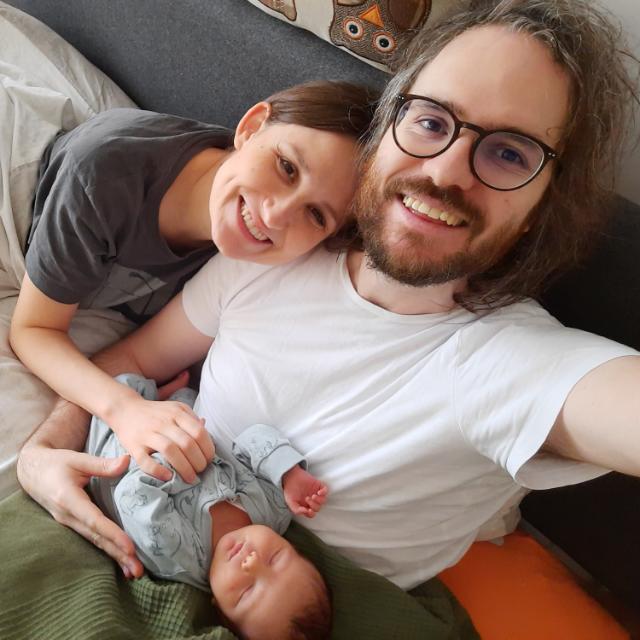
We went for breakfast with our daughter. Walking there, I felt a glow pass through me: I wanted this so badly and yet I could not believe it was happening. I breathed in the moment. When our food came, I insisted we take a selfie, so I would remember the hours after finding out, that secret time when your world changes and no one yet knows. 

A week later, one of my favourite influencers, a woman who has been documenting her struggles with endometriosis and IVF for years, announced her pregnancy. I cried with joy for her; big, ugly messy mascara-tinted tears. Our pregnancy was only one week apart.

My daughter demands to see the video of the “woman crying and laughing with the stick in her hand.” 

“Why did I not cry for us?” I ask my husband. “Why did we not cry for us?”

“It`s not our style,” he says. “We don`t scream on rollercoasters either.”

He is right. After so many years of agonizing over whether I could dare to indulge the deep and audacious desire to mother again, my joy was a quieter one, a creeping, cautious gratitude tinged still with an acute awareness that nothing can ever be taken for granted, especially not a safe pregnancy. 

Our daughter, aware that something momentous is happening, is clinging to me more than ever. My fatigue is so extreme that I often fall asleep in her bed while reading her bedtime stories. When she wakes in the middle of the night and sees me there, a huge smile spreads across her face. I bundle her in my arms and kiss her hair. 

“Maybe we should call our baby sheep,” she says. “Maybe,” I agree. 

She lays her still tiny hand on my stomach. 

“Your tummy is getting so big!” she says, adding “I also want to be a mama.”

“But also a bus driver,” I remind her. 

She nods. 

“You can be both,” I stress, remembering that everything is both personal and political. “How many children would you like?” 

“Ten,” she replies. 

Our surreal breakfast in Krakow
Mama

“I’m just going to stitch you up,” said the doctor. “You’ve lost quite a bit of blood.”

She was kneeling on the floor, looking between my legs.

“Okay,” I said. “Thank you.”

It was just before 5 in the morning, Sunday three weeks ago.

My newborn lay on my belly, and looked right into my eyes.

“We’d usually take you to the operating theatre for this, but I think you’re still numb enough from the epidural.”

I held my daughter against my chest. After a brief, reassuring cry, she inched herself upward, searching for my boob.

I looked at my husband, incredulous. His eyes were shiny bright.

For 36 agonizing hours of labour, her head had not moved. But when she finally came – coaxed out by a suction cup and my pure desperation – she seemed fully formed.

Eyes open. A head of dark brown hair. My husband’s face in hers.

She was perfect.

“Do you want to keep the placenta?” a midwife asked.

The bloody mass she was holding up like something you glimpse in the back of a meat delivery truck.

At once tremendous and terrifying.

“No thank you,” I said.

***

“I’m scared I won’t be able to produce any milk,” I told the nurse hours after delivery.

She pinched my nipple until a tiny bit of yellow goo came out. “You’re fine,” she said.

Colostrum!

Liquid gold.

I wanted to hug her.

Tiny, tiny drops of it fell from me during the night.

The joy and terror of my body sustaining another.

***

The womb was a timeless swamp. No such thing as night and day.

We get up late in the mornings. Eat breakfast in bed. Our baby girl between us, making us smile.

Everything is fluid

My bedsheets stained with milk. Huge pale yellow patches of it. Big clumps of blood still emerging from me as my organs squeeze back into place. And then the baby spits back up the milk.

***

There is a concept here called Wochenbett . It sounds old-fashioned to a half-foreign ear. But the idea is that new mothers need weeks in bed to recover. We don’t take it literally. But for the first three weeks, my husband does all the cooking. And nearly all the nappies, too.

***

The way he talks to her, as he changes her.

I knew he would be a good father. I always did. But he is far better than I could even imagine.

I listen to the stories he tells her. The softness of his voice. The way he looks at her. She could cry all night and his tone wouldn’t change. He has always had the patience of a saint.

***

She has his face, I think but when her expressions change, I see flashes of myself.

She can look kind of impish sometimes, nonplussed.

And there’s this luxurious stretch she does .. an act of gentle obstinanace.

And then she purses her lips like she’s mimicking someone haughty and posh.

All with her eyes closed.

And then sometimes she looks utterly heartbroken. Like she is watching tragedy unfold.

All of humanity is in her sleeping face.

***

She makes the most amazing sounds.

Eh? she asks. Eh? Eh?

Usually she is looking for food.

Eh! I reply.

As I unclip my nursing top her breathing gets faster, heavier. The pant of hunger.

***

We already have many nicknames for her.

Feral squirrel, when she lunges at me and bashes her little head impatiently against my boob.

Milkworm when she emerges sleepy with a red face covered in milk.

Spooky Sally today, when we dressed her in the little ghost costume my sister sent.

***

I’m so used to looking down at her little face when she feeds that when I look at my husband now, his face seems huge.

The algorithms are changing, too.

How to bathe newborn. How to clean umbilical cord. Newborn diarrhoea.

Yesterday, we looked through a photo gallery of baby poo.

“Was it seedy though?” I asked.

“Kind of.”

“Hmm. Keep an eye on it then.”

“Have you taken her temperature?”

“37.2. In the normal range.”

‘***

Writing this has been stop-start, all evening long.

Our little one has been especially unsettled.

We fed and we walked. We snuggled and we talked.

I insisted on finally doing some cooking.

Pumpkin risotto, for the day that’s in it.

Served seven feeds and three hours later than I’d hoped.

I knew it would be like this.

A few words at best, here and there.

Scraps of life.

As I type, in bed now – my eyes are closing.

As husband and baby sleep.

Outside, a late-night bus drives by.

***

Parenthood is more poetry than prose.

No coherence. Or conclusion.

Just the hard-won knowledge – imperfectly expressed –

That life is the most beautiful, fragile thing.

The rabbit cage

A few years ago, a large grey rabbit appeared in the hallway of the nursing home.

Residents would park their Zimmer frames and wheelchairs by its cage and stick their fingers through the bars.

The rabbit would twitch its nose in curiosity, and in response they’d exchange satisfied smiles.

Frau B told me it belonged to Alessandro, one of the care-workers. She said his girlfriend had thrown him out of the flat they shared and ordered him to take the rabbit with him.

This wasn’t true. But it was amusing, and so I went along with it.

I wasn’t sure Frau B really, truly believed it either.

Sometimes, when Alessandro came into the room, Frau B would say, “Here he is! The rabbit’s daddy.”

“It’s NOT my rabbit,” Alessandro would reply through gritted teeth. Then he’d slam the little cup that contained her painkillers down on the table and leave before she could say another word.

Frau B’s stories always had a dramatic narrative arc. When an old man named Mr Klein moved into the room next to her, she swore he was having a liaison with one of the women at her table.

She said she’d caught them looking at each other across the dining hall.

It was a most appealing tale which conveniently erased Mr Klein’s wife, who lives downstairs.

Still, I nodded indulgently.

As time went by, Frau B’s stories changed. They became less Mills and Boon.

She became increasingly paranoid.

The care-workers were coming into her room at night and eating her pears.

The cleaners were stealing her money and helping themselves to her jewelry.

The other residents were giving her dirty looks and talking about her behind her back.

She had deliberately been given a wheelchair with a faulty brake.

Frau B didn’t respond well to my attempts at gentle persuasion, so I mastered the art of deflection.

I’d listen as she catalogued the slights against her, then change the subject. I’d tell her about my friends’ love lives, or read to her from the Erich Kästner book.

For a while, it seemed to work.

But things are different now.

She insists that the staff  hate her.

And that the people she sits with at mealtimes are conspiring against her.

She sits in her room all day, ruminating about their treachery.

As a result of these perceived slights, this year, she is boycotting the Christmas party I’ve accompanied her to for the past five years.

The one where one of her favourite care-workers dresses up as Santa Claus and distributes gifts to every single one of the residents.

When I suggested she may regret not going, she became angry.

I didn’t bring it up again.

Last Sunday, when LSH and I came to visit, we found her looking for money.

She’d hidden it envelopes all around the room and couldn’t remember where she’d put it.

I offered to help, but she refused, in a tone that suggested she thought I wanted to pocket it.

We unpacked the shopping she’d ordered on the phone the day before: pears; hair slides (the long ones; she can’t grip the shorter ones with her arthritis-ridden fingers); two bars of chocolate and baby powder. We’d also picked up her jumper from the dry-cleaners.

“Is that all?” she said.

“Oh?” I said. “Did you need anything else?”

“You know I did,” she said. “Why didn’t you get grapes?”

I tried to explain as politely as I could that she hadn’t asked for any.

“And what about the pine branch?” she asked.

On this, she had a point.

She’d been talking about getting a small festive centerpiece for her table.

I’d actually bought her one already. But when I’d arrived with it last week, I discovered that her niece from Hamburg had been around in the interim and had supplied her with an alternative. It featured a glittery cut-out of a reindeer wedged inside a box of festive vegetation.

Frau B preferred mine, but thought it would be too risky to switch them in case her niece came back. On her instructions, I took the little pot home back home.

Photo from Katzi

Photo: LSH aka Andrew Hayden: instagram.com/andrewchayden

She did mention pimping her inferior centerpiece with a real pine branch. But she hadn’t brought it up again when I called, and – after a tiring week of getting up at half past three for work every morning – it had slipped my mind.

“So you’ve begun to exploit me too,” she said. “You think you can do what you like because I’ll forget.”

“That’s not fair,” I said, calmly.

“I told you I wanted a pine branch,” she said, her voice rising in anger.

“I’m sorry I didn’t get you one,” I said, curtly now. “I’ll get one this week.”

“You’re playing me for a fool.”

“Let’s read,” I suggested.

I thought it would help.

But she interrupted and said she needed the bathroom.

I let her wheel herself in and closed the door behind her – a small dignity she still insists on.

“Let me know if you need help,” I called after her.

LSH and I sat there, looking at our phones and whispering about how this wasn’t a very enjoyable visit.

Suddenly, a terrible cry came from the toilet.

I shot up and found Frau B hovering over the seat, clutching the bar with one hand and trying to pull her soiled underpants back over her knees with the other.

I re-inserted the sanitary towel that had slid down the inside of her tights, pulled up her underpants and tucked her vest into them.

Then she slid back into her wheelchair, and broke down.

“I can’t do this anymore,” she said. “I can’t go on.”

I bent down before her, and looked her right in the eye.

“Today is a bad day,” I said. “Tomorrow will be better.”

“I’ve been horrible to you,” she said.

“Don’t worry.”

“I need to get out,” she said. “I need to leave this room.”

We left LSH in the bedroom to ward of the thieves and I wheeled her up and down the corridor.

When we came back, some of the darkness had lifted. I made up stories about my baby niece I knew would make her laugh.

Still, a heaviness accompanied LSH and me home that evening.

The next day, I called her on my way home from work.

“Who’s this?” she said.

She sounded agitated and I realised she would have to strain to hear me above the traffic.

“Das Kätchen!”

“Kätchen?”

“Yep, it’s me.”

“I wasn’t expecting you.”

“I just wanted to see how you were.”

“I’m feeling ashamed,” she said.

“Don’t,” I said.

“I treated you terribly.”

“It’s nothing.”

“And to think that after everything I said, you still call me.”

“I was worried about you.”

There was a pause on the other end of the line.

“I often think I’m no longer capable of crying,” she said finally. “But the thought that there’s still someone who worries about me is enough to make me shed tears of joy.”

Now it was my turn to pause.

Then, in a matronly tone designed to stop me from welling up, I said: “Of course I care! How could I not?”

We hung up just as it began to drizzle.

As I walked on towards the train station, I imagined her watching the clouds form from her bedroom window, imprisoned in a cage she had a part in making.

Why I’m a tree hugger and you should be too

When Frau B looks out of her fourth-floor bedroom window, she sees two tall trees. On the left is a spruce. Its mass of deep-green needles presents a burst of colour all-year-round.treehuga

But she’s more interested in the maple tree beside it. Each September, she watches its leaves turn from vibrant green to grimy brown and yellow. A few weeks later, the wind snatches them away, leaving a stark tangle of branches for Frau B to observe during the winter months.

At the age of 97, even she is a whipper-snapper compared to a tree.

When I told her the other day that scientists in Norway had discovered a 9,500-year-old spruce, she sighed.

tree2

a tree community in Volkspark Humboldthain

“Mich nimmt der liebe Gott auch nicht,” she said, meaning ‘God won’t take me either.’

It’s something she says quite often, usually with a smile. This time, it conjured up an image of a long line at the gates of heaven. When Frau B eventually gets to the top, she is rejected alongside a Norwegian spruce. Together, they lament the curse of their longevity.

In the past few weeks, my relationship to trees has morphed from passive appreciation to zealous awe. Peter Wohlleben, the author of The Hidden Life of Trees is mostly responsible.

The book was an impulse-buy, having met my three criteria for spontaneous literary purchases: an inviting title, a pretty cover and the promise that I would be a slightly different person after reading it.

My transformation has become especially apparent to LSB, who now finds himself at the receiving end of a barrage of excited outbursts:

“Do you know that trees use fungal networks to communicate?”

“Woah! You will NOT believe this! Trees can detect the saliva of insects and use THAT knowledge to send out chemicals to attract their predators!”

bark.jpg

tree bark in Volkspark Humboldthain

“Okay, I promise this is the last one: did you know that parent trees deprive their children of LIGHT in order to keep their growth rate steady?”

“…I know, I know: I’m sorry but I just have to tell you this: trees of the same species INFORM each other about impending environmental threats!”

At first, he listened politely, nodding occasionally as he scrolled through his phone. But as the days turned to weeks and my enthusiasm failed to wane, he advised me gently that I was putting the “bore”into arboreal.

It hasn’t stopped me though.

What I find so extraordinary about trees is in fact quite unremarkable: they’re just like us.

They have memories, which they can pass on. Communication happens via a sophisticated electric network forged over millions of years. The sick are nursed and the tendency is to protect one’s own.

Eventually though, like you, me and Frau B, they breathe their last and descend into the ground. There they turn to humus and enable new life, once again, to begin.

trees

a sick tree is propped up by its neighbour in Volkspark Humboldthain

Lidl children

Whenever I go to Lidl, the cashier asks if I’m collecting the football stickers. When I say “no,” she looks surprised and a tiny bit relieved.

Yesterday I went to another branch closer to work. There were loads of little girls loitering at the entrance, eyeing up the customers. If they had been bigger, I would have felt very threatened.

This time, the cashier simply handed me two football stickers with my receipt.

Outside the shop, the girls lunged at me.

“Did you get a football sticker?”

I rummaged awkwardly in my bag.

“ME! GIVE IT TO ME, GIMME!” they cried.

They were encircling me now, like prey.

“Give them to me, PLEASE!” the ringleader of the group said, coming very close to me. She had a long black plait and reached up to my shoulder.

I looked around helplessly at the many eager faces.

I picked out the one I found least threatening because it was furthest away.

“Are you collecting them too?” I asked her. She nodded shyly.

“She’s my sister!” the girl with the plait shouted.

“Are you really?” I asked the quiet one.

“Yes!”

“We’ll share,” the plaited girl said.

I gave up and handed her the cards.

“Promise you’ll share?”

“PROMISE!” she said, grabbing the stickers and running away.

The others followed her like wolves.

Image source: www.lidl.de

Image source: http://www.lidl.de

When I was a little girl, my mother used to buy me rolls of stickers from the Pound shop. I stuck the best ones in a special sticker album. I kept the rest in a plastic case for future use decorating envelopes and sticking on dolls.

My album contained an entire section of glow-in-the-dark grasshopper stickers. My piece de resistance was a hologram sticker that glimmered green, blue or yellow depending on how you looked at it.

These days I don’t collect anything except for empty beer bottles. There must be about sixty in the kitchen now. Some day soon, I’ll bring them back to Lidl and get an enormous “Pfand.”

I’ll probably spend the “Pfand” on more beer. Then I’ll get more football stickers, which I’ll pass on to another pack of schoolchildren.

The circle of life.

World Apart

I get the U8 to work.

Berliners call it the Drogen Linie – a title it’s earned.

Men and women with drooping eyelids and sad shuffles inhabit the line.

On the platforms, people with trolleys containing their belongings shine torches into bins looking for bottles to recycle.

Once, a girl with black eyes got on my carriage. Her dark hair was pulled back loosely and she had on a flowing skirt. She was breast-feeding a big baby, who was clinging on to her very pregnant belly. The baby was playing with a copper coin.

It toppled to the carriage floor. The lady sitting opposite picked it up and handed it, almost apologetically, to the girl. She took it. Her fingernails – black with dirt. She was no more than fourteen.

I get out at Gesundbrunnen, in the middle of the line. In the eighteenth century, the area was famous for a spa dedicated to the Prussian Queen Louise.

source: Wikipedia

source: Wikipedia

When it joined the city of Berlin a century later, Gesundbrunnen became a working class district. Today, over half of its residents are people Germans describe as having a Migrationshintergrund, or “migrant background.”

The term includes people like me but in the media it’s almost synonymous with second and third generation Turks whose parents and grandparents arrived in the 1960’s and 70’s as Gastarbeiter – guest workers – to help build up post-war broken Germany.

The area is home to a sprawling mall called the “Gesundbrunnen Center.” It’s right next to the train station, which is also the starting point for tours of Berlin’s former bunkers.

The mall is always full. It is like every shopping centre, with an enormous H&M, plenty of stalls selling implausibly fragrant nuts and lots of red-faced children weeping tears of indignation as they are dragged from shop to shop.

To ease the suffering of those unfortunate children and their parents, an enterprising group has recently set up a pony-rental service on the ground floor. The ponies are life-sized stuffed animals on wheels. They come in three sizes and their prices vary accordingly.

The children glide along; their backs held straight and their expressions changing rapidly from concentration to joy. Their parents point smart phones at them to preserve the ride for posterity.

Close to the ponies-on-wheels there is a pet store. I go there to look at the guinea pigs. Earlier today, a sales assistant with pale skin and lots of piercings opened the snake cage to spray water inside. A woman wearing a headscarf looked on curiously.

“Are they poisonous?” the woman asked, pointing to two grotesque snakes coiled around each other, exposing their forked tongues every few moments.

“No. We don’t sell poisonous snakes,” the member of staff answered in a remarkable monotone.

The snakes are fed with dead white mice. I wonder if the store is supplied with dead mice or whether they simply taken them from the cages selling mice as pets. If the latter is the case, I wonder how – and where – the killing takes place.

On the street leading to my office, there is an unassuming and cheerful cake shop. It sells pieces of kiwi sponge for a euro and boasts a special blend of Arabic coffee. It’s family-run and open late. In the evenings when it’s quiet, the teenage daughters take care of the tills and bring you coffee. They seem well brought-up. One of them sports charmingly chipped red nail polish.

There are high-rise blocks of flats along the entire road. Chained absurdly to a lamppost outside one of the buildings are two plastic cars for toddlers.

None of it is my world. But sometimes I realise that being an outsider is where I feel most at home.

How to turn flat-hunting into a hobby

Regular readers know I’m more than a bit of a creep. I stare unashamedly at strangers and note down snippets of conversations I hear on trains. And – no I am not joking, LSB got me a periscope for Christmas.

So, despite the well-documented tedium of finding a flat in Berlin and a certain Mr Humphreys who tried to scam me into moving into a restaurant, looking for a flat over the past few months has provided me with a welcome opportunity to poke around thirteen strangers’ homes without getting arrested.

Prenzlauerberg  Source: Wikipedia

Prenzlauerberg
Source: Wikipedia

One such stranger was Jürgen. He and his wife were giving up their apartment in Prenzlauerberg to move into something bigger. Their neat second-floor flat overlooked a street full of restored period houses which had been painted green.

LSB and I were only vaguely interested in the flat because the advertisement had mentioned that applicants willing to buy the in-built hall cupboard for €1300 would be preferred.

The moment we walked in we knew it was not for us. The flat was oddly misshapen – a hexagonal kitchen jutted left off the hallway and the bedroom straight ahead was small and windowless. It looked vaguely like the nearby bar dedicated to life in the GDR.

But we continued on anyway, browsing awkwardly and exchanging false smiles with our prospective competitors. As we were trying to make a beeline for the front door, Jürgen – bespectacled, earnest and thoroughly decent- caught us.

(We had decided that when looking for flats, we would play by ear whether to tell people that LSB was only beginning to learn German. In some cases, I simply translated and in others, people were all too eager to practise their English.)

Jürgen however was unconcerned about LSB’s language skills. All he wanted to talk about was his hall cupboard.

“Schau mal,” he said, opening a long mirrored door. “I built this myself. It is a perfect fit.”

“Mmm” said LSB appreciatively.

An entirely different cupboard which I probably would pay for. Source: Wikipedia

An entirely different cupboard which I probably would pay for. Source: Wikipedia

“And take a look at this!” he said, showing us some shelf fittings.

We listened politely as Jürgen continued to speak extensively about his carpentry.

Every now and then, LSB nodded in confusion and said: “Ah!”

Jürgen, delighted with the enthusiastic, if deferential response, pulled open yet another door.

This went on for ten minutes and concluded with: “A better cupboard for this spot you will not get.”

Back on the street, LSB said: “I didn’t understand a word of that.”

I didn’t understand much, either.

But I liked Jürgen. He was an uncomplicated, dignified kind of person who took great pleasure from his work. There was nothing cynical about his spiel. He really just wanted to speak at length about his self-built cupboards.

Tania from Tiergarten, on the other hand, did not wish to speak at length.

When we arrived for a private viewing of her apartment, she opened the door slightly and said: “Schuhe aus!”

LSB and I almost tripped over each other in the attempt to remove our shoes at speed.

We proceeded in and received a swift, efficient tour of the airy apartment, which we learned was to be rented out unfurnished.

The most remarkable thing about the bedroom was a colossal square of purple on the otherwise white-painted wall.

Tania motioned to a large tin of paint sitting on a table.

“Should you take the place, you will be contractually obliged to paint over the purple square. I have purchased paint for the purpose. I don’t have time to do it.”

We nodded. We would learn to do a lot of that as our flat hunt continued.

Next up was a flat in Friedrichshain, a punk-friendly area in the east of the city where I lived when I first moved here.

Tim, the young man offering the flat, was a DJ who was going travelling for a year.

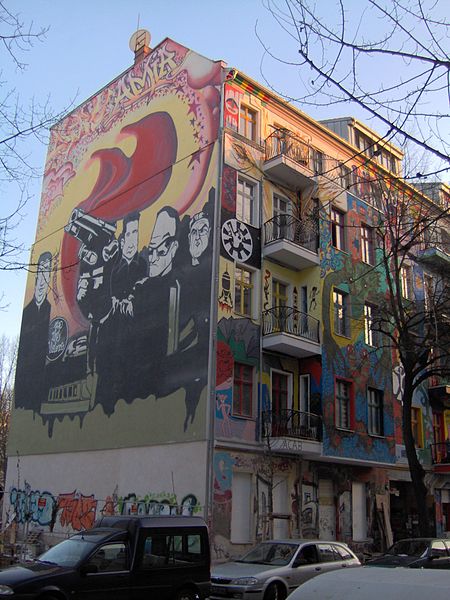
The entrance hall of the large front house was like a cringeworthy movie set dedicated to Berlin’s “alternative scene.” No centimetre of the wall was free of graffiti, which featured slogans such as “Fuck the police,” “The revolution begins now” and “Go vegan.”

A house in Friedrichshain (not the one we went to) source: Wikipdia

A house in Friedrichshain (not the one we went to) source: Wikipdia

It was horribly dirty. To get into Tim’s flat, we had to cross a pitch-black yard. As we were making our way to the door, a large terrier bounded at us out of the darkness. I didn’t scream. When I am terrified, I go mute.

We made our way up the graffitied stairway to Tim’s place and rang the bell.

Tim had shaggy hair and glasses.

“Hey, you guys,” he said. “You found it! I know the buildings are pretty run-down man, but you got the best one here.”

The flat stank of smoke. Tim led us past the kitchen, where a pile of dirty dishes towered next to the sink. There were hundreds of records on the shelves in the hallway.

In the living room was a tatty armchair and a fridge. “For the beer! Nothing better than having a nice beer ready for you when you stumble home at 4 am!”

LSB and I nodded excessively.

“Cool,” I said.

“Very handy,” said LSB.

“And of course you guys can smoke in here! No problem at all,” said Tim.

“Brilliant!” I said.

(LSB and I do not smoke.)

“The only thing really,” said Tim – “don’t touch the records. At all. They are my babies.”

We saw ten other places. Writing about them all would be boring.

Suffice it to say, one of the strangers became our friend. It’s unsurprising really because she has a corner couch and a Goethe quotation painted on the wall. I’d be lying if I said I’d always wanted a Goethe quote, but the corner couch has been a dream of mine for quite some time. She also has a copious supply of kitchen utensils.

She left us a crate of beer, a charming welcome note and plenty of shelf space.

LSB and I have colour-coded our books. We have a red, blue, green and yellow section.

And even though our small, north-facing balcony overlooks a car park, there is a school building across the way.

Some mornings, I peek out from behind the curtains and try to make out the teacher’s power point presentations.

Kate Katharina appears in rag, LSB brings home bottled water

Some of you might have noticed that I’ve been blogging less since LSB moved here. But, as my psychology professor used to enjoy pointing out, correlation does not equal causation.

I mean, of course we do spend the occasional evening in streaming epsiodes of 7th heaven. (We’re on Season 5 – Mary is in big trouble because – instead of going to college – she’s working at a pizza joint where she makes unsuitable friends who smoke pot and have premarital sex).

The Camdens of 7th Heaven. Image source: Wiki Media

The Camdens of 7th Heaven. Image source: Wiki Media

But, truth be told, most of the time we are awfully busy having our own lives and co-habiting on the side.

Take this week for instance. LSB started an internship at an advertising agency, where he gets “thinking time,” free yoga classes and and an endless supply of bottled water. (His interview for the position took place on a bean bag).

I, on the other hand, made it into the notorious BILD tabloid – Germany’s equivalent of the Daily Mail – with the seniors’ blogging project I co-founded last year. The blog – Berlin ab 50 is a place for the over 50’s in Berlin to share their experiences of getting older in the city.

Safe to say, I was a little bewildered that BILD – the world’s second best-selling newspaper with a circulation of nearly four million requested an interview with us.

And cynic that I am (in fairness, BILD is a rather nasty publication) I wondered whether my group of senior bloggers – three of whom are in their sixties – were sitting on a big dirty secret. Had they been in the Stasi? Had an ill-advised fling with a high-ranking official?

With a gulp, I wondered whether perhaps I was the villain of the story. However, I quickly realised I was far too much of a square to make it legitimately into the pages of a rag. Bloggers in BILD! source: http://www.bild.de/regional/berlin/berlin-aktuell/drei-seniorinnen-haben-einen-internet-blog-34082682.bild.html

Well, as it turned out, the BILD journalist was a very nice young woman who spent a whole hour asking us questions about our blog. Her colleague – a thin photographer who tried not to look bored during the interview – got the three seniors in the group to pose with laptops and smart phones around a table on which he had strategically placed some coffee cups.

The article, which you can see here, leads with the bold headline “We are Berlin’s oldest bloggers.”

Of course, our hits went through the roof. And then we started getting media requests from everywhere. We’ve even been invited to go on television.

I know.

Speaking of television, you’d be surprised how many people write to it.

You see, another reason I’ve been awfully busy in the past few months is that I’ve taken on additional job at the international broadcaster where I work. It’s in the Zuschauerpost or “Viewer Correspondence” department and it’s my job to answer the e-mails and letters people send to the television station. When I took the job lots of people said: “Why on earth would you want to do that? Only crazies write in to TV stations.” To them I say: perk of the job.

I get some very sad mails from people in developing countries who have access to a television but not to adequate medical care. And I get some very entertaining complaints. I derive a guilty pleasure from composing eloquent replies to ridiculous requests.

But it comes on top of my regular job as a writer and translator at the company, my shifts at The Local, my senior’s blogging project and my treasured visits to Frau Bienkowski.

Oh, and did I mention LSB and I found a flat? And moved into it?

preparing for a 7th Heaven session.

preparing for a 7th Heaven session.

Well, we did. More on all of that to come. But for now, it’s time for beer and a bit of 7th heaven. Got to get our priorities right.

(By the way, this post from The Atlantic about the worth of blogging as a medium, inspired me to finally sit down and write a post again! Check it out- it’s definitely worth a read)

Christmas with Frau B

Willy Brandt wouldn’t really have been my type,” Frau Bienkowski says, examining the Tagesspiegel’s full-page spread in his honour.

“Nor mine” I say.

“He was a bit of a womaniser.”

“Well, just as well he’s not our type!”

Willy Brandt  source: Wiki Media

Willy Brandt
source: Wiki Media

She laughs. “Shall we get some coffee?”

“Sure!”

“So Katechen, tell me about your week.”

I tell her about my friend’s visit and our trip to Dresden. And about work and the Christmas parties I’d been to.

She tells me her niece is arranging a little Christmas party for her and that the cooks downstairs have agreed to roast them a goose.

This will be Frau B’s 95th Christmas. She has decorated her room with electric candles (real ones are deemed too hazardous in the home), a bunch of deep red flowers and a table cloth she made herself.

We agree that Christmas is an event choreographed by women and enjoyed by men.

“I remember my father standing by the fire once. It was just after Christmas and he was saying ‘Oh, it’s a wonderful time of year! I could do this all over again.’ Quick as lightening my mother piped up ‘No wonder – you didn’t have to lift a finger! ’”

Frau P smiles. “I’ll never forget that!”

I take out my gift for Frau P.

It is poorly wrapped in grey tissue paper.

She opens it gingerly and fingers the picture frame.

Because she has impeccable manners she says immediately: “Oh, it’s lovely!”

But I can tell she hasn’t seen it properly yet. I wait for a moment while she examines it more closely.

“Is that… us?” she asks.

“Yes!”

“But when..?”

“Do you remember my parents when my parents came to visit in the summer?” I say.

“Oh yes!” she says. “Thank you, Katechen – that makes me really happy!”

“Now,” she says. “It’s my turn.”

“What? Frau B … you’re shouldn’t have.. ”

She hands me a little package wrapped in reindeer-themed paper. “It’s just five bars of chocolate,” she says. “You know I can’t get out to the shops.” Then she presses an envelope into my hand.

“Open this at home,” she says. “It’s for you and Andrew. I made an attempt at writing but you know I’m no longer capable of it.”

I stammer a thanks and tuck the envelope into my bag.

I pick up the book about the Irish nuns.

(My current fine on it is €8.75)

“It’s amazing how long we’ve been at this,” she says. “We are just so good at chatting!”

“I reckon we’ll have it done by this time next year,” I venture.

“Oh come on Katechen,” she says. “How long are you expecting me to live?”

“Oh, there’s life left in you yet!” I say – brightly because that is the only way to talk about death to a 95 year-old.

Later on at home, I open the envelope. Inside is €30.

I can’t make out much of what it says in the card inside but I can discern the word “Katechen.”

On life and death and the sanitary towels in between

“I thought that at my age I could no longer cry,” said Frau Bienkowski. “But this morning, the tears came.”

Frau B had spent the whole day trying to get hold of a packet of sanitary towels because ever since her hip operation, she has been unable to retain water.

But the person in charge of making the fortnightly order was on holiday and nobody had thought to take over his duties.

In the end, one of the volunteers popped over to the chemist’s to pick some up. They weren’t the right kind, but they would do for now.

“I’d be lost without Frau Lintz,” said Frau P of the lady in question.

The nursing home is short-staffed because there have been an unusually high number of deaths over a short space of time, leaving several rooms empty.

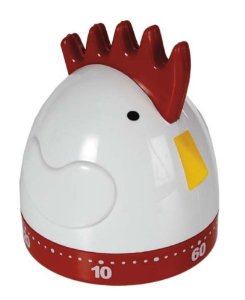
Frau B's egg timer. Source: www.amazon.com

Frau B’s egg timer. Source: http://www.amazon.com

Money is tight and management won’t increase the staff-patient ratio. So when a certain number of residents die without being replaced, the carers lose their jobs too.

Death at the nursing home is a small table placed outside a bedroom door. On it is a candle and a framed photograph of the deceased.

A few months ago there was a table outside the room opposite Frau B’s.

“The lady across the way died,” Frau B said, matter-of-fact.

And another time she said: “Every night when I go to sleep I pray that I won’t wake up.”

In other circumstances, the sentences might sound tragic.

But if I have learnt anything from my weekly visits, it is that welcoming death is not the same as abandoning life.

Frau B and I are seventy years apart but we talk like sisters – about boys and clothes and death and what’s in the news.

image source: centralavenuepub.wordpress.com

image source: centralavenuepub.wordpress.com

We laugh out loud at the absurd hen-shaped egg-timer she’s been given instead of an alarm clock and I bring her several packets of the sweets her doctor has told her not to eat.

We continue reading the book about the cantankerous Irish nuns, even though we get through about ten pages each week and I’ve been paying library fines for months.

Recently, we found out that we both get dressed up for my visits.

“Sure who else notices what I’m wearing?” Frau P asked with a smile and I told her I felt the same way.

So if death is a small table, life is the perm Frau B insists on getting touched up every week.

And the moments we spend laughing at silly hen-shaped egg-timers and the humiliated tears we shed about elusive sanitary towels are the beautiful and tragic bits that happen in between.