Meat

Once upon a time, people thought black people should serve white people, gays should be killed and children should be seen and not heard.

Lots of people who thought that way were kind and charitable too. Among them were devoted husbands, loving wives and generous uncles.

It took hundreds of years for things to change. Now directors make films about Americans quarrelling about slavery, men loving men and sad, lonely children in big houses.

I think in the future, the films will be about charismatic vegans speaking out against factory farms.

Image Source: tmsfoodie.wordpress.com

Image Source: tmsfoodie.wordpress.com

This isn’t really a post about eating animals, but if you’re into that, I’d recommend reading Jonathan Safran Foer.

It’s about suffering caused by ordinary people.

Conditions for animals in farms the world over are so bad that watching a video about what goes on in ordinary farms almost makes me sick.

The suffering is so great you can barely even imagine it.

The animals we eat go through agony. The happiest moment is their death.

Most people know this in principle. They’ve seen the odd video about factory farming, read the occasional rant in favour of veganism and realised they’d feel pretty bad about eating their pet dog.

But they haven’t quite thought about it for long enough. Like me, they’ve turned off the videos when things get too uncomfortable and skimmed the final few paragraphs of those moralistic articles. They’ve conveniently and falsely associated the vegetarian/vegan diet with a hippy lifestyle, which they’re too busy paying taxes to support.

They’ve mistaken the argument against supporting sadistic cruelty with the one against eating meat at all. Some say “well, that’s the order of things” and others wear ironic t-shirts that say “Meat is murder. Tasty, tasty murder.”

Though I don’t eat meat, I’m not against it in principle. Having been a vegetarian for many years, the idea seems very strange to me, but should my health depend on it, I would go back to it. And I would sooner eat road-kill than a cheap burger. It is not the fact of the animal’s death that disgusts me, but the horror of the life it must endure.

The most important thing for me is to avoid contributing to needless, unimaginable suffering.

Living ethically is difficult. I’m no great example. Last week I bought six eggs from a lady with wild, white wiry hair selling her produce from a trailer. I made an omelette. Later when I looked carefully at the stamp on the remaining eggs, I saw that they had the second lowest rating for quality. I’d eaten eggs produced by hens kept in deplorable conditions.

Here in Germany, the “organic” industry is being rocked by a scandal of deception and mislabelling. It turns out that the expensive and well-sold “bio” products are not quite so bio after all.

According to my own principles, I should go vegan. I’ve thought about it and am held back by two factors: the fear that my health would suffer, and the high cost of animal substitutes designed for vegans.
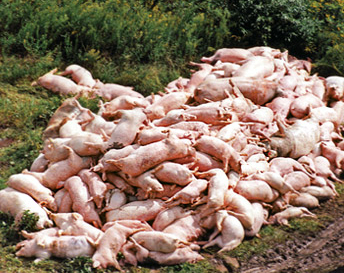
Image source: www.change.org

Image source: http://www.change.org

The world we live in can seem farcical. I can follow the whims of celebrities across the world on Twitter, but I can’t tell you where my yoghurt came from.

I’ve lived in a city all my life. The only foods I’ve sourced have been blackberries from the garden, or the occasional potato at the bottom of the compost heap.

I am ignorant but not naïve. There is another way and it starts with widespread exposure to the horrors of modern farming. Looking away has always been the surest way of supporting what is immoral. Consumers of animal products have a moral obligation to find out about the industry they’re supporting.

The argument that everything is about profit has been brought to an immoral extreme in many industries, but in farming it has been bizarrely accepted.

Part of what makes humans put themselves on a pedestal above other animals is what many identify as a superior capacity for moral reasoning. The irony of that assumption in the context of the conditions allowed for meat production should not be overlooked.

I am no paragon of morality. But education and information have made me change my habits for the better. I’ve still far to go.

I firmly believe that the scale and depth of suffering being inflicted by humans on animals in our time will be the stuff of horror history documentaries in the future.

Our descendants will ask “How did people do nothing for so long?” They will consider us barbaric and sadistic. They will pity us for our immoral economy and greed. They will question how things went on for so long, even in a time of instant, mass communication.

None of that will happen soon. But give it a few hundred years, and people will say that among those who supported these practices were devoted husbands, loving wives, generous uncles, and even passionate pet-owners.

Watching the snow with Frau Bienkowski

“You should always avail of the free coffee here,” Frau Bienkowski said. “Sure, why wouldn’t you?”

“I did,” I assured her. “I had a latte downstairs. It was delicious.”

The dress Frau Bienkowski admired

The dress Frau Bienkowski admired

“Good,” she said, looking at me closely. “Now, this is a dress I haven’t seen before! It’s lovely!”

“Thank you!” I said and admired her pastel-coloured floral two-piece.

Outside, thick snowflakes were swirling in the air. “It’s such a shame about the weather,” said Frau Bienkowski.”I still have to give you a tour of the grounds.”

“And you promised to tell me the story behind the funny little statue outside,” I said.

“Don’t worry, I haven’t forgotten!”

“How have you been sleeping?”

“Not well,” said Frau Bienkowski. “The other night I was awake the whole night. When the alarm went off at 7 o’clock I just couldn’t face getting up. So when the first lady came in, I had to think of some reason to stay in bed, so I told her I had a headache.”

“She asked me where,” Frau Bienkowski continued, smiling wickedly. “So I waved my hand about and said from front to back. Of course they got the doctor to check up on me. Then they took my blood. And of course I’d a perfect reading.”

I laughed. “Would you not tell them you’ve trouble sleeping?”

“Ach, I told you before, I haven’t been able to sleep since my husband died. And that was a long time ago.”

“Do you listen to the radio or watch TV in the evenings?” I asked.

“Oh yes,” said Frau Bienkowski. “I only watch television in the evenings. But listen to this; the other day a message to turn down my TV came from a lady all the way down the corridor. There was no way she could have heard it. I even asked my next-door neighbours if they could hear my TV. They couldn’t. Sure we are all hard of hearing here.”

“Difficult neighbours can be found everywhere!” I said.

“That they can,” she said. “Now, tell me about these CD players.”

“Well, I did a price check,” I told her. “And the ones with the decent speakers are about €50. The smaller ones with low quality speakers are around €30, but you wouldn’t be able to hear from bed if we plug it in over there.”

“We’ll have to wait so” said Frau Bienkowski. “I spent €12.50 on that coffee jug last week,” so I can’t afford to spend any more money for a while.”

Frau Bienkowski looked at the clock. “Be careful you’re not late for your night shift!”

“Don’t worry, I’ve my eye on the time,” I told her.

“How long are you working tonight?” she asked.

“Until 2.30 in the morning,” I said. “When I’m on my way home, you’ll be awake in bed, hopefully with the radio on.”

“Yes,” she said.

On Love

I grew up in a large, cold house. In the winter, I would curl up beside the gas heater until I became dizzy from the fumes. We didn’t have anything fancy like instant hot water. If you wanted to have a shower, you had to plan at least 40 minutes in advance. Waiting for the water to heat up was an opportunity to work on my juvenilia, or to stare at people on the street below.

It was character-building, nineteenth-century-style.

It was the kind of cold that seeps through to your bones. Sometimes my father would suggest I dip my blue-white fingers into boiling soapy water to get the blood flowing again. Other times my mother would enter the kitchen in mid-summer and drape a gigantic coat over my shivering frame.

Like in all good Victorian novels, love shone through in actions, not words.

Earlier when I was wracking my brains about how to write about love in a way that was not insufferable, a memory – one of my earliest- popped into my head.

I was a small child, well below school-going age. The house was, you guessed it, cold and I was waiting virtuously outside the toilet. My mother emerged and lifted me onto the pea-green seat.

She had pre-warmed it, like a mother hen.

That was love.The Gift of Warmth

In my formative years, I continued to gravitate towards those providing warmth. I became enamoured by electric heater salesmen and canteen staff with large ladles of steaming hot soup.

Romantically too, I have favoured those offering to make me warmer. LSB’s shaggy hairstyle, spare coats and facial hair have proven to be a winning combination.

And I have to give it to him: LSB was quick to pick up on my requirements. Once in our early courtship, I was on a bus on the way to Crumlin. It was a dark and dreary night and we were going to a party. When I got off the bus, I found him waiting with a hot-water bottle.

That went down so well that on the New Year’s Eve just passed, he packed it again for our walk up Calton Hill.

A warm and fuzzy feeling, on demand.

Happy Valentine’s Day. This year, consider giving the gift of warmth.

Another cup with Frau Bienkowski

When I arrived at the nursing home earlier this afternoon, I passed a group of ladies pushing Zimmer frames and wearing feathered masks. Before I went up to Frau Bienkowski, I ordered a coffee downstairs. I was served by a lady with whiskers and a tail.

Frau Bienkowski said she would prefer to forgo the carnival celebrations downstairs, but we turned on the TV and watched an enormous red float make its way through the centre of Duesseldorf.

“When I was young,” Frau Bienkowski said, “we didn’t dress up that much for Carnival. But we had a masquerade ball.”

masq

“At midnight, you would take off your mask to reveal your face to your dancing partner.. Of course it wasn’t always a surprise. You knew some people by their hands, or the way they moved.”

She paused. “You aren’t wearing that beautiful pattern today,” she said, studying me carefully. “But that skirt is nice too.”

I complimented Frau Bienkowski on her green two-piece suit.

Then I emptied out my bag. “I brought something for you,” I said.

“Oh?”

“Well, since you said you liked reading, but that your eyes were no longer quite up to it, I took out some audio books from the library.”

“Audio books?”

“Yes, here have a look.”

“I didn’t know there was a such thing as audio books,” she said. “And you can take these out of the library?”

“You can! And you can even borrow films too,” I said. “Now, if you’ll excuse me, I have to go and borrow a CD player.”

“Will it be big?” asked Frau Buenkowski.

“It might be,” I said.

“Here, take this,” she said, pushing her Zimmer frame over to me. “And would you mind picking up some coffee too?”

I made my way down the hallway to the communal sitting room. Five ladies in wheelchairs were seated around a table, eating cake and drinking coffee.

“Did you hear the Pope has resigned?” said one.

“Oh, I knew that already!” replied another.

“On grounds of age,” chirped in a third.

I unplugged the CD player and popped it inside the basket of my Zimmer frame. I filled up two cups of coffee and balanced them precariously on top.

Frau Bienkowski and I listened to a few minutes of a German novel, read by the author himself.

“Do you think you might like this?” I asked.

Frau Bienkowski nodded. She looked happy.

“Which library did you go to?” she asked.

I told her. “Did you know that the building used to be a Sparkasse bank?” she asked.

I didn’t. “It was a vault, which the Russians plundered after the war. Back in the day, people had less jewellery, and they used to bring it there for safekeeping. One of my friends never saw her necklace again.”

My eyes were becoming wider. “Anyway,” Frau Bienkowski continued. “Tell me about what you’ve been up to.”

I told her I’d worked a rather uneventful night shift last night. Frau Bienkowski laughed. “It’s not every day the Pope resigns, is it? I don’t know why they picked someone so old in the first place.”

Frau Bienkowski, like me, suffers from insomnia. Hers is much worse. “I haven’t been able to sleep since my husband died,” she said. “Last night I was awake until 5 o’clock, but I got up again at 7. Routine is important.”

I asked her if she was plagued by racing thoughts.

“No,” she said. “My husband and I used to have wonderful times together. We went to the museum a lot. I have a wonderful talent to recall these happy thoughts. Some other people are riddled with anxiety at night, but I simply think of these good times with my husband.”

We talked for two more hours and I said I would call Frau Bienkowski later that week. She looked at me. “I never want you to feel obliged to come see me,” she said.

Frau Bienkowski, forgive me my bluntness but you could not be further from the mark. And this week, I am going to buy you a little CD player from Medienmarkt.

Shine, Jesus, Shine.

I can’t pinpoint the exact moment it became cool to join the Christian Union at school. All I know is that one day people were carefully tearing away the threads that bound their little blue hymn books together and the next you were being shoved out of the way for a go at the Prayer Wall.

Testimonials became all the rage. Powerful, popular student speakers would address school assembly and describe their conversion at pop concerts. The Christian Union band became a staple feature of morning gatherings and suddenly everybody was belting out Shine, Jesus Shine as if their lives depended on it.

My best friend and I set out on a surveillance Mission. One Friday after school, we walked in on an Open Mic prayer session. The cream of the crop were gathered in a circle, waiting patiently for their turn with the mic. A tall brunette girl with ringlets finally got her go. She clutched the microphone, shut her eyes tightly and said “Dear God, please help me not do something I regret on Junior Certs results night.”

I was amazed, because I was doing all I could to prevent divine intervention on Junior Cert Results night.

The Junior Cert is a set of exams that Irish school children take when they are 15. They sit in sports halls with no windows and answer questions about Romeo and Juliet, Pythagoras’ theorem and volcanoes. During the exams, the sun comes out and shines all over the country. Flowers blossom and birds sing. When the adjudicator says “Pens down” after the final exam, it begins to rain.

Anyway, “results night” is when under-age teenagers sneak their way into night clubs around Dublin. The girls are usually naked and the boys wear oversized shirts with their collars pulled up. If things go to plan, the next morning the streets will be lined with neat little pools of vomit.

I had done hideously well in the Junior Cert. So well, that cool boys in the corridor cried my result at me whenever I passed. I thought the way they yelled “12 As” every time I went by was flirtatious, until somebody suggested that I was being bullied, which seemed more plausible.sh

Anyway, as I was ironing my hair that night, I decided it was high time I started drinking alcohol. Contemporaries had been doing it for months, and I felt I was missing out on a developmental stage. I thought the prospects that night were good. I had an invitation to a party at a boy’s house.

I made sure my hair was flat and lifeless before I headed out. When I got to the party, it was still bright and everyone was in the garden, bouncing on a trampoline. I joined them, certain that the illicit activity would begin after dark.

As dusk was settling, I spotted some boys retreating behind the bushes. One of them caught my eye. This was very promising. We exchanged a dangerous glance. I slipped off the trampoline and into the cover of a suburban hedge. An Evian bottle was being passed around. It was dirty and there was murky liquid inside. “It’s a mix,” one of the boys told me.

I thought for just a moment about cold sores, and about how once you got the Herpes virus, you have it for life. But then I remembered that alcohol was a prime ingredient in many household cleaning products, and my spirits lifted again.

I took a swig. I put great effort into appearing underwhelmed. The bottle got passed around. Before I knew it, it was empty and ready for the recycle bin.

I wondered whether it was possible to be so drunk as to not notice any effect at all. I tried hard to identify the symptoms of intoxication. I wondered whether I might be unsteady on my feet, but my legs stubbornly obeyed my commands. I thought it might be an idea to display irrational behaviour, but I was painfully uninspired.

I’ve always been confused by behaviour that occurs while drinking alcohol. You see, you just never know if the behaviour and the alcohol have anything to do with each other. The very last thing you want to do is to mix up causation with correlation. At least, that’s what the Psychology lecturers at college used to say.

Not so long ago, years after I left my school-days behind me, I found myself drifting on the fringes of a dance-floor. I spotted a cool boy I had been to school with. I tapped him on the shoulder.

“Kate!” he said. “SO good to see you!”

“And you,” I said, beaming.

“You know what,” he continued. “You’re just dead on. You are just such a good person. You know, I just have so much respect for you and the path you have taken.”

I was unemployed at the time.

He looked wistfully beyond me, his gaze otherworldly.

“Is that your boyfriend?” he asked suddenly.

I dragged LSB under the disco ball.

“Yes,” I said.

“You’re some lucky fucker,” he said, “you really are.”

We exchanged phone numbers. “Let’s seriously, definitely, actually meet for coffee,” the boy said.

I was delighted. I imagined the conversation would continue exactly where it had left off. I would gaze modestly into my latte, stirring the foam with my little finger and say, “Stop, no really… Did you honestly..? … you really always thought that of me? And all that time I thought you were cool and I wasn’t?! Gas.. No look stop now, you’re embarrassing me..”

In the days and weeks that followed, I thought about bringing my phone for a routine check-up, just in case there were some calls not getting through or something. But as the weeks turned into months, I began to wonder if the boy had been under the Influence.

The Noisy Peeing Girl and The Sexy Reporter

When I was at school, it was considered polite to put on the hand dryers in the bathroom while somebody else was peeing. One day I went into the toilet and straight past two Cool Girls, who were applying lip gloss and scowling in the mirror. I started doing my business but the dryer didn’t come on.

“Oh my God,” one of the girls said. “That sounds so weird.”
“Yeah,I know” said the other.

I kept on peeing, as you do. When I came out, instead of saying something witty or challenging like “Oh, so your magic lip gloss makes you pee silently then, does it?” I stared at them, long and hard.

They might have thought it was a look of defiance but in fact it was shameless curiosity. I was always trying to figure out how Cool Girls worked. Now that I knew they’d never heard the sound of peeing before, I was wondering whether they had extraordinary bladder control, or whether they struck underhand deals with each other about manning the dryer: I’ll lend you my sparkly eye shadow in exchange for three shifts by the dryer next Tuesday… No? Oh fine, go on then, I’ll throw in a go of my bronzer too. Sheesh, you’re a tough bargain. Okay, done

You should never underestimate the effort that goes into being a Cool Girl. Once I was in the bathroom tucking my shirt into my oversized trousers, when I noticed a Cool Girl adjusting her navy knee socks, a couple of millimetres at a time. I tried to look sympathetic, thinking she had an itch. But when she saw me looking she said, “It’s the fake tan.” I wanted to say something really in the know like “Oh I bet it’s St Tropez – such a pain .. try Rimmel, hon” but instead I just kept watching her.

She must have been having a weak moment because we got talking. She told me all about how she applied tan every morning but only on the bits of skin that were exposed by the school uniform. That meant that as well as her perfect golden face and sleek neck, she had to cover the couple of inches between where her socks ended and her skirt began and where her t-shirt ended and her tiny little arms began. It sounded like solid honest work requiring patience and precision, like old ladies sewing outfits for tiny dolls. I was full of awe. I didn’t even shower every day.school

The only time I ever tried fake tan I was with my best friend. We thought we’d try it in a safe environment so that if we had any side effects we’d have a support network around us. We wanted to remember what it’d be like so we decided we’d do it on the night of the school production. Even though the two of us are naturally exceptionally gifted actresses, who chose to devote ourselves to the lucrative study of humanities over the stage, we were given identical, very minor roles. We were “reporter 1 and 2,” which is kind of funny when you think about it because I’m still in that role now.

Anyway, we decided we’d pep up our image a bit by dressing all sexy. You wouldn’t believe how easy that is. Just put on a really short skirt and super high heels and there you have it. It was strategic really because what’s the point of fake tan if you’ve only got a tiny bit of skin to cover. (That was during the Celtic Tiger days, before rationing came in).

So I whipped out the tube and hurled a couple of globs at my thigh. I could feel my cool factor rise with every smear. It all got terribly streaky but we didn’t let that get in the way of anything. We were sexy reporters and streaks were part of our feminine mystique.

Streaks were also part of my feminine mystique when I got orange highlights but that’s another story altogether.

Anyway, just before the production, all the Cool Girls came into the bathroom to touch up on their fake tan. Some of them were opting for the strip and re-apply method, which I’ve heard is also the right one if you’re thinking of re-wallpapering.

One of them shouted out: “Anyone got some toothpaste for this?”

Now I’m not good on general knowledge, but I had picked up somewhere in the Corridors of Cool that toothpaste was an excellent way of getting rid of fake tan. I was staying over at my best friend’s house that night so naturally I’d packed a nice little collection of toiletries.

“I’ve some,” I cried out, cautiously at first and then triumphant, as I saw the hungry eyes flickering in my direction.

The Cool Girls formed an orderly queue. At first I was overcome by the novelty of being such a sensation but after a while, I got little perturbed by how quickly my Colgate was disappearing. After the seventh Cool Girl had squeezed out a much-too-generous glob of it and abandoned the tube on the floor, I picked it up. It looked limp, dejected and betrayed.

In defence of pigeons

People think it’s okay to be rude about pigeons because they’re clumsy, grey and ill-proportioned. But you’d never dream of talking about your grandparents like that. You’d never call them “flying rats” or “the scourge of the streets.” Even if they were part of a senior citizens’ drug gang, you’d probably find a way around it.

People think it’s okay to dismiss pigeons because they’re so common. But logically, most people are common too. Crowds flock to the zoo to see exotic birds like parrots and peacocks and pelicans. They stare into their cages with open mouths and say things like “would you look at those magnificent feathers” or “isn’t she a beauty?” meanwhile kicking the pigeon who has landed near their foot.

Last May, German daily Der Tagesspiegel published an excellent article in defence of the pigeon. The writer concluded that the bird had an “image problem” and dispelled many of the hateful myths associated with it. For one, pigeons don’t carry any more diseases than your average feathered friend. Their excrement is not as abundant as you think either. In Berlin, dogs produce 20,000 tonnes of poo a year. Pigeons, on the other hand, a measly 27. Pigeon expert Ludger Kamphausen claims the chance of picking up an infection from a flower pot containing mushrooms is higher than from a city pigeon.

This is nothing new. Birds have been maligned for not matching up to an aesthetic ideal for hundreds of years. Hans Christian Andersen’s The Ugly Duckling was published in 1843. It tells the story of a duckling who undergoes hardship because of its plain feathers, until one day it turns into a beautiful swan and is re-accepted into the community.

Here’s the thing though. It’s not pigeons that have the image problem, it’s society. We can blame it on evolutionary biology but it’s no excuse really. We think that if things are cute, they are good. And good things are more deserving. Take these two examples.

In 2007, Germany went crazy for a polar bear cub called Knut after he was rejected by his mother. He became an international phenomenon; books, DVDs, teddy bears and even songs were produced in his honour. After his untimely death, Spiegel Online ran an obituary of Knut which described him as an “innocent bear who enchanted millions.” A bronze statue was erected at the zoo in his honour.

Thousands visited Berlin to pay their respects to Knut. They mourned the loss of the bear while eating mass-produced pig meat which they bought from the hot dog stands nearby. Jonathan Safran Foer writes eloquently about this irrational behaviour in Eating Animals, which is worth a read whether or not you are a committed carnivore.

From Knut to Susan Boyle. Two years after Knut came on the scene, 47 year-old frumpy Scotswoman Susan Boyle appeared on TV talent show Britain’s Got Talent. The judges laughed at her and unfortunate members of the audience, whose faces have been immortalised on Youtube, scowled cruelly when she came on stage. Then she started to sing. She was very good and moved one of the judges to tears. They stopped laughing after that because Susan Boyle had compensated for the offence of not being conventionally attractive. She had talent, so her aesthetic shortcoming, or in other words the crime of looking like a normal person, would be quashed, pending a makeover as soon as she got a record deal.

The story of the Ugly Duckling and of Susan Boyle have been packaged as if they contain some moral message. But they tell us much more about society’s questionable collective morality than anything else. In the case of the Ugly Duckling, enduring years of hardship is rewarded by becoming beautiful and accepted. In the Susan Boyle saga, the message is that it’s possible to distract people from the obvious defect of not being glamorous by showcasing alternative accomplishments, like a beautiful voice or a talent for embroidery.

As for what Knut teaches us, it’s no more than the inconsistency pet-owners who eat meat recognise in themselves. We seem hard-wired to prefer things that look nice, but we’re also smart enough to know that acting on that bias goes against the equality mature societies strive for.

So next time you shoe a pigeon away while canoodling with a canary, think about whose feathers you’re really ruffling.

Kate Katharina’s Theory of Relativity

On my ninth birthday I sat in the armchair in my living room and felt overwhelmingly sad. There was wrapping paper on the floor and what I’m sure were wonderful presents, and a cake too, but all I could think about was that time was passing me by and I could do nothing to stop it. My first decade was nearing an end and I was going to have to grow up.

This is completely true because I remember the feeling vividly. My mother reassured me that I was still a child but it didn’t help, because in my head, to be nine was entirely different from being eight. It was a milestone and I had reached it before I was ready.

A few months before I became wistful about the passing of time.

A few months before I became wistful about the passing of time.

I wasn’t precocious, I was just keenly self-aware. But either way, the point is, I was wistful about time passing, at the age of nine.

And could you blame me? All I had ever known was to be a small child and now on this day that was full of surprises and cards and cake, it hit me that some day very soon I would be a big child and I would have to accept all the responsibilities that went with it.

I’m 25 now. I know, ancient. People older than me especially like to hear me say that. They never sigh and roll their eyes and remark “What I’d do to be 25 again..”

(But seriously, a quarter of a century and not a novel to my name..)

There’s a reason I’m writing all this. I’ve spent the whole day translating an academic essay about Paul Feyerabend, an Austrian philosopher who was all about relativism, before he put it in perspective.

Feyerabend believed a lot of nonsense which makes my head spin but that’s neither here nor there.

He got me thinking about the curse -and the blessing – of relativism.

Alexander the Great had become great king of Asia Minor by the time he was 25. James Joyce composed the politically poignant poem “Et Tu Healy” at nine. Mark Zuckerberg was a billionaire at 23 and Justin Bieber is about seven and a half.

I could be here all day.

As most of you know, my accomplishments are few and far between and despite my best intentions, I do sometimes think about all the more wonderful people in the world.

And I don’t usually dwell on them because I am too busy with my quarter-life crisis and because wallowing, given the enormous privileges I enjoy, is quite obscene.

But I couldn’t get way from relativism this week. The news was full of the findings of a study that confirmed that Facebook “makes you miserable.”

Apparently, looking at beautiful people on beautiful holidays with beautiful cocktails doesn’t make you feel good, especially if you’re the kind of person that lurks, rather than gets involved on social networks.

So to spite Feyerabend, who despised the empirical method, I spent the week lurking, trying to find out whether other people’s more beautiful lives were making me miserable.

Further research is needed.

But the more I looked at it, especially when I logged off Facebook, the more mind-boggling it all became.

There are infinite comparisons you could make. You could compare yourself to someone with nicer hair or to one of the rats that skirts about on the tracks of the underground. You could think about how insignificant you are in the cosmos, or about how LSB didn’t scrub the pot, even though he said he would. You could think about everything you are or everything you’re not.

Relativism

Relativism

But when you pop on your onesie, sit back with a cup of Barry’s tea and really think about it, you realise that it’s all a load of nonsense.

The only thing worth envying is happiness. And envy doesn’t get you there.

Chocolate, beer, nice people and a good sense of humour do.

And on that note, Feyerabend, whose name rather ironically translates as “Beer O’Clock” has left me craving an Erdinger.

But my fridge is empty and it’s dark and snowy outside. And I suppose that relatively speaking, I’m rather happy and cosy in my chair, munching on some milk chocolate and writing my very first ever philosophical treatise.

Lessons from the Lampsilis Mussel

Until yesterday, mussels were something I avoided looking at when passing the frozen deli section of my local supermarket. But when, late last night, I discovered the lampsilis mussel, native to the streams of Missouri, everything changed.

Mohammed Noor, a delightfully geeky professor of biology at Duke University, who is running a free online course on Evolution and Genetics, directed me to a video about the ingenious mollusc.

What I saw left me almost speechless. Not once since the demise of my goldfish Miranda, have I been so intrigued and enamoured by a freshwater creature.

For those of you too lazy to watch the video or in the kind of place where it would be inappropriate, let me tell you about the lampsilis mussel. It will sound like I’m making stuff up, but if you go back to Monday’s post, you’ll realise I’m incapable of that.

Here we go. For some reason, baby lampsilis mussels cannot become adults unless they spend some time inside a large-mouthed bass.

Don’t dwell too long on that. Just trust me that it’s true. Given that mussels cannot swim and are blind, it seems like an almost impossible feat to accomplish.

But the clever lampsilis mussel has found a way to export its young into the mouths of unsuspecting bass. It knows that if there’s one thing a big fat bass fish likes to eat, it’s a smaller, “darter” fish. Now, it’s not exactly going to find some small fish willing to paddle around it all day acting as some kind of bass bait.

So instead, they simply grow a fake one, which is fixed to their shell and exhibits all the characteristics of a small fish. It even darts around when the mussel senses the bass approaching.

When the bass reaches out to gobble up the fake fish, the mussel squirts its young into the bass’s mouth. The mussel babies grab hold of the fish’s gills and feed off its blood before finally dropping off as fully-formed mussels several weeks later. Beyond being deprived of the tasty meal it expected, the bass isn’t harmed in the process.

I’ve been so inspired by the story of the lampsilis mussel, that I’ve drawn up a list of things that humans could learn from them.

1. No matter what the extent of our defects, there is always some inner resource we can employ to solve a problem. It’s our job to find it. It could be anything from the talent to grow a fake fish to the ability to pick ourselves up again after we’ve been knocked.

2. If you can benefit from another’s weakness without harming them in the process, (and even save another fish while doing so) then by all means, go for it.

3. If evolution lends credibility to the highly ridiculous, then so should we.

4. Be patient and persevere. Sometimes you have to wait a while to get what you want. Not every bass is going to swim right into your trap, but chances are if you wait long enough, eventually one will.

5. Non-traditional early childhoods can be very successful.

Kate Katharina is looking for an Agony Aunt… and she’d better be real.

Earlier this morning, I was asleep on a plane with a copy of Anna Karenina abandoned on my knee, when I was jolted awake by an adapter plug, which hit me in the face. I looked up to see a young man hovering over me. He looked mortified.

He had been searching for something in his case in the luggage carrier over my head and seemed startled to have launched a missile.

“I’m so sorry!” he said, grabbing the offending converter.

“Don’t worry!” I said, compensating for my drowsiness by employing an inappropriately bright tone.

He then had the unenviable obligation to continue looking for whatever he needed while leaning over me.

It was a laptop. He took it to his seat, which was diagonally across from me, and opened up a Word file containing many pages of text. The font was too small for me to make out. He must have sensed my dismay because just as I was craning my neck to make the title out, he turned to me and apologised again.

Kate Katharina being unimaginative among natural beauty recently.

Kate Katharina being unimaginative among natural beauty recently.

“Not a problem!” I said, waving my hand as if flicking away some trifling annoyance, like a fly or an undeserved compliment.

I thought that if this were the beginning of a story, our paths might cross again in an awkward collision on the way to the tiny plane toilet or while looking for lost baggage.

Inspired by the few pages of Anna Karenina I had managed to read, I began to weave a narrative in the style of a nineteenth century Russian novel. But soon enough, the prose became less imaginative, and the young man who had fired the plug morphed into LSB, and his glamorous but troubled victim, a peasant girl masquerading as a wealthy actress, became me again.

This is the problem, you see.

Reality claws its way into my writing. The effect is similar to the sense of confinement suffered when entrapped by an uncomfortably tight scarf.

Fiction is of course, suitably, the dream. Everyone wants to write a novel. And blogger types like me really want to. Sure you’d be mad not to. What could be more satisfying than cementing your immortality in pretty prose?

But the cruel tug of real life gets in the way of my dreams. Every time I sit down to write a story about things that are not true, things that are creep in.

When I actually managed to complete a short story recently, I sent it to my father to read. I thought I had struck a happy medium. Much of the story was true, but the interesting, pivotal bit was not. He liked it all but for the bit I had fabricated, which he found, *sigh* unconvincing.

He tried to comfort me by reminding me of the virtues of lesser writing, like travel memoirs and historical essays.

“Nonsense”, I said. Non-fiction is the refuge of the unimaginative. “Like me”, I added sadly.

It’s not as if I can’t make things up. In fact, LSB frequently accuses me of shameless fabrication. I’m able to imagine stories of boys with magical powers, dystopian universes and tales of dwellings made entirely of marzipan and inhabited by colonies of chocolate worms.

I just don’t seem to be able to write about them. Any time I go to write about something that was not, it occurs to me that I am infinitely more qualified to describe something that in fact, was. And so I write about the giant dog I accosted on the train, or the time LSB rolled down the hill.

Everything I have written above is the *sigh* true tale of a non-fiction writer in denial. But perhaps dreams can come true. I know many of you casual readers out there are talented weavers of convincing deceit. I’m left with little choice but to appeal to you, to teach me your art. In other words, help me before I am irretrievably lost to the Real.

Yours helplessly grounded,

Kate Katharina