Berlin versus Vienna: a Capital Battle

After spending four months in Berlin, I took a holiday in Vienna.

If, as some claim, Berlin is a city going through puberty, then Vienna is its older, more responsible sibling. On the surface the family resemblance is clear: the beautiful Altbau (literally “old building”) style of architecture, much of it restored since World War II, can be found in both cities, though it dominates more in Vienna, where significantly less of it was destroyed.

Altbau houses are typically painted in tasteful shades of blue, pink or green and are decorated both outside and inside with elaborate plasterwork. They are tall but not imposing and, while very pretty, not particularly remarkable. In Berlin, in the fortunate neighbourhoods where Altbau buildings dominate, their charm contrasts reassuringly with the gritty Soviet blocks, which are usually within sight. In Vienna, on the other hand, where every street corner boasts yet another impressive feat of architecture, they merely add to the provincial, sophisticated feel which characterises the city.

Altbau in Berlin

While both cities boast an efficient underground transport system, in Vienna the stations look like Duplo models. They are easily navigable, childishly labelled, pristine and absolutely identical. In Berlin, they are different colours, often garish and grotty and full of musicians and homeless men with long, wild beards rooting through bins.

Both places are made for easy living. You can get around quickly until late at night and you can visit galleries and museums or lounge comfortably in the vast open spaces which surround them. In the summer, both cities set up rows of deckchairs beside their rivers. Little kiosks selling peanuts, crisps and beer pop up nearby. In Vienna you can fill your bottle with ice-cold water at Trinkwasserstations, which occur at regular intervals throughout the city. In Berlin, both the young and the old prefer to travel with a bottle of beer in their hand.

While Berlin and Vienna might share roots, their character couldn’t be more different. Vienna is stylish and self-contained, while Berlin is anarchic, vigorous and care-free.

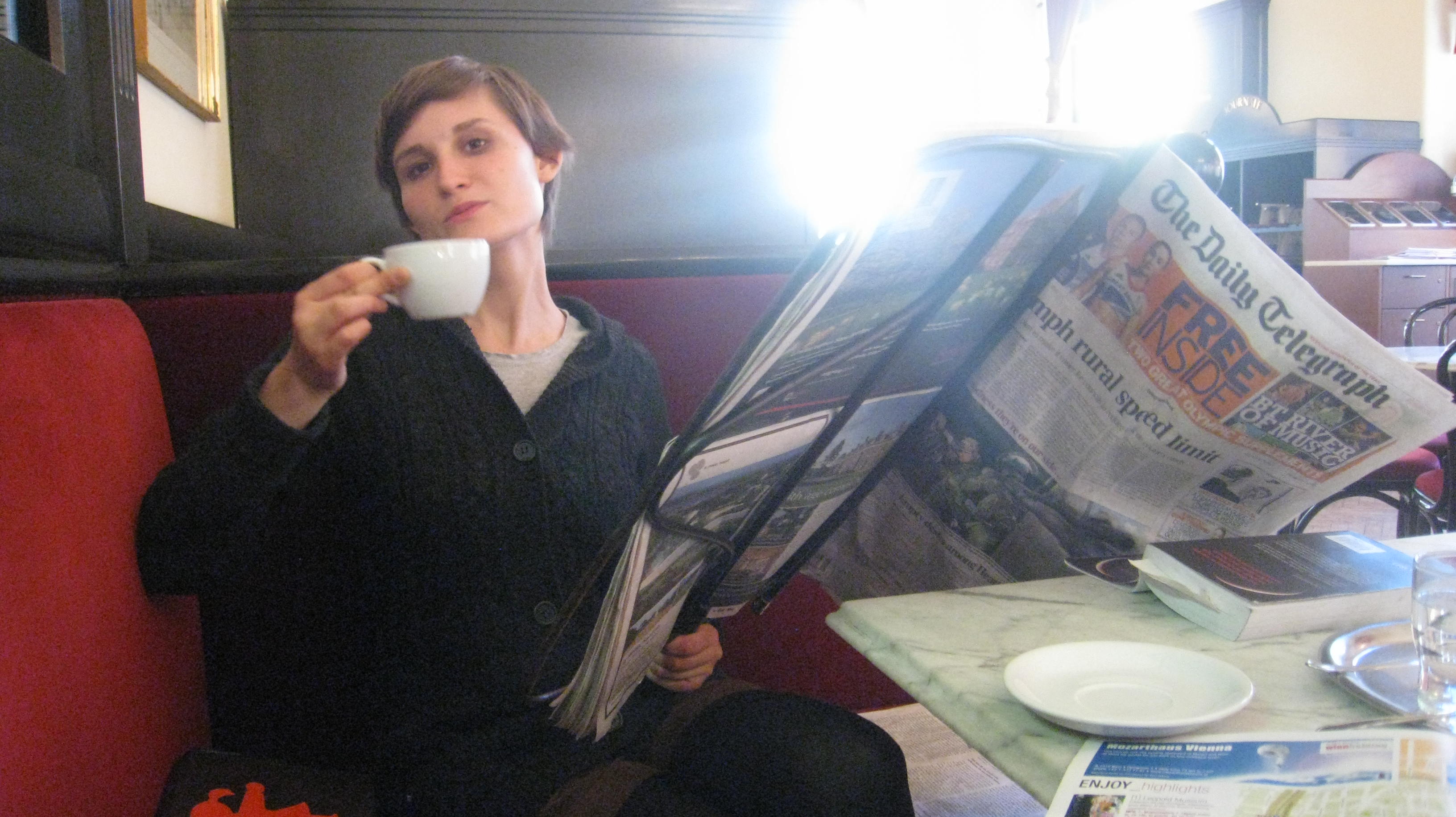
Viennese Coffee Culture

In Vienna, the sophisticated coffee shop culture and well-dressed middle-aged lady reign supreme.

In Berlin it’s the punk bars and anybody inside themthat claims to want to fight the system.

In Vienna, most of the art is kept in museums which charge a high entry fee. In Berlin it’s all around you and changes at the whim of the latest anarchist movement.

The street-corners in Berlin are alive with fire-breathers, hip-hop dancers and human statues covered in body paint. In Vienna, the police politely ask the street musicians for their papers and the latter move on without complaint when they fail to produce the right ones.

Vienna is a city that no longer has much to fight for and whose history has been tastefully, expertly painted over. Berlin is attacking its raw wounds with an aggressive, momentous vigour.

Berlin is growing up. If it develops like Vienna, in a few years it will mourn the loss of adolescent ideals, which many of us too grow up to grieve. And there’ll be fewer beer bottles for the homeless men to collect.

Football in Berlin: Flat Out Support

Berliners tell me that the 2006 World Cup was the first time since the war that Germans dared wave the national flag. Now you can see them dotted on balconies, slung out of shop windows and on the tops of cars.

Alone in Berlin: Part Two

In late February Berlin was brown and the air was cool. I saw a Chinese man standing by the bin at the entrance to my underground station every morning. He had a blank face and kept a neat shoulder bag slung over his body. At first, I wondered who he was waiting for. Then I learnt that he sold cigarettes, which he kept in tight plastic packaging in the bottom of his bag.

He never moved, but some days when he was feeling bold, he would line up three or four packets of Marlboro on the edge of the bin to eliminate any doubt about why he was there.

His brazen passivity intrigued me. I developed the involuntary habit of staring him right in the eye as I turned to go down the steps to the platform.

I sat in a corner on the eighth floor of a silent office. It was a five-minute walk from the Brandenburg Gate. When it became warmer, I would sit by the Spree at lunchtime and watch the tourist boats go by. Sometimes I would read or listen to music, but mostly I just sat.

One night my flatmate came home and said “We’re going out.” It was shortly before midnight. He took me to a rundown sports hall. Inside it was dark. Illuminated figures were racing across a badminton field, firing glow-in-the-dark shuttlecocks at each other. It smelt of sweat and alcohol. Even the nets glowed. Afterwards, a girl offered me a sip of bubble tea. It tasted like lentils and bath salts. Now I’m on the mailing list for “Spedminton,” a sport you play in the dark, while drunk.

Another time, I went to the punk bar down the road. Men and women in their forties, wearing leather jackets and vacant expressions, sat in clouds of smoke. They drank beer and had conversations about life and sometimes death. In the corner of the bar, completely out-of-place, was a foozeball table. My flatmate directed me towards it. I played so badly that his friend told me I must be tired. I thought I was at the top of my game.

At the weekends I went walking in the city. I watched teenagers nodding their heads to beat boxes, homeless men reaching into bins and Roma girls with clipboards approaching tourists, always with the same high-pitched greeting, “Speak English?”

My flatmate asked me to wipe the tiles dry after I showered. He had a special scraper for it. I would stand there, naked and dripping, pretending I was a window cleaner. A few weeks later, in a moment of rebellion, I simply stopped.

Overnight, I became a journalist. I made phone calls to surly trade unionists, government representatives and natural history museums, from a little sound-proof glass box, where my colleagues couldn’t hear me.

Once I met a man who thought I was more important than I was. He invited me to his office, which overlooked the Brandenburg Gate and he said, “So are you going to become a TV presenter?” I looked at him incredulously. And he said “You have the personality for it. You’re charming.” I told him that I was shy and didn’t want to be famous.

The dizzy feeling of accomplishment I got from publication made me afraid. I learnt that I am equally scared of success as I am of failure. Sometimes to atone, I would buy a newspaper from the crippled homeless man on Friedrichstrasse. I made a point of reading it on the way home, in case the emptiness of achieving my dream overcame me.

Alone in Berlin: Part 1

At first it was exhilarating.

I wanted the hostel, where I stayed the first few nights, to be my home forever. I loved the anonymity of the place – the backpackers waiting for a leftover packet of pasta to boil, the discarded tea bags, the little laminated signs asking travellers to consider the environment before throwing away their rubbish.

There were two Asian-looking girls in the kitchen one evening. One had an American accent, the other was British. They had met at the hostel and now they were friends. The American wanted to go to “school” in Europe. The other nodded and made dinner.

Alone in Berlin, reading Alone in Berlin

In the evenings I bought a falafel sandwich or a slice of pizza on the main street which was soon to become my neighbourhood.

One morning — my first in Berlin, I took a bus tour of the city. On the top deck, a round lady with red-painted lips and peroxide hair gripped a microphone and gave a commentary of the city in English that was so broken that a tourist behind me muttered that he had more chance of understanding German. Her smile was fixed to her face like a stubborn mole, her face was wrinkled. If she had had no folds on her face, she would have looked like a doll. I knew she had grown up in east Germany. She learnt Russian at school. No west German tour guide would speak so little English.

I scribbled down the names of places that looked interesting from the bus. I saw pink water pipes all over the city, the president’s house, the parks, and a beautiful square.

I found my workplace and my heart jumped when I saw that it was five minutes away from the Brandenburg Gate. I found a little photo booth and got a picture taken for my student travel card. I followed the instructions for getting a passport photograph taken. “Don’t smile” said the machine. “You must not tilt your head, or obscure your face with your hair.”

I look so stony in the picture that weeks later, when the secretary at Spiegel looked at the card she said “but you are so cross!”

After I checked into my hostel on that first night, I went out to try to find the apartment I would be moving in to.
It wasn’t far from the hostel. It was late February and it was dark. I approached the flat from a direction I never walk now. I found the shoe shop and the children’s book store that Google Maps had promised me. The street was quiet and I was alone.

Obeying The Machine

I found the number and glanced up at the building. It was too dark to see anything.

I walked past a church, back to the main street. Next to my hostel was a photocopying shop and a video store. All rentals one euro. There was a large adult movie section on display in the window.

The day before I moved into my new flat, I met a book vendor outside Humboldt University. He had wild white hair and a black hat. He said: “You don’t think I have mornings when I wake up and say ‘Fuck this shit. I don’t want to stand at this fucking table selling books all day? And then you know what? I see children laughing and playing and nothing matters any more.”

I nodded at him, I think I smiled. I thought we were the only two people in the city. The sky turned midnight blue and the TV tower was lit up in the distance. I bought a book called “Der Steppenwolf”. The cover is blue and there are bits of paper still stuffed inside a page in the middle of the book, where I stopped reading it.

As the lights came on and I got into a grubby underground train, something danced in my brain. Now I realise it was the taste of freedom.

Bag Yourself A Sister Like Mine

“What does this mean?” I said, thrusting an official letter from the Federal German Post Office at my flatmate.
His eyes darted from left to right.
“You have to go to customs to collect a parcel,” he replied.
“Yes, but why?”
“I don’t know.”

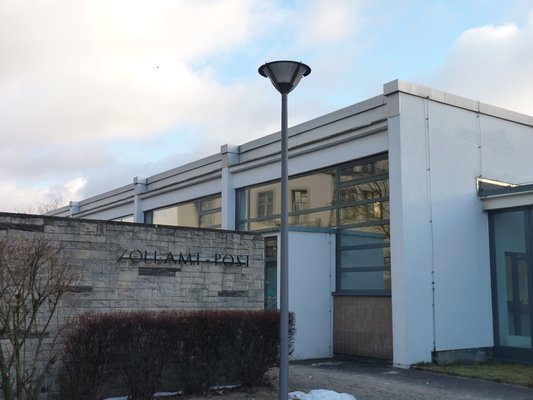
The customs office was far, far away. When I got off the train I saw a motorway, some industrial buildings and a pair of old ladies smoking. It was cold and damp.

As I approached the dreary concrete customs office and a wind began to blow, I began to feel more and more like I was at home. I joined the queue. Two men were working behind the desk. Another fifty or so people were sitting with little tickets, waiting for their number to be called. A waft of inefficiency filled the air.

image source: http://www.yelp.de

It came to my turn. I handed the officer my documents. He had a crinkled orange face and a snide mouth. “Do you know the sender?” he asked.
I did. My lovely sister, who is a geneticist in Philadelphia and says she analyses butt samples for a living, had sent me a parcel back in April and was dismayed that it had not arrived yet.

“What’s in the parcel?” said the man gruffly.
…..
“I don’t know,” I replied. “It’s a gift.”
“Well I don’t know isn’t going to get you very far, is it?” he said.
“I’m sorry,” I said “but how am I to know what is inside the parcel?”

He narrowed his eyes. “We need to know what’s in the parcel.”
“Okay,” I said with false breeziness. “I’m sorry, but I’m not from Germany and I’m not familiar with this system. How does it work?”

His lips flickered with hatred.
“Do you think you’re the only one who needs to be served today? Look behind you. Look at the queue.”
He sighed and rolled his eyes.
“Okay,” I said. “I’m sorry, I just don’t know what’s in the parcel.”
“What could it be then?” he said with dull resignation.

I paused. He fumed.

“I’m sorry I don’t know. Maybe it’s a piece of clothing, or some chocolate. I really don’t know.”

He scribbled something down and issued me with a ticket. On it was printed the number 240.
“It’s a minimum two hour wait. Do you want to accept the parcel?”
“Of course!”
“Well sit down then.”

I took a seat beside a black man, who was swinging his legs with boredom.

I looked at the clock. It was twenty to four. “I’ll chance it,” I thought to myself.

I got out my phone and dialled my sister’s number.

“Hello?”

“Nothing has happened. There is no emergency. I’m sorry for calling so early.”

“Okay?”

My sister, who was settling into a day’s work in her laboratory listened patiently as I told her that I was in the middle of nowhere and that officials were demanding to know what was inside her parcel.

“It’s a handmade bag,” she said.

“Aw!” I said. “That’s so sweet! Thank you so much.”

“Way to ruin a surprise!”

“I know!”

I rejoined the queue.

This time I got the other official.

“Hello,” I said. “I was talking to your colleague earlier.” (The latter snorted over, “It’s true.”) “I have just called my sister in America. And I can reveal that there is a handmade bag in the package.”

He looked at me. Silently.

“Does this help you?”

“It is too late,”he said. “You have been issued with a number already. You must wait your turn. When your number is called, you will open the parcel with a knife in the presence of an official.”

I returned to my seat. Thankfully I had Greg Baxter’s book “The Apartment” with me.

Every thirty seconds my reading was interrupted by a ping announcing a number.

After some time, I became puzzled. The numbers were not being called in chronological order.

I glanced at the noticeboard directly in front of me. Pinned to it was a sign which said “Customers should note that due to our organisational system, numbers may not be called in chronological order.”

Pot luck, then.

One of the girls in the queue was being told that she had to pay €75 tax on clothing from America which she had bought online. She was confused and dismayed.
“That’s the rules,” said the official.

Suddenly there was a ping and the number “240” flashed on the display board. I jumped. Only one rather than two hours had elapsed since my confinement.

I rushed through a little white door and found myself in a large space full of long tables. I made my way to station number 5. The official with whom I had spoken to second was standing behind the table.

The table was the kind that you sit on with one or two others when you are in secondary school. On it was nothing but a tiny package with my sister’s characteristic handwriting on the front.
I let out a little squeal of excitement.

The official handed me a knife.

“Open it.”

I put the knife down and tore it upon with my bare hands.

An envelope and a little package covered in bubble wrap slid out.

I unwrapped the bubble wrap carefully.

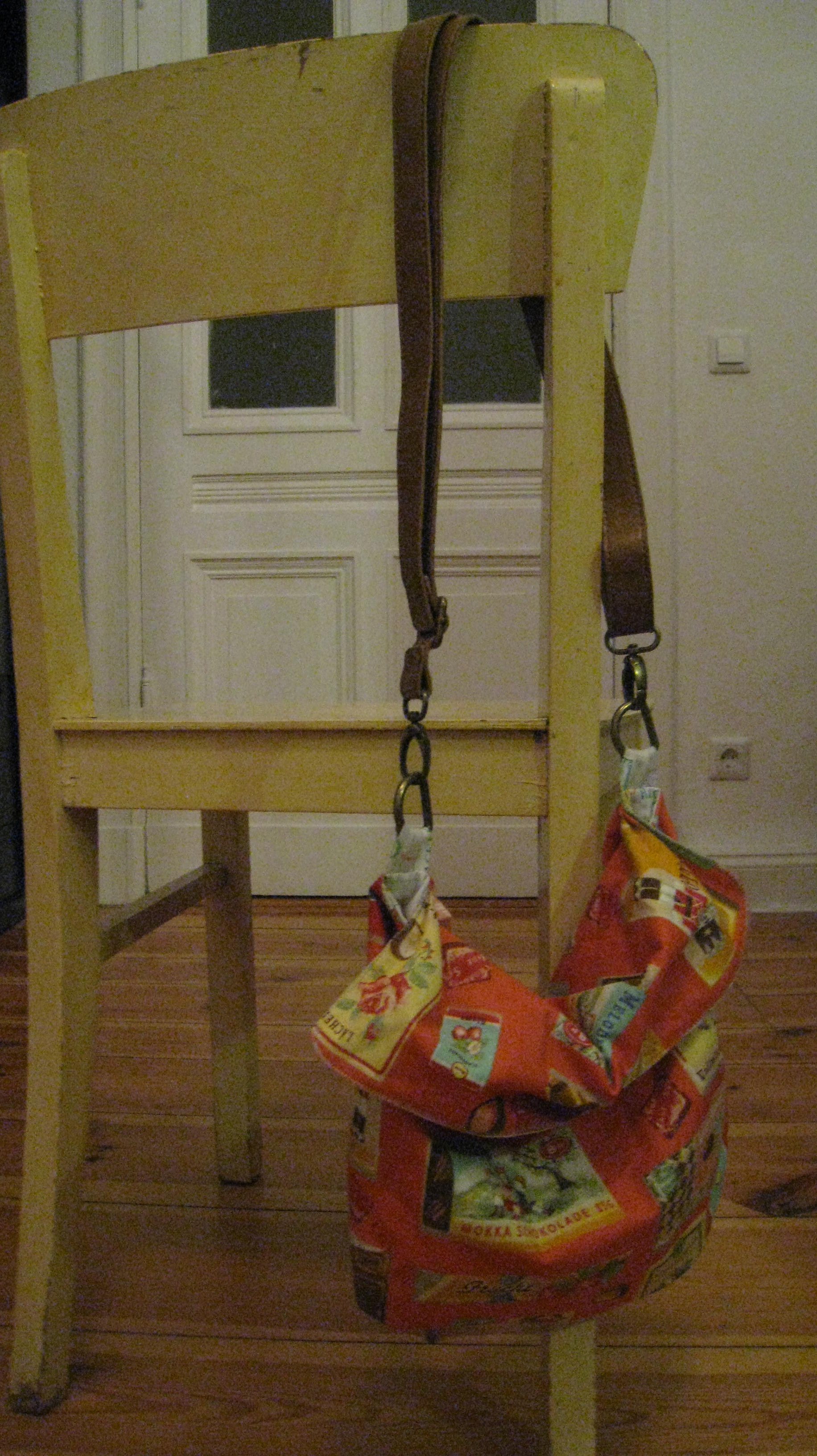
My heart skipped. In my hands was the most adorable and charming of cloth bags. It had a brown strap and buckle and the pattern was Berlin-themed. There were little green signs with the names of the city’s famous stations and scattered between them, were little pictures of umbrellas, clocks, suitcases and trains.

The official’s face changed.

He smiled. “That’s lovely.”

“My sister made it,” I said, still gasping.

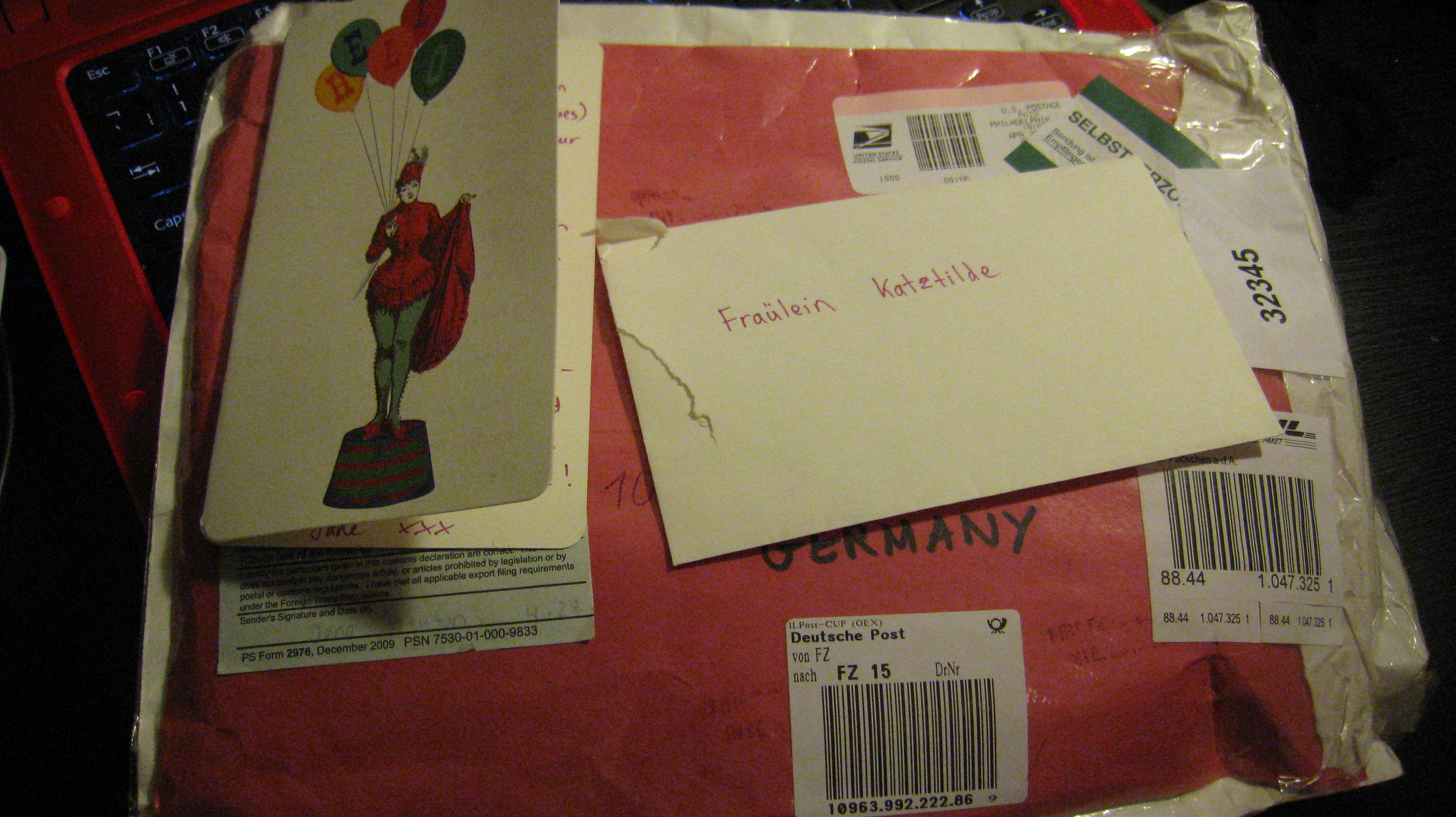
Then he looked at the envelope. My sister had written “Fraulein Katztilde” on it in purple pen.
Urban U-Bahn Chic

“That’s sweet,” he said.

“I know!”

“No tax payable. Have a nice weekend.”

Chocolate Fesch

“Really!”

I didn’t wait for an answer and dashed outside clutching my precious bag.

I opened the envelope on the train. Apart from all the other lovely things she had written, my sister also finally provided unequivocal proof of her genius.

“I couldn’t decide which fabric was better so I made the bag reversible – just turn it inside out to go from urban U Bahn chic to traditional chocolate Fesch.”*

I looked at the red fabric on the inside of the bag, which featured lots of pictures of traditional German chocolate from times past.

Somehow, my sister, had created a two-sided magnet-drawn fastener which would allow me to sport two super-cool German-themed bags in a city known for both its trendiness and efficiency.

So, not only is she a talented analyser of butt samples, terribly witty, exceptionally attractive, kind, sweet and thoughtful, my sister is also a queen of crafts.

So, if you are reading, Jane Franziska, thank you so much. I absolutely love it. You’re a complete ledgeBAG.

*Fesch is a German word meaning something like “trendy,” which the Ferguson family finds amusing.
Why Grocery Shopping Is Better Than Therapy

While I was still living at home, grocery shopping was a pleasant diversion but it was always coloured by a faint association with futility. My parents stocked the fridge regardless and I just bought extra kidney beans to supplement my vegetarian diet.

Now that I am hungry and alone, grocery shopping has become a noble necessity. I could go so far as to say I couldn’t live without it.

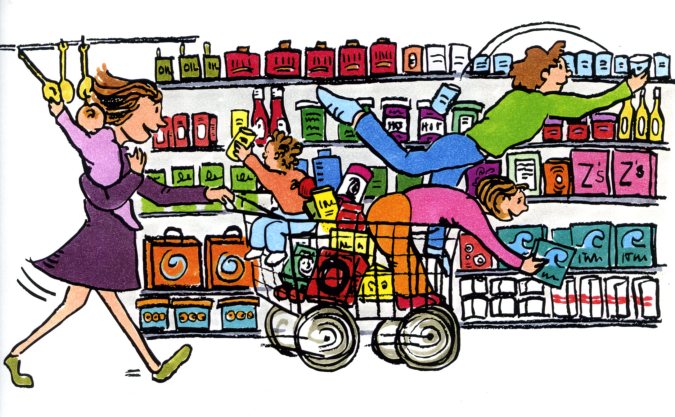
Every second day on my way home from work, I wander into my local branch of Netto and greet the three punks, who have inhabited the dirty pavement outside and spend their days drinking beer and enjoying banter with the store’s security guard. For the next twenty minutes, I forget my worldly problems as I navigate my way through bundles of asparagus, the weekly deal of a desktop printer and boxes of instant dumplings.

Image source: yestheyareallours.com

On the occasions that I have felt directionless, grocery shopping has restored a sense of purpose. There is no therapy like it.

While I am not one to write shopping lists, I do like to dash to my post box to snatch the latest promotional leaflet featuring upcoming deals at my local discounters.

It is an exercise in self-control not to rush at every offer of 19 cent bundle of radishes and toilet seats at just €19.99. With time, this kind of restraint may develop into a widely-applicable life skill.

And even if you do succumb to temptation, as I am apt to do when a 100 gram bar of Milka chocolate is offered at just 59 cent for one week only, buying superfluous groceries does not compare to the guilt associated with conventional retail therapy.

Grocery shopping melds our most primal needs with the more sophisticated cognitive processes of reasoning and restraint. We must learn to differentiate between the times when succumbing to temptation is a good thing (for example when Milka chcocolate is on special offer) and the instances when a purchase would be unhelpful (as in the case of the extra toilet seat). Such high-level strategy is rarely taught, let alone mastered at university level.

A tempting offer.
Image source: jonco48.com

For those under the impression that grocery shopping represents mere escapism: it has its challenges too. Sometimes you end up with an excessive quantity of toilet paper; and at other times you come too late for the marzipan-flavoured Milka bar.

Sometimes when I am in a queue, the customer before me places a little barrier in between their shopping and mine. Though such an action is ultimately self-serving, I always thank them profusely. Then they look at me in the bemused way to which I have become accustomed when behaving with excessive politeness. It is the same look I get when I thank a bus driver or wish the man selling me falafels a good day. I can’t help feeling a little peeved when I place a barrier between my shopping and another person’s and I do not even get the slightest hint of acknowledgement.

Such gritty reality must sadly be faced in the world outside and grocery shopping has equipped me with the necessary skills to cope.

None of the self books I used to borrow from Rathmines library taught me as much about the human condition as shopping for food has.

Despite the transformative power of shopping for groceries, I have met individuals that profess not to be advocates. I have even heard food shopping described as “boring” and “stressful”.

I hesitate to entertain the notion, but could I be alone in my enjoyment?

The Stress Test

Katekatharina stressed (I couldn't open my tin of tomatoes.. I'd been trying for weeks)

I was walking down Kudam, west Berlin’s main shopping street, yesterday when a man with bulging eyes stopped me in my tracks. He smiled sweetly.

“Would you like to take a stress test?” he asked.

“Yes please!” I replied.

He was delighted.

“What’s your name?”

“Kate.”

“And where are you from, Kate?”

“Ireland.”

“Ireland?”

“Yes.”

“Do you speak English?”

“Yes, but German too of course.”

He laughed. “Oh yes, of course!”

A moment of awkwardness passed as he peered at me.

“Let me introduce you to my colleague,” he said.

“Oh, sure.”

“Em, kkKarl,” he called nervously to his superior. “This is Kate.”

Karl, an older man with a harder face but equally penetrative eyes turned to me.

“Hello,” he said and shook my hand.

“Hello.”

“Take a seat.”

“Thank you.”

“First of all, look at these metal rods I am holding,” said Karl.

They looked like dumbells.

“Obviously they are not going to give you an electric shock,” he said. “Look, here I am holding them and nothing is happening.”

“Yes,” I said.

He handed me the rods and I clutched them with all my might.

“I am going to ask you a question, Kate.”

“Okay.”

“The energy from your body will flow into this machine.”

“Right.”

“Think of somebody in your life.”

The counter hovered around zero.

He waited.

Finally he said, “who were you thinking of?”

“My mum.”

“What kind of a relationship do you have with her?”

“It’s good.”

“Do you ever have differences of opinion?”

“Oh, sure. But nothing big”

“But there are sometimes disagreements?”

“Yes.”

He paused a while and then said “What do you do professionally?”

“I’m an intern.”

“In what capacity?”

“I’m working as a journalist.”

His mouth flickered unpleasantly.

But he said, “I want you to think about your job.”

“Okay.”

“Do you like it?”

“Yes.”

“Are there ever stressful moments in your workplace?”

“Yes.”

The scales budged a little.

“Do you see that? This is the negative energy floating from your body.”

“Ah, yes.”

He paused.

“Would you like to know how to eliminate negative energy from your life?”

“Perhaps.”

“Would you like to buy a book which will change your life for the better?”

He whipped out a copy of L. Ron Hubbard’s Dianetics: The Modern Science of Mental Health.

“No thank you. I think I’d like to find out a little more before committing to a purchase.”

He handed me a plastic booklet outlining the main tenets of the Church of Scientology. I skimmed it and thanked him without committment..

He snatched it back and flashed me a murderous glance. I continued down Kudam.

Three Women That Don’t Know They’re In My Life

1. The Prostitute

She has white-blonde hair and long, thin legs. She stands by the red-brick buildings of Hackesher Markt. She wears white leather hot pants, tan coloured tights and furry white snow boots. Her cleavage is pushed up by a skin-tight leather jacket, which she keeps half unzipped. She has red lips and cool, blue eyes. Last Saturday night, it snowed in Berlin. She watched a group of Italian men walk up the street. She stood in their way and smiled, casting her eyes up and down their bodies. First they were uncomfortable, then aroused. She put her arms around one and pushed her body towards his. She pressed her breasts to his chest. All the time, she took sidelong glances at his friends. The snowflakes were sticking to her hair. She was cold.

Berlin's Affluent Red Light District

2. The Girl at the Bakery

She sells sour dough bread and pastries at a bakery at an underground station and her red uniform includes a crumpled tie. She has an old-fashioned kind of face, which refuses to be offset by her hoopy silver earrings, lip piercing and the two thick black scrunchies, which hold back her wavy hair. When she serves customers, she is upbeat. There is something naive in her face which I am drawn to. I think she would flair up at injustice and I think that she is happy in her job. Once when I was eating a Nussecke and sipping on a latté at the bakery, I saw her chat quietly to a colleague. The tone was conspiratorial. It surprised me.

3. The “Tickets Please?” Girl

She could be a child but she is not. She is small and has big brown eyes and dark curly hair. She lives at the entrance to my underground station with homeless men and their giant dogs. Her voice rings in my ears. She says the same thing every day. “Tickets please?”. (Fahrscheine bitte?”). She says it like she is a bored train conductor, but really she is a bored homeless person collecting tickets to sell on. She’s not on drugs because her eyes, while large and droopy are alert. She wears puffy clothes from the 80s and she works much harder collecting tickets than her male friends.

The One-Meter Bar Of Chocolate and Katekatharina’s Mega Easter Competition

A few weeks ago I met an important man in his office on Unter Den Linden.

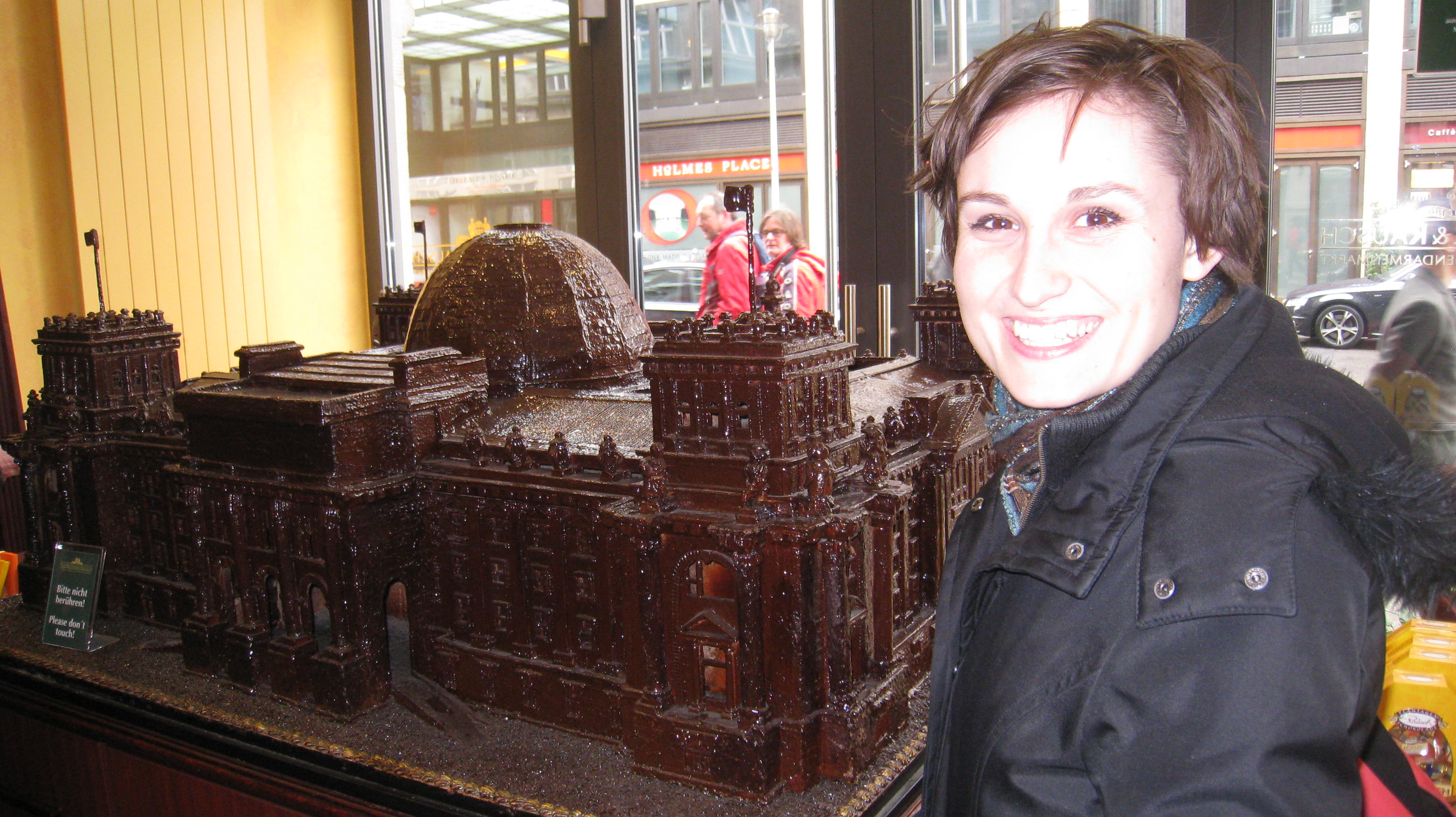
LSB dives into the chocolate Reichstag

The same evening, the new German president Joachim Gauck was being sworn in. The surrounding area was awash with media types clutching furry microphones, adjusting broadcast platforms, parking vans.

I didn’t know the man I was meeting. He was a Spiegel-employee friend of my boss and I was doing him a favour. He was planning a holiday in Ireland and was overwhelmed by the detailed itinerary his travel companion had compiled weeks in advance. He wanted me to amend it.

He made me a latté and we sat down and poured over the meticulous plan.

“You won’t manage all that,” I said. “Not if you want to sleep.”

For the next few hours we teased out the relative merits of Longford and Louth, Killarney and Kilkeel.

“You can give Derry a miss,” I said finally. “Just go to the Giant’s Causeway instead.”

“Is it Derry or Londonderry?” he wondered.

“Oh, that depends on with what foot you dig,” I said.

Joachim Guauck was being sworn in on the television in the background.

“I’m sorry for keeping you so long,” he said as I was making a leave. “Do you drink wine?”

“Yes I do.”

I have a very expensive bottle here.”

“Oh?”

“Alternatively, do you like chocolate?”

“Oh yes, very much so.”

“Well then I have just the right thing for you.”

Out of nowhere he pulled out a metre long stick of Rittersport chcocolate.

“For you!” he beamed, wielding it at me. “As a thank you.”

Loyal readers will know how much of a chocolate advocate I am, but even I was stunned at the scale of my killing. If you are sceptical, examine the chocolate in relation to the medium-sized cat.

Last Saturday, LSB and I went on a chocolate tour of Berlin. We started off at Fassbender and Hausch, where we could afford a single truffle each.

Then we went around the corner to the Rittersport museum and shop. We learnt about the cocoa been, and about Klara Ritter, who invented Ritter Sport because she wanted football supporters to be able to fit a 100 gram bar of chocolate into their pocket when they went to matches.

Choco stack

Then we decided to design our very own bar of chocolate. We chose three fillings from a possible 27. We tasted the chocolate the next day. It was heavenly.

If you become a fan of the katekatharina facebook page, and correctly guess two of the three flavours we picked, I will have a bar of Rittersport personally designed for you and post it to you, wherever in the world you may be. If you can get ten friends to become fans of the page, I will design a chocolate bar for you too.

Entries must be received by midnight Easter Sunday. Just leave a comment on the page with your suggestion. One entry per person. Check out the page for clues until then.

Me at the chocolate Reichstag

“What have you got to smile about?”

Last Friday morning I woke up displeased. The cat was licking my nose and even in my sleepy state I remembered that I had discovered it lapping out of the toilet bowl the day before. I yanked my eyes open and looked at LSB who was fast asleep, wearing an angelic countenance and taking up most of the bed.

We had been to a concert the night before and I hadn’t slept enough. Going to work seemed like a waste of a day, especially when LSB was in town. I rolled to the bathroom, wearily sliced the heads off my strawberries and left LSB a little note explaining how the key worked.

The only person in the office when I arrived was Benji, the curly-haired production assistant. He sits opposite me and I like him very much. He often chuckles to himself at things he reads or overhears and I find he has an unusually pleasant and uncomplicated presence.

“Morning! How are you doing?” I said cheerily, for it is only my nearest and dearest that I privilege to the unbridled version of my morning grumpiness.

“Not good,” he said.

“What? Why?”

“The internet’s down!”

“No?!”

“Yes.”

Internet problems are an inconvenience at the best of times but when you work for a website, it’s enough to..

Take the day off.

It was that simple. At first they were talking about calling me to come back in when the connection was restored but then one of the editors pulled me over and whispered “go out and have a nice day with your boyfriend.”

When I texted LSB to tell him the news, he thought it was a prank.

We arranged to meet at Alexanderplatz, the large square featuring the iconic TV tower which was lit up green when I visited it all alone on St Patrick’s Day.

On my way there I was delayed by an old man who wanted to sell me a subscription to Die Zeit, a German weekly. I tried to explain very gently that I had only stopped because I thought he was giving out a free copy but the sweeter I was, the more enthusiastic he became. He positively glowed as he told me about the special money-off coupons I would be entitled to should I sign up. In the end, I apologised and he let me go. He even winked at me as I was walking away.

Since I had time to kill and was in a joyous mood, I decided it was a good time to pay my €40 fine.

“Next,” a dreary voice behind the counter called.

“Hello!” I said to a long-faced man with glassy eyes and a thin, white moustache that fell in an incomplete rectangle over his lips.

He didn’t reply so I continued, “I would like to pay my fine please.”

“Well then what on earth have you got to smile about?” he asked.

“Well..” I was going to tell him the truth about my day off but thought it might be insensitive.

Instead I told him that I had made an honest mistake so instead of feeling guilty, I considered it one of life’s comparatively unimportant annoyances.

“It’s a costly mistake to make,” he said, as if he were a sage tasked with evaluating the severity of my misdemeanor.

“Well, yes,” I said “but as of now I’m free of my punishment and I’m looking forward to returning to normal life.”

I may have been mistaken but a tiny grin seemed to creep its way towards the incomplete rectangle of his moustache.

Back at Alexanderplatz, LSB seemed to be taking much too long.

Suddenly my phone (or Haendy, as the locals call it) rang. It was LSB. And he was upset and agitated.

“Katzi.” he said.

“Yes?”

“I can’t open the door.”

“What door?”

“Your door.”

“Why?”

“It won’t open.”

“What do you mean it won’t open?”

“JUST THAT.”

“Well.. have you tried the key?”

Strangely, the question seemed to irk him.

“Katzi. I can’t get out.”

“Did you see the note I left with the key?”

Silence.

“I’ll be right there,” I said, hoping it wasn’t a prank.