Banking Crisis in Berlin: A Special Report

I would like to set up a bank account in Berlin. So this morning I popped into the Sparda Bank on Georgenstrasse, where I’ll be working, and looked around for somebody to talk to. It was an odd kind of bank. There were several ATM machines and people milling about but there was an unusual formality in the air.

A man resembling a pencil caught my eye and glided over. He had a silver pen wedged into the pocket of his shirt and there wasn’t a crease to be seen in his pin-striped suit. He exuded pleasant authority.

“Hello” he said, “how can I help you?”
“Hello! 🙂 I’m new in Berlin and I’d like to open a bank account. Are you the right person to talk to about this?”
“Potentially”, he said, “though I’ll see if one of my colleagues can help you. Please take a seat”.
“Thank you!”

I sat down opposite a round-faced man with tufts of thick blonde hair. He was reading the Spiegel. My heart did a little skip.

Posters of grinning middle-aged men in flashy cars and attractive women getting massages in exotic surroundings were pinned to a display board advertising loans. A coloured graph showing the values of shares going up and down was captioned “Values always rise after a financial crisis”.

After some time, a lady came to me. “If you’re ready, Madam, I’ll take you this way”.
My Goodness, I thought. What service. You don’t get this in the Trinity Branch of Bank of Ireland.
She led me into a little chamber, pulled out a chair for me and said, “Please take a seat”.
I shuffled in and got my feet tangled in my bag.
“Could I get you something to drink?”
Something to drink? I thought. Sweet Mother.. How long does she think I’m staying?
“No thank you”, I replied brightly, compensating for my bewilderment with excessive friendliness.
“Now”, she said, “tell me about yourself”.
“Well” I started, “I’ve just moved here from Ireland and am going to do an internship with Spiegel for three months. I’m not sure how long I’ll stay after that but I would like to have access to money from a German account if it’s possible”.

Her face changed. Suddenly she looked both panicked and apologetic.
“I’ll have to check with my colleague. Please wait”.
“Sure”, I said.

I twiddled my thumbs.

She came back.

“I’ve discussed the matter with my colleague. We feel that this might not be the right bank for you”.
“Oh really?”
“Your plans are a little vague. We require our customers to hold onto an account for a minimum of one year”.
“Ah, I understand”, I replied.
“Furthermore, when you open a bank account with us, it is mandatory to become a shareholder of the company”.

I gulped and tried to smother laughter.

Had I just attended an important business meeting with an investment banker?

Yes, I had.

There was nothing for it but to head to the Brandenburger Tor.

Next stop: Brandenburger Tor

**********************************************************************************

PS – My day was very eventful so I might blog again later if I’m not being a superhero in the hostel kitchen.

Ich bin angekommen!

So here I am alone in a hostel in east Berlin, munching on Rittersport (Knusperkeks flavour) chocolate. The original plan was to sit alone drinking beer, but when I checked in I was presented with a formidable list of “Hausregeln” (or “House Rules”). One of them said that drinking alcohol in the dorms was prohibited. Dejected, I scrawled “Kate Katharina” in the appropriate place and signed my humble plan away.

So now it’s just me, the single square of chocolate that’s left and a potted plant with spindly leaves, which greeted me from the window sill when I arrived.

Earlier when I got off the plane and into the arrivals hall at Schönefeld, I set eyes on a peculiarly tall youngster. He was dressed all in white – in a baggy tracksuit and matching pristine cap (which he was wearing backwards). He was holding an artificial bunch of roses upside down. I thought he might have jumped out of one of Eminem’s music videos, but then it occurred to me that it might be LSB in disguise.

Given his tendency towards deceit and his elaborate plan to surprise me for Valentine’s Day again this year, I thought it was reasonably plausible that he had taken a night flight after we parted ways yesterday (underneath Ranelagh Luas Bridge) in order to welcome me in Berlin.

I looked over expectantly but the rapper-romancer was oblivious to me. There was nothing for it but to continue my journey to the Airport train station.

My going-away gifts for LSB


Schönefeld airport reminded me much more of Ireland than the swanky Terminal 2 in Dublin. It’s a modest building, and you collect your luggage from a sluggish conveyor belt in cramped space. While you’re waiting for it, entertainment comes on a screen which shows the three-day weather forecast, the business news and an advertisement for a back massage clinic in continuous rotation. It had a charming higgledy-piggledy feel which made me feel right at home.
While I was yanking my unobliging cases through the walkway on the way to the trains, I passed a man lurking about holding a sign that read “Need ticket” in neat black biro print. Some kind lady stopped to give him change. I wondered how he had landed there.

I was happily prepared to soak up my first impressions of Berliners on the S9 to Friedrichshain. I even asked the train driver, a man in his fifties with half his face taken up by a magnificent curly grey beard, if I was on the right line. I was. When I asked if he stopped at Frankfurter Allé, he paused dramatically, so that I might think I was way off.

Then he grinned and said “Ja, da fahre ich hin”.

I could have been on Dublin bus.

My mum told me that Berliners are known to have a sharp sense of humour, that can be cutting at times. It’s called the “Berliner Schautze” (the Berlin Snout). More of that in future posts.

Having taken a seat on the S9, I stared at the people around me, as I have the bad habit of doing. Opposite me sat a lady with a nest of red hair that concluded in a limp tail that looped around her left shoulder. She was wearing sunglasses and orange and blue snow boots and got off at a stop which translates as “Tree School”.

I paused to consider what kind of things young saplings might need to learn but was stumped after I came up with dendrochronology.

An Australian lady with wavy blonde hair and a nose piercing was reading an academic paper with the title “The roots of gender inequality in Government”. She was marking the important bits with a yellow highlighter.

Unfortunately, my desire to get an authentic flavour of Berlin was thwarted by a group of noisy Irish students who had also been on my flight. They were talking loudly about who they were “shifting”, about the strapless tops they’d bought in Penneys and about the RTE player.

I sighed.

When I got off, I was immediately confronted by a murmuring drug addict looking for money. On the way to the hostel I passed a man lying on a few blankets with a broken shopping trolley and two large dogs for company. A few yards up a homeless woman, her face distorted by drug use, was muttering to herself. It was surreal to hear the language of drug abuse and poverty being spoken in German. I don’t know what I expected. They couldn’t all have a flat Dublin drawl.

It was far from the fairytale villages I know from Bavaria but it was exciting, with cars whizzing by, darkness beginning to descend and the scores of pizzerias and kebab shops tempting me to dinner.

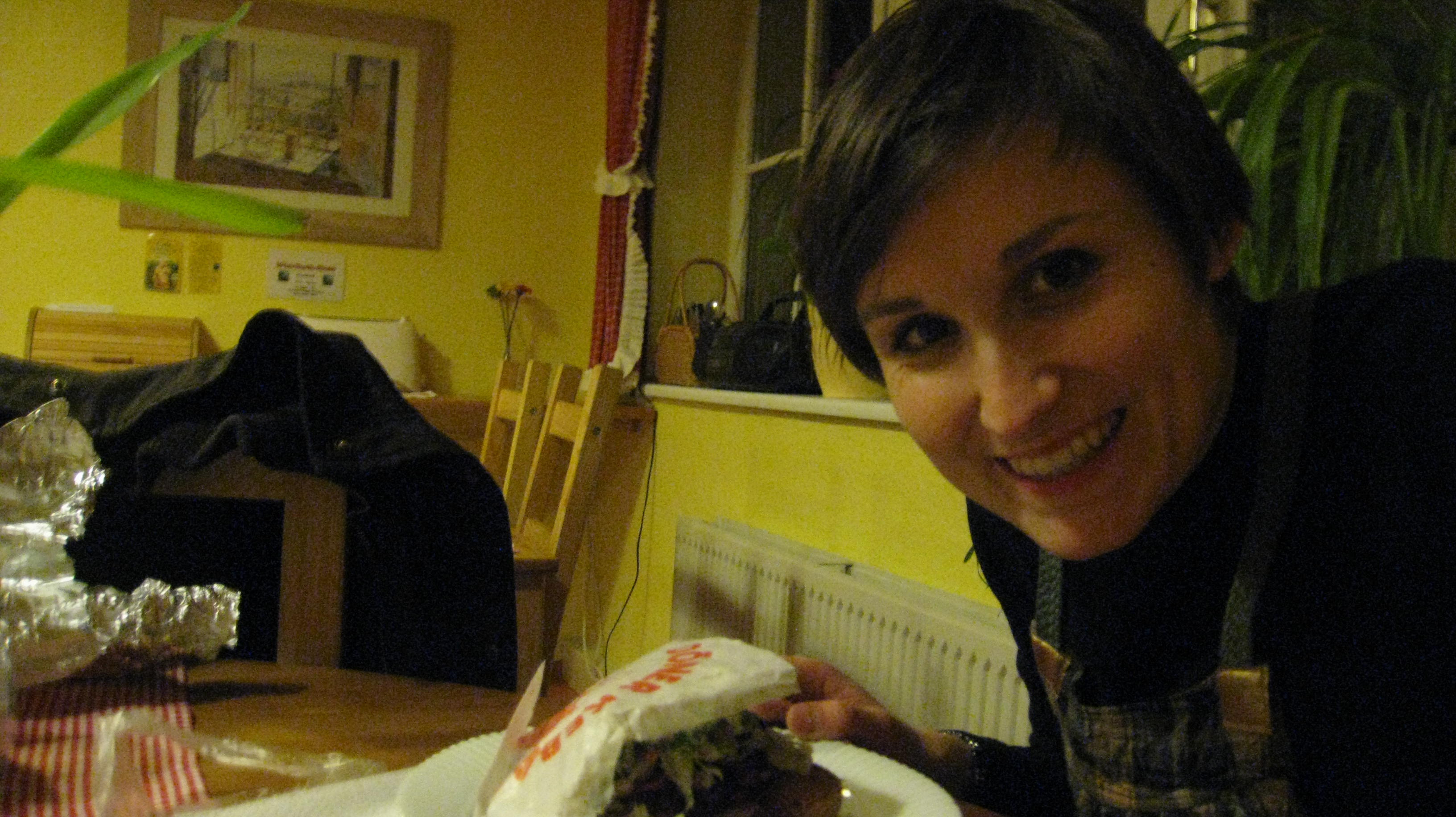
As I type my eyes are becoming heavy. I’m installed cosily beside a radiator at a desk nestled in the corner of my little private room, which is attached to a four-bed dorm. Impressively, I’ve already made a friend. We met in the kitchen. I had my mouth full of falafels when he walked in.

His name is Tom. He’s forty-six and I saved him from burning his stew. He’d popped out of the hostel kitchen muttering something about “missing the vital ingredient” and left the pot unattended.
When he came back bearing a bottle of wine, I was dealing with the cauldron, where bubbles had begun to burst at the brim.

Me and my falafel.

So we had a chat over dinner and he told me that I had a distinct gypsy vibe. My eyes and the shape of my face, he said. I lauded his perception. After all, I recently found out that all of the women in my family have rare mitochondrial DNA associated with the Roma tribe. He said that he definitely wouldn’t have put me as either Irish or German. Russian perhaps, or Polish.

Just as well I’m living in east Berlin, I suppose. My guidebook charmingly describes Friedrichshain as “a traditionally rather dowdy working-class district which is increasingly being discovered by the well-to. I’ve a feeling I’ll fit right in.

Now, where can I recycle my Rittersport Knusperkeks wrapper?

Thoughts on leaving Ireland: Why emigration is my lifestyle choice

This time two weeks, if everything has gone to plan, I’ll be sipping beer alone in an east Berlin hostel.

I’m leaving Ireland for a few months to do an internship at Spiegel International, the English version of Germany’s Der Spiegel.

I’m one of the people Michael Noonan was referring to when he talked about emigration being a “Lifestyle choice”.

I intended to emigrate when I graduated in 2010 but I couldn’t afford it. After I did a TEFL course, which my parents paid for, I was lucky enough to get a job at the school where I trained.

I have loved this job and were I not young, passionate about writing and curious about the world I would do well to keep it.

I don’t agree with Eamonn Dunphy that Ireland is a dump. I agree with George Hook that this country gave him a “bloody good living”.

If we were in the middle of an economic boom I’d be in more of a rush to leave.

Because moving shakes you up, allows you to meet people that challenge how you think and forces you to define yourself within new parameters.

I’ve lived in the same house for 24 years. I know its every nook. When I come home, my father is where he is supposed to be. As I push open the gate, I look in the window and see the back of his head and his arms outstretched. From behind, it looks like he’s made a tent out of the Times newspaper and is holding it stubbornly in place because he has run out of pitching pegs. I hear clinks of plates in the kitchen. I smell his butter beans beginning to burn. I find my mother’s school-bag in the hall and hear her practising the Alto part to the piece of music she is singing in choir. When I come into the room she turns from the piano and tells me an amusing story about one of her pupils or something that she saw on the way to school.

In the mornings, I wake up and Áine Lawlor’s voice is like wind, willing me out of bed. All I can think about is how warm I am in my onesie and how early Áine must have to get up every single day. After a while I feel ashamed and curl into a foetal ball and roll out of bed.

As for the the three men that are in my life but that don’t know it they won’t miss me one bit.

I saw the man with long blonde hair and pools for eyes again today. His head was pushing down Harcourt Street, like a hound in slow motion. Last week I bought the Big Issue from a Romanian women in Rathmines, instead of from my friend outside Trinity. I haven’t seen him in a while but if I do, I will buy another copy. LSB has promised that he will buy each new issue from him while I am away. I know he will, because he always keeps his promises. And if he forgets, my face will appear on his computer screen as soon as he signs into Skype and I will ask him why he hasn’t done it yet. I am charming like that.

I’ll miss town on a Saturday. My vegetarian breakfasts at Cornucopia, where I spy on people who have nice haircuts, pretty coats and carry pocket books. I’ll miss John Gormley’s neat head and chiselled chin, which you can see in a frame hanging on the wall. I’ll miss the flea markets and co-ops which are beginning to blossom like a shy bride all over the city. I’ll miss the silent Falun Dafa-practising protesters, who stand around banners at Stephen’s Green with their eyes closed, drawing shapes in the air, uncannily in sync.

After the terrible things I have said about it, I’ll miss O’Connell Street. I’ll even miss the towering superfluous spike. Sometimes when I’m whizzing along on the U-Bahn gobbling up breaking news, I’ll think back to the times I felt sad when I passed the alcoholics who drank inside the pubs on Parnell Street at half eight in the morning. I’ll think back to Wednesday mornings, which are Dole days in the north inner city. I’ll remember the sorry queue of hunched figures in tracksuits waiting to get into the little green post office.

Sometimes, I’ll yearn for those moments when you’re waiting at a bus stop or sitting on a park bench and an old man or lady looks at you a little longer than they should and then decides that you are a safe person and talks to you about the weather or the recession or about when the bus should arrive.

I’ll miss the men and women who work in the charity shops on Camden Street and the type of lady that I overheard last week in the Cancer Society shop telling a customer that she couldn’t win an argument, let alone the National Lottery but that it doesn’t stop her from dreaming.

I will miss the -often irrational- indignation of the callers on Liveline. I will miss the ceaseless banter and inoffensive drizzle and the feeling I get of being a 1930’s maiden any time I’m in Neary’s Pub.

But I’ll be back. And I’ll have learnt how to live with a cat despite my prejudices and what it’s like to write to live instead of to live to write.

I might just have managed to see out my Quarter -Life Crisis. but I’m not promising anything.

And I’ll be blogging so that you can come to Berlin too, if you like.

*********************************************************************************************

Tomorrow is Valentine’s Day. E-mail me privately with suggestions as to how to get LSB back for last year.

If you’re on Facebook and want to join in on some chats, you can “like” Katekatharina’s page.

What septic tanks and education have in common

I’ve spent three-quarters of my life being educated and the last two years educating others.

Since I began school at the age of four, I’ve associated education with evaluation.

First it was stickers and stars and rubber stamps. These evolved into report cards with little boxes beside the words: poor, fair, good, very good and excellent. Next came the letters of the alphabet: A, B and C. Then fractions and percentages arrived and after that, points. At university, marks were converted into classes and you could be first, second or third.

Compulsory education – like the septic tank- originated in the nineteenth century. While both aged tolerably well, of late they have begun to fail us.

image source: insectapedia.com


After all, as Ken Robinson, an educational theorist points out, the current system of education was conceived in the intellectual era of the enlightenment and the economic context of the industrial revolution.

Like the septic tank, it has failed to keep up with the times, often producing impenetrable sludge before practical distillation.

(If you need proof, try understanding what on earth academics writing in humanities journals are trying to say).

It’s not that our education is of poor quality. It’s not that we have bad teachers, or unmotivated students. They never help but they’re neither unique to this period nor the cause of the problem.

The real issue is that we haven’t decided whether education is a journey focussed on itself or on its destination.

Let me explain.

Up to recently, education was a means to an end. You walked out of school and into the workplace. If you went to university and got a first class degree, you got a first class job.

Now things have changed. We have too many people educated in areas with too few jobs.

The difficulty is that we still believe that the higher your educational level, the loftier your career expectations should be.

Of course it’s a prospect that many are failing to realise.

Now, if you get a first class degree, you take your place among all the others and compete for any old job.

It’s a case of social progress outrunning institutional reform.

You could see the situation as a social leveler. Now unemployment is for everybody, not just the least privileged.

Some students spend twenty years collecting stamps and stars and letters and numbers.

And then they find that the numbers don’t add up to a job.

Their experience calls into question the very purpose of evaluation.

The transition from pupil to teacher has taught me that evaluating students is rather arbitrary. It doesn’t measure very much at all.

But we’re hooked on comparison. We get frustrated if our own evaluation can’t be backed up by a standard measurement. If we think we’re better than the person next to us, we want it neatly before us in percentage form.

I guarantee that in a secret ballot, students wouldn’t vote out tests and exams.

Science backs it up. Research has shown that the pleasure circuits are activated in advance of finding out a result.

We thrive in conditions of uncertainty.

Waiting for a test result is like waiting to see if you have won in Poker. Ultimately neither tells you how well you have played or how much you have learnt, but rather how well you have performed relative to others.

It’s time we took a step back though.

The right to education is one of the great privileges of our age. While its original and most important purpose-to lay the foundations for economic subsistence- has been eroded by the unprecedented pace of progressive reform relative to growth in employment opportunities-we must take time to remember what has been so long neglected: the timeless, immeasurable pleasure of learning for its own sake.

Could it be that indulging ourselves in constant measurement against others is doing us more harm than good?

Andrew Bird, an American folk singer condenses the possibility beautifully in the song “Measuring Cups” which opens:

Get out your measuring cups and we’ll play a new game. Come to the front of the class and we’ll measure your brain. We’ll give you a complex and we’ll give it a name.

This generation, more intensely than any other before it, has experienced education as a closed system of incessant measurement.

For many that measurement has not amounted to more than restlessness and disillusion.

Learning for its own sake has been forgotten amidst the obsession with making ‘it’ which means ‘making money’.

If teaching has taught me one thing, it’s that the responsibility to evaluate is nothing compared with the possibility to inspire. My job is to encourage before it is to instruct.

Pupils are not watering cans: we can’t fill them up without their consent. They must want to learn, not in order to get a good job or to become rich or to sound clever, but because, as Merlin in T. H. White’s The Once and Future King reminds us, “it is the only thing that never fails”.

I have the following words pinned to my bedroom wall:

“You may grow old and trembling in your anatomies, you may lie awake at night listening to the disorder of your veins, you may miss your only love, you may see the world about you devastated by evil lunatics, or know your honor trampled in the sewers of baser minds. There is only one thing for it then, to learn. Learn why the world wags and what wags it. That is the only thing which the Mind can never exhaust never alienate, never be tortured by, never fear or distrust, and never dream of regretting. Learning is the thing for you”.

Equipped with this original joy of learning, and a quieter, more humble confidence, our young people may be more inspired to carve an independent niche on the side-lines rather than enter the desperate rat-race of out-performance.

Let’s make our recovery less sludgy than a septic tank. In remembering why education matters for its own sake, we avoid throwing the baby out with the bathwater.

“Welcome to life at The Irish Independent” – how Ireland’s best-selling newspaper embraced “L’Ethica dela New of the World”

Print journalists need three things.

First, a passion for the truth, second a concern for people and third a reasonable command of language.

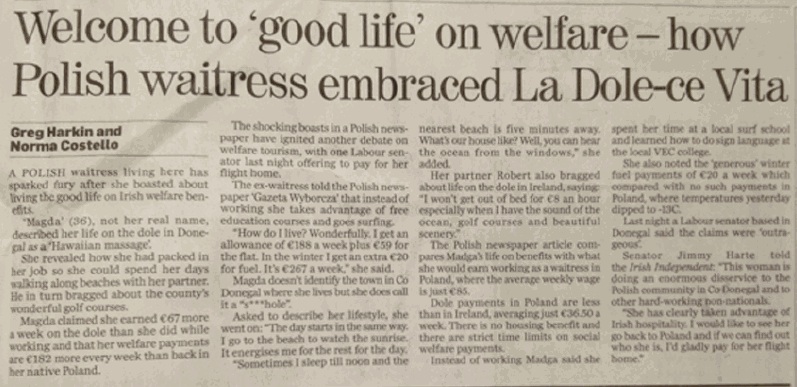
For those that haven’t heard, on Wednesday Ireland’s best-selling daily newspaper The Irish Independent printed an article about a Polish lady living in Ireland.

image source: broadsheet.ie

The source of their piece was the Gazeta Wyborcza, a Polish newspaper, which had been running features about life in recessionary Europe.

In the original article, “Magda” spoke about her life in Ireland and the state benefit she has received since losing her job.

The Irish Independent titled its piece “Welcome to ‘good life’ on welfare: how Polish waitress embraced La Dol-ce Vita”.

In the original Polish article, Magda says of being on benefits: “I don’t want to live off the state, that’s why I treat the benefits as an aid, which will help me to start my own business.”

On budgeting, she says:

“Once every two months I pay for electricity, that’s around 100 euro. I cook at home, I don’t go out to restaurants. I go to the market where I can get local products cheaper than in a shop. I look for special offers in Centra – for example 6 rolls for 1.50 euro. … I buy my clothes in Penney’s … but not too many, because I don’t have the need to glam myself up. My latest buys: yoga sweatpants for a euro, trousers for 7 … I buy my shoes in TK Maxx – max 10 euro per pair. In the autumn I get a winter clothing allowance … I look for books in a charity shop. Look: ‘The Jungle Book’, ‘Robin Hood’, ‘Out of the Silent Planet’ by C.S. Lewis – all three for 2.50 euro.”

The Independent article reads “A Polish waitress living here has sparked fury after she boasted about living the good life on Irish welfare benefits”

Magda’s welfare benefits entitle her to take courses to increase her skills. According to the original article, “Magda can do a basic massage, a Hawaiian one and a hot stone one that she’s learnt at a free course organised by the social welfare office.”

The Independent’s version reads “‘Magda’ (36), not her real name, described her life on the dole in Donegal as a ‘Hawaiian massage’”. It also claims that she “revealed how she had packed in her job so she could spend her days walking along beaches with her partner” and sometimes sleeps till noon.

The original says ““I always start my days in the same way: I go down to the beach to see the sunrise. It sets me up for the rest of the day. I used to sleep until noon, but now I don’t want to waste my life.”

The Independent quotes Labour senator Jimmy Harte, who describes the claims as “outrageous” and adds that he’d “gladly pay for her flight home”.

Thanks to the John Murray Show on RTE, which commissioned an accurate translation of the text, the Irish Independent has been exposed for falsification and misrepresentation.
Its response today was tragic and even comical:

“YESTERDAY’S story about a Polish woman living on welfare payments in Ireland sparked much discussion and controversy.”

It could have been a parody on its opening from yesterday which claimed that the same story had “sparked fury”.

Its only admission of wrongdoing is the acknowledgement that “Some parts of the original interview, on which the story was based, were inaccurately translated.” It then provides a translation of the original, which it describes as “fuller”, as if its version had been missing body rather than fact.

It may seem obvious but to journalists Greg Harkin and Norma Costello it was not: the function of a newspaper is to offer responses to real events rather than elicit reactions to fabricated ones.

Even more obviously perhaps, newspapers are not storybooks. We expect them to tell the truth.

News reporting is retrospective, not prescient. It cannot claim something before it has happened.

If a Polish lady’s claims have “sparked fury” and “ignited a debate about welfare tourism”, we need evidence beyond the comments of an unfortunate local Senator who has been lied to.

Should Greg Harkin and Norma Costello fall victim to unemployment, they may do readers the courtesy of polishing up on their Polish. Perhaps Magda could recommend a good FÁS course, or better, teach them herself.

When interviewed on the radio this morning she spoke perfect English with a slight hint of a Donegal lilt.

The Euro Crisis: A Family Drama

Cast of Characters

The Proud Parents: Germany and France
The Eldest child: The United Kingdom
The Wild Child: Greece
The newly adopted: Croatia
The Redeemable Rogue: Ireland
The neglected middle child: Spain

Synopsis

 G and F didn’t like each other. Then tragedy brought them together.

They cast their differences aside and became inseparable. They decided to build a family.

They vowed to be the best parents in the world. They were young and believed their family would be the happiest in history.

They were wise too. They welcomed their young with open arms and closed fists full of caveats.

(If their own bitter experience had taught them anything, it was that successful family life meant balancing freedom and constraint.)

Each year a new member was born. G and F wanted a big, happy family and they weren’t finished yet.

Their eldest, UK was a strapping lad. At first he imbibed his parents’ values. As the family grew, he began to feel stifled. He wanted more independence.

During a romantic weekend away in Maastricht, G and F conceived a fresh plan to unite them all.

It was the last straw for UK. He decided he wanted out.

When the kids hit their teens, G and F noticed that a crisis in family values was looming across the waters. They blamed fast food and the American consumer culture.

Within a few months, things got worse. Ir, who had fought through a shaky start in life to become everyone’s favourite teenage success story, turned out to be living precariously close to financial ruin. G and F were disappointed and wondered if they were too lax in tolerating her constant partying.

Then S and P went off the rails too. G and F wondered if they’d spoilt the children.

But the family pulled together and bailed the kiddies out.

The mess wasn’t over yet.  Now Gr, the fiery middle child was in trouble. Financial ruin kind of trouble. Gr had been lying to his parents for years.

That was the last straw for G and F, who began to impose discipline.

On top of it all, they agreed to adopt another child.

Cro, a youngster with a troubled past had wanted to be part of the perfect family for years.

When the time finally came though, Cro realised that things weren’t so perfect after all.

Can they all pull together and become a model family once again? A vacation in Davos seems to be their only hope..

What the critics say:

This tension-filled family drama is sure to be a bloc-buster

                               More drama than your average Greek tragedy!

image source: http://www.salon.com

Big Issue: Small change

The man that sells the Big Issue outside Trinity College has one brown beard, two blue-white tired eyes and five or six wrinkles folded down his cheeks.

His head and shoulders slope to the right so it seems as if he is suspended in the middle of collapsing. He never carries more than three or four copies of the magazine but the little bundle he has got he clutches tightly in his right hand, which he keeps raised in the air, like the Statue of Liberty and her torch. He has a vacant stare which usually points in the direction of Front Arch.

image source: atp.cx

I bought the December issue from him. The cover featured a photograph of a spectacled man in a Santa Claus costume and inside you could read about the origins of the song Have Yourself a Merry Little Christmas and about a day in the life of Garda Pauline Sheehan.

When I approached him, his face flashed alive, as if a switch had turned his eyes on.

“Hello, I’d like a copy please”, I began redundantly.
I had two €2 coins ready.
“Yes, love”, he replied, huskily, “yes love. Just a moment.”

I handed him the coins, adding cheerfully, “that’s four euro for you there”, to compensate for the sadness I felt for him, as a long trickle of snot began to drip from his nose.

The Big Issue costs €3. Half that goes to the vendor.

He fumbled for change in the dirty corduroy pocket of his pants. I made a pointless remark about the cover so that he would think I hadn’t noticed the large tear of snot reaching his lips.

He dug slowly inside his pocket until he found a euro among a handful of coppers.
I thanked him.
“Happy New Year, Love. Happy New Year. Happy New Year to you”.
“And to you too!”

I came back for the January issue. It contained a feature about Ireland’s only real-life pet detective.
“Hello Love. Happy New Year”, he said.
This time I had the exact change.
“God bless, love. Happy New Year to you. Happy New Year now”.

Last week I walked past him again. I was sure he was watching me as I went by. I scolded myself for self-absorption. But I could feel his eyes digging into the side of my face as I passed. The sensation overwhelmed me and I turned back.

He was looking me right in the eye.

I retraced my steps.

I was impulsively apologetic.

“I’ve got that issue already”, I said as if I were guilty of something indefensible.

He grabbed my arm. I could feel the force of his thumb on a vein through my coat.
“I love seeing you”, he said. “I love seeing you go by. It’s lovely seeing you. Happy New Year, Love. It’s so nice when you go by”.

I thought about him later that evening; standing in front of Trinity College with snot dripping down his nose searching for a euro to give me back and it came to me that it was one of the most dignified things I have ever seen.

Ireland’s Big Issue is street journalism at its best and I hope there’ll never ever be an app for it.

Armpit hair or the Eurozone crisis? The writer’s dilemma

I met a girl once who let her armpit hair grow nice and bushy so that she could weed out the guys that were more interested in her grooming habits than her intellect. I thought of her yesterday as I was killing time flicking through the bestsellers in Easons. I’d picked up Caitlin Moran’s How to be a woman and happened upon a passage outlining the importance of maintaining a fine balance between the cultivation and removal of excess pubic hair. Apparently, girls as young as 12 are now seeking full body waxes. Furthermore, young boys’ exposure to porn means that they’re unfamiliar with the follicle reality of the female anatomy, which shocks them upon their first real encounter with it.

The things you learn.

I was conscious that it had been nearly a week since my last post and even though popular science dictates that the third week in January presents the greatest statistical probability of lapsing on your New Year’s Resolutions, I was determined to buck the trend and continue blogging.

So I thought about writing about bodily hair; about how I’ll be damned if I shave my legs in the winter, or about how I got my eyebrows threaded last June and that though it was very painful and my eyes were watering like a hose, when the beautician asked me if I was alright I answered that I was doing just fine and that the streaks of mascara decorating my cheeks were intentional.

But I thought the better of it. After all, there are more important things to be worrying about than the state of the nation’s armpits. I resolved to educate myself on a more sober theme.

As a result, I spent much of today in solitary confinement; having decided that I wanted to be someone who writes about the things that matter, rather than the colonies that fester in secret under our nation’s arms.

It didn’t take me long to find a suitable treatise.

With the stealth of a long-repressed id, the Eurozone crisis reared its ugly head from the back of my mind, where I had shoved it to avoid returning to the shameful and possibly unalterable fact that I don’t understand economics.

I began by googling promising terms like “Eurozone crisis”, “structure of European banking system” and “austerity”.

I decided it would be only right to set myself a plausible-sounding essay title to focus my enquiries.

I came up with “Outline the causes of the Eurozone crisis and discuss potential outcomes of Government measures to tackle the crisis”, which I thought sounded promising.

Like most academic titles, it was embedded with the code “Write anything you know about this theme and don’t forget to reference several bizarrely named academics to make the whole process a bit more bearable”.

I skimmed through a few generalities and familiarised myself with key Eurozone celebs like Hosé Manuel Barosso, Christine Lagarde and Evangelos Venizelos. I even recorded the duller-sounding names in a notebook for future perusal.

image source: guardian.co.uk


I thought I’d hit the jackpot when I happened upon the BBC’s Crisis Jargon Buster. I rushed downstairs to make myself a cup of mint tea, took a deep breath, then spent the entire day reading the list of terms and taking notes, which I intend to copy into the desktop folder I have called “My general betterment”.

As it turns out, the crisis is not without its gratifying terms. So much so, that when LSB picked me up this evening, we whiled away a pleasant half hour making economy-related puns over our cappuccinos.

I asked him if he could guess what my new favourite cereal was. Though he’s a savant, he was stumped. He knew that it used to be Aldi’s own-brand strawberry crisp but I told him that was old news.

My morning victual of choice was now … “Credit crunch”.

His groan was nothing on the one I had let out when I reached the letter “H” in the jargon buster glossary. Wedged defiantly between “Glass-Steagall” and “Hedge fund” was the word “haircut”.

And it didn’t refer to armpits.

Such are the dilemmas I’m facing as I embark on another year of blogging. Do I write about my savant boyfriend, who generates hundreds of hits, or about the war in Iraq or the meaning of “art” , which fewer people want to read about?

Should journalists give the public what it should want, or what it does want? Is it more important to inform or to entertain?

What do you think?

How the Iron Lady boils an egg: why private moments matter in politics

If I learnt just one thing from watching The Iron Lady, it’s that despite popular belief, politicians are people too. Margaret Thatcher might have sent missile ships to the Falklands and vowed never to negotiate with terrorists, but she still boils an egg, fills black sacks for Oxfam and asks her daughter to fasten the catch at the back of her dress which she can’t reach.

The snippets of Maggie’s domestic life are definitely the most moving parts of the film (which, in case you are wondering I would highly recommend). It’s impossible not to feel something as you watch the forgetful but resolute old lady plonked awkwardly on the floor in an uncomfortable cotton dress, trying to prise open a DVD case and twitching as she eavesdrops on conversations her daughter has with her carer.

It made me think that if Britain has its iron lady in ‘Maggie’, then Germany has found her equivalent in ‘Angie’.

Like Thatcher, Merkel is frequently portrayed as emotionless and inexpressive and ultimately, as Maggie was, “out of touch”.

A recent article published on Spiegel Online seeks to redress the balance. In it, journalist Dirk Kurbjuweit, who has spent many years accompanying Merkel on her trips, documents a series of moments, unrelated to the financial crisis, nuclear power, or the future of the Euro, in which Merkel shows herself as something more than a political machine.

As a Human Being in fact.

They are ordinary moments.

Once, she laughed uncontrollably and snorted while telling a story about the Lithuanian Prime Minister, who was detained by the Belarusian police while out cycling disguised as a tourist.

Another time, after her defence minister Guttenberg resigned following revelations that he had plagiarised passages of his doctoral thesis, she made an uncharacteristically emotional speech. During it, she kept tugging at a loose thread on her sleeve.

She makes her husband breakfast every morning.

Some, especially the French, might inquire as to why on earth it matters what a politician does behind closed doors. Can they not sew their buttons in peace? Have they not got the right to entertain several lovers without the world having to know about it?

The French media in particular thinks personal privacy is sacrosanct.

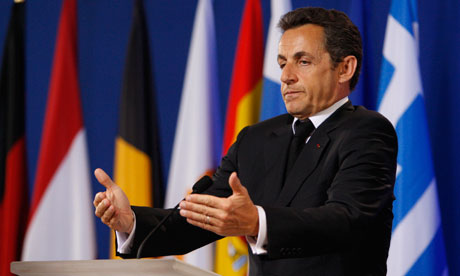
Back in November, at the G20 summit Obama and Sarkozy were having a chat. The Israeli Prime Minister came up in conversation.

“I can’t stand him anymore, he’s a liar”, said Sarkozy, to which Obama replied, “You may be sick of him, but me, I have to deal with him every day!”

The problem with the conversation was that their mikes were on. A couple of journalists heard the whole thing. Instead of rushing to their editor with their enormous scoop, they stayed quiet, in the belief that this was a private conversation, and would be damaging to report.

Nothing was said for a few days until the French website Arret sur Images published their remarks. As soon as international journalists got their hands on the clip, it went global and the mainstream French media reported it too.

Why is this important?

Because it reinforces the point that politics is a drama encompassing the full spectrum of human emotions.

We must never forget that it’s the behind-the-scenes conversations over strong cups of coffee and dog-eared files that end up directing events on the world stage.

Political decisions, like any other are made on the spur of the moment, and under the influence of powerful personalities. If your leader is more eager to be liked than to do what’s right, it matters. If they are impulsive or inexpressive or icy, it will affect their governance. Personality counts.

It’s one thing to believe in protecting private comments from the public glare but it’s another to detach entirely the personal from the political.

Research has shown that politicians get elected on the strength of their personality rather than on their policies.

It’s not surprising.

People are interested in people. They are less interested in policies. Policies may be more important, but ultimately it’s people, not machines that make them.

It’s futile to remove the personal from the political. We can rationalise emotions but we can’t remove them. Margaret Thatcher’s style of governance was probably affected a great deal more by the values of her stiff-upper lip upbringing than by the pages of briefs and pieces of advice she got from various channels during her premiership.

The media have a choice to make between objectifying and subjectifying. Objectifying is talking about Hillary Clinton’s bum, while subjectifying is telling us how her mouth twitched when her daughter failed a maths test.

The future of journalism is uncertain: the overwhelming speed at which news now travels has eliminated much of what the job used to entail.

There is a new opportunity though and it requires us to slow down, to reflect and to write with insight rather than haste.

Demanding of our journalists to be emotionally astute as well as politically sharp will lead to a more complex picture of what is anything but a straightforward job: making decisions that affect millions of lives and the future of our planet.

Journalism may sustain its integrity into the future by maintaining a fine balance between the personal and the political. When it comes to reporting from the private realm, it must replace sensationalism with psychological realism.

It’s what’s missing in the constantly updated, hyper-evolving virtual media landscape.

Unless we begin to privilege the mundane everyday, politicians will stay “out of touch” with it, and the public will continue to see them as little more than worn out political machines; inanimate and inept.

How Maggie boils an egg matters, but you’d really better go and see the film to find out.

On being a creepface

I have the unfortunate habit of staring for long periods of time at strangers I find interesting. Conditions in early childhood encouraged the practice. My bedroom was at the very top of the house facing a busy park and a bus stop. From there I could observe ladies in leggings and ear muffs making their way to the shops and groups of children trying in vain to retrieve shuttlecocks they had misfired into trees.

Sometimes I would sit for so long by the window that I could see the ladies return with their Dunnes Stores shopping bags. It always gave me satisfaction to note the details, like that they’d removed their ear muffs and bought a stick of French bread or two packets of toilet paper.

Some people are interested in living life but I am surprisingly content just to look at it. When I was young, I used to find it fascinating to watch my sister play with her playmobil. She’d set up her toy ambulance, or farmhouse or schoolroom and assign names to each of the playmobil figurines, which she recorded in a special little book which I have preserved for posterity.

She became a scientist; I studied Psychology.

I don’t watch much television because my parents are always watching the Bavarian news or German documentaries about the Pope. When I get the chance though I love to watch people watching television.

My favourite person to watch is my mother.

When she has time, my mother watches sentimental German films, which feature families that seem to making a wholesome livelihood milking cows and running hotels in the Alps, but inwardly battling with deep-seated problems like long-lost loves and corruption in the bovine trade.

In the last thirty minutes of such dramas, my mother’s face changes. As conflicts reach their climax, and true thoughts are expressed, her lips begin to move a little, her eyes grow bigger and she can’t stop the tears that begin to roll one-by-one down her cheeks.

When I turn to look at her, she gets embarrassed and flashes me a sheepish smile. I pretend I haven’t noticed even though she should really know by now that her indiscriminate display of empathy is among the billions of things I admire about her and that her compassion for villagers in complicated love triangles is endearing.

My father’s expression becomes exceptionally benign when he watches trains bounding through glorious British countryside and stuffy antique shows where soft-spoken elderly males evaluate the worth of a 1786 gold-plated pocket watch.

In a domestic context, my bad habit doesn’t get me into too much trouble. Apart from the odd bus passenger sitting on the top deck, whose eye I catch as he’s looking out the window into my bedroom, I seem to keep my creeping quite covert.

It’s different when you’re on the luas though, or taking the bus. That’s a riskier business altogether. There you have to be careful. You see, I find observing people on public transport an indescribabe, insatiable delight. I frequently select my seat on the basis of maximum viewing potential.

The other day a south Dublin boy with a voice several decibels louder than the roar of the engine was making arrangements with his friend on the phone.

“Get us a mixer for tonishe will you”, he yelled. “I’ve got lieke three bottles of vodka but I toshally forgot the OJ in Londis. Ish’s going to be SUCH a laugh tonishe…. Definitely. You’re a star…Definitely. Such a laugh.”

He was speaking with such affectation and lack of self-consciousness that a man at the front of the bus turned around in disgust and stared at him for the duration of his entire conversation, and then again when his friend Lola rang back.

Unfortunately the man who turned had spotted me giggling into my scarf and tried to catch my eye. I didn’t want to catch his eye in case he thought I was only laughing because I wanted to share a special moment with him alone.

Once I was coming home on the last Luas and a group of drunk youngsters were amusing me with their unfathomable babble.

I was the tiniest bit tipsy so my subtlety was at an all-time low. I was caught.

“How are you tonight?” the one sporting a pink shirt with an upturned collar asked me.
“Very well”, I beamed.
“ Where are you from”, he asked.
“Bavaria”.
“Is that in Australia?”
“Yes! How did you know?”
“I’ve been there. It’s a beautiful place”
“It is! I love it there”
“People from there are so sound”
“I know, they so are! – Sorry, this is my stop”
“BYE darling! See you in Bavaria!”
“Bye now!”

When I got home, I turned off the bedroom light. As I was closing the curtains, I took a steely glance out at the quiet street below. I saw a couple kissing by the park railings. And I watched a man cycling by, singing to himself.