Snapshots of a Weekend in Berlin

Berlin is like one of those postcard strips which fold out to reveal a dozen snapshots. No matter how much exploring you have already done, each time you turn an unfamiliar corner, a little square, or a park or church will pop out at you. Here are some snapshots of my weekend, as I think back over it, wrapped in a blanket, with the cat at my feet, rolling a bouncy ball over the floor.

Friday night, 4.30 am Burger King, Friedrischshain

I am remarkably unaffected by the five shots of Kräuter Schnapps, one Amaretto and apple cocktail, and two bottles of beer I’ve consumed. But still, there’s nothing like a greasy bag of onion rings and packet of chips given the circumstances. The lady behind the counter has grey hair and steely eyes and a face full of resignation. I immediately feel guilty for being somebody that makes it worthwhile to keep Burger King open at this hour. I am exceptionally polite when I order. Behind me, two homeless men, with colourful floppy hair and both on crutches, are slurring their words as they address her co-worker, a stylish man with black eyes.

“Why don’t you point at the meal you want?”, he suggests, as if this is a standard cure for those who can’t articulate. The men look at the pictures of slimy bacon double cheese burgers and chicken nuggets and make a selection. “Would you like a drink with that?” the sever asks.

They can’t think of a response for this one. Suddenly I feel something against my leg. One of the men has started to prod me with his crutch. I jump to safety. His companion defends me:“Hey man, don’t do that, she’s a girl. Stop..”
As I am eating my onion rings, one of the men collapses. His burger flies to the ground. The cheese soaks into the dirty grey tiles.

Friedrichshain Park, Saturday, 3 pm

There are two enormous concrete elephants in the park. A little blonde girl is colouring them in with chalk. She’s not wearing any shoes, and her socks are pink. She’s totally engrossed in her task. She paints the elephant’s trunk green.

On the far side of the green, heart-shaped balloons tied to trees are dancing in a light breeze. A group of twenty-somethings are having a party. They’ve set up a little barbecue and are serving sausages and potato salad on paper plates. Suddenly they all put down their plastic forks to sing Happy Birthday to their friend.

A young man with a black pony tail and tired eyes is sitting on a bench, bent over his Border Collie, caressing it slowly, with a large brush. The collie stands patiently, looking straight ahead, bending its knees when required and responding instantly to the man’s gruff “Setzen.” There is tremendous dignity in the collie’s profile. It looks as though he is smiling politely, as large tufts of his black and white fur fall to meet the dusty ground. After several minutes, the man puts the brush away. The collie lifts his head to look into his owner’s face, with deference and expectation. “Na, geh,”the man with the tail concedes, and the collie, still for so long, now bounds away. He meets a Labrador on the way and they sniff each other’s bottoms.

image source: architectureinberlin.com


Sunday, 5 pm The Topography of Terror

Today, exploring the area around Check Point Charlie, I landed at a stretch of the original Berlin wall. A little sign revealed that this was the “Topography of Terror.” There was a visitor’s centre at the site. I went in. And I saw pictures of Jews being paraded round their hometowns wearing signs with words designed to humiliate them. And documents authorising handicapped children to be used for medical experiments. And I listened in to a guide, who was telling a school class about the big companies that had donated money to Hitler during the war.

Suddenly an old man, who had also been listening in, blurted out “I’m not responsible for what my father or grandfather did.”

The teenagers turned their heads.

“I’m innocent! It’s not my fault. I don’t even know if my father or grandfather did anything bad.”

“We’re not talking about blame,” said the tour guide, a curly-haired polyglot, whose first language was not German.

“I didn’t do anything wrong!” the old man repeated, in an accent I now recognize as Berlin, and which most people suppress, because they think it “undesirable.”

“Maybe we can talk about this later,” said the guide. The man stopped talking. The guide finished his tour and told the teenagers never to stop asking questions in order to find out the truth.

As the schoolboys trotted away, the guide approached the old man and shook his hand.
“I’m sorry,” said the old man.
“Don’t worry,” said the guide.
“I’m innocent,” said the old man, his face folded with guilt.

“Thanks for the bailout”: Irish Celebrate in Berlin

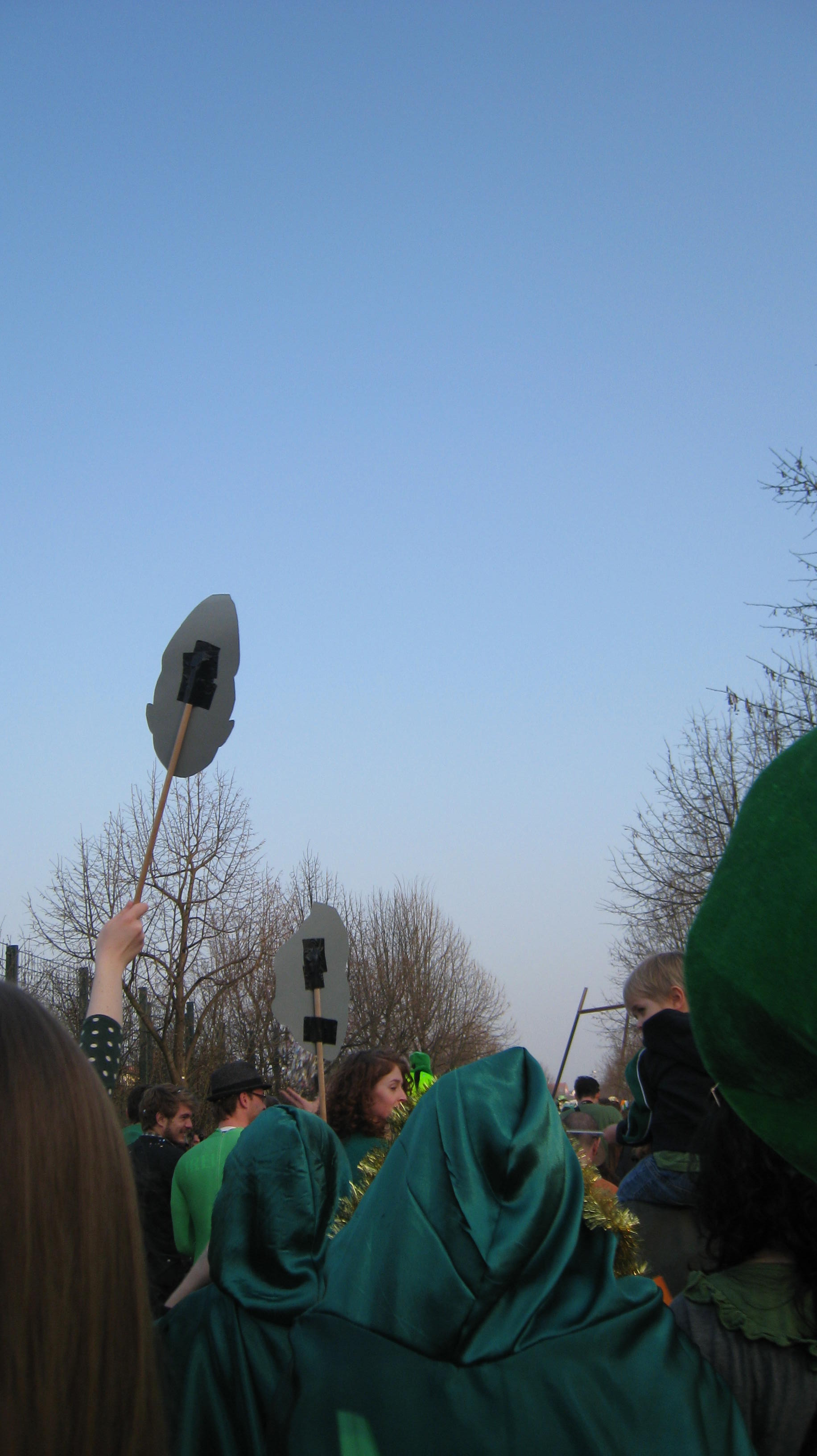
“Thanks for the bailout,” cried a girl in a leprechaun hat, holding a placard featuring Jedward.
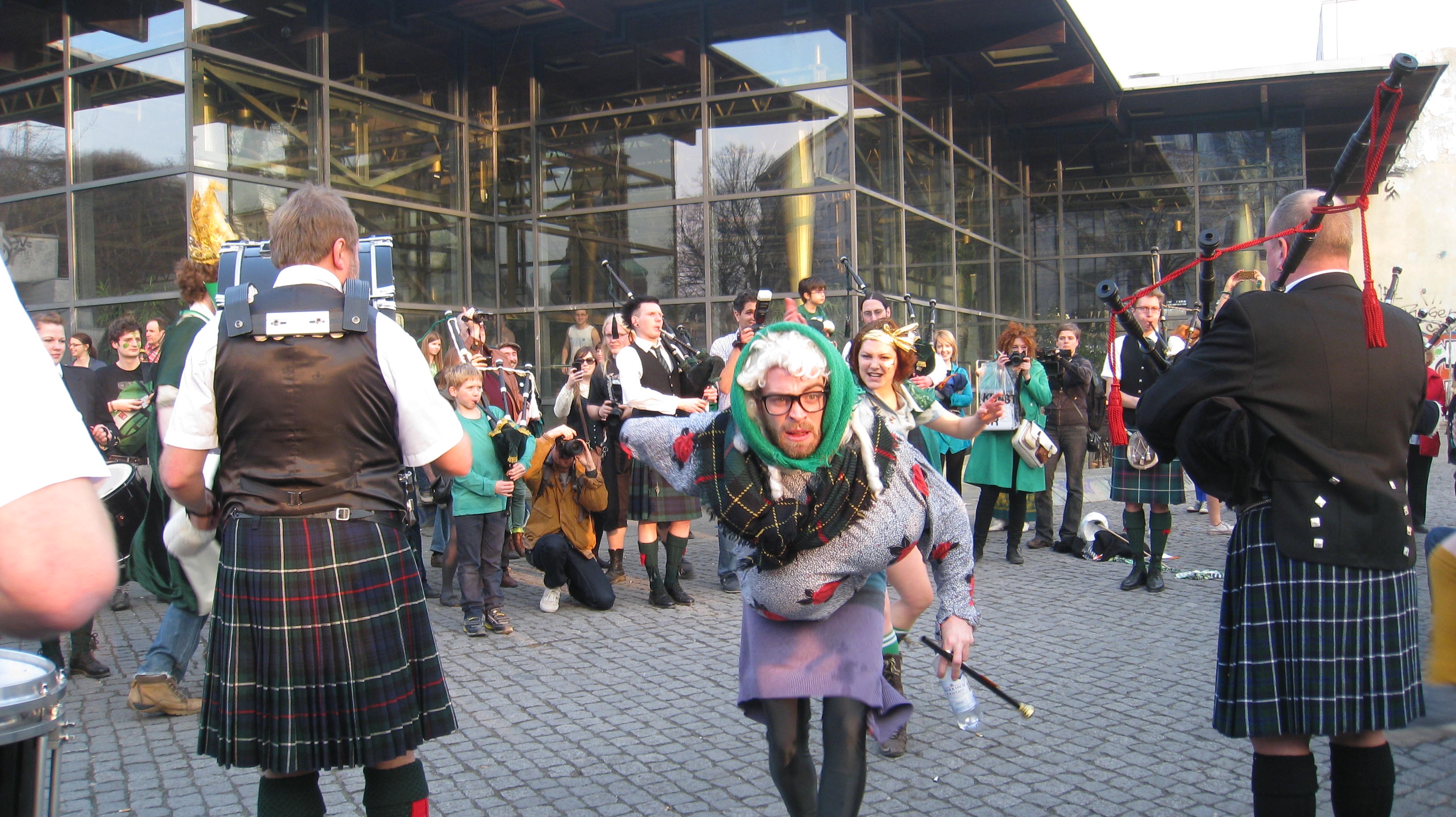
“Careful now,” yelled a boy at her, tooting his plastic horn. Ahead, the Berlin pipe band continued its drone and children dressed in Viking hats danced a jig.

It’s 4 pm in Goerlitzer Park in Kreuzberg, a district in west Berlin. The Irish “parade” is making a haphazard round of the park. “St Patrick,” tall, thin with a long brown beard and a wooden cane is in front. A paper dragon is floating beside him, held up by three girls in green felt, dressed as shamrocks.

I joined in just as the gathering entered the park. There were a few hundred Irish at least, bottles of Weissbier in one hand, and mini tricolours in the other.

Jedward featured in the parade.


Thick country accents initiated a rendition of “The Fields of Athenry,” which rippled a few rows up before it gave way to traditional songs I had never heard before.

I had no idea that there were so many Irish in Berlin. I was hoping for a similar-minded awkward loner, with which I could strike up a friendship. But it wasn’t to be. The people were already tipsy, and, dressed in leprechaun hats, moving only in large groups.

I found myself behind the Irish ambassador to Germany. Actually, when I come to think of it, thats’s just who I think he was. But, if circumstantial evidence stands, he was the only man in a suit and green tie with a well-groomed wife in an emerald outfit by his side.

Irish and Germans celebrate in Goerlitzer Park

Despite being lonesome on such a day of festivities, I went into a bar decorated with green paper shamrocks. I asked for a Berliner Weiss but they said “nicht hetute.” So I got a Guinness, for the day that was in it. It cost twice as much as the other beers, and tasted foul.

It came in a plastic cup, which I took back to Goerlitzer park.

I sat on top of a hill and watched the people around me.

Next to me was a group of six teenage boys. They were taking drugs of some sort. At one point two of them put their faces together, cupping each other’s mouths as if they were going to kiss in secret. They stayed like that for a few seconds and after, the blonde boy’s face broke into a gloriously pure smile, like that of an infant: ecstasy.

Berlin pipe band lift spirits


Lower down the hill, a couple was playing chess on a magnetic travel board. She had a long flowing skirt and three dreadlocks, and he was bald apart from a floppy green Mohawk hanging limp to one side.

A woman in a dirty black leather jacket and a face entirely obscured by scraggly hair, stumbled to the couple and asked “Hast du eine Zigarette?” The man had a bag of tobacco, which he pushed towards her. She fumbled in it and then flopped down beside the girl. The couple continued to play their game of chess. The woman in black began writhing beside them, and moving closer to the girl, until her head was resting on her lap. Every once in a while, she would raise her feet and kick the air.

When the couple had finished their game, they got up gingerly and said “tchuess” to their dosed-up friend.
She didn’t hear them, and lay alone, her head in the grass.

I finished my Guinness just as it was getting dark.

On the way home I got off at Alexander Platz, the former centre of east Berlin.

TV tower lit up in green

There I saw the iconic television tower, glowing green. I looked up at it for a while. Then I disappeared underground again and made my way home, where the cat was waiting for me.

On The “Erfolgserlebnis”

The word Erfolgserlebnis means experience of success but the usage in German is much more subtle than that.

If you win the lottery or get a great job, you don’t have an Erfolgserlebnis; you’re simply “erfolgreich”, or “successful.” But if you finish a particularly tricky Sudoku or make a delicious apple pie, you have an “erfolgserlebnis.”

My first erfolgserlebnis in Berlin was finding my hostel successfully. I am notorious for having no sense of direction. That’s still the case but because I was so anxious before I came here, I took extensive notes of the landmarks which I could expect to see when I got out of the Strassenbahn. When I then managed to find the hostel without difficulty by identifying the gigantic Fernseher Turm: the tower which was covered in mist that time I almost died while climbing the Victory Column I positively glowed with success.

My second erfolgserlebnis was finding out that there’s a marzipan flavour of Milka chocolate and that you can buy it for just 57 cent at Kaufland. I plan to stock up this weekend.

My third erfolgserlebnis was last Friday, when I had my first article published on Spiegel Online. I was convinced I would be the first intern not to have anything published so when the story came up and my ridiculous name appeared in the byline I was more than chuffed. I was smiling so stupidly on the U-Bahn on the way home that I had to hide my face in my scarf to avoid offending the other passengers.

On the way home that night I bought myself some raspberry flavour beer. Since making friends is still on my “to do” list, that evening it was just me and the cat.

Drinking beer in less challenging circumstances

After heating up some of my leftovers, I decided it was high time I settled down with some of the local brew.

Then, in one of my life’s more unfortunate epiphanies, I discovered I usually drink beer in company and often with with LSB, who is kind enough to open the bottle.

Now that I have become emancipated, I had to search helplessly for a way in to the promising brew.

I have seen cool people open beer bottles with their teeth, or by levering the edge of the lid against a counter-top.

I tried both these things. Then, remembering about the evolution of tools, I searched for a bottle opener.

I scoured the kitchen and then grabbed a little implement triumphantly from the drawer.

After several minutes, I realised that I was trying to open my bottle of beer with a garlic crusher.

This, dear readers, was not an example of an Erfolgserlebnis.

*********************************************************************************************************
For the anxious among you, I did eventually manage to find a bottle opener and savoured the raspberry beer all evening long. Would recommend.

Why I am becoming a punk

Having been in Berlin for almost two weeks, I’ve decided to become a punk. I’ve been spying on them like a creepface since I got here, and am now planning the transformation.

I was only thinking the other day that it was time to rid myself of my squeaky clean image. The conversion would be quick and easy and wouldn’t require more than the purchase of a dog and a new wardrobe.

Plus, the lifestyle seems a lot less stressful than that of a journalist. Here are some notes I’ve made in advance of my conversion:

Punks in Berlin tick all the boxes. They have to – after all, they are German punks.

Most sport at least one stylish luminous spike, which bears a keen resemblance to a rhinoceros horn. Colours can vary, but red and green are preferred.

Piercings are mandatory. At least one nose ring is essential, as is a leather jacket with metal accessories. Spikey collars and patchwork black denim are encouraged but not proscribed.

Punks in Berlin are required to own dogs. These are unusually large hounds with leather collars, who, foaming at the mouth, are taught to snarl at conformist passers-by.

Berlin punks are early-risers. In the mornings you meet them hanging out at the U-Bahn stations taking swigs out of bottles of local beer and occasionally shouting obscenities on the escalators.

All in all, they are a benign bunch, characterised more by their sartorial conformity than by any act of rebellion.

I know I should be telling you more important things than about my dreams of joining a subculture but the problem is, all the things that are worth writing about, are “off-the-record.”

I would love to write about the Spiegel newsroom, where I spend the majority of my time in front of a computer translating articles about potential wars with Iran and the future of nuclear power in a post- Fukushima world, all while a mere three minutes away from the Brandenburg gate. But I can’t.

I’d like to talk about some peculiar characters I’ve had the delight of meeting but there’s a danger they might be reading.

I could of course write about Cauchy the housecat, who I am learning to love despite my well-documented feline aversion but that too could have libellous repercussions since Cauchy is showing signs of literacy.

Or I could tell you about the weekends I’ve spent alone wandering round the magnificent city, breathing in the incredible creative energy it contains and turning strange corners to find yet another beautiful expanse to inspire the senses. Last Sunday morning, I ventured out to the famous fleamarket at Boxhagener Platz, which is near me, and whiled away the hours looking at beauty magazines from the DDR times, and at old-fashioned dolls, which sat bolt upright in their prams, staring at me.

Flea market at Boxhagener Platz


But usually at the end of the day I am so tired that all I can do is grab a block of frozen spinach, which I buy for 35 cents in Netto, and shove it into a saucepan with an onion.

I could write about being alone, or about Skyping with LSB or about my flatmate, who is the sportiest person I have ever met and even stretches recreationally but as I’ve said before, this is not a diary.

Those tales I reserve for those of you with which I enjoy the pleasure of a private conversation.

I can report that I visited the largest chocolate shop in the world last weekend and that it was absolutely magnificent. The chocolate Reichstag was infinitely more impressive than the real thing and the enormous slabs of almond chocolate laced with cherries to die for.

Chocolate Reichstag

I also went to a street where the last cement slabs of the wall still remain in their original position. Pristine on one side and covered with graffiti on the other; a tidy contrast between freedom and repression. I climbed up high and looked down on the barbed wire fencing and Soviet watchtower and at the high-rise flats on either side, where east and west Berliners could wave at each other while the watchmen took a nap.

Remains of the Berlin Wall.

I’m alone at home now, with my feet toasty beside the radiator and the cat asleep in the armchair beside me. It’s very still here just now. Soon the neighbours will turn up their music and I’ll hear the clatter of footsteps in the hallway outside.

But for now, I’m going to enjoy the silence and curl up with a copy of The Steppenwolf, which I bought on Unter den Linden from the vendor that never ceased to talk.

Goodnight from Berlin.

Thoughts on leaving Ireland: Why emigration is my lifestyle choice

This time two weeks, if everything has gone to plan, I’ll be sipping beer alone in an east Berlin hostel.

I’m leaving Ireland for a few months to do an internship at Spiegel International, the English version of Germany’s Der Spiegel.

I’m one of the people Michael Noonan was referring to when he talked about emigration being a “Lifestyle choice”.

I intended to emigrate when I graduated in 2010 but I couldn’t afford it. After I did a TEFL course, which my parents paid for, I was lucky enough to get a job at the school where I trained.

I have loved this job and were I not young, passionate about writing and curious about the world I would do well to keep it.

I don’t agree with Eamonn Dunphy that Ireland is a dump. I agree with George Hook that this country gave him a “bloody good living”.

If we were in the middle of an economic boom I’d be in more of a rush to leave.

Because moving shakes you up, allows you to meet people that challenge how you think and forces you to define yourself within new parameters.

I’ve lived in the same house for 24 years. I know its every nook. When I come home, my father is where he is supposed to be. As I push open the gate, I look in the window and see the back of his head and his arms outstretched. From behind, it looks like he’s made a tent out of the Times newspaper and is holding it stubbornly in place because he has run out of pitching pegs. I hear clinks of plates in the kitchen. I smell his butter beans beginning to burn. I find my mother’s school-bag in the hall and hear her practising the Alto part to the piece of music she is singing in choir. When I come into the room she turns from the piano and tells me an amusing story about one of her pupils or something that she saw on the way to school.

In the mornings, I wake up and Áine Lawlor’s voice is like wind, willing me out of bed. All I can think about is how warm I am in my onesie and how early Áine must have to get up every single day. After a while I feel ashamed and curl into a foetal ball and roll out of bed.

As for the the three men that are in my life but that don’t know it they won’t miss me one bit.

I saw the man with long blonde hair and pools for eyes again today. His head was pushing down Harcourt Street, like a hound in slow motion. Last week I bought the Big Issue from a Romanian women in Rathmines, instead of from my friend outside Trinity. I haven’t seen him in a while but if I do, I will buy another copy. LSB has promised that he will buy each new issue from him while I am away. I know he will, because he always keeps his promises. And if he forgets, my face will appear on his computer screen as soon as he signs into Skype and I will ask him why he hasn’t done it yet. I am charming like that.

I’ll miss town on a Saturday. My vegetarian breakfasts at Cornucopia, where I spy on people who have nice haircuts, pretty coats and carry pocket books. I’ll miss John Gormley’s neat head and chiselled chin, which you can see in a frame hanging on the wall. I’ll miss the flea markets and co-ops which are beginning to blossom like a shy bride all over the city. I’ll miss the silent Falun Dafa-practising protesters, who stand around banners at Stephen’s Green with their eyes closed, drawing shapes in the air, uncannily in sync.

After the terrible things I have said about it, I’ll miss O’Connell Street. I’ll even miss the towering superfluous spike. Sometimes when I’m whizzing along on the U-Bahn gobbling up breaking news, I’ll think back to the times I felt sad when I passed the alcoholics who drank inside the pubs on Parnell Street at half eight in the morning. I’ll think back to Wednesday mornings, which are Dole days in the north inner city. I’ll remember the sorry queue of hunched figures in tracksuits waiting to get into the little green post office.

Sometimes, I’ll yearn for those moments when you’re waiting at a bus stop or sitting on a park bench and an old man or lady looks at you a little longer than they should and then decides that you are a safe person and talks to you about the weather or the recession or about when the bus should arrive.

I’ll miss the men and women who work in the charity shops on Camden Street and the type of lady that I overheard last week in the Cancer Society shop telling a customer that she couldn’t win an argument, let alone the National Lottery but that it doesn’t stop her from dreaming.

I will miss the -often irrational- indignation of the callers on Liveline. I will miss the ceaseless banter and inoffensive drizzle and the feeling I get of being a 1930’s maiden any time I’m in Neary’s Pub.

But I’ll be back. And I’ll have learnt how to live with a cat despite my prejudices and what it’s like to write to live instead of to live to write.

I might just have managed to see out my Quarter -Life Crisis. but I’m not promising anything.

And I’ll be blogging so that you can come to Berlin too, if you like.

*********************************************************************************************

Tomorrow is Valentine’s Day. E-mail me privately with suggestions as to how to get LSB back for last year.

If you’re on Facebook and want to join in on some chats, you can “like” Katekatharina’s page.

What septic tanks and education have in common

I’ve spent three-quarters of my life being educated and the last two years educating others.

Since I began school at the age of four, I’ve associated education with evaluation.

First it was stickers and stars and rubber stamps. These evolved into report cards with little boxes beside the words: poor, fair, good, very good and excellent. Next came the letters of the alphabet: A, B and C. Then fractions and percentages arrived and after that, points. At university, marks were converted into classes and you could be first, second or third.

Compulsory education – like the septic tank- originated in the nineteenth century. While both aged tolerably well, of late they have begun to fail us.

image source: insectapedia.com


After all, as Ken Robinson, an educational theorist points out, the current system of education was conceived in the intellectual era of the enlightenment and the economic context of the industrial revolution.

Like the septic tank, it has failed to keep up with the times, often producing impenetrable sludge before practical distillation.

(If you need proof, try understanding what on earth academics writing in humanities journals are trying to say).

It’s not that our education is of poor quality. It’s not that we have bad teachers, or unmotivated students. They never help but they’re neither unique to this period nor the cause of the problem.

The real issue is that we haven’t decided whether education is a journey focussed on itself or on its destination.

Let me explain.

Up to recently, education was a means to an end. You walked out of school and into the workplace. If you went to university and got a first class degree, you got a first class job.

Now things have changed. We have too many people educated in areas with too few jobs.

The difficulty is that we still believe that the higher your educational level, the loftier your career expectations should be.

Of course it’s a prospect that many are failing to realise.

Now, if you get a first class degree, you take your place among all the others and compete for any old job.

It’s a case of social progress outrunning institutional reform.

You could see the situation as a social leveler. Now unemployment is for everybody, not just the least privileged.

Some students spend twenty years collecting stamps and stars and letters and numbers.

And then they find that the numbers don’t add up to a job.

Their experience calls into question the very purpose of evaluation.

The transition from pupil to teacher has taught me that evaluating students is rather arbitrary. It doesn’t measure very much at all.

But we’re hooked on comparison. We get frustrated if our own evaluation can’t be backed up by a standard measurement. If we think we’re better than the person next to us, we want it neatly before us in percentage form.

I guarantee that in a secret ballot, students wouldn’t vote out tests and exams.

Science backs it up. Research has shown that the pleasure circuits are activated in advance of finding out a result.

We thrive in conditions of uncertainty.

Waiting for a test result is like waiting to see if you have won in Poker. Ultimately neither tells you how well you have played or how much you have learnt, but rather how well you have performed relative to others.

It’s time we took a step back though.

The right to education is one of the great privileges of our age. While its original and most important purpose-to lay the foundations for economic subsistence- has been eroded by the unprecedented pace of progressive reform relative to growth in employment opportunities-we must take time to remember what has been so long neglected: the timeless, immeasurable pleasure of learning for its own sake.

Could it be that indulging ourselves in constant measurement against others is doing us more harm than good?

Andrew Bird, an American folk singer condenses the possibility beautifully in the song “Measuring Cups” which opens:

Get out your measuring cups and we’ll play a new game. Come to the front of the class and we’ll measure your brain. We’ll give you a complex and we’ll give it a name.

This generation, more intensely than any other before it, has experienced education as a closed system of incessant measurement.

For many that measurement has not amounted to more than restlessness and disillusion.

Learning for its own sake has been forgotten amidst the obsession with making ‘it’ which means ‘making money’.

If teaching has taught me one thing, it’s that the responsibility to evaluate is nothing compared with the possibility to inspire. My job is to encourage before it is to instruct.

Pupils are not watering cans: we can’t fill them up without their consent. They must want to learn, not in order to get a good job or to become rich or to sound clever, but because, as Merlin in T. H. White’s The Once and Future King reminds us, “it is the only thing that never fails”.

I have the following words pinned to my bedroom wall:

“You may grow old and trembling in your anatomies, you may lie awake at night listening to the disorder of your veins, you may miss your only love, you may see the world about you devastated by evil lunatics, or know your honor trampled in the sewers of baser minds. There is only one thing for it then, to learn. Learn why the world wags and what wags it. That is the only thing which the Mind can never exhaust never alienate, never be tortured by, never fear or distrust, and never dream of regretting. Learning is the thing for you”.

Equipped with this original joy of learning, and a quieter, more humble confidence, our young people may be more inspired to carve an independent niche on the side-lines rather than enter the desperate rat-race of out-performance.

Let’s make our recovery less sludgy than a septic tank. In remembering why education matters for its own sake, we avoid throwing the baby out with the bathwater.

The Euro Crisis: A Family Drama

Cast of Characters

The Proud Parents: Germany and France
The Eldest child: The United Kingdom
The Wild Child: Greece
The newly adopted: Croatia
The Redeemable Rogue: Ireland
The neglected middle child: Spain

Synopsis

 G and F didn’t like each other. Then tragedy brought them together.

They cast their differences aside and became inseparable. They decided to build a family.

They vowed to be the best parents in the world. They were young and believed their family would be the happiest in history.

They were wise too. They welcomed their young with open arms and closed fists full of caveats.

(If their own bitter experience had taught them anything, it was that successful family life meant balancing freedom and constraint.)

Each year a new member was born. G and F wanted a big, happy family and they weren’t finished yet.

Their eldest, UK was a strapping lad. At first he imbibed his parents’ values. As the family grew, he began to feel stifled. He wanted more independence.

During a romantic weekend away in Maastricht, G and F conceived a fresh plan to unite them all.

It was the last straw for UK. He decided he wanted out.

When the kids hit their teens, G and F noticed that a crisis in family values was looming across the waters. They blamed fast food and the American consumer culture.

Within a few months, things got worse. Ir, who had fought through a shaky start in life to become everyone’s favourite teenage success story, turned out to be living precariously close to financial ruin. G and F were disappointed and wondered if they were too lax in tolerating her constant partying.

Then S and P went off the rails too. G and F wondered if they’d spoilt the children.

But the family pulled together and bailed the kiddies out.

The mess wasn’t over yet.  Now Gr, the fiery middle child was in trouble. Financial ruin kind of trouble. Gr had been lying to his parents for years.

That was the last straw for G and F, who began to impose discipline.

On top of it all, they agreed to adopt another child.

Cro, a youngster with a troubled past had wanted to be part of the perfect family for years.

When the time finally came though, Cro realised that things weren’t so perfect after all.

Can they all pull together and become a model family once again? A vacation in Davos seems to be their only hope..

What the critics say:

This tension-filled family drama is sure to be a bloc-buster

                               More drama than your average Greek tragedy!

image source: http://www.salon.com

A quarter-life crisis, a Familienfest, the land of the free, my first real job.. Here are the highlights of 2011

January

I was: unemployed, restless, devilish

What I said: “I have few accomplishments to recommend me; I cannot draw, my recitals on the pianoforte are clumsy at best and I have neither a talent for embroidery nor the gift of graceful movement. The one area in which, after much searching, I have found myself to excel is in the ability to produce plausible-sounding Gibberish at will…” more

February

I: found a job, was still devilish.

What I said: “I check my e-mail before going to sleep and there’s a Valentine e-card in from LSB! I think: “Aw, what a sweetie”. I open it up only to find a Fine Gael cartoon canvasser tell me that “Labour are red, Fine Gael are blue, we won’t raise your taxes like they want to do”. Then he winks and looks shiftily (seductively?) to the side. I send one to every member of my family signing it Eoghan Murphy xxx, the name of the Fine Gael candidate in my constituency who topped 98 fm’s “hottest election poster boy” poll…” more

March

I: had a quarter-life crisis

What I said: “There was once a raven-haired fortune teller who, tracing her forefinger over my palm, told me that I would live to be in my nineties. I was alarmed when I realised some time ago that I had reached quarter age in spite of her promise of longevity. This realisation, coupled with acute post-graduation panic (PGP) has propelled me to a life crisis…” more

April

I: tried to forget about my Quarter Life Crisis by taking a trip to Sligo with LSB

What I said: “We’re leaning against a stony wall by the riverbank. I’m unzipping my camera case gingerly because I want to remember the stillness and his solitude when a blonde-haired man of about thirty staggers, stony-eyed towards us.
“Don’t you dare take my picture”, he yells. “You’ve no right, you sons of bitches. You’ve no fucking right at all”…” more

May

I: thought about my younger and more vulnerable years.

What I said: “I was 16 and practically the same but for a hideous mane of long, straggly brown hair with orange highlights. I had just finished struggling through The Satanic Verses. I’d taken it to Germany where I spent many a journey on slow trains, puff-puff-puffing their way through the Bavarian countryside, with the battered book on my knee, trying to make sense of it all. Bizarrely-named angels, and evil and the Muslims didn’t like it: it went something like that…” more

June

I: took up a political cause

What I said: “As they beat their hammers on their oak writing tables and whisper “Objection” in advance of September’s Referendum, the twenty-two dissenters will inevitably privately concede that the scrapping of Article 35.5 represents good riddance to bad rubbish. Objection over-ruled…” more

July

I: thought about pens and penises

What I said: “Unless it’s accepted as equally scandalous that the proportion of male nurses is equivalent to that of female corporate executives, a discussion of gender can never be detached from a social weighting in favour of money…” more

August

I: attended the annual Familienfest

What I said: “As I was tucking into my vegetable bags (or Gemuse Taschen) I had a sudden sinking feeling: I had forgotten to pick up the bag of black sausages!…” more

September

I: admitted that I don’t have the first clue about the economic crisis

What I said: “Every weekday morning, I brush my teeth while listening to the business news on Morning Ireland. Once the weather comes on, I know it’s time to spit…” more

October

I: realised that there’s nothing quite like an Irish Presidential election.

What I said: “The struggle for the presidential candidates to find many more words than the Queen of England herself during the “Irish Language” debate revealed the incongruities that are still gripping this little nation, which – desperate for an export-driven recovery from economic ruin- continues to struggle with its own identity…” more

November

I: went to America.

What I said: “Subways in New York are grubby places. They are for poor people and for people who read large books with city library stamps printed on their spines…” more

December

I: finished learning the Arabic alphabet!

What I said ““That is a beautiful and new car!”, I said pointing to a rusty 1993 fiat punto. “I am Kate Katharina.” “Pleased to meet you.” “Give me a falafel please”.”… more

………………………………………………………..

Thank you all so much for making 2011 lovely and for taking time out of your much more exciting lives to leave comments. I appreciate you all enormously. ❤

The Mouse

One September morning in our poky kitchen, my father and I were enjoying an early brunch. He was spooning floating pineapple rings from a large glass bowl while I dipped some oatmeal biscuits into my peppermint tea. From the corner of my eye, I noticed something small and dark flitting across the floor, but the moment I turned in its direction, it was gone.

My father’s pineapple ring splashed unceremoniously back into its pool. “Did you see that?” he asked.

“See what?” I replied, wondering whether he was talking about the same thing.
“Something on the floor?”
“Yes! It was probably a Daddy Long Legs”, I told him.
He agreed and we laughed at my infantile terminology.

I thought nothing more of it and we continued to eat in amicable silence.

That September represented a new and unforeseen period of my life. I’d finished university the May before and was still at home, having failed in my attempts to travel and to find a job.

The upside to it all was that I was rather enjoying domestic life. I got to see a lot of my dad, and we’d developed our own little routines, like making mochas in the tiny steel pot which he’d had since university and listening to programmes on Radio 4.

Though I could sense myself regressing, I took solace from the fact that these moments at home were precious; that they wouldn’t last forever.

Throughout the summer, I had been indiscriminately applying for jobs but nobody would have me; the country was at a standstill. Then one day an enormous opportunity presented itself: The Irish Times was looking for an intern.

600 applied and I was in the final eight. I wasn’t holding my breath but I was devouring newspapers all the same and after a summer of uncertainty, a date for the final interview had at long last been set. Many of my conversations with my father went something like this:

“Dad, do you think I have a future?”
“Of course”, he said “You will become a literary lay-about just like me”

My father is the honorary editor of a history journal and spends much of his time cycling to and from the National Library to check if Major General so-and-so of the fifth battalion really did travel to Kinsale in 1752 as the Right Honourable Blogs’ diary of that date alleges. If he’s not doing that, he’s sitting in front of his laptop, painstakingly typesetting articles, which have arrived in his inbox from the eclectic collection of contributors he has garnered from around the world.

“Of course you won’t be rich”, he said, “but you will find a niche eventually”.

So went our conversations that summer and we revelled in the gentle irony with which we viewed our mundane daily existence.

Now that the summer had drawn to a close, the brunch we were enjoying in early September was my last before the final Irish Times interview, which was to take place the following day.

That evening, my father made an announcement.

“We have a mouse”.

“What?”, I said, already squirming.

He nodded solemnly. “Yes, I rather feared that’s what I saw in the kitchen this morning, but I didn’t want to scare you”.

“Ugh”, my mother sighed, from under her woollen blanket in the living room. “We’d better seal up the kitchen door so it doesn’t escape into the rest of the house”.

And so it began.

I refused point-blank to enter the kitchen the following morning and set off for my interview without breakfast.

I’m a vegetarian but that does not mean that I like to be invaded; particularly not by fast creatures, with long, thin tails, I told myself. After all, that’s why I chose to grow up with guinea pigs and hamsters rather than gerbils and rats. I further justified my over-reaction by telling myself that I was under enormous stress: what with a potentially life-defining interview ahead of me.

I arrived home that evening to bad news.

“We saw it in the living room”, my father said, grim-faced but full of resolve.
“It was incredibly fast”, my mother added gravely.

On the way upstairs, I quivered at every nook, convinced that the creature was about to emerge from hiding and crawl up my leg. I couldn’t bring myself to take out my furry slippers from under the hall table either, in case the mouse had taken refuge there. I shuddered and locked myself into my room.

I sat there and wondered about myself.

Two days later, things took a turn for the worse:

“It was in our bedroom”, my mother said “I saw it scamper behind the cupboard”.

She too was highly uncomfortable about the invasion.

Action had to be taken. My father got some traps.

My protest was pathetic: “Can’t we just capture it and free it humanely? Please

We could not, and I had some nerve if I thought that I could just sit there, being an hysterical and inert vegetarian, applying a guilt trip while they went to war on all our behalf.

Impractical, irrational and immature, I knew that I could neither see the mouse suffer nor capture it alone.

There had to be another way.

I made my way to the local hardware store, passing through shelves of creosote and weed-killer until I got to a section labelled “Pest Control”. Jumping with delight, I found exactly what I was looking for; I snatched it from the shelf and proceeded to the till.

I arrived home triumphant.

“I have a humane trap”, I declared.

“Huh?”

They weren’t nearly as enthusiastic as I was. They’d spent the day trying to catch the thing, which had now been spotted in several locations throughout the house, only to have me saunter back from my sojourn in the moral high-grounds, wielding a tiny cardboard box, which promised “easy capture and release”

They wouldn’t replace their multiple killer-traps with my one humane one, but agreed to use it as a supplement to their own.

The following day I spotted the mouse in my sock-drawer, and screamed.

I noticed though, that it was much smaller than I had expected.

It was a baby mouse, with a beautiful little face and a shorter-than-average tail.

I thought about the techniques for overcoming fears that psychologists recommend. One of them was called “mere exposure”: simply coming into contact with a fear can help alleviate it.

On Sunday morning my mother went to Church, having seen the mouse scuttle under her wardrobe.

By then our battle with the mouse was becoming somewhat of a farce; so much so that my father had placed our mouse-shaped pumice stone onto a trap in the living room the day before in order to startle me.

Fortified by courage and relaxed by the prepostrousness of the situation I entered the room. My father was in bed, reading a tatty book with a dull title.

“What’s the situation?”, I asked.

He lifted his nose reluctantly from under the book: “It has to be over there”, he said, motioning to the far corner of the room, “It definitely hasn’t left.”

With a sudden surge of courage, I ran to the kitchen and snatched the humane trap from where I had placed it just beside the door.

Returning upstairs, I opened the flap to the linen closet where scores of my mum’s dresses were hanging.

In the corner, half-concealed by a green velvet wrap, whiskers twitching and tiny ears erect, I saw it perched.

Any of the fear I had left drained from me in a flash. It was adorable.

We waved a scarf at it and it dashed. We dived and it squeezed past us in a blur. We put the hoover on and it didn’t move.

We laughed.

Mum came home and I retreated, expecting that we would have the little creature captured and released into the wild by lunchtime.

Later that day a voice called me from above.

“Kate, we have it!!! We’ve got it!! Come here!”

I rushed up, tripping on the pieces of cheese they had left in a trail across the floor.

My father, grinning, was holding the plastic box, where the mouse had become entrapped.

“There you go, it was your humane trap that did it in the end”, my mother conceded, smiling with a twinkle in her eye.

I took the box from my father and stared in at the little face, with its jet-black beedy black eyes peering back at me.

In those few minutes, as we sat there in my parents’ room, surrounded by traps, with clothes and cheese strewn around the floor and the tiny creature in our hands we felt closer to each other than we had for a long time. Somehow this little incident had brought us together: first through our nervous tension and then, when we saw the cute thing up close, in our shared appreciation of the ridiculous.

There was some sticky stuff on the base of the trap so the creature couldn’t run away.

“We’ll release it in the park across the road”, I cried, beaming at the idea.

“It won’t be long before it’s back!”, my father laughed as we were getting ready to go.

We were giddy with our success.

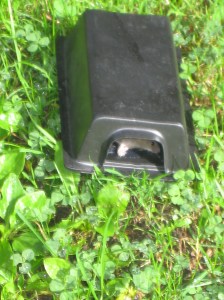
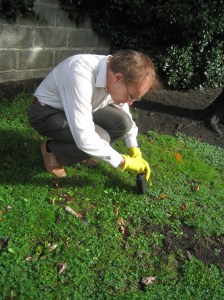
I ran upstairs to grab my camera so that I could record the moment of release. We got as far as the gate and I got my mother to take a shot of my father and me with our mouse friend.

Once in the park, I returned the box to my dad, to do the honours. We’d brought a pair of kitchen scissors with us so we could remove the top of the box.

Gingerly, my dad cut through the roof. The mouse, impaled on the floor, did not look happy.

“Not long now”, I gushed over it, still frivolous and light-headed with our victory.

My father placed the plastic container down on the ground.

Suddenly from behind, an enormous labrador came bounding towards us, barking madly. He had smelt a rat.

My instincts suddenly aroused, I growled and ushered him away, becoming a little embarrassed as I turned and saw his ten-year-old owner watching me.

The dog gone, the park fell silent but for some leaves, which rustled in the distance. We must have been there for only a few seconds but suddenly an uncertainty engulfed the air.

My father stepped back to look at the motionless mouse, stuck to the base of the box and after a while, he asked my mother to get him a sand scraper from the house.

While she was gone, I bent down, and looked more closely at where the mouse was stuck.

Attached to the base of the box, were not just the four paws, as I had thought, but the entire belly of the mouse, rendering it utterly immobile.

My mother returned with the scraper. Dad picked up the box again. With gentleness that stirred me, he attempted to get it under the mouse’s tiny feet.

It didn’t work. The gluey goo was too deeply ingrained into its silky-thin fur.

My heart was beating more quickly now.

The little body was beginning to twist in pain. My father’s expression changed: scraper in hand, he too was twinging with discomfort.

As the mouse moved, more of its fur became dislodged.

I began to see blood.

“Stop”, I yelled, hopelessly.

I had to look away. My father’s eyes were full of pain, as he continued to scrape at the little body, wreathing in agony.

An autumn chill was in the air.

The last I saw of the creature was its outstretched neck and taut, mangled, tortured body being ripped away from the plastic box.

It haunts me still.

In the days, weeks and months that followed, nothing has invaded me like this image. We had some other mice after that which were killed, humanely by guillotine. I got a rejection letter from the Irish Times some weeks later and didn’t feel much. And for all the bloodshed I have seen in the news, and the depressing images of suffering on the streets around me, nothing disturbs me like that image, or sends a pang of guilt so accute gushing through my entire body.
An Image of America

A woman perched atop a ladder is attaching a plastic bat onto the roof of a porch. Across the street from her, just in front of a park, a man in a wheelchair is rolling over to a haggard lady, who is doubled-over at the entrance to a tiny tent. I watch them speaking. He rolls his eyes, shakes his head slowly and says “Man, he’s worse than Bush. I’m sorry he ever got my vote”. He turns his head to a squirrel at his feet: “I’m sorry I’ve no nuts for you, buddy”.

The lady has been holding a vigil against America’s nuclear policy for over twenty years. She lost her husband two years ago. He spent twenty-seven years in the same tent. Today her home-made signs promoting peace are sopping wet and the squirrels sheltering inside her tent keep her company.

The woman descends the ladder. A plastic bat flaps its wings in the breeze: black against the gleaming White House.