Unknown's avatar

About Kate Katharina

Kate Katharina wltm people with stories for literary fling and maybe more.

When Penneys came to Berlin

Penneys has come to Berlin. It’s enormous. And like in Britain, it’s called Primark. It takes up most of the Schloss-Straßen shopping centre. Our ambassador opened it officially back in July.

I had to visit.

As soon as I got off the train, I spotted two übercool teenage boys swinging Primark shopping bags. Very pleasing.

It was full to the brim inside. Like a game of bumper cars. It may have opened over a month ago, but Berliners are still coming to terms with this Irish import.

Primark takes up most of the shopping centre! I probably looked a little strange taking this photo.

One girl I saw had stopped dead in front of a €2 pair of wine-coloured tights. She picked them up and stroked them. Then she bent her face over them in case she had missed a trick. After one final caress, she flung them into her enormous cloth basket.

You can’t blame her. Such a thing is unheard of in Berlin. While everything else may be cheaper (and I mean everything: rent, food, toiletries, pets ..), clothes are not. Especially not tights. Tights are a luxury afforded to those lucky enough to have a disposable income of more than seven euro.

Onesies are new too. They may be a step too far for Berliners though. The section with the zebra-print one-piece suits with lace-up paws was the only one empty today. But as the weather cools down, perhaps braver Berliners will take the plunge.
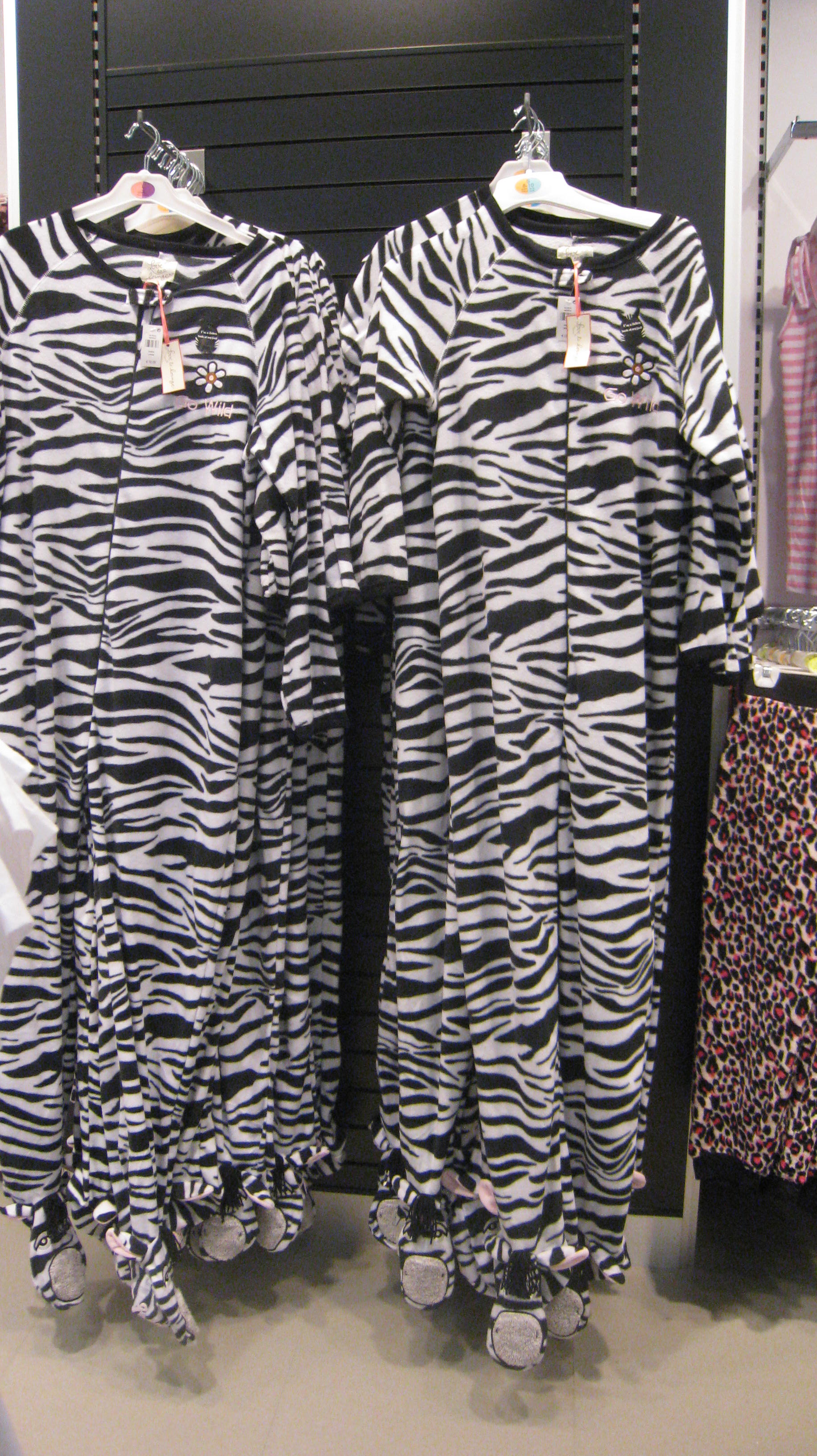
Nobody stopped me from taking a picture of the onesies..

Primark Berlin is full of languages. I couldn’t count them all as there were some I couldn’t distinguish with certainty. Staff wear the same uniform as in Dublin and the Muslim women wear black headscarves.

It was surreal to hear staff announcements like “Ute Müller zur Kasse bitte” blasting through the store.

I couldn’t justify my expedition without visiting the fitting rooms. I joined an almighty queue. Unlike in Dublin, the lighting on the way into the changing area is dim. Almost Hollister-esque, which made me cringe. It snaked around and around and made me feel like I was about to visit a haunted house.

Manno,” said a girl in front. “This is going to take forever.”
“Only eight items per person,” cried the shop assistant. “It’s quicker that way.”

I had grabbed a yellow mini skirt and a woollen wrap to try on.

In huge letters above the changing room entrance it says. “Try it, Like it, Buy it!” Germans love English slogans.

The light inside the changing rooms was just as unflattering as in Dublin. It just proves the success of the business model. People buy this stuff despite recognising blotches and follicle sprouts ordinarily concealed by more flattering light.

Neither skirt worked. Might have been the lighting but more likely the fact that I am very poor. I did however make a purchase. I’ve started running you see. Not far, or fast or anything, but you do end up breaking into a little sweat. So I picked up a turquoise tank top that promised to “stretch” and headed to the checkout. No amount of semesters studying economic psychology could take away the temptation to impulse buy on the way to the till. I resisted faux porcelain cupcake-shaped containers, facial wipes and novelty socks. But when I saw antibacterial handwash I could stand it no longer. I grabbed a bottle. My total purchase came to €6.

Outside I walked down Schlossstrasse and wandered into Vero Moda. Without the soft rock in the background, you could have heard a pin drop. Empty as sin. A blonde sales assistant was unfolding folded sweaters. “Hello,” she said when she saw me. There was a hint of hope in her voice. I took a look around. The clothes were nice, and I looked more tolerable in the mirrors. But some things cost more than €15. And I’m not sure if they got the memo, but there’s a recession on. And if there’s one thing we Irish know a lot about…

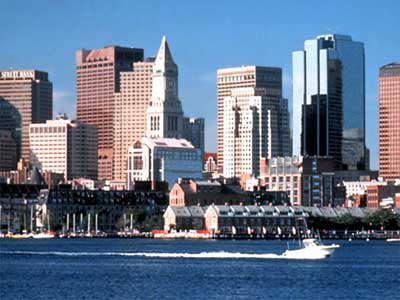
Boston or Berlin?

It was the summer of 2000 and things were going swimmingly. Ireland was the fastest growing economy in the developed world and the unemployment rate had dropped from 10% to 5% in three years. Mary Harney, second in command, had been invited to address the annual meeting of the American Bar Association at Blackhall Place in Dublin.

Mary Harney’s message was a positive, American-friendly one. Image source: http://www.imt.ie

Her short speech sparked a debate which has since become known as “Boston or Berlin.” Harney drew attention to Ireland’s unique position wedged between Europe and America and summarised the characteristics commonly associated with each continent. Europe stood for social inclusion and governmental regulation while America championed the freedom of the individual and minimal government involvement. She acknowledged that they were simplified descriptions but concluded that “spiritually we are probably a lot closer to Boston than Berlin.”
Twelve years later, Ireland’s unemployment rate is 14.9%, emigration is at its highest rate since the 1980s and the continents on both sides of our shores are in crisis.

Without the background roar of the Celtic Tiger and the allure of shiny cars and kitchen extensions, now might be the time to revisit the debate from a more sober perspective.

What did Harney mean when she said we were “spiritually” closer to Boston than Berlin? Was she referring to our economic model, which had been defined by tax cuts and incentives for foreign investors? Or was she talking about our common language, our history and culture; our national psyche?

Boston
Image Source: irishcentral.com

Whether or not economic policy can be divorced from the ideology or “spirit” of a place is debatable but given that Ireland matched corporate incentives with a generous welfare system, our affiliation with either Boston or Berlin isn’t even clear in fiscal terms. Our identity crisis is totally understandable. We are a tiny, teddy-bear shaped island on the outskirts of Europe and on the passageway to America. We’ve only been independent since 1922. And we stayed out of the Second World War.

This second fact is absolutely central to any lack of affinity we have with Europe. The European Union we know today is the product of a collective abhorrence of the horrors suffered and inflicted during the war and a resolve – at all costs- to prevent evil from recurring. The focus has always been on unity. The foundation of the United States, on the other hand, arose from a very different impulse: a determination for independence and resistance to the coloniser.

We can relate more to the latter than to the former. We too rose up against what we conceived as an oppressor. And though we can read and learn about it, we cannot really fathom the horrors of World War II. Here in Berlin, they are etched into bronze plaques on buildings, in concrete slabs on train platforms and in the minds of thousands whose lives were brutally dismantled.

Ireland is in a lucky place: we are liked by our neighbours on both sides. Americans find us charming and endearing and mainland Europeans find us wholesome, mysterious and other-worldly.
And while we happily consume and model American culture, we are less familiar with that of our closer neighbours in Europe.

German, with over 90 million native speakers, is the most spoken language in Europe but only 18% of Irish school pupils learn the language. That compares with the 94% of German and 99% of French pupils learning English. Of course, English has become the biggest international language of trade and technology and we can easily “get away” with not knowing another foreign language, but we also lose out on the opportunities to work and travel elsewhere in the European Union, safe in the knowledge that our basic living needs will be met by our membership.

To live and work in Boston you must prove that no American would be fit to take your job whereas to live and work in Berlin, you just need to turn up and register yourself with the authorities.
America is a place where a large portion of people do not believe that it is the government’s responsibility to protect its most vulnerable citizens and where a channel with as big a following as Fox News can claim without irony that the Muppets movie promotes a Communist agenda. It might be united by a common language and culture but its artificial two-party system results in less understanding and consensus than the 23 languages of the European Union do.

Berlin Image Source: a-t-s.net

Back in Blackhall Place in the summer of 2000, Mary Harney, referring to Ireland’s economic model said, “if it ain’t broke, don’t fix it.”

Now that it’s very much broken, we might do well to look at Berlin as well as Boston.

Were you born in Dublin or in “Baile Átha Cliath?”

The lady in the bank squinted at my passport.

“Were you born in Dublin or in Baile Átha Cliath?” she asked.

“They’re the same place,” I said. “Baile Átha Cliath is the Irish word for Dublin.

She paused. “Can I just fill in Dublin?”

“Sure!”

“Thank Goodness. It’s much shorter,” she said, beginning to tap on her computer.

Earlier at the town hall, where I had gone to register with the police (it’s a blanket requirement rather than a sign of criminality here) I was seen by a woman whose sister had married a Northern Irish man.

“He comes from Coleraine,” she said. “But I still haven’t got around to visiting.”

Kate Katharina at her most patriotic

I felt compelled to tell her about the wildness of the west, the incessant drizzle and the friendliness of our people.

“Now I really want to go!” she said.

I told her she should.

Just in time for my move back to Berlin, the Irish Times is concerned this week with the relationship between the Germans and the Irish. In their aptly-titled series “A German Complex,” journalists are writing about Kerrygold and the idyllic German view of the Irish.

As the product of a German-Irish relationship and a literature graduate, my favourite article in the series so far has no doubt been the descriptions of the Irish by German writers and poets.

I was personally flattered by Heinrich Heine’s opinion, expressed in 1828, that an “amalgamation of the two elements would produce something excellent” and was strangely moved by Johann Georg Kohl’s conclusion in 1842 that “this island of misfortune and discontent, this country of so many incongruities otherwise unknown in the rest of Europe – can quite justly be called, like Prospero’s, an island of wonders.”

The observation which really stopped me in my tracks came from Philipp Andreas Nemnich in 1806, who found that “the Irish often express themselves too obligingly. They seem never to be able to turn down a request, and yet they never keep their promises, no matter how often one reminds them.”

I recognised myself immediately. Like many of my fellow Irish, I too am inflicted by a rather pleasant disposition. I find myself smiling at strangers and being very polite even to people I dislike. I make offers I expressly do not wish to be taken up and then curse myself when they are accepted.

All that wouldn’t be so bad if I simply didn’t bother to keep my promises, as Nemnich claims most Irish people fail to do. But I have inherited the unfortunate trait of reliability from my mother and invariably end up keeping the promises I did not wish to make.

I wonder what Philipp Andreas Nemnich would make of me.

I was asked earlier this year to carry out a Vox Pop in Berlin to find out what German people thought of Ireland. The old stereotypes prevailed: Guinness, green pastures and traditional music were the most common responses.

There’s a lot they know less about here though. Our wonderful writers for one. Our excellence in cultivating potatoes. Our uncomplicated kindness alongside our cynicism and repression.

The poor lady at the bank now knows about our national language though. Then again, she’ll find that out as soon as she lands at Dublin airport and is greeted by a poster of the beaming Westlife lads and a “Fáilte” signpost.

I love the Irish language, but don’t get me started on the signposting in Dublin airport…

So to all our potential German tourists, I hope you enjoy your stay as much as I enjoy recommending it.

Go n-Éirí and bóthar leat because the road signs sure won’t bring you any luck.

Irish boy cries; Turkish man orders buttermilk

At 5 o’clock this morning, I found myself in a queue to get through security at Dublin airport. It was moving sluggishly, like a lazy snake. Every time it took a bend, I caught sight of a young man a few meters in front. He was nineteen or twenty and slightly lanky. He had a gentle face and blonde hair, which flopped a little to the side. He was crying.

At every bend his face grew sadder and when I saw him take out a crumpled tissue from the pocket of his jeans, I discovered tears in my eyes too. I wanted to reach over the barrier, touch his wrist and say “Skype is great, you know” but I couldn’t because the night before, when LSB had left me at my garden gate, I ran away up the stairs and to my toilet so nobody would see me crying.

I lost him after he went through security but he had a face and expression which personified every single Irish short story about grief and emigration I have read.

There were quite a few empty seats on my flight. I was on the aisle, with a space between me and a neat-looking man at the window programming things on his ipad. When the cabin lights were dimmed for take-off, I tried to turn my overhead reading light on but it was defective. The man stretched across and turned on the middle reading light for me. I thanked him and he smiled.

I’ve only been here a few hours but moving from the east of Berlin to the west is like ageing thirty-five years in a day. Gone are the punk bars and graffiti. Gone are the anarchist posters stuck to trees. It’s quieter, more leafy.

I was thinking this anyway, on my way from the S Bahn stop, on the lookout for a snack. I found a kebab joint and ordered a falafel sandwich. I sat down on a steel table outside, with my luggage wrapped around my feet.

The two men at the next table stared at me.

“Where were you on holiday?” the older one with a moustache asked.

I explained that I hadn’t been on holiday but was coming for work.

“There’s no work here,” he said.

“What are you drinking?”

“Nothing, thanks.”

“Cola?”

“No thanks.”

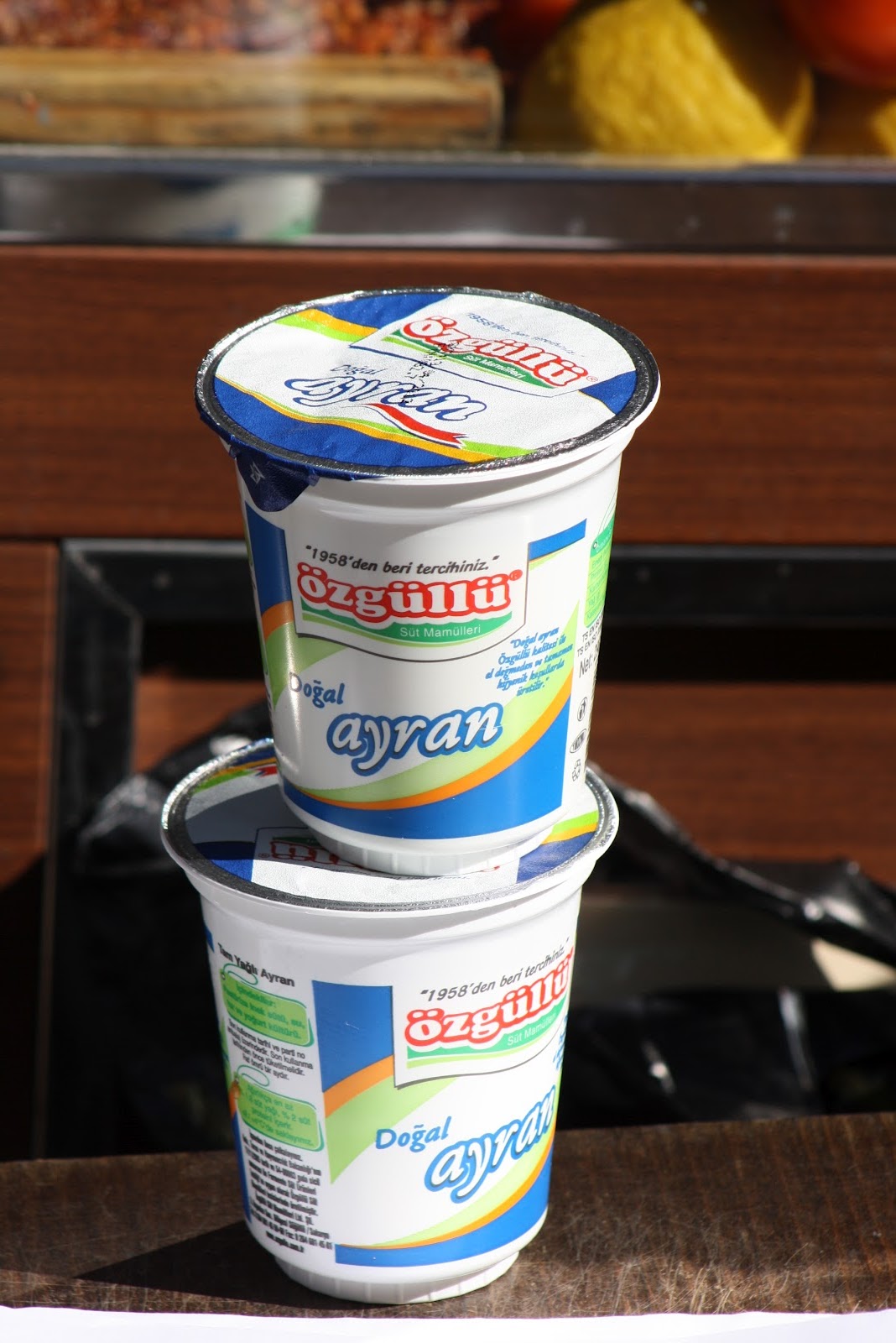
He ordered me Turkish butter milk. It came in a yoghurt container and was full of salt and bubbles.

Image source: sweettoothcraving.blogspot.com

“Ever had this?”

“No.”

“Where are you from?”

“Ireland.”

“How much is a kebab in Ireland?”

“More expensive.”

“How much?”

“€4.50.”

“Is it.”

“Yes.”

“We’re not German either. I’m Turkish and he’s Greek. We’ve been here thirty years. It’s not easy coming here new.”

They told me I would need a work visa if I didn’t want to work “Schwarz.” (The German language rather offensively refers to “schwarz” or “black” as the colour of transgression.)

I told them Ireland was in the EU.

“How much rent you paying?”

I told them.

“I could get you a flat to yourself for less.”

I gratefully declined.

“You living around here? That street there?”

I was arrested by his guess and didn’t deny it.

When he guessed the number I became frightened.

I told him I didn’t know yet.

“That street’s full of alcoholics. You could have a place to yourself for less. Who you staying with?”

I texted LSB and asked him to call me.

We spoke in Irish. I waited and waited. The Turkish man eventually got bored and left. The Greek stayed behind. I paid €2.50 for my falafel sandwich. The Turkish butter milk was on the house.

Why did the three little boys go to the market?

Yesterday LSB and I wandered into a little shop in Crumlin called “Better Value”. It was full of cardboard boxes and handwritten signs in black marker advertising Pringles, Chocolate Chip cookies and washing detergent. It looked like something from a feature film about Ireland in the 1980’s and I liked it very much.

image source: dublin.ratemyarea.com

The man at the counter was tall and thin and had a nice tanned face. He was being bombarded by three little boys, aged about seven. Two had freckles and similar round faces and the third had black eyes and floppy hair. They were hurling questions at the shopkeeper and he said, “Where’s your manners?”

The three boys each bought a bottle of Jones soda. “I’ve never had the blue one!!” said one. Outside, they ripped the wrappers off their bottles and dropped them on the pavement, where they curled up and quivered in the breeze.

image source: compare.productwiki.com

“Are you going to pick that up?” I asked one of the boys with freckles.

“No,” he said loudly. He was defiant and tiny.

I was wearing a black puffy jacket. In it, I was more than twice his size.

“And why not?” I asked him.

“Cause I don’t wanta,” he said.

I told him about dirty streets and the poor people that had to pick things up after litter bugs.

He talked over me to his friends.

LSB was standing a little away from the scene. The boys and I walked towards him.

LSB was wearing headphones.

“Are they beats?” one of the boys shouted at him.

image source :lovefont.blogspot.com

Apparently “beats” are the name of a pair of extortionate headphones produced by American rapper Dr Dre. Harvey Norman sell them for €299.

LSB shook his head.

The three little boys, clutching their bottles of American soda, schooled only in commercialism and brashness, brushed by us in a blur.

Rose of Tralee 2012: The Highlights

Am writing this during the commercial break. My heart’s pounding. In a few minutes, Daithí said, we’ll find out who will be crowned the 2012 Rose of Tralee.

What an evening it’s been. The Coronas won’t calm me down at this stage. Thought Gerald Fleming was being sarcastic earlier when he predicted that “low pressure was coming.” It’s anything but here.

My heart went out to the Australian rose. There she was performing her telepathy card trick. Daithi outsourced to the Inspector of Ceremonies to pick a card. Didn’t work first as he blurted it out while waving his baton. He finally chose the 6 of diamonds. Rosie twirled around, took out the deck of cards, shuffled happily, beamed and asked “was it was the 9 of diamonds?” Silence. Daithi couldn’t go back now. “It wasn’t,” he said very apologetically. Quick as lightning she said “were you thinking of it upside down?” “I was yeah,” he said.

She left the stage promptly.

Of course the competition would be nothing without the close-ups of the mothers crying. Mother of Perth had to dab her eyes while her daughter sang and mother Cork got out the tissues while her daughter recited a poem.
Most original talent went to the rose who could imitate a dolphin.

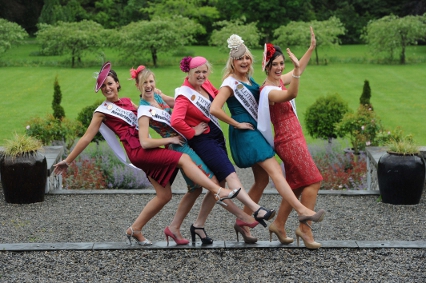
Lovely girls. Image source: http://www.roseoftralee.ie

Best anecdote goes either to the story of the Australian Rose’s boyfriend mistaking “Fir” for “female” and “Mná” for “men” or the nannie who objected to photographs of Debs dates in the toilet of her granddaughter’s suitor. But Prince Philip’s quip to the Dublin Rose (studying Nanotechnology) that she must have “very good eyesight” will go down in national memory too.

Daithi’s top question of the evening had to be: ” You fell through a garage, did you?” to which he got the reply “I’m sorry?” Maybe next year he should try, “you stumbled on a geranium, did you?” More Rose-like.

Nice to see festival branching out with Daithi parading around in red heels. It’s becoming terribly progressive with all these educated women included in the competition.

But I digress. The Coronas have stopped. And there they are now. All the Roses in a row. The audience is going wild, chanting. Who on earth will it be, Daithi’s asking.

Oh damn it, they’ve invited the Rose of Tralee CEO on stage now. Waffle. Come on now. He just said judges are “exceptional people.” Let’s get this done. What name is inside this envelope? “Will it be the scientist or the gymnast?” Daithi asked just a few minutes ago.

Here’s the envelope now. You could hear a pin drop.

And now….. drum roll..

It’s the Luxembourg rose! And she can’t believe it!

Her parents jump to their feet, whooping. The pride is oozing out. Their daughter the rose of Tralee.

The police band play the tune. They all sing along. Flanked by the other roses, Nicola gets her crown. Ends with a nice flashback of her reaction about thirty seconds before. What a lovely girl.

Power Shower

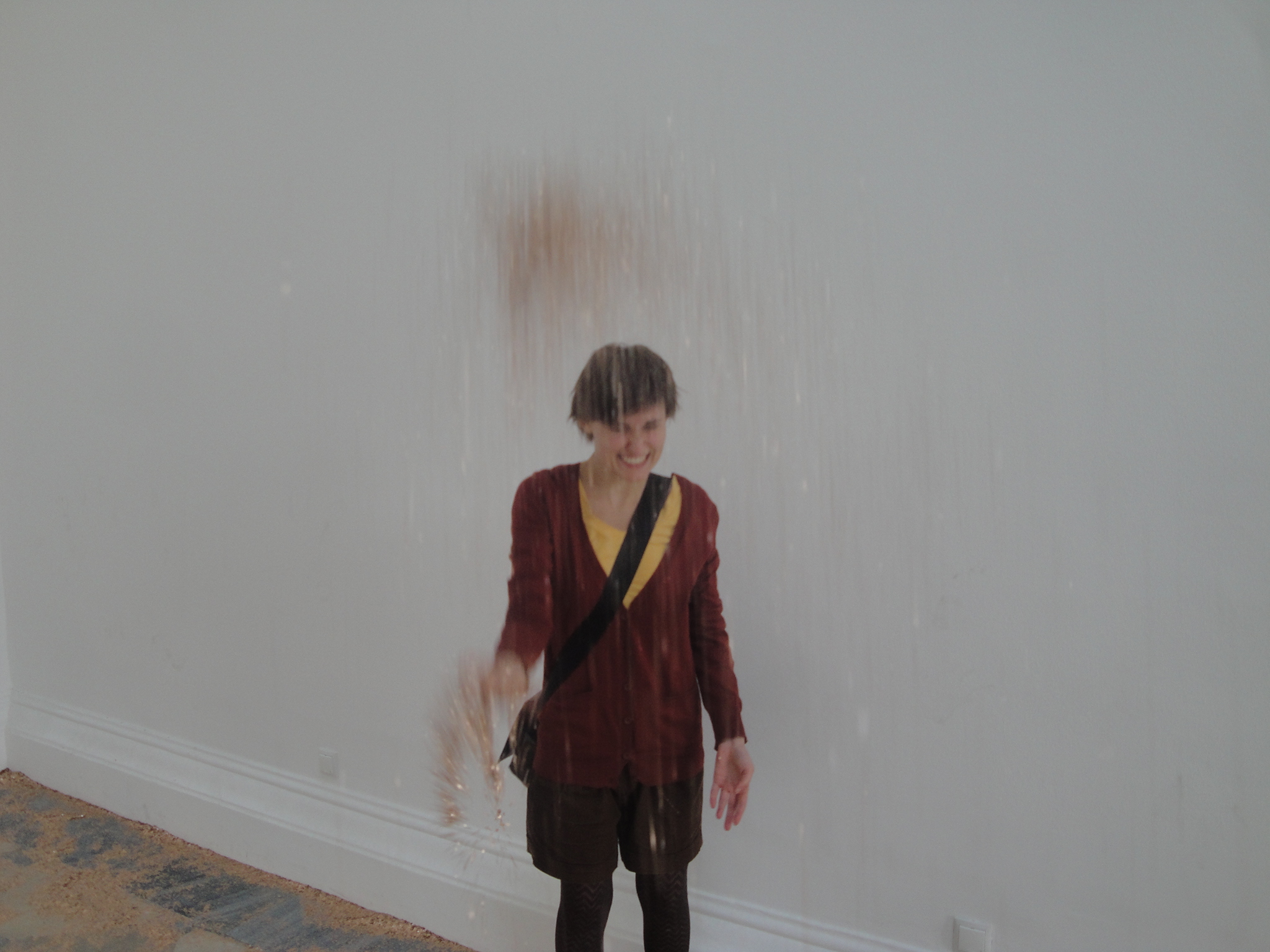
LSB, our friend and I took a walk in the Volkspark in Vienna last month. We came across a pretty white building, called the “Theseus Temple.” Inside it was empty except for hundreds of thousands of tiny bronze discs. First we didn’t know what to do but then some other people came in and started playing with the discs. They grabbed handfuls of them and showered each other with bronze. It wasn’t long until we did the same. Art can be anything you want it to be.

Familienfest: The Ferguson Sisters’ Moment of Truth

“Keep your gaze fixed at the back of the room,” LSB had said, against the conventional wisdom of imagining your audience naked.

I instinctively disregarded his counsel, and fixed my eye creepily on a number of individuals I believed would be sympathetic. I looked most often at my mother, who had abandoned her high-heels in favour of a pair of sensible sandals.

Given that I often fail to entertain myself, the prospect of commanding the attention of the entire Schultz family and even attempting a few quips along the way was rather daunting.

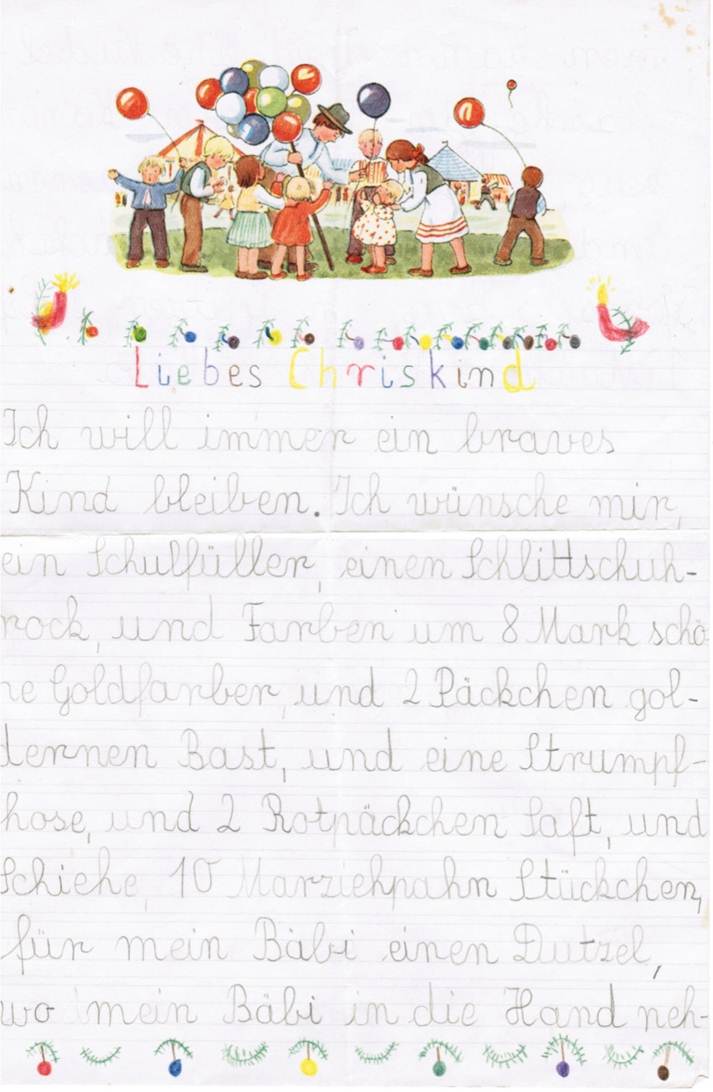
My mama’s letter to the Christ Child

However, there I was standing in my black graduation dress with all the Schultzs staring at me, desperate to figure out what the Irish contingent had come up with this year. I decided the best thing to do was to start speaking.

“When our mother was a little girl,” I began (in German) “and adults asked her what she wanted to be when she grew up, her answer was always the same.”

I paused for effect and a Schultz baby (third generation) began to cry. Unable to decide whether it was in empathy or disgust I continued:

“She wanted to be a martyr.”

The baby wailed again. My sister clicked the next slide and a picture of my mother as a child beside a stock image of Martin Luther (the reformer) appeared.

I regaled my audience with a hilarious anecdote about my mother challenging an irate nun in class. The Schultz family laughed politely. The baby demanded to leave the room.

Before I knew it, it was time for the first theatrical performance.

As part of the research into our mother’s past, we had stumbled across a letter she had written to the “Christkind” when she was a little girl.

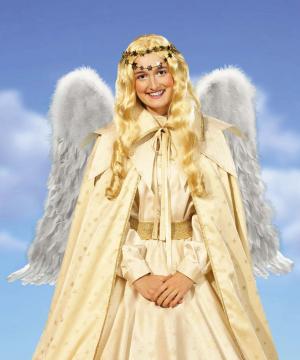
While the Christkind fulfils the same role in Germany as Santa Claus does in this part of the world, there are notable differences between the two. For one, the Christkind is an angel, rather than a Coca-Cola-inspired fat man, and according to my mother, genderless. He/she flies from the heavens on Christmas Eve and deposits presents under the trees of good children.

My mother made modest demands of the Christkind. She asked for a pair of tights, a bottle of Rotbaeckchen juice and a fountain pen.

The Christkind

I acquired these items in Regensburg and decided that a cameo appearance from the Christkind simply had to feature as part of the presentation. Having mentally auditioned the entire younger generation of Schultzs, I finally cast my 17-year-old cousin in the role. She is a natural Child of Christ, waif-like with long blonde hair and an angelic countenance.

She fashioned herself a golden costume featuring an enormous pair of glittery wings and to complete the transformation, LSB had the ingenious idea of covering our Frisbee with tinfoil to make a halo.

Shortly before the presentation (we were interrupted by the Family Song) the Christ Child and I briefly rehearsed what cue she would need in order to fly to my mother at just the right time. She had prepared to hide in a little adjoining room until the time was right.

Up to that point –all things considered — my performance had been without major hitch. I was fair-minded enough to put the baby’s reaction down to the stress of his first ever introduction to the Schultz family and accounted for his disappointment at the standard of my opener by diagnosing a case of precociousness.

When I spoke the Christ Child’s cue (“To show our mother that dreams really can come true, we have invited the Christ Child here today to lavish her with gifts”), nothing happened.

No Christ Child flew in, bearing fruit juice, a pair of tights and a fountain pen.

I paused and spoke again.

Still no Christchild.

The Schultzs were quiet. No baby cried now.

I paused a while.

In spite of my meticulous preparation for this event, I had not tested the acoustics of the room next door.

I became increasingly desperate.

“Christchild,” I yelled. “CHRISTCHILD.”

There was a flutter of wings at the door and the Christchild flew in to a great cheer from the Schultzs.

My mother was overwhelmed by her winnings and immediately asked the Christchild to pose for a photograph.

The public’s positive reaction to the Christ Child’s appearance was unprecedented and I relaxed in the confidence that the next theatrical performance would go down just as well.

It did.

My Greek cousins re-enacted my parents’ first dance with rare and delicate sensibility. My research had revealed that my father and mother had communicated in French when they first met and that my father was an exceptionally poor dancer. My male cousin, dressed in an afro wig similar to my father’s hairstyle of the time, grabbed his sister around the neck and stepping on her toes, misdirected her in an unfortunate and entirely graceless waltz around the room. She, a method actor in turn, called out “Oh la la,” and “Fais les petits pas” in what came across as very genuine desperation.

Here’s a picture of us all that Onkel Fritz took it just before the presentation. Do we look nervous?

Having completed the first section of the presentation, I breathed a sigh of relief, let my sisters take over and took a seat in front of the laptop. On my way, I managed to catch LSB’s eye. He couldn’t give me the thumbs-up because he was holding his camera at arm’s length (much to the mortification of my sisters) but he winked encouragingly at me.

At this point in the story, perhaps I should offer some insight into the background to this curious presentation. This might be of particular interest to my mother, who at time of writing, remains in the dark.

The Ferguson sisters are like any series of collectables. We are essentially the same but we each have some nice individual characteristics to recommend us to the peculiarly attentive.

When we were little, our father used to invent stories featuring my sisters and me in a parallel ancient Greek world. So that they don’t beat me up, I’m going to refer to them by the names our dad invented for us. My oldest sister, Penelope is the DIY extraordinaire and one not to libel, the middle child, Hermione is the scientist and bag-maker in Philadelphia and you all know me, Persephone as the youngest, least accomplished one that isn’t quite sure what she’s doing with her life.

In preparation for the presentation, Penelope scoured the family archives (dusty boxes in the basement) for photographs, Hermione compiled them into a Powerpoint file and I, Persephone wrote the accompanying text.

In the weeks leading up to the Familienfest we encountered a series of artistic differences, which were fortunately tempered by the great physical distance between us.

On the day however, as I watched Penelope and Hermione present our mother finally with a magnificent home-made medal (a speed limit sign with the number “60” within it) and I closed our speech with reference to her love of etymology (the word “martyr” is related to “memory…”) I realised that no matter how far apart, the Ferguson sisters are a bizarre force to be reckoned with.

Belated Happy Birthday, Mama. Hope you liked the juice.

Familienfest 2012: The Family Song, Beef-ball Soup and The Birthday Child

Familienfest 2012 was officially opened by my mother, who clinked on a glass, rose to her feet and recited some charming verses of welcome, which she had penned herself. As one of the five “Gerburtstagkinder” (birthday children) celebrating a combined age of 320, she dazzled the crowd not only with with her rhymes, but also with a stunning pink floral dress, and her first ever pair of shockingly high heels.

image source: pinkandgreay.ca

This year’s seating arrangement was even more strategic than last and reflected the openness of the Schultzs to including non-family members in the celebrations. LSB and my sister’s boyfriend sat beside each other and compared their recollection of Schultz names in loud whispers. LSB was making an excellent impression and things were going rather smoothly until the first course arrived. The menu had advertised “tomato consumé” soup as a starter but certain family members were dismayed to find several balls of beef swimming in their bowls. It was a moment of glory for LSB and me, who, far from being bound by the set menu, could enjoy the full range of choice from the vegetarian menu. We ordered tomato and basil soup. It was delicious.

Conversation meandered from the mundane (the current economic climate) to the sublime (what is the best German beer?) and took place in both German and English.

The family song had been rehearsed the night before at Onkel Fritz’s house. My father, LSB and my sister’s boyfriend had taken the opportunity to check out Regensburg’s beer gardens. Details of their evening remain scarce: the three arrived home late and LSB has made himself unavailable for comment.

The family choir outnumbered the audience members. LSB, who knows all the words, was tasked with videoing the performance. Those interested in viewing it should feel free to approach me with a small fee, which may cover the medical cost of recovering from my sisters’ silent threat of beating me up for publicising any material related to the Familienfest.

LSB and I in the run-up to Familienfest2012

Schultz birthdays come with the associated and thinly-disguised responsibility of nuclear family members to pay tribute, in a performative art of their choice, to the Birthday Child. My aunt’s children composed and recited poetry and sang a song. My uncle’s daughter presented a series of themed photographs to a soundtrack of topical songs. Previous years have featured tap dancing, the Ferguson sisters’ violin trio and a song about toiletpaper.

Regular readers and personal friends will know that I have two older sisters. One is a scientist in America and makes nice cloth bags and the other lives in Dublin, is a super hand at DIY and definitely not one to libel.

Months ago, the three of us convened on Skype to discuss the tribute we would pay to our mother.

It was the best of times, it was the worst of times. I juggled my TV internship, job applications, flat searches and LSB, while they battled with commitments to fat samples, single nucleotide polymorphisms and legal wranglings. Tradition and common sense dictate that the Birthday Child should be ignorant of the nature of the performance until the day of celebrations. After weeks of competing visions and frantic conferences on Skype, we came up with what we considered a fitting tribute to our mother.

After the waitresses had brought in a large selection of cakes, it was time. Onkel Fritz tapped a glass, set up the computer, and, as opener of the presentation, I advanced to the front of the room to face the scores of expectant Schultz faces before me.

To be continued…

***************************************************************************************************************

Regular readers: I’ve been nominated for an Irish Blog Award 🙂 and need your help! Do you have a favourite blog post at katekatharina.com? If you do, please email me so I can enter it into the “best post” category. It’s a public vote, so if you do enjoy the blog, it would be lovely if you could vote for it. I’ll put more info on my Facebook page later.

“Nuala put on the spuds:” I’m home!!

The first words I heard when I landed back on Irish soil came from a lady sitting behind me on the plane. “I’ve told Nuala to put on the spuds,” she said.

If the impossibly green landscape I’d just flown over hadn’t been enough to convince me that I was finally back home, Nuala making spuds was. I was delighted.

Terminal 2 makes Berlin Schoenefeld look like it’s stuck in the dark ages. Although a new airport is due to open in Berlin soon, an unexpected delay of several months was announced to much controversy just a week in advance of its proposed opening. The new date is amusingly, St Patrick’s Day 2013.

Terminal 2 features walls of photographs of Irish people, some prominent figures, some not. I noticed Enda beaming at me to my left and a chiselled, greying Pierce Brosnan to my right.

Some of you will have noticed my appalling attendance in the Blogosphere in the past while. Rest assured that I have been collecting Blog Fodder along the way. LSB and I spent the last two weeks in my mother’s hometown of Regensburg. I blogged about it before, when we visited my grandmother and the Christmas markets two years ago.

Regensburg

This time, my whole family was together, which is sadly a very rare occasion since my sister and I emigrated. Familienfest 2012 was a momentous occasion, which deserves (but might not get) a whole series of posts to itself. It was my mother’s and two aunt’s 60th birthday, my Great Uncle’s 90th and an uncle’s 50th. The combined age was 320, so the celebration was suitably large.

The Ferguson sisters pulled together from Philadelphia, Vienna and Dublin in an attempt to entertain the scores of guests with a presentation about our mother’s life. It featured cameo roles from my cousins, who re-enacted scenes from my mother and father’s courtship and a special appearance of the “Christkind” (the German version of Santa Claus), who lavished my mother with gifts.

The last while has also seen a return of my Quarter Life Crisis, so those of you nostalgic for more uncertain days will be relieved to know that they are not behind me yet. After much indecision and emotional turmoil, I decided to move back to Berlin. More on that when it happens, in two weeks’ time.

For now, I’m sitting in my suitably messy room under three quilts and a heavy blanket, delighted to be home. I found a little spider in my wardrobe and wondered how long he’d been there. Last night I had to turn on the immersion before I showered. The fridge is empty so I’m off to buy milk and organic eggs and Dairy Milk chocolate and potatoes and soda bread. There’s no place like home.