Unknown's avatar

About Kate Katharina

Kate Katharina wltm people with stories for literary fling and maybe more.

Frau B takes on “the modern condition”

“Nice haircut, Frau B!”

She pats the sides of  her head, self-conscious and pleased. “Like it? You’re the only one who bothers to notice.”

There’s a knock on the door. A young woman, slight and dark-haired, sporting a pale green uniform, walks in.

“Julia!” says Frau B. “Now you can finally meet Katechen, my little Iren.”

Julia and I greet each other.

“Julia comes from Spain,” says Frau B. “Don’t you?”

“Yes, ” says Julia and hands us both a cup of coffee.

“She speaks very good German,” Frau B says after she’s left. “She came here because there were no jobs at home. Just like you did!”

Attribution: Bundesarchiv, Bild 102-00134 / CC-BY-SA via Wikipedia Creative Commons

Attribution: Bundesarchiv, Bild 102-00134 / CC-BY-SA via Wikipedia Creative Commons

We talk about mass unemployment and the effect it has on the political landscape of Europe. Frau B was a child when Germany was in its deepest ever financial crisis.

“1929 and 1930 were the worst years,” she says. Even my father was unemployed for nine months. People said that if he had no work, it meant there really was none.”

“What did he do?”

“He was a precision mechanic. He was very good with his hands.”

“Something you inherited!”

“I sure did. I got his feet too. He had tiny feet, for a man.”

Screen grab from Daily Telegraph article of 27 January 2012

Screen grab from Daily Telegraph article of 27 January 2012

She takes a sip of coffee and continues:

“Hitler would never have come to power were it not for unemployment. See, he re-built the army and got people back to work.”

I tell her about Ireland’s Republican party, Sinn Féín, and how they’re currently enjoying a rise in popularity.

We agree that mass unemployment and disillusionment add to the allure of extremism.

Sometime later, when we are done talking about politics, Frau B mentions her grandmother who was born in 1838.

As a child, Frau B would spend long afternoons reading the Bible in her grandmother’s rural home. But it is a detail related to her Oma’s appearance rather than any biblical verse, which has stuck most in Frau B’s mind.

“My grandmother used to be bothered by a few little hairs, which sprouted above her lips. She’d tear at them with her hands until they came out,” she says.

Now Frau B notices a few hairs growing above her lips. “It comes with age,” she says. “I pluck at them when I can’t get to sleep.”

“Some people believe vanity is unique to the modern condition,” says Frau B. “It’s really not.”

As I observe Frau B rearranging her hair-do, and think about the events which led up to the horrors of World War II, I feel both comfort and unease at how relatively small our 70-year age-gap really is.

Lá Fhéile Pádraig Shona Daoibh!

A chairde,

I’m sorry.

I’m going to resume a much more regular posting schedule soon. Expect some half-baked musings for the “Big ideas” section,an update on preparations for Frau B’s 96th birthday and hopefully some anecdotes about an upcoming trip to the island of Rügen. pat

In the meantime though, I’d like to wish you all a wonderful St Patrick’s Day. I was lucky enough to attend not one but two  events here in Berlin to mark the occasion. One took place at the top of the television tower on Alexander Platz, the other in a Kreuzberg club which defied its dingy exterior to reveal a glorious Irish haven inside. With tea and biscuits on sale, bowls of potatoes on display and a spectacular performance by Jigs and Reels, an Irish dancing school in Berlin (run by a friend of mine) I felt as if I’d been transported right back to the homeland.

As you can see from the picture, LSB and I are fully embracing our Irishness for the day that’s in it.

Slán go fóill,

KK

Why I’m afraid of social media timelines and you should be too.

We do it without thinking. On the train to work, or at home on the sofa.  Sometimes even under the table at a meeting. For some of us, it’s even part of our job.

But if you think scrolling through your Facebook or Twitter feed is no big deal, take a moment to imagine the offline equivalent:

The posters on your train to work keep changing in line with the items you purchased last week.

An anonymous colleague keeps  dropping articles on your desk. You have no idea how they know about your interest in personality tests and vegan cooking.

Political canvassers representing views just a little more extreme than yours randomly appear when you’re in your favourite thrift store, or browsing through magazines at the newsagent.

We all know algorithms aren’t actual people. But they might as well be, because the information they gather is sold to real companies, which use it to make you buy stuff and influence the way you think.

Social media is a dream come true for advertisers. Rather than hoping a random billboard might grab your attention, they simply buy the right to find you by following your online cookie trail.

And as much as we like to consider ourselves free-thinking, independent individuals, big data and advances in statistics have made our behaviour eerily easy to predict.

This cringeworthy video designed to celebrate big data implies that its main advantages are to help us remember our friends’ birthdays, choose clothes and source free cupcakes.

Of course there are enormous real benefits of big data – like helping to make roads safer, improve healthcare and stop the spread of diseases.

But its commercial use presents a moral dilemma.

As we know from economic psychology, people generally base their decisions on the information most readily available to them. It’s called the availability heuristic and as common sense would suggest, it means that we often act on the first thing that comes into our head.

The first thing that comes into our head is usually the information we’ve been exposed to over and over again.

Articles in our timeline which reinforce our existing worldview.

Photographs similar to ones we’ve reacted strongly to in the past.

Groups of people we’ve associated with before.

In other words, a repetition of who we are and the experiences we’ve already had.

The use of mass data sets coupled with algorithms adds a new dimension, without us even realising it.

An essay by WIRED editor David Rowan, which appears in a book titled “What should we be worried about?” opens:

“In a big-data world, it takes an exponentially rising curve of statistics to bring home just how subjugated we now are to the data crunchers’ powers.” He goes on to lament that:

 “Any citizen lacking a basic understanding of, and at least, minimal access to, the new algorithmic tools, will increasingly be disadvantaged in vast areas of economic, political, and social participation.”

The problem with cookie-led advertising and links generated by algorithms is that they are covert. There is no one to hold accountable for them.

There is no guy with a roller pasting an ad to the wall of an underground station.

If we open up a print newspaper, we know that every other reader is going to see the same advertisement for a high-power vacuum cleaner on page 6.

We can also reason that another publication might instead be trying to sell readers wellness retreats or flat-screen televisions.

Individually tailored timelines remove that certainty and erode our biggest antidote to advertising: collective cynicism.

Since the links and advertisements we’re seeing change from one second to the next, it’s  impossible to develop a coherent narrative about their presentation, let alone construct a common picture of what’s happening.

So, what’s the solution?

Sure, we could quit social media altogether.

But it would be foolish to throw the baby out with the bathwater.

What we really need to do is to be aware of the extent our world view is being shaped by the things people pay for us to be exposed to online.

That is the first step towards reclaiming our capacity for independent thought.

Five women’s blogs I check every day. For pleasure.

1. Fieldwork in Stilettos                                                                                                       I’ve been reading Kat Richter for years. She’s a Philadelphia-based writer and dance teacher who blogs about dating, writing and lately, home improvement. Her prose is extremely fun to read. I’ve followed her through a questionable “manthropological” dating experiment, a couple of meaningful relationships and roughly the same number of heartbreaks. If you think her posts sound throwaway, check out the couple of times she’s diverged from her usual subjects – to talk about the experience of encountering anti-abortion campaigners outside a women’s clinic and, drawing from her background in anthropology, to explain why there’s no such thing as race. Whatever she writes is lively, sharp and worth following.

2. Captain Awkward                                                                                                        When I discovered this blog, I devoured the archive in hours. Captain Awkward dispenses insightful, practical and thorough advice on subjects ranging from a  woman whose otherwise wonderful partner will not accept her feminist views to anxiety about interacting with former co-workers. Written by a movie writer and director, Captain Awkward promotes mental health, we well as sexual and gender equality. The blog is also mega-successful, with each post attracting hundreds of comments.

Reading is good offline too.

Reading is good offline too.

3. Brain Pickings                             This blog makes me gush. Maria Popova’s writing is exquisite, her take on philosophy, creativity and critical thinking  always thought-provoking and beautifully expressed. Her essays draw on the wisdom garnered from some of the world’s greatest thinkers and how their insights might apply to our everyday lives. Her selection of quotations and suggested further reading always make me think. Read her on the boundary between hope and cynicsm and diversity and difference in children’s literature. In fact, just read everything she writes. Her site remains ad-free and funded (though I’m not sure how substantially) by readers. For me, Brain Pickings represents the very best of what the internet can do to promote independent, creative thinking.

4. Broadside Blog                                                                                                                Caitlin Kelly is a veteran New York journalist who turned freelance a few years ago after losing her job at a major daily paper. She posts about work, travel, the media industry, as well as friendship and family relationships. I’m attracted to her crisp, uncompromising and confident tone, as well as the many insights she has about journalism. I don’t agree with everything she says, but the way she says it is reason enough to read her work. Her writing strikes that delicate balance between personal and professional- I feel like I know her but there’s nothing I wish I didn’t know.

5. Aileen Donegan                                                                                                           We’ve never met but know each other from our blogs and Twitter. Aileen’s a 26 year-old journalist from Ireland with an interesting background in online activism and experience living in Strasbourg. In the wake of the attacks on the Charlie Hebdo offices in Paris, she wrote a compelling piece about attending a small solidarity march in Dublin and about how that event, unlike demonstrations she’d been to in the past, sat right. I loved her recent post about the summer she spent as a teenager reading Sylvia Plath’s The Bell Jar.

I’m always on the lookout for new blogs to follow, so let me know if you have any favourites I should be adding to my list!

Calling all language-learning enthusiasts!

If you’re an Irish person who teaches, researches, writes or creates in an area related to language-learning, the following information sent to me by Léargas might be of interest.leargas1

Léargas is looking for language projects and potential language ambassadors to apply for the European Language Label. It’s a languages award with two sections, projects and individuals. “Projects” can cover anything and everything, from short term to ongoing, from online to tangible and from community group to university research. Very wide-ranging, but the jury look at each and every project in its own context. This year the individual award is for “language ambassador”, the jury quite often select a number of language ambassadors rather than just one single person. The title is recognition and acknowledgement and a nice awards ceremony, it doesn’t involve any tasks. There are posters, application forms and short video clips of past winners on www.leargas.ie/ell The deadline for applications is 27 February 2015. We look forward to receiving your application!

#FreeRaif: Saudi Arabia ‘postpones’ flogging for blogging

Amnesty International has just broken some good news on Twitter:

This is a direct result of pressure not only from Western governments but also by ordinary people voicing their outrage on social media.

For those of you who haven’t heard of him, Raif Badawi is a 31 year-old Saudi writer who set up a website called the Saudi Free Liberals Forum, a platform he used to campaign for free speech and secularisation. Some of his writing has been translated into English here.

"رائف-بدوي" by User1500 - Own work. Licensed under CC BY-SA 4.0 via Wikimedia Commons - http://commons.wikimedia.org/wiki/File:%D8%B1%D8%A7%D8%A6%D9%81-%D8%A8%D8%AF%D9%88%D9%8A.jpg#mediaviewer/File:%D8%B1%D8%A7%D8%A6%D9%81-%D8%A8%D8%AF%D9%88%D9%8A.jpg

“رائف-بدوي” by User1500 – Own work. Licensed under CC BY-SA 4.0 via Wikimedia Commons – http://commons.wikimedia.org

In  2012 he was arrested and sentenced to 10 years in prison, as well as to 1000 lashings. These were to be administered 50 at a time, each Friday, in public. The first of these sessions happened last Friday. Here is an account from someone at the scene.

In the last week, mainstream media coverage of the case has been putting increased pressure on governments to act and has motivated ordinary people to make their voices heard too. Amnesty International’s 5 ways to help Raif Badawi provided people who cared with an easy checklist of how to take action.

That work has paid off. Today’s lashings have been postponed on “medical grounds.”

But there’s a lot more to be done. For one, the lashings have been postponed, not cancelled. Just days ago, Badawi’s lawyer, Waleed Abu Al-Khair  had his 15-year prison sentence re-instated.  And this case represents one of hundreds, if not thousands and tens of thousands of others which haven’t been publicised. We don’t know the numbers because Saudi Arabia doesn’t want us to.

What we do know is that flogging is an extremely common practice and that women who have been raped are often punished in this way by judges who refuse to distinguish rape victims from the those committing adultery.

When I used to teach English in Ireland, I remember how bemused my Saudi students were when I expressed horror at their casual descriptions of encountering public floggings.

Saudi Arabia is at the brink of a change of rule.Now is the time to send clear signals about what the West expects from the country and what it will refuse to tolerate.


Why you should keep your mouldy shower curtains

Last week Frau Bienkowski and I got talking about how best to dispose of Christmas trees.

I was telling her about how I’d been über-enthusiastic in undressing my tree only to find that the recycle people wouldn’t be coming to collect it until the following week. Since I live in an intimidatingly law-abiding neighbourhood, I figured I might face ostracisation  if I dumped it outside prematurely. As a result, I’d lugged it to the balcony where it was now in a sorry state of limbo, having left thousands of pine needles (perhaps out of spite, I thought) in its wake.

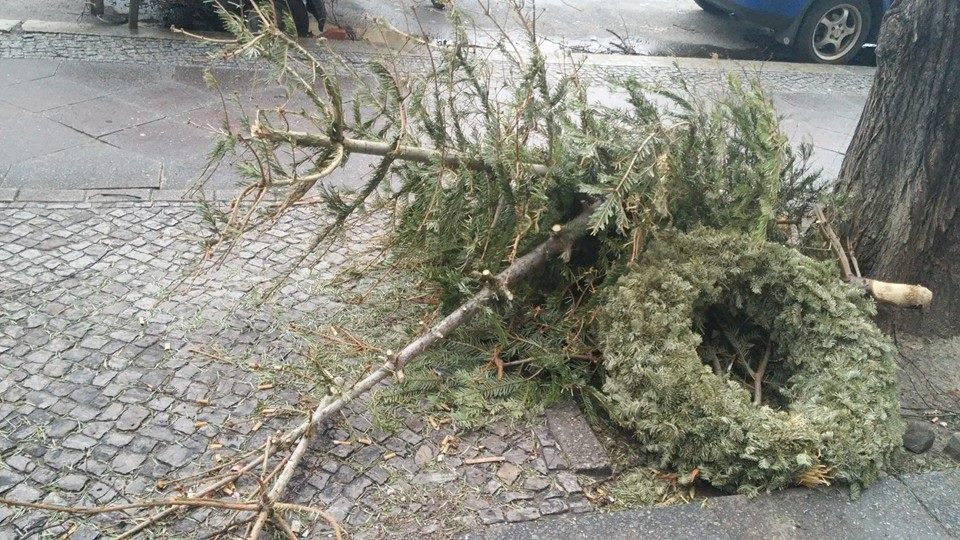
Nothing says "January blues" more than a pile of sorry-looking Christmas trees.

Nothing says “January blues” more than a pile of sorry-looking Christmas trees.

“I insisted on non-shed in my latter years,” said Frau B. “I just couldn’t deal with those needles.”

“So how did you get rid of your Christmas tree back in the day?” I asked.

“I just threw it out the window.”

“What?”

“Yes, would you not consider doing that?”

“No!”

“Why not? That way, you won’t have to clean up all the pine needles from the stairwell. After all, you don’t want to annoy the neighbours!”

I wonder if this individual removed all the needles of their tree one-by-one.

I wonder if this individual removed all the needles of their tree one-by-one.

“I can’t just throw my tree out the window! What if I hit someone? Like my crazy neighour? Or the 86 year-old Hausmeister?”

“I used to recruit children to keep watch,” said Frau B. “They’d stay below and give me a signal when the coast was clear. Then they’d carry it to the side of the road. I gave them chocolate in return. It was win-win.”

“I’m not doing that,” I said.

Fast forward a week and it’s Christmas tree removal day. A heap of sorry-looking Christmas trees has accumulated outside the apartment building. One individual, presumably with the admirable intention of not dropping a single needle in the stairwell, has even shorn their tree, leaving behind nothing but a creepy-looking skeleton of branches.

I enlist the urgent help of (resident savant) LSB.

LSB and his genius mouldy-shower curtain contraption. (MSCC)

LSB and his genius mouldy-shower curtain contraption. (MSCC)

He immediately makes his way to the bathroom, from where he emerges wielding the mouldy shower curtain we recently got around to replacing.

“Watch,” he says.

He lays the mouldy shower curtain on the floor of the hall and instructs me to lift the tree onto it. As if he were tucking a child into a hammock, he covers it gingerly, finally securing it with two firm knots.

Keen to get the credit for the ingenuity, I insist on carrying it down to the street myself.

I don’t shed a single needle on the way.

Later, when I relate the event to Frau B, she appears suitably impressed.

Why Ireland needs a national paedophile treatment programme

In November of last year, I exchanged some e-mails with a paedophile living in the UK. I wanted to know how he felt about his sexual attraction to children. “I wish it would go away,” he wrote. “Sometimes I wish I could just take a blow-torch to my own mind.”

I’m calling him a paedophile which, despite common misconceptions, doesn’t make him an offender. In fact, this guy avoids children at all costs; he doesn’t want to be an abuser. But he does need help. He told me that the two therapists he’d approached said they weren’t equipped to treat him. So he gets most of his support from on-line forums populated by people with similar issues.

I come from Ireland, where I grew up hearing about horrific cases of child sexual abuse, mostly perpetrated by Catholic priests. As many as one in four Irish people may have experienced sexual abuse as children.

Perhaps it’s this backdrop of horror that makes talking about paedophilia such a particular taboo in Ireland. In popular discourse, paedophilia – defined medically as a persistent sexual attraction to children – is almost indistinguishable from the crime of acting on that desire.

Photo:Tommy Kavanagh Wiki Commons

But the truth is that the relationship between paedophilia and child sexual abuse is far from straightforward. Recently, I spoke to a man called Jens Wagner. He represents Germany’s national paedophile treatment programme. He told me that 80% of cases of child sexual abuse are not carried out by paedophiles. Canadian psychologist Hubert Van Gijseghem mentioned the same figure in an address to a parliamentary committee back in 2011.

At first I was surprised by the figure. But the more I thought about it, the more it made sense. Paedophilia is an orientation; it has nothing to do with a person’s character or their likelihood of committing a criminal offence. Consider paedophiles as ordinary people and you realise that their aberrant desires are likely to be a source of considerable anguish.

In Ireland, if you are in prison for sexually abusing a child, you are entitled to counselling. However, I’m yet to find a single treatment centre for paedophiles who haven’t offended. While researching this, I stumbled upon a transcript of a debate in the Irish parliament that took place in 2001. Fine Gael TD Dan Neville was asking then Minister of Health Micheál Martin his views on the lack of services available for paedophiles seeking help controlling their urges.

After an unsatisfactory interchange, Martin concluded that “the idea of setting up a specially designated service is not one that has found favour so far with those in the health boards or the relevant professions on the grounds that it could lead to stigmatisation and, perhaps, a reluctance to participate as a result.”

It’s an extraordinary reply, when you think about it. The implication is that the possibility of paedophiles being stigmatized for getting help outweighs the potential benefit of providing it. Apply that way of thinking to any other area of medical treatment and you will realise how ludicrous it sounds.

Public policy-makers play a significant role in shaping social attitudes. They have a responsibility to provide help to vulnerable people.

And here is a sentence that might make some of you squirm. Paedophiles are vulnerable members of society. For the most part, they are ordinary people who know that to act on their urges would be to commit a horrible crime. They are people who want help to make sure they never hurt a child. Unfortunately, they have to do just that in order to be entitled to treatment.

They are, in effect, forced into a culture of silence.

Let’s take a look at the alternative. In Germany, the “Kein Täter werden” (Don’t become an offender) programme offers free counselling to non-offending paedophiles. It deals with potential stigma by guaranteeing patient confidentiality. Therapists in breach of it could even end up in jail. When I spoke to Jens Wagner for a related story, I asked him if the societal taboo on paedophilia was good or bad. “Bad,” he answered without skipping a beat. “Hysteria helps nobody, nor does the myth that every paedophile becomes a molester.”

Ireland needs to face up to the fact that paedophilia is a sexual orientation, not a crime. It needs to provide therapists with the tools to treat people looking for a way to manage their desires. It should not take a child to be abused for that help to be offered. Sweeping sexuality under the carpet should be a thing of the past.

Merry Christmas, Frau Bienkowski

“They’ve outdone themselves with the decorations,” said Frau B.

Word had it that some of the carers in Wohnbereich 4 had been up since 4 o’clock in the morning. The dining hall had been transformed into a winter wonderland, with baubles, fir tree branches and paper stars adorning the tables and walls. Someone even had the genius idea of hanging cotton buds from the ceiling to resemble a snow scene.

Most of the residents had dressed for the occasion. Frau B had on a navy jacket she’d sewn for herself at the age of 85. On it, she’d pinned a sparkling turquoise brooch. She’d had her hair done too.niko

I complimented her style.

“Katechen,” she whispered. “Have a proper look around. Later, I want you to tell me who you think is the most attractive person here. You’d better be honest though.”

The hired entertainer, an earnest man in a questionable cloud-patterned shirt, led the Christmas carol-sing-along. I heard Frau B join in to Stille Nacht. The lady next to me, who had been whimpering in distress only moments before, began clapping her hands on the table in delight as she hummed along pitch-perfect to the music.

“She has lost her Verstand [has dementia]” Frau Bienkowski whispered. “But occasionally, she has remarkable moments of recall.”

After we had polished off our Stollen (Frau B thought it was sub-par) and the entertainer concluded his festive repertoire, it was time for the exchange of presents. A carer in a Santa costume appeared on a sleigh carting presents for the residents.

“Ho, ho, ho Frohe Weihnachten, liebe Einwohner,” he said, enlisting the help of his colleague, whom he referred to as “mein Engel,” to distribute the gifts.

From observing those around us, we figured out fairly fast that Frau B was likely to get either a large animal-shaped heat cushion or a desk calendar.

It was the latter.envylopy

We had arranged earlier that we would exchange our gifts privately. This was after all, only the nursing home party, not our own.

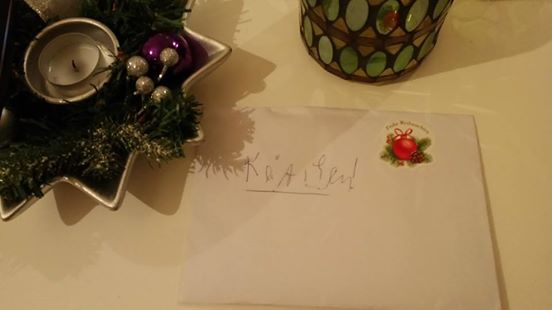
Later on, back in Frau B’s room, she handed me an envelope. On it was written, in a scrawl I have come to know well, “Katechen.”

“I can’t see what I write,” she said. “So, I was quite impressed that I got any letters down at all.”

She made me promise I wouldn’t open it until I’m back in Ireland on Christmas Eve.

I handed Frau P a bag containing an assortment of perishable gifts. The hamper included a slice of mackerel, two bottles of Berliner Kindl beer,  a box of Lindt chocolates and some organic (it is Christmas, after all) apples.

She told me to hide the beer at the back of the cupboard.

“I’m not going to drink it alone,” she said. I took that as an invitation for a beer date in the new year.

Back in the quietness of the room, I asked Frau B how she had been feeling this week.

“Terrible,” she said. “I really thought my time had come. I was convinced I was going to close my eyes one final time.”

We looked at each other for a long time.

And then it passed and she asked me who I honestly thought was the most attractive resident in Wohnbereich 4.


Is the Internet making you more tolerant?

For those of us who work, shop, socialize, bank and even date online, it’s next to impossible to overestimate the effect the Internet has had on our lives. In the places it’s reached, the online revolution has transformed economies and enabled mass communication in ways that seemed inconceivable before.  Economists say that if the internet were a sector, it would be worth more than agriculture. But has the internet changed the way we view the world too?  In particular, has it made us more tolerant?cropped-blogpic.jpg

I checked out some research to find out what scientists have to say on the subject.

  • In 2003, the remote Pacific island of Niue became the first country in the world to offer nationwide free wi-fi.  Almost a decade later, Swedish business student Ludvig Foghammar traveled there to find out whether using the internet was making the islanders more or less tolerant. He monitored the hours inhabitants were spending online and gave them a questionnaire to assess their tolerance.He found that those who used the internet for more than an hour a day scored higher on overall measurements of tolerance. But the findings couldn’t establish a causal link between Internet use and tolerance. After all, people who spent longer online may have been more tolerant in the first place.
  •  In another study published last year, Japanese researchers controlled for a tolerant predisposition when measuring the relationship between internet use and tolerance of foreigners. Their findings supported the link between internet use and social tolerance, even when they controlled for other variables like existing contact with foreigners.
  • Exposure to and acceptance of other belief systems (a key feature of tolerance) on the Internet may also be causing us to abandon our own set of religious convictions. An analysis of two decades worth of data by computer scientist Allen B. Downey led him to conclude that “internet use decreases the chance of religious affiliation.”

These findings might not strike many as particularly surprising.  After all, any repository of easily accessible information is likely to broaden the mind and turn us away from a prescriptive world view.

But is that really how we use the Internet? A cursory glance at the comments section beneath almost any YouTube video or news article shows little sign of tolerance flourishing online.

Many internet users have seized the opportunity of hiding behind an avatar to disseminate their own particular messages of hate. The phenomenon of cyber-bullying gained mainstream media coverage after the 2010 death of teenager Tyler Clementi who killed himself after his flatmate secretly filmed him kissing a man and then released the footage online.

Equally, hate groups made up of xenophobes, misogynists and even terrorists find like-minded company online, often using technology to gain new recruits.

After the Arab Spring, academics engaged in a fiery debate about which had come first: the medium or the message. While some credited social media with mobilizing protesters to come out in force, others argued that its use simply corresponded with a change in attitudes that was occurring offline.

In his speech accepting the Nobel Prize for Literature, French author J. M. G. Le Clézio  presented a particularly optimistic view of the internet: “Who knows, if the internet had existed at the time, perhaps Hitler’s criminal plot would not have succeeded – ridicule might have prevented it from ever seeing the light of day.”

In a week that’s seen terrorist group Islamic State release a fifth video of a beheading online and an eminent astrophysicist publicly burst into tears after the shirt he was wearing during a historic moment in space history caused a #shirtstorm, that view may seem utopian.

I’m on the fence. Have we become more or less tolerant since going online? Post your thoughts below!