“You’re not thinking of marriage, no?” asked Frau Bienkowski.

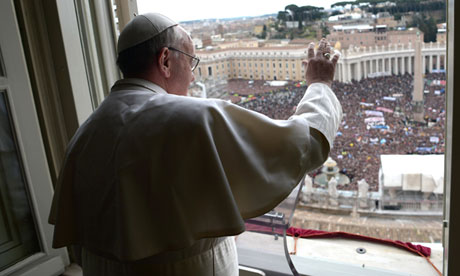
“So we have a new pope,” Frau Bienkowski said, as I handed her the bag of medium-sized apples and two packets of sugar-free sweets she’d ordered.

“He could have been a black man,” she continued. “It wouldn’t have mattered.”

“No!” I said.

“But there was something irregular about Benedict’s resignation, wasn’t there? Popes don’t just resign!”

I agreed it wasn’t their custom.
“Could you get us some coffee?” she asked, pushing her stroller over to me. “You can put the cups at the front!”

I pushed the Zimmerframe down the corridor and passed three ladies in wheelchairs. One of them had a remarkable face, like a gazelle. They were staring straight ahead. One of them was saying, “You could write a novel about a life, if you just think back to all your encounters. You could write a novel. You really could.”

I placed Frau Bienkowski’s cup in front of her, and she pushed one of her sugar-free sweets towards me.

“So tell me, how has work been this week?”

I told her I’d been busy and that the new pope was creating a lot of work for us.

“It’s good you’ve got work,” Frau Bienkowski said, “especially as you’ve booked flights to see your boyfriend!”

“I couldn’t agree more,” I said.

“You’re not thinking of marriage, no?”

“Well, it would be difficult logistically since we live in different countries,” I said, apologetically.

She nodded. A few weeks ago she’d told me that she thought German president Joachim Gauck really ought to marry his long-term partner, since she travelled with him in an official capacity.

A little later, we got talking about Germany. “We’ll never escape our past,” she said and paused.

“They could have just removed the Jews from official positions. But there were good Jewish doctors, good workers. Sending them to concentration camps, killing them was wrong.”

For the first time, I felt uncomfortable around Frau Bienkowski.

“Of course it was,” I said.

Frau Bienkowski presented me excitedly with a fashion catalogue. “Look what I got in the post!” she said.
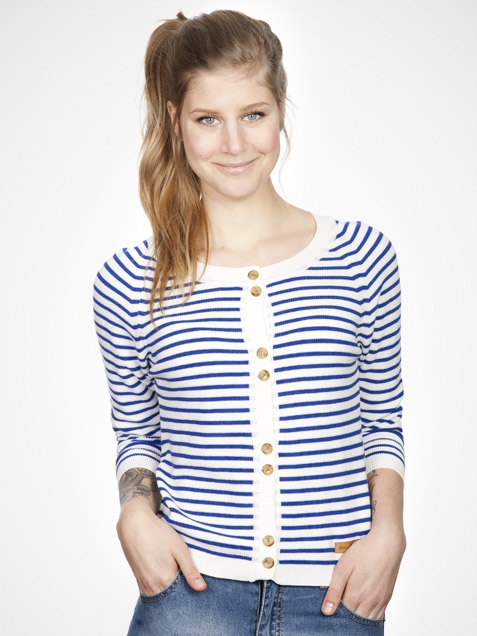
We spent some time leafing through the pages and commenting on the clothes.

“I like that,” I’d say, pointing at a blue and white striped cardigan.

“Yes,” she’d reply, “It’s pretty, but look at the pattern on that blouse .. it’s a bit much, isn’t it?”

We looked at a model in high-heeled shoes. “Do you like them?” I asked.

“Oh yes,” she said.

“Did you wear such high shoes when you were younger?”

“Oh yes!”

“And could you walk in them?”

She smiled. “If you wear them, you walk in them!”

We read some more of the story about the cantankerous 100 year-old living in an Irish convent.

I apologised that I wouldn’t be able to see her next week.

“Don’t you worry!” she said. “This should never be an obligation. And tell Andrew I say hello!”

Another cup with Frau Bienkowski

When I arrived at the nursing home earlier this afternoon, I passed a group of ladies pushing Zimmer frames and wearing feathered masks. Before I went up to Frau Bienkowski, I ordered a coffee downstairs. I was served by a lady with whiskers and a tail.

Frau Bienkowski said she would prefer to forgo the carnival celebrations downstairs, but we turned on the TV and watched an enormous red float make its way through the centre of Duesseldorf.

“When I was young,” Frau Bienkowski said, “we didn’t dress up that much for Carnival. But we had a masquerade ball.”

masq

“At midnight, you would take off your mask to reveal your face to your dancing partner.. Of course it wasn’t always a surprise. You knew some people by their hands, or the way they moved.”

She paused. “You aren’t wearing that beautiful pattern today,” she said, studying me carefully. “But that skirt is nice too.”

I complimented Frau Bienkowski on her green two-piece suit.

Then I emptied out my bag. “I brought something for you,” I said.

“Oh?”

“Well, since you said you liked reading, but that your eyes were no longer quite up to it, I took out some audio books from the library.”

“Audio books?”

“Yes, here have a look.”

“I didn’t know there was a such thing as audio books,” she said. “And you can take these out of the library?”

“You can! And you can even borrow films too,” I said. “Now, if you’ll excuse me, I have to go and borrow a CD player.”

“Will it be big?” asked Frau Buenkowski.

“It might be,” I said.

“Here, take this,” she said, pushing her Zimmer frame over to me. “And would you mind picking up some coffee too?”

I made my way down the hallway to the communal sitting room. Five ladies in wheelchairs were seated around a table, eating cake and drinking coffee.

“Did you hear the Pope has resigned?” said one.

“Oh, I knew that already!” replied another.

“On grounds of age,” chirped in a third.

I unplugged the CD player and popped it inside the basket of my Zimmer frame. I filled up two cups of coffee and balanced them precariously on top.

Frau Bienkowski and I listened to a few minutes of a German novel, read by the author himself.

“Do you think you might like this?” I asked.

Frau Bienkowski nodded. She looked happy.

“Which library did you go to?” she asked.

I told her. “Did you know that the building used to be a Sparkasse bank?” she asked.

I didn’t. “It was a vault, which the Russians plundered after the war. Back in the day, people had less jewellery, and they used to bring it there for safekeeping. One of my friends never saw her necklace again.”

My eyes were becoming wider. “Anyway,” Frau Bienkowski continued. “Tell me about what you’ve been up to.”

I told her I’d worked a rather uneventful night shift last night. Frau Bienkowski laughed. “It’s not every day the Pope resigns, is it? I don’t know why they picked someone so old in the first place.”

Frau Bienkowski, like me, suffers from insomnia. Hers is much worse. “I haven’t been able to sleep since my husband died,” she said. “Last night I was awake until 5 o’clock, but I got up again at 7. Routine is important.”

I asked her if she was plagued by racing thoughts.

“No,” she said. “My husband and I used to have wonderful times together. We went to the museum a lot. I have a wonderful talent to recall these happy thoughts. Some other people are riddled with anxiety at night, but I simply think of these good times with my husband.”

We talked for two more hours and I said I would call Frau Bienkowski later that week. She looked at me. “I never want you to feel obliged to come see me,” she said.

Frau Bienkowski, forgive me my bluntness but you could not be further from the mark. And this week, I am going to buy you a little CD player from Medienmarkt.

Three Men that don’t know they’re in my life

1.The pioneering beggar

Every day I see an oval-faced man on Grafton Street holding an enormous wooden sign, which points you in the direction of the Sweet Emporium on Duke Street. He has been holding this sign day in, day out for many months. For years before that he sat slumped on the steps of the insurance building next to Hodges Figgis with a tin covered in chipped orange paint. His eyes were too sad and vacant to be those of a charity collector; he was a pioneering beggar. Somebody must have noticed him there and decided that if he was going to stay in the city centre looking for money all day, he might as well send people to the Sweet Emporium. Now he works double shifts because I’ve seen him back by the steps on Dawson Street at evening time. He’s been on my mind on and off for years. I wonder what we’d talk about, if I ever found the courage to introduce myself.

2. The Man with long, blonde hair

Since my schooldays, I’ve been passing an extremely tall man, with long blonde hair and thick pink lips. When he walks, his whole body jolts heavily forward and then bounces back, as if on a spring. He has a long, beige face, which blends in with the bewildered expression he wears. When I watch him, he seems to be looking at something beyond what I can see. I think he is the wildest and gentlest man I’ve ever seen and I also think that he is intellectually disabled. I feel sad when I see him, because of the way he moves, and because of the large blue pools which are his eyes. Every once in a while he puts on black, knee-high women’s boots and stumbles down the street in them. Sometimes I try to imagine his mother and father but I can’t because I can’t paint their pictures in my head.

3. The Opera Singer

He wears a smoking jacket and bow tie and sings to the crowds of shoppers as if he were on stage in an Italian opera house. He has a neat, tight face with symmetrical features and short, sandy brown hair. He could be from the Czech Republic or from Slovakia, but in fact he comes from our own shores. I’ve heard him speak; he asked a lady last week if he should sign her CD “To Anne with an E”.
His body language, coupled with his attire is highly comedic. I know this because once I was sitting by the window upstairs in Bewley’s watching him speak to a middle-aged lady, who happened to be a fan. He bent forward to touch her arm and tilted his head backward to laugh at what she had said. He used his hands constantly, flapping them politely in her direction and then mock-modestly at her wide-eyed praise. He’s a charmer.

These three men are in my life but I’m not in theirs.