What septic tanks and education have in common

I’ve spent three-quarters of my life being educated and the last two years educating others.

Since I began school at the age of four, I’ve associated education with evaluation.

First it was stickers and stars and rubber stamps. These evolved into report cards with little boxes beside the words: poor, fair, good, very good and excellent. Next came the letters of the alphabet: A, B and C. Then fractions and percentages arrived and after that, points. At university, marks were converted into classes and you could be first, second or third.

Compulsory education – like the septic tank- originated in the nineteenth century. While both aged tolerably well, of late they have begun to fail us.

image source: insectapedia.com


After all, as Ken Robinson, an educational theorist points out, the current system of education was conceived in the intellectual era of the enlightenment and the economic context of the industrial revolution.

Like the septic tank, it has failed to keep up with the times, often producing impenetrable sludge before practical distillation.

(If you need proof, try understanding what on earth academics writing in humanities journals are trying to say).

It’s not that our education is of poor quality. It’s not that we have bad teachers, or unmotivated students. They never help but they’re neither unique to this period nor the cause of the problem.

The real issue is that we haven’t decided whether education is a journey focussed on itself or on its destination.

Let me explain.

Up to recently, education was a means to an end. You walked out of school and into the workplace. If you went to university and got a first class degree, you got a first class job.

Now things have changed. We have too many people educated in areas with too few jobs.

The difficulty is that we still believe that the higher your educational level, the loftier your career expectations should be.

Of course it’s a prospect that many are failing to realise.

Now, if you get a first class degree, you take your place among all the others and compete for any old job.

It’s a case of social progress outrunning institutional reform.

You could see the situation as a social leveler. Now unemployment is for everybody, not just the least privileged.

Some students spend twenty years collecting stamps and stars and letters and numbers.

And then they find that the numbers don’t add up to a job.

Their experience calls into question the very purpose of evaluation.

The transition from pupil to teacher has taught me that evaluating students is rather arbitrary. It doesn’t measure very much at all.

But we’re hooked on comparison. We get frustrated if our own evaluation can’t be backed up by a standard measurement. If we think we’re better than the person next to us, we want it neatly before us in percentage form.

I guarantee that in a secret ballot, students wouldn’t vote out tests and exams.

Science backs it up. Research has shown that the pleasure circuits are activated in advance of finding out a result.

We thrive in conditions of uncertainty.

Waiting for a test result is like waiting to see if you have won in Poker. Ultimately neither tells you how well you have played or how much you have learnt, but rather how well you have performed relative to others.

It’s time we took a step back though.

The right to education is one of the great privileges of our age. While its original and most important purpose-to lay the foundations for economic subsistence- has been eroded by the unprecedented pace of progressive reform relative to growth in employment opportunities-we must take time to remember what has been so long neglected: the timeless, immeasurable pleasure of learning for its own sake.

Could it be that indulging ourselves in constant measurement against others is doing us more harm than good?

Andrew Bird, an American folk singer condenses the possibility beautifully in the song “Measuring Cups” which opens:

Get out your measuring cups and we’ll play a new game. Come to the front of the class and we’ll measure your brain. We’ll give you a complex and we’ll give it a name.

This generation, more intensely than any other before it, has experienced education as a closed system of incessant measurement.

For many that measurement has not amounted to more than restlessness and disillusion.

Learning for its own sake has been forgotten amidst the obsession with making ‘it’ which means ‘making money’.

If teaching has taught me one thing, it’s that the responsibility to evaluate is nothing compared with the possibility to inspire. My job is to encourage before it is to instruct.

Pupils are not watering cans: we can’t fill them up without their consent. They must want to learn, not in order to get a good job or to become rich or to sound clever, but because, as Merlin in T. H. White’s The Once and Future King reminds us, “it is the only thing that never fails”.

I have the following words pinned to my bedroom wall:

“You may grow old and trembling in your anatomies, you may lie awake at night listening to the disorder of your veins, you may miss your only love, you may see the world about you devastated by evil lunatics, or know your honor trampled in the sewers of baser minds. There is only one thing for it then, to learn. Learn why the world wags and what wags it. That is the only thing which the Mind can never exhaust never alienate, never be tortured by, never fear or distrust, and never dream of regretting. Learning is the thing for you”.

Equipped with this original joy of learning, and a quieter, more humble confidence, our young people may be more inspired to carve an independent niche on the side-lines rather than enter the desperate rat-race of out-performance.

Let’s make our recovery less sludgy than a septic tank. In remembering why education matters for its own sake, we avoid throwing the baby out with the bathwater.

The reality of working in retail

Toeing the Line

Pippa’s feet hurt. They’re wedged in narrow pumps and she’s been on them all day. She’s moving between the till and a number of milling customers, which include a formidable lady in her forties sporting a mass of auburn curls and examining a pair of shiny black boots. “D’you have them in a thirty-nine?” she calls over, waving the article at her. “I’ll just check for you now”, Pippa says, issuing a receipt and handing the customer at the till her bag before returning to the lady.

While she’s in the stockroom, Pippa’s colleague appears, her head barely visible beneath the enormous tower of shoeboxes she’s carrying. “Deliveries just in”, she whispers as Pippa emerges with the boots in a thirty-nine. “Oh, God”, Pippa gasps looking at the mountain of boxes growing in front of her.

Meanwhile, the lady has begun tapping her foot. Pippa hastens over. “Hi there. I’m really sorry for the delay. Unfortunately, we only seem to have size 39 in navy..” The lady purses her lips. “Is that right?”
“Yes, unfortunately. But I can check with our other branch to see if they have them in stock”.
She blinks a few times. “Alright, check”.

Pippa goes to the phone behind the till but there’s already another customer waiting to buy a pair of shocking-pink heels. “Sorry for keeping you”, she says taking the box and commenting, “they’re gorgeous” as she drops them into a plush black carrier bag. Transaction complete, she calls the other branch and dodges around the heap of boxes her colleague is sorting. On the way, another customer taps her on the shoulder.
“Are these leather?”
“They wouldn’t be entirely leather”, Pippa replies apologetically. “but they’re leather-lined”.
Back with the lady now, Pippa explains that she branch ten minutes away has the black boot in size 39 in stock.
The lady shakes her head vigorously; “Oh, I just can’t face the walk!”
“Or I could order them in for you?”, Pippa suggests.
The lady takes another look at the boot, with its glittery heel and floppy leg and puts it down. “I’ll leave it”.

“No problem”, says Pippa brightly, packing it back into its tissue wrapping and returning it to the stockroom upstairs. Her colleague is now up at the till dealing with a man who is demanding a refund for a shoe his daughter damaged while out dancing. As soon as he’s gone, Pippa’s colleague calls over to her and says “hey, go on your lunch, you haven’t even had a break”.

Pippa takes a look at the heap of boxes, at the group of shrieking friends who’ve just come in looking for matching stilettos to wear to a hen night and at the accounts that are yet to be filled in. The sales target figure her boss has given her seems alarmingly out of reach. Rocking Around the Christmas Tree comes on again. “I can’t”, she says.

Living on a shoestring

Pippa has been working in the shoe shop for the last year and a half. She’s got a Master’s Degree and worked part-time all through college. She’s one of the 216,229 retail workers in Ireland and part of a growing number of graduates entering the sector.

Like many others retail employees, Pippa’s work conditions are poor. She splits her time between the various branches of the shop and frequently runs the smaller outlets with no help. “It’s a nine-hour shift, on my own, with no break”, she says.

Quite apart from compromising safety, such conditions represent a breach of the law, which states “Shop employees who work more than 6 hours and whose hours of work include 11.30am-2.30pm are entitled to a one hour consecutive break which must occur during those hours”. Furthermore and rather curiously, retail workers in the Footwear and Drapery trade in Dublin only “are entitled to a 15-minute paid break (exclusive of the main meal break) if working more than 4 ½ hours.” Taking into account the amount of work she does and her experience, Pippa feels that she “could do with getting more than nine euro an hour at this stage”.

To add insult to injury, Pippa is not allowed to wear her own shoes but is instead forced to wear footwear that the shop stocks, for which she must pay out of her own wages. She finds them uncomfortable and permanently suffers from blisters. “I have wide feet”, she explains and “because of that these type of shoes hurt”. The one time she dared to come in to work in her own shoes, she was shouted at by her manager. “She just went crazy”, Pippa remembers.

Fear of managers and bosses is widespread among the workers I speak to. “It’s just a lack of respect”, one girl tells me. “We’re dispensable, so they can afford to treat us badly”. Pippa is used to being shouted at. Of her manager she says, “She has been horrible to me on many occasions, but, to be honest, it’s just her manner with you, and a build up of little things, which over time, would have your confidence in ribbons!” she says, adding, “everybody is scared of her”. On the week I pop by, she has been made cry twice by her employer, which Pippa describes as a “new record”.

Image source journal.ie

“We’re just the Christmas slaves”

Wendy, also a graduate worked her sixth Christmas in retail this year. “In the three weeks before Christmas I worked 16 late shifts; they included 2pm-11pm and 2.30pm-12.00am. There were a few consecutive days where I did not even see daylight. I would come home from work at 12.30am, finally wind down to sleep at 3.00am, wake up at 1.00pm to get to work by 2.30pm … I lived like a vampire, microwave meals became my everyday dinner; eating a home cooked meal was a rarity … My sleeping pattern has become alarming and now that the Christmas rush is over all of us on our staff are suffering with colds, infections and the flu from being so run down and stressed. All because people want to shop at 11pm at night … I remember on one occasion finishing at 12.15am, heading home to bed and my alarm going off at 5.30am to be in the store by 7am: all for minimum wage.”

“Nobody thinks about us”, she says “we’re just the Christmas slaves to the shoppers”.
Compared to other years though this Christmas has not been the worst for Wendy: “The years I worked in fashion retail at Christmas were hell but selling face creams and body lotions is pretty straightforward”.

Short-staffing and Dispensability

The problem of short staffing is widespread in the retail sector. With employers taking on fewer staff, individual workers are forced to work longer hours and to go beyond their prescribed duty. The scramble for vacancies makes employees less likely to speak out against their employers’ malpractices, for fear of losing their job to the ever-growing queue of people hoping to take it. The participation of shops in the Government Job Bridge Scheme, which pays interns €50 on top of their weekly social welfare allowance to work for a period of up to nine months, further restricts the number of workers hoping to get paid minimum wage for doing the job.

Experiences with customers: a mixed bag

Mandate, the third largest trade union in Ireland represents 40,000 workers, the majority of which are employed in major retail companies. In 2009 it launched its Respect Retail Workers Campaign following a survey it carried out on twenty retail businesses and their employees, which found that 74% of workers had received verbal threats from customers in the past year and almost 10% had been assaulted by a customer in the course of their employment.

For Pippa, encounters with customers have been varied “Experiences with customers can be really lovely and make you feel very appreciated and like you have helped someone in some little way, even if it is just by lending them an ear; other times, it can be hell!”

Wendy agrees, “Honestly customers were not so bad this year … but of course there were the people who argued over 20 cent for a gift wrap bag that went to charity and the man who wanted money off for buying three things”.

Employees of smaller business losing out

For the thousands of retail workers employed by smaller businesses who are not part of a union, bringing change about is a difficult, risky process. Speaking out threatens to damage relations with colleagues as well as prospects of promotion. The “At least I have a job” mantra appears to be the guiding principle behind silent, gritted teeth and stoic continuance.

As for work being valued, according to Pippa, “Nothing I’ve seen or heard would really suggest it. It’s a tiring job at first, but you do get used to it. Emotionally it can be awful at times, but the people around me are lovely. It’s nice to be working around people my age, who can pick you up when you are down”.

As for the employers, who are supplied with an ever-increasing number of staff faced with little choice but to work in poor conditions, a change in behaviour is bound to come from above rather than below. For the Government, that means enforcing and checking on the written records employers are required to keep of hours worked, to impose the maximum fine of €1,900 on employers who fail to co-operate with it and to monitor the Job Bridge Scheme to make sure that it introduces more, not fewer paid workers into the sector.

What do you think? Have you ever worked in retail? Do shop workers have it tougher than most?

A quarter-life crisis, a Familienfest, the land of the free, my first real job.. Here are the highlights of 2011

January

I was: unemployed, restless, devilish

What I said: “I have few accomplishments to recommend me; I cannot draw, my recitals on the pianoforte are clumsy at best and I have neither a talent for embroidery nor the gift of graceful movement. The one area in which, after much searching, I have found myself to excel is in the ability to produce plausible-sounding Gibberish at will…” more

February

I: found a job, was still devilish.

What I said: “I check my e-mail before going to sleep and there’s a Valentine e-card in from LSB! I think: “Aw, what a sweetie”. I open it up only to find a Fine Gael cartoon canvasser tell me that “Labour are red, Fine Gael are blue, we won’t raise your taxes like they want to do”. Then he winks and looks shiftily (seductively?) to the side. I send one to every member of my family signing it Eoghan Murphy xxx, the name of the Fine Gael candidate in my constituency who topped 98 fm’s “hottest election poster boy” poll…” more

March

I: had a quarter-life crisis

What I said: “There was once a raven-haired fortune teller who, tracing her forefinger over my palm, told me that I would live to be in my nineties. I was alarmed when I realised some time ago that I had reached quarter age in spite of her promise of longevity. This realisation, coupled with acute post-graduation panic (PGP) has propelled me to a life crisis…” more

April

I: tried to forget about my Quarter Life Crisis by taking a trip to Sligo with LSB

What I said: “We’re leaning against a stony wall by the riverbank. I’m unzipping my camera case gingerly because I want to remember the stillness and his solitude when a blonde-haired man of about thirty staggers, stony-eyed towards us.
“Don’t you dare take my picture”, he yells. “You’ve no right, you sons of bitches. You’ve no fucking right at all”…” more

May

I: thought about my younger and more vulnerable years.

What I said: “I was 16 and practically the same but for a hideous mane of long, straggly brown hair with orange highlights. I had just finished struggling through The Satanic Verses. I’d taken it to Germany where I spent many a journey on slow trains, puff-puff-puffing their way through the Bavarian countryside, with the battered book on my knee, trying to make sense of it all. Bizarrely-named angels, and evil and the Muslims didn’t like it: it went something like that…” more

June

I: took up a political cause

What I said: “As they beat their hammers on their oak writing tables and whisper “Objection” in advance of September’s Referendum, the twenty-two dissenters will inevitably privately concede that the scrapping of Article 35.5 represents good riddance to bad rubbish. Objection over-ruled…” more

July

I: thought about pens and penises

What I said: “Unless it’s accepted as equally scandalous that the proportion of male nurses is equivalent to that of female corporate executives, a discussion of gender can never be detached from a social weighting in favour of money…” more

August

I: attended the annual Familienfest

What I said: “As I was tucking into my vegetable bags (or Gemuse Taschen) I had a sudden sinking feeling: I had forgotten to pick up the bag of black sausages!…” more

September

I: admitted that I don’t have the first clue about the economic crisis

What I said: “Every weekday morning, I brush my teeth while listening to the business news on Morning Ireland. Once the weather comes on, I know it’s time to spit…” more

October

I: realised that there’s nothing quite like an Irish Presidential election.

What I said: “The struggle for the presidential candidates to find many more words than the Queen of England herself during the “Irish Language” debate revealed the incongruities that are still gripping this little nation, which – desperate for an export-driven recovery from economic ruin- continues to struggle with its own identity…” more

November

I: went to America.

What I said: “Subways in New York are grubby places. They are for poor people and for people who read large books with city library stamps printed on their spines…” more

December

I: finished learning the Arabic alphabet!

What I said ““That is a beautiful and new car!”, I said pointing to a rusty 1993 fiat punto. “I am Kate Katharina.” “Pleased to meet you.” “Give me a falafel please”.”… more

………………………………………………………..

Thank you all so much for making 2011 lovely and for taking time out of your much more exciting lives to leave comments. I appreciate you all enormously. ❤

Why Ireland must ban smacking children

Texan judge William Adams enters his daughter’s bedroom. On the wall next to the computer in the corner is a poster of Bart Simpson writing lines on a blackboard. In front of Judge Adams is his daughter’s bed, covered in a red and black spread.

His daughter Hillary is wearing thin grey pants and what looks like a pyjama top.
“Bend over the bed”, he says, quietly in his southern drawl, “Bend over the bed”. She’s whimpering now. “No. Dad”, she pleads.
“BEND OVER THE BED”.

He’s swinging a belt.

He thrashes her on her thighs before shouting once more “BEND OVER THE BED”.

She folds herself over the bed. She’s cowering, weeping, screaming. He keeps thrashing her. Crack, crack, crack. She’s flailing so he presses down on her back, to force her onto her stomach. He strikes her again and again and again.

He moves away. She sits up. Her shoulders continue to jerk forward; still flinching from the attack. She starts wailing. Her father stands before her and regards her for a second. Then he lashes out again. With each crack of the blow, there’s a gasp as she tries to find air. Her mother, from the corner of the room watches on and tells her daughter to “take it … like a grown woman”.

Hillary’s crime was to download music illegally from the internet.

The abuse continues for six minutes. The footage emerged in November when Hillary, who had secretly set up a webcam in her room to record her father’s ongoing abuse decided to release in on the internet.

Though he’s being investigated, there’s a good chance that William Adams won’t be held to account for his actions because of the time that has elapsed since his crime; the footage was taken in November 2004 when Hillary was 16. Judge Adams and Hillary’s mother have since split up, the latter claiming that she was”completely brainwashed and controlled” in her marriage. Hillary and her mother now have a good relationship and have appeared on chat shows together.

I found it impossible to watch the full seven- minute clip posted below but I forced myself to watch enough to decide that what Judge Adams did was a disgusting crime deserving of a prison sentence. Alarmingly, there are many who, having watched the same clip, disagree that Adams is even guilty of abuse.

While Judge Adams was abusing rather than ‘spanking’ his child, the case illustrates why it is socially important and morally necessary to protect children under law.

The Minister for Children, Frances Fitzgerald is considering bringing in a blanket ban on smacking children.

She should do so as soon as possible.

Most of the generation before me was beaten. Many were sexually abused.

In Ireland today, parents still smack their children in the middle of the street.

The purpose of a law is to create a boundary of social propriety. Broadly speaking, when a democratic society prohibits something, it sends a signal out about what is right and wrong.

Smacking children is wrong. It is not necessarily abusive, or worthy of criminal pursuit but it is still wrong.

Many who were smacked grow up to say “well, it never did me any harm”. Many of them use this as an excuse to smack their own children, claiming that “spare the rod, spoil the child”.

There is no evidence to suggest that smacking a child is beneficial. As children develop, they learn to model their behaviour on that of the people around them. Researchers have found that children who are smacked are more likely to grow up to be violent themselves.

Smacking a child is a poor parental strategy. It is a lazy, uncreative way to stop undesirable behaviour and leads to long-term damage to both parent and child.

I have heard the weak argument expressed that children under three have failed to reach the “age of reason” and can therefore only respond to discipline in the form of corporal punishment.

While it is tself highly contestable that children under the age of three cannot “reason”, this argument falls through because it is certain that children from the moment they enter the world, copy the behaviour of the people around them. Unless violence is desirable, children’s exposure to it should be prohibited.

Supposing a toddler lacks the capacity to understand that throwing food from their high chair is wrong. If he or she is smacked, they still don’t make the connection. Instead they learn that when their parents are upset, or angry, they respond by lashing out.

“But what if a child is running into the middle of the road and a car is coming and you lash out to stop them?” I hear people cry.

This is okay, you will not be prosecuted.

This is an uncomfortable topic for plenty of people. Many ‘good’ parents smack their children and admittedly the long-term damage might be minimal. Nevertheless, the message is ineffective and the means in itself infantile and unsophisticated.

Parenting is not easy. The temptation to smack will arise. In the majority of cases, at least a handful of smacks will be administered.

Where the law comes in is in changing perceptions. The fact that many people in America and beyond can watch a video as horrendous as that of Judge Adams’ assault of his daughter and claim that it doesn’t constitute abuse is utterly alarming.

It shows that laws – like parents – must set clear boundaries. Physical punishment is wrong. Apart from the unusual case where a child is innately violent (not having learnt the behaviour) and when a parent must use force in self -defence, it is unambiguously unacceptable.

In eighteen of the forty-seven member states of the Council of Europe, it is illegal to inflict physical punishment on children in all settings, including the home.

According to the Irish Times, enforcing the same ban here is problematic because of the constitutional guarantees afforded the family.

It is ironic that in an attempt to protect a child from an abusive family, the rights of that same family could be infringed. It is the same kind of logic that protected the institution of the church over the abuses it perpetrated against its flock.

Unfortunate back story? YOU could be the next big thing!

A couple of weeks ago, I had the misfortune of watching “Germany’s Got Talent”. It wasn’t my choice; I was babysitting and the parents had decreed it. The three children had permission to watch the show provided they ate up their salami baguettes and promised to be in bed by 9.30 pm. As I tossed salami slices onto their French sticks, I prayed for a hunger strike, but it was all in vain: they tore through the bread and the youngest even asked for seconds.

If its British counterpart is objectionable, Germany’s Got Talent is downright offensive. It’s even more slow-moving and features considerably more sexually provocative performances and an unacceptably broad definition of talent.

I asked the children whom they were rooting for. “The piano player” they answered. Oh, how nice!

Turns out he’s a Brazilian-German with a red Mohawk known as “Punker Jorg” who’s been up to no good; for the last few years he’s been living on the streets and getting in trouble with the police. Somewhere along the way, he started playing Yann Tiersen songs on the keyboard and now he wants to turn his life around. We see some teary tributes from his grandmother and an emotional appeal from his family to quit his path to self-destruction.


Before he performs we must watch a Russian lady showing off her uncanny ability to change outfits in seconds while covered by a sheet her husband drapes over her; an unfortunate man who is besotted with the main judge, whom he describes as his idol; and a blind lady whose dog sits beside her panting as she sings.

The kids’ eyes get bigger and bigger with each story of an unfortunate life about to be transformed by a winning performance.

This all came back to me tonight because I stumbled upon a clip of Korea’s Got Talent on youtube. Sung-Bong Choi is 22 and was abandoned as a child. He’s spent his life working on the street selling gum and sometimes the public toilets are the only shelter he can get.

One night he’s in a nightclub selling gum when he hears a vocalist performing with such emotion that he decides he wants to sing too and turn his life around. Korea’s Cheryl Cole gazes at him with adoring pity while the camera pans out to audience members, who are wearing uniform expressions of patronising compassion.

Sung Bo, self-contained and humble starts to sing and the crowd goes wild. Cue millions of youtube hits: the boy goes viral and he’s the next Susan Boyle (with that name, he has to be).

Well-intentioned youtube comments beneath videos of this kind remind us “not to judge people by their looks” and thank the Su Bos of the world for having talent despite adverse life circumstances and lack of physical attractiveness.

They’re called “feel-good” videos and they travel around the world in seconds and bring tears to people’s eyes, which they then tweet about with a link back to the video.

Pity that these superstar moments rely on the gross assumption that talent and good looks and fortune are usually correlated and where this is not the case it’s legitimate to make an enormous deal out of it.

Much to the kids’ disappointment, Punker Jorg doesn’t win. An African panflautist who hasn’t been able to afford to see his family for eight years does. Magically, before his winning performance and after an elongated series of clips conveying his unfortunate life-story his mother appears on stage, having been flown over courtesy of the show to hear her son perform the melodies of his native land.

He begins to play. The pretty judge wipes a tear from her cheek with her perfect nail. He’s crowned winner and embraces his mother.

By this time, the kids’ eyes have glazed over. As I tuck them up, I ask whether next time they’d like to play make-believe “Das Supertalent” instead. They nod in excitement. When I return downstairs, I notice a piece of salami stuffed down the side of the sofa.

Leprechauns trade in gold as downturn hits the streets

On North Great George’s Street this morning I saw a woman pushing a buggy with her belly while using her hands to scrape a scratch card with a coin. I imagined the baby going flying as she raised her arms in jubilation but alas, it didn’t happen. This morning wasn’t her lucky day.

I enjoyed the image though, particularly as it happened right outside the tacky off-license at the corner where a few days ago I saw the homeless man who sits on O’Connell Bridge (with his rabbit and dog) buy booze. He stuffed his rabbit into his shopping trolley and held the dog under his arm while he rummaged for coins to buy his cans. He could have gone to Centra but he was looking for good value. Aren’t we all?

If these moments tell us anything about the Irish, it’s that we’re damn good at recessions. If it’s a quirky economic downturn you’re after, look no further than Dublin city centre.

Without a doubt the creature that has benefitted most from the downturn is the Leprechaun. This being, formerly associated with ancient folklore and American gullibility, (“Do you really have leprechauns in I-Ur lend?“) has experienced an unprecedented comeback in times of austerity. On Grafton Street you can find a man of about two and a half-foot who has painted his face orange, attached a ginger beard to his chin and placed a pot at his feet. He looks a little like an Oompa Lumpa from the original Charlie and the Chocolate Factory film. If you felt sorry for him I think the joke would be on you; he’s probably making a killing. Size matters.

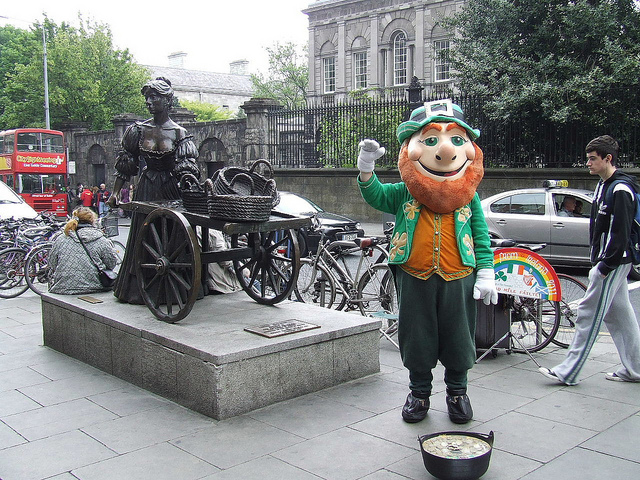
Size matters so much among opportunistic leprechauns that the one that hovers around the Molly Malone statue is enormous. His artificial head is about six times as big as his own. He waves his gigantic leprechaun arms awkwardly at passers-by and of late he has decorated his crock of gold with silver tinsel. The other day I saw him leaning against a lamppost on the phone, with his huge fake head under his arm. He didn’t look Irish, which made it all the more wonderful. He’s probably an economic downturn migrant from the BRIC area who’s heard that no one throws a recession session quite like the Irish.

It’s not all fun and games though. There are feuds on the streets; warring factions have developed. Resentment is building.

You can see why.

Way before economic opportunism was in fashion, an old man from Cavan had an idea. He decided to put on a tweed cap and a patchwork waistcoat and sit on Molly Malone banging on a badhrán. The tourists loved it. He’d motion to them to come sit beside him and encouraged them to take photographs. He even bought spare tweed caps for them to pose with in the pictures. Once, when I was in my first year of university, I pretended to be a German tourist just to get a picture with him. If somebody else tried to sit down on the statue beside him, he’d snarl at them and tell them to clear off. He had the kind of audacity I can only dream of.

The good old days


It may be easy to mark your territory when the property market’s booming but things have changed. A few weeks ago, I saw my tweed-capped friend outside River Island, patting his badhrán with a sour face. Two American tourists stopped to have a look at him and quick as lightning he beamed. After both of them had had a go of the badhrán and dropped a few euro into his cap, he pulled them closer to him. Pointing at the giant leprechaun parading around Molly Malone, he whispered conspiratorially, “See that leprechaun? Don’t bother with him; He’s a fake”.

Budgets aside, recessions in Ireland are pure Gold.

Also, if you find this post facetious, you can read a serious piece about my opinion of the Irish here.

American Diary Part 1: The Land of contradiction

Compensation Culture

Cruising down the highway on a megabus from New York to Philadelphia I am bombarded by a series of enormous billboards advertising attorneys. They feature pictures of balding men with captions like “Had an accident? Get compensation! Call 15800COMP”. The first thing I see on the Long Island railroad from JFK to Penn Station is a poster of a vacant-looking woman with the accompanying text “Suffering health complications as a result of vaginal mesh surgery? You may be entitled to compensation! Call 1800MONEYBACK to speak to a professional with a track-record of payouts”. “What is vaginal mesh surgery?” I whisper to LSB, who looks bewildered and uncomfortable, because he hasn’t seen the ad I am talking about. “I don’t know, Katzi”, he replies, shifting in his seat. Another morning LSB and I are watching an excellent episode of Family Feud only to be interrupted by yet more flashy ads for attorneys promising to ensure you BIG $ compensation and no fee unless successful”. They all look offensively shifty and everything that flashes on the screen is aggressive and in your face. I feel my televisual aura being invaded.

Commercialism

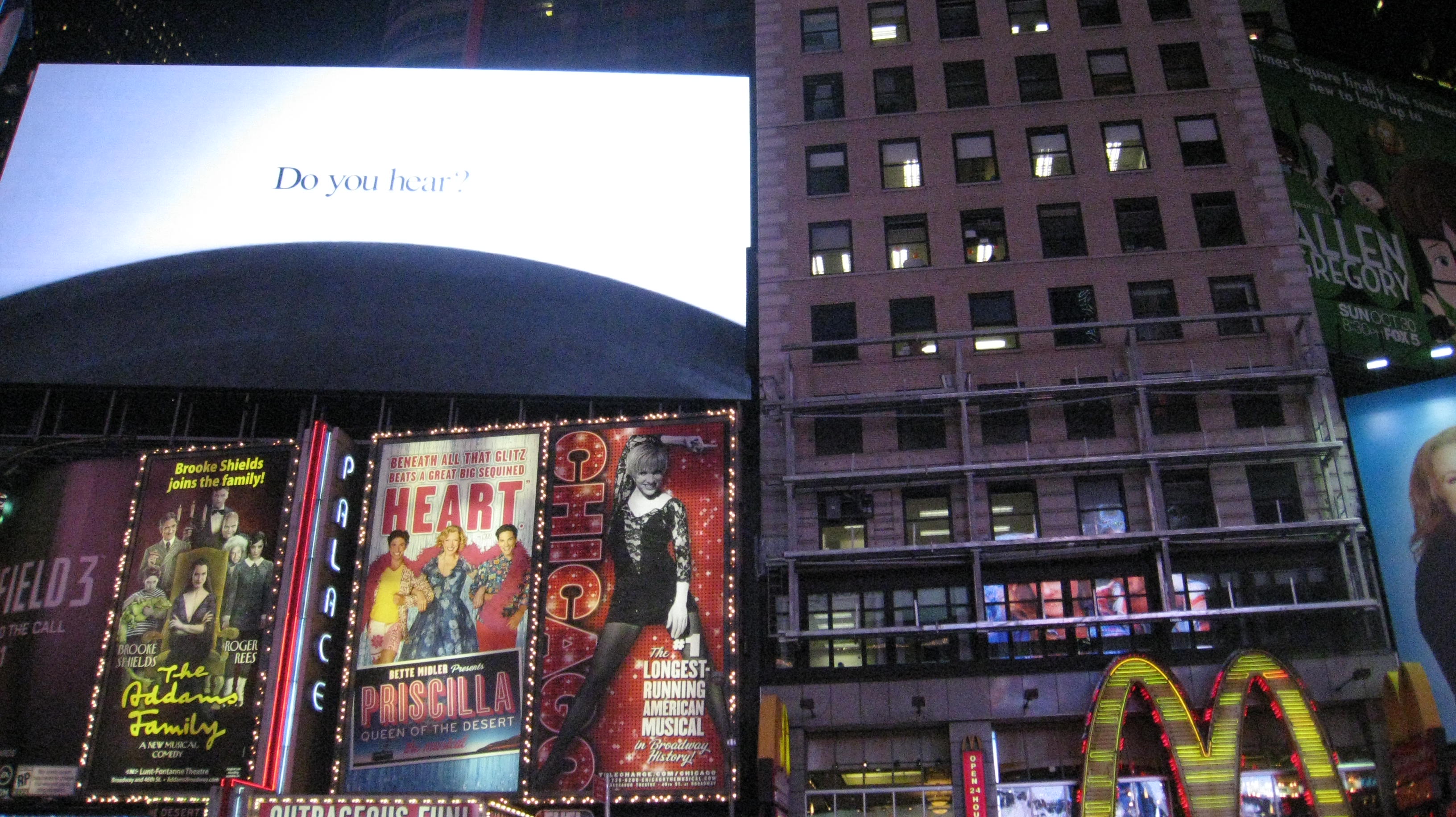
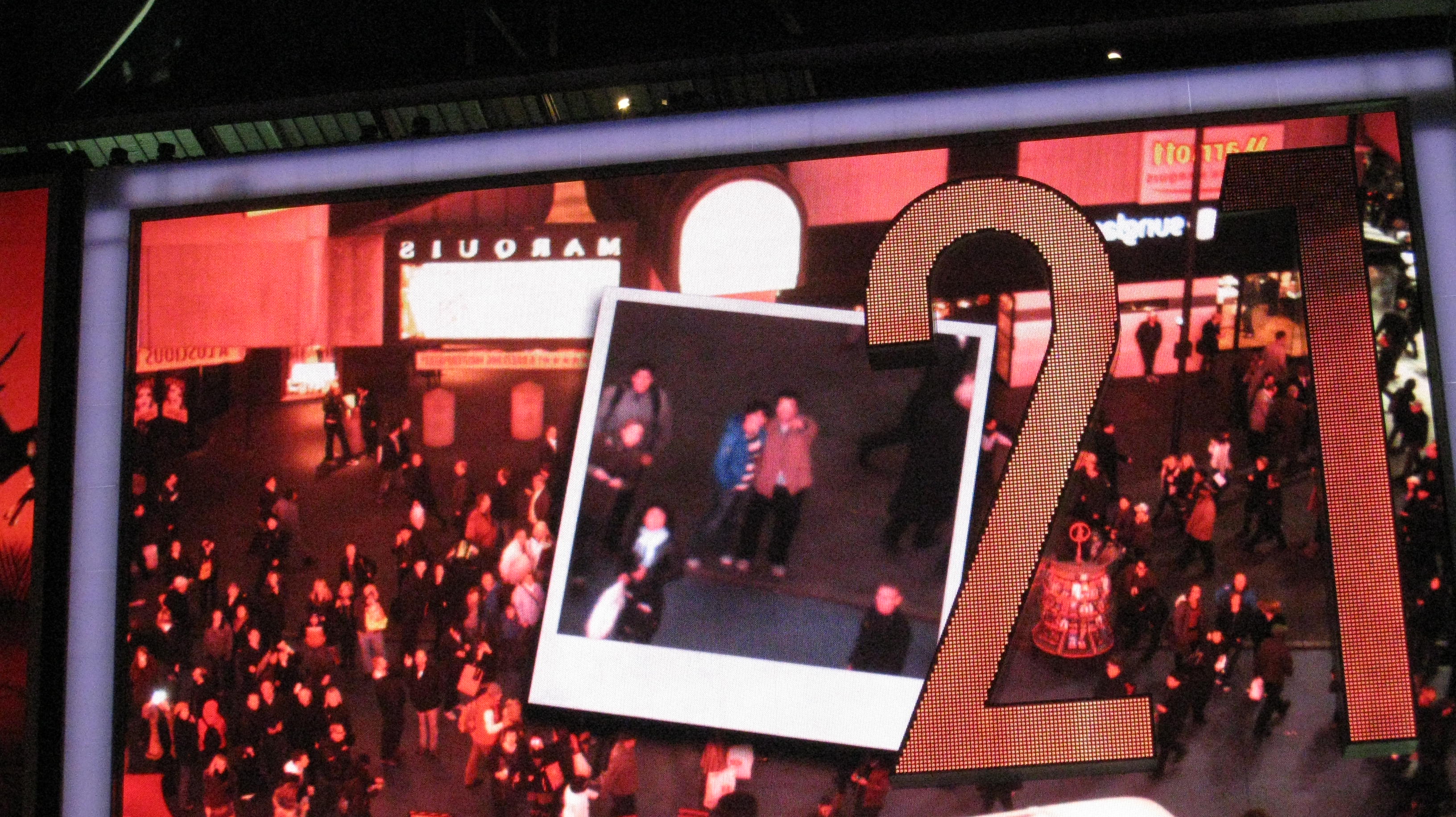
We walk a total of ninety-five blocks all the way from Central Park to the centre of Manhattan. We hit upon Time Square: lights, colours, enormity; everywhere. It conveys an overload of sensation and an adrenalin rush to the pit of my stomach. The changing colours of billboard lights make it instantly addictive. I stare stupefied at my surroundings, and like all the others, I whip out my camera and add to the numbifying flashes of lights. Each skyscraper in Time Square is servant to an enormous screen, which casts rapidly-changing images onto the ground, where we as tiny human creatures stand as awe-struck consumers of a world we are too tiny to control. It’s an enormously impressive place: its size, its lights, its sensations. Forever 21 there is open until 2 am each night. From the store-front an enormous screen shows a live video of the people passing by on the street below. This video provides the backdrop to a dancing model, who pops up between the little speckles of real people behind her. We stand underneath the screen for a while, searching for ourselves as if we were in a “Where’s Wally” page and then, predictably – find ourselves in the corner, point excitedly and pull out our cameras.

Brilliance and its victims

Forever 21's live video of crowds below

The ‘New’ in New York sure lives up to its name. The skyscrapers and omnipresent screens are like something from the future. Genius entrepreneurs like Steve Jobs, Mark Zuckerberg and Google’s Larry Page and Sergey Brin have changed the way in which we live. At the same time, they have created a culture of technological dependency and fuelled a society whose commerce feeds off a perpetual feeling of inadequacy, social comparison and greed. We have an accident and our immediate thought is: “I can make some money. Where is that Attorney’s number?” We want to look good all the time, so we vote with our feet and make it commercially successful to open a clothes store until 2am each night.
We ignore the little guy holding a hand-made globe on top of his head in Time Square to raise awareness about Climate Change because he doesn’t have flashing lights and isn’t tall enough to scratch the clouds. America is a story of brilliance and its victims.

#Occupydamestreet exposes what’s good about Ireland

I admire the Occupy Dame Street protesters. On a night like this, as the wind pounds on my window panes and the rain pours down, I imagine them huddled together discussing the agenda for the day ahead. They are a peaceful bunch, who have spent their days postering trees with quotes from Fight Club rather than hurling abuse at the workers whose premises they occupy.

In spite of my self-confessed lack of understanding of the economy, I don’t share their belief that bankers represent the evil 1% of the population and that 99% (the “rest of us”) are their unequivocal victims. It can’t be as simple as that. I’m also not sure whether the protest has any concrete aim but it is certainly drawing attention to the displeasure of many as a result of the actions of few.

What really interests me about this protest is how it exposes the Good in our society.

Here are a group of people occupying a central location and plastering around it slogans determined to undermine the country’s main financial institution.

And yet, it’s peaceful. No aggressive guard has entered the scene, and yelled “Hey, you angry hippy, move it or I’ll shoot”. No protester has screamed abuse at the passing bankers to which they attribute a decline in society’s moral code.

Instead, the public casts a glance, takes a look around, enjoys a talk with a protester about the meaning of life and ambles on, equipped to make its own mind up.

The Occupydamestreet movement tells me a lot about what’s right with this country; the assurances that we take for granted are those for which so many of the Arab Spring protesters have died for.

So inspired have I been by #occupydamestreet that I’m off to #occupywallstreet in the morning. I’m visiting my sister in Philadelphia. She emigrated there two years ago, but not before hosting an “emigrate-like-its-a-recession-party”. When I ask her about her job she tells me that she analyses butt samples but I have a funny feeling there might be a little more to the job of geneticist than that. I’m gutted to be missing the election. If there’s anybody apathetic enough to vote for my first choice I’d be most obliged. Mail me privately for my politics.

I intend to update you on my travels in the Free World but should that not be possible, I will record my thoughts in my little blue copy book and transcribe them at a later date. See you on the other side of the Atlantic!

Confessions of a Teacher: Part 3

This content is currently unavailable.

Bertie Bowls and World Cups

Bertie Ahern is grinning up at me with scrunched up nose and open-topped shirt. I find him perched comfortably at the top of page 70 of the July 4 edition of the Irish News of the World, where he has conceded that “there are questions to be answered and issues to be resolved” and that “all of the players should realise that it is time to hold their hands up and then move on.” In his capacity as sports columnist for the aforementioned publication, he is of course referring to England’s dismal performance in the world cup. His blend of endearing naivety and wily opportunism is representative of a peculiarly Irish mindset, which has dominated the body politic for at least the last decade.

As its most successful exponent, Bertie Ahern stood smiling over the country throughout its period of extraordinary prosperity and glided to a swift resignation conveniently in advance of its crippling economic demise. At the launch of his autobiography last year, he told David Frost that accusations that he had received bribes from property developers were unfounded and based on nothing more than that ‘one guy said that the other fellow told him he did’. A polished Cleggeron he may not be, but his colloquial circumlocution renders him a similarly slick smooth – speaker.

The Irish gift of the gab is not just about sliding through the nets though. Our eager benevolence and uncomplicated approachability represent the ideal of a mobilised community spirit. When Joe Duffy spoke recently to a woman living in the west of Ireland who confessed to feeling lonely and depressed in her surroundings, within minutes calls flooded in from strangers offering chats over cups of tea and spare rooms in Dublin, where she was on a housing waiting list. With similar vehemence, homeless charities have launched an impressive campaign against the demolition of empty houses in the outskirts, suggesting instead that they be made available to shelter the homeless.   

I was born an invincible Celtic tiger cub and have developed lately into a scavenging graduate, competing to take on unpaid work so that some day a philanthropist will discover an archive of my eclectic and unpublished scribblings and plead with me if they may not immortalise them in serialisation  – at any price. Like Ireland’s dream of winning the world cup, it is a goal worth striving towards in the strangely reassuring certainty that it will never be achieved. It is this paradoxical conviction of both success and failure, which makes possible the symbiotic relationship between self-deprecation and delusion, which has contributed to Ireland’s staggering economic rise and fall.

Bertie Ahern’s curious decision to keep his money under his mattress rather than in a bank account is the mark of both madman and genius, each masquerading as the quietly quotidian everyman, drinking still as Taoiseach in his local pub and insisting on going to Mass every week in spite of his cohabiting relationship with a woman not his wife. Paradox and irony thrive in a culture where emotion is self-consciously privileged over intellect. When Ireland rejected the Lisbon treaty, it did so with an impish ‘let’s see what happens’ attitude. The ‘No’ vote was not an indictment of Europe, but rather a concentrated attempt to get on the government’s nerves. After all, they had burst our bubble. Having wedged ourselves between Scylla and Charybdis, we grinned and voted ourselves out second-time round, much to the annoyance of the UKIP.  

In a televised debate about head shops, it was claimed by a frustrated liberal that Ireland is a country where laws are set “not by experts but by Joe Duffy”. Indeed, when our former Taoiseach concludes as sports expert from the pages of a tabloid that “no one person should be made to be the scapegoat for what was a collective failure” one can only smile at the audacious success of his opportunism and shake one’s head at the grave irony of his accompanying naivety.