Loose Change

Uncharacteristic affection for the cat

Here in Berlin I sleep in an extremely comfortable double bed in a light, airy room where the sun shines in through linen curtains.

Sometimes the cat wakes me up by jumping in my face or by scratching at the door until I let him in. Other times it’s the alarm on my phone, which goes off at 6.50 am, the exact time it used to ring in Dublin.

I eat breakfast with my flatmate at a little plastic table in the kitchen. I have peach yoghurt with strawberries and he eats a jam or meat salad sandwich. We don’t buy cereal.

He goes to his job in an insurance company and I get the underground to work.

On the way home in the evenings I pick up some scallions or pesto or whatever else I have run out of.

It’s eerie how quickly I have got used to it. To my corner in the office, to the daily news meetings where I pitch story ideas, to the fact that the Brandenburg Gate is around the corner, to calling German museums and asking them about rhinoceros horns.

I talk to my family and LSB almost every day. I tune in to Drivetime on RTE and I click onto the Irish news websites. I’m on Facebook. I know what’s going on in Ireland.

And yet it is as if I have been remade here. As if I have been encased in a little protective shell and rolled across the continent.

I never knew how easy it was to be alone.

And suddenly I’m sitting next to LSB in the train with my placard stuffed back into my bag and I think, How strange.

How strange it all is, the way my life has been transformed and his hasn’t.

“This is a bit surreal,” he says as we change from the train to the underground. “This is all new to me. But for you, it’s.. just commonplace.”

“I know,” I say. “Is it strange for you?”

“A bit,” he says. “I just hope you haven’t forgotten me.”

“Of course not.”

When we arrive in the flat, the boys are still playing poker.

For the next few days, LSB and my flatmate (from now on we shall call him “Klaus”) are much more polite than I know either of them to be. Klaus stops teasing me as he is accustomed to do, and LSB sticks up for him when we have a jocular disagreement.

I sleep terribly the first night of LSB’s visit. Because suddenly a piece of home, and a piece of me is tapping at that little shell. I find myself caught between two places.

But I am so happy to see him.

LSB comes to work with me. At the U Bahn he doesn’t have enough change for his ticket so he puts his Laser card into the machine and asks, “Katzi, what does all this stuff mean? All I want to do is pay for my ticket!”

Tomorrow: LSB’s Chocolate Tour of Berlin

LSB Makes Berlin Debut

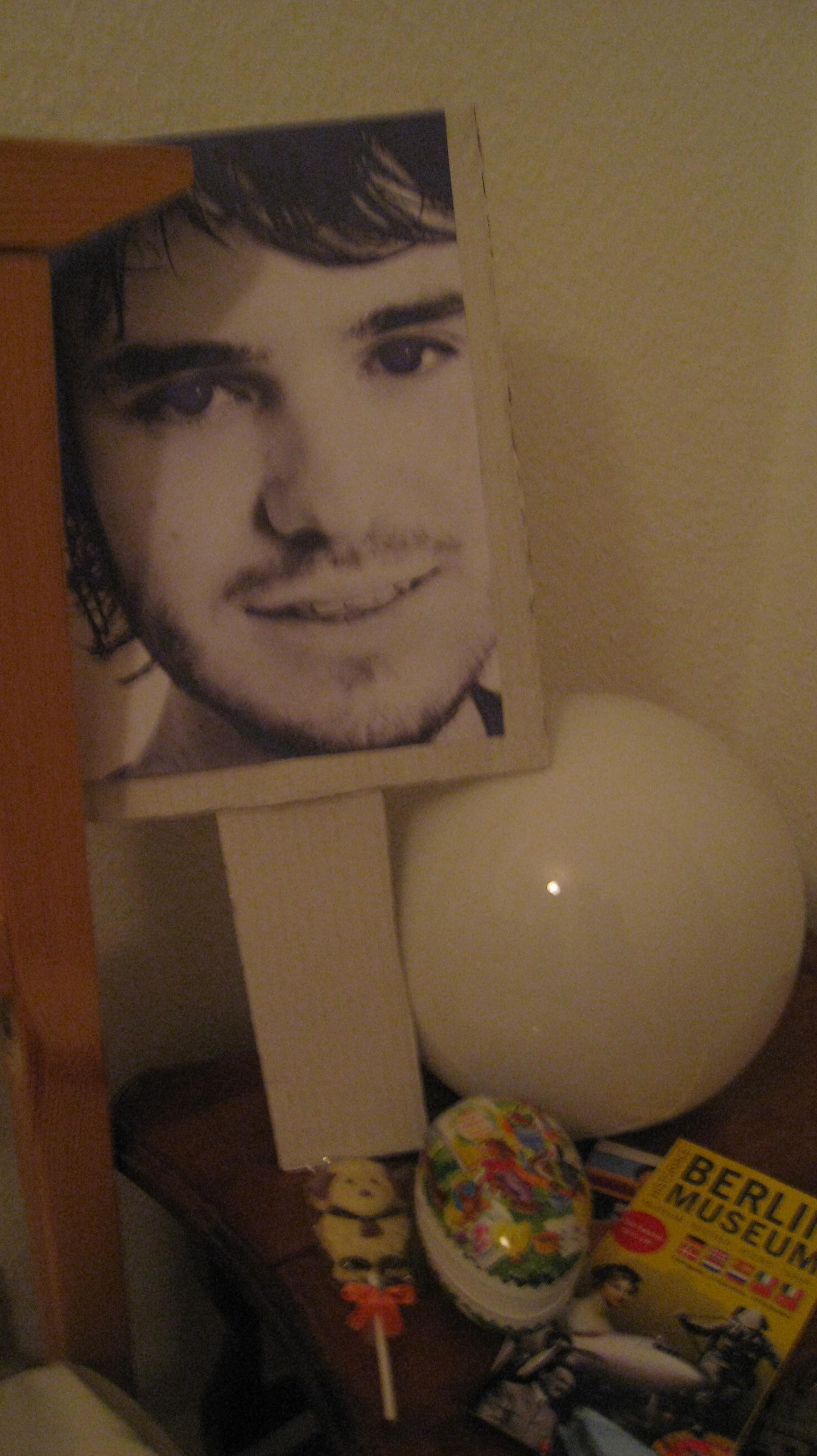
I decided to greet LSB at Schoenefeld airport with a placard featuring a blown-up picture of his own face. I had all the available equipment at hand: my flatmate’s high-quality printer, a cardboard box, which I had used to carry my groceries home, and some sellotape.

The evening of LSB’s arrival, my flatmate was welcoming friends to an “All-Male Poker evening.” Though he had included me on his invitation list, he had also apologised to his guests for my sex, adding that at least I could “make myself useful by serving beer.”

LSB placard and Easter-themed welcome gifts.

I responded by crafting a formal email during work, which I had checked and improved by a very obliging production assistant. Writing to all those included in the invitation list, I mentioned that it was with extreme regret that the Poker Evening would have to be cancelled since I had made a prior commitment to host a feminist congress at the address.

One of the advantages of being Irish and odd, is that when in a foreign country, the latter is often excused by the novelty of the first.

Unfortunately as the first guests were arriving I was in the kitchen, of all places, and even worse, cooking.

I was making LSB a potato and kidney bean bake to welcome him to my motherland. But I was doing so in a highly emancipated fashion.

Of course the scene delighted my flatmate, who ushered his friends in with insufferable smugness, pointing out that I was both a woman, and in the kitchen.

One of the guests greeted me with a smirk and said “Feminist Congress, yeah?”
I beamed at him.
“Thank you so much for coming!” I said. “The discussion topics are displayed in the room next door.”

He blinked.

“What?” he asked.
“You should have got my email,” I told him straight-faced.
“I did but I thought it was a j..”
“I really appreciate you coming,” I said. “It’s always hard to get men to agree to come to these kinds of events.”

His face dropped and I returned to the saucepan.

I left for the train station just as the “boys” were seating themselves at the “poker table.”

One of my favourite things about living in Berlin is my “Azubi” train ticket. With it, I can travel all around the city without having to tag on or off and it is valid on the weekends too, meaning I can whizz about exploring the city.

In the five weeks I have been here, I have not once been checked for a ticket.

As the train was pulling into the Shoenefeld stop, a group of four young men entered the carriage. They had chains and tattoos and shaved heads and suddenly one yelled “TICKETS, PLEASE”.

Ruffians, I thought.

Until one approached me.

I looked up at him, in his torn jeans and crumpled t-shirt and thought “Are you serious?”

But he had one of those machines.

I rummaged in my bag for my wallet and whipped out my Azubi ticket, complete with hideous photo ID.

His lip curled a little.

“Do you have an extension ticket?” he asked.

“A what now?”

“An extension ticket.”

“Em.. No?”

“The zones covered by this card were transgressed at the last stop,”he said.

“Oh! I had no idea,” I said, as the door opened and the voice announced “Last Stop.”

“I’m sorry,” I offered.

“Please show me your passport,” he said.

Mother of divine comedy, I thought.

At this point I was imagining LSB loitering forlorn in the arrivals hall, thinking I had forgotten him.

All I wanted was to get away from this most unpleasant man, and wave my placard.

“Where do you live?” he asked, still in possession of my passport.

I gave him the necessary details, and avoided the question about my “police-authorized address” by asking how I was supposed to have known that “extension tickets” existed.

I did all this in a most charming manner, hoping that he would consider me diminutive and not that bright.

He was having none of it and issued me with a €40 fine.

Clasping the little slip of paper and inwardly cursing him, I ran all the way to the arrivals hall.

I saw an elderly lady dressed in a green overall arrive and embrace her dog, who was on a lead held by her daughter, whom she ignored. Then an Irish businessman was greeted by a German Paypal employee.

And finally, LSB emerged from behind the screen.

I waved my placard madly.

He ran to me.

“Katzi!”

“Wilkommen in Berlin!”

“What on earth is this?” he gasped.

“Oh, just in case you’d forgotten what you looked like,” I murmured as I took him by the hand and led him to the ticket machine, where I bought an “extension ticket” for €1.50.

LSB reading my suggested itinerary for his first day in Berlin.

More on LSB in Berlin to come.

Snapshots of a Weekend in Berlin

Berlin is like one of those postcard strips which fold out to reveal a dozen snapshots. No matter how much exploring you have already done, each time you turn an unfamiliar corner, a little square, or a park or church will pop out at you. Here are some snapshots of my weekend, as I think back over it, wrapped in a blanket, with the cat at my feet, rolling a bouncy ball over the floor.

Friday night, 4.30 am Burger King, Friedrischshain

I am remarkably unaffected by the five shots of Kräuter Schnapps, one Amaretto and apple cocktail, and two bottles of beer I’ve consumed. But still, there’s nothing like a greasy bag of onion rings and packet of chips given the circumstances. The lady behind the counter has grey hair and steely eyes and a face full of resignation. I immediately feel guilty for being somebody that makes it worthwhile to keep Burger King open at this hour. I am exceptionally polite when I order. Behind me, two homeless men, with colourful floppy hair and both on crutches, are slurring their words as they address her co-worker, a stylish man with black eyes.

“Why don’t you point at the meal you want?”, he suggests, as if this is a standard cure for those who can’t articulate. The men look at the pictures of slimy bacon double cheese burgers and chicken nuggets and make a selection. “Would you like a drink with that?” the sever asks.

They can’t think of a response for this one. Suddenly I feel something against my leg. One of the men has started to prod me with his crutch. I jump to safety. His companion defends me:“Hey man, don’t do that, she’s a girl. Stop..”
As I am eating my onion rings, one of the men collapses. His burger flies to the ground. The cheese soaks into the dirty grey tiles.

Friedrichshain Park, Saturday, 3 pm

There are two enormous concrete elephants in the park. A little blonde girl is colouring them in with chalk. She’s not wearing any shoes, and her socks are pink. She’s totally engrossed in her task. She paints the elephant’s trunk green.

On the far side of the green, heart-shaped balloons tied to trees are dancing in a light breeze. A group of twenty-somethings are having a party. They’ve set up a little barbecue and are serving sausages and potato salad on paper plates. Suddenly they all put down their plastic forks to sing Happy Birthday to their friend.

A young man with a black pony tail and tired eyes is sitting on a bench, bent over his Border Collie, caressing it slowly, with a large brush. The collie stands patiently, looking straight ahead, bending its knees when required and responding instantly to the man’s gruff “Setzen.” There is tremendous dignity in the collie’s profile. It looks as though he is smiling politely, as large tufts of his black and white fur fall to meet the dusty ground. After several minutes, the man puts the brush away. The collie lifts his head to look into his owner’s face, with deference and expectation. “Na, geh,”the man with the tail concedes, and the collie, still for so long, now bounds away. He meets a Labrador on the way and they sniff each other’s bottoms.

image source: architectureinberlin.com


Sunday, 5 pm The Topography of Terror

Today, exploring the area around Check Point Charlie, I landed at a stretch of the original Berlin wall. A little sign revealed that this was the “Topography of Terror.” There was a visitor’s centre at the site. I went in. And I saw pictures of Jews being paraded round their hometowns wearing signs with words designed to humiliate them. And documents authorising handicapped children to be used for medical experiments. And I listened in to a guide, who was telling a school class about the big companies that had donated money to Hitler during the war.

Suddenly an old man, who had also been listening in, blurted out “I’m not responsible for what my father or grandfather did.”

The teenagers turned their heads.

“I’m innocent! It’s not my fault. I don’t even know if my father or grandfather did anything bad.”

“We’re not talking about blame,” said the tour guide, a curly-haired polyglot, whose first language was not German.

“I didn’t do anything wrong!” the old man repeated, in an accent I now recognize as Berlin, and which most people suppress, because they think it “undesirable.”

“Maybe we can talk about this later,” said the guide. The man stopped talking. The guide finished his tour and told the teenagers never to stop asking questions in order to find out the truth.

As the schoolboys trotted away, the guide approached the old man and shook his hand.
“I’m sorry,” said the old man.
“Don’t worry,” said the guide.
“I’m innocent,” said the old man, his face folded with guilt.

The Forbidden Fruit: Why Paul Begley Won’t Go To Hell

Paul Begley is 46, Irish and until recently, had a good job. He travelled around the world, packing fruit and vegetables into big crates. Then he shipped them to Ireland and sold them to supermarkets. If you wanted a good gherkin or an organic asparagus, he was your man. It wasn’t glamorous work but it paid the bills easily and allowed him to take on a few people. He donated money to children’s charities and liked getting involved in awareness campaigns like “Kids in Action.” Now he’s going to prison, because he pretended that his bulbs of garlic were apples. He’s going to stay there for six years, just in case anybody else gets the idea to mislabel their garlic.

The tone might be facetious but the facts stand: As Judge Nolan said as he was sentencing him, Paul Begley was a “decent man.” He was probably about as honest as the next person.

It’ll cost the Irish taxpayer around half a million euro to keep him in prison. For every bit of money you earn, a little portion of it will go towards keeping Paul Begley in his cell. If, as is likely, he gets depressed you might also end up contributing to the salary of a prison psychologist.

As he said himself, what Paul Begley did was wrong. He shouldn’t have put “apple” labels on boxes of garlic. He shouldn’t have avoided paying tax, because no matter how inordinately high the tax on garlic, as opposed to say its cousin, the onion, Paul Begley was not in a position to take the law into his own hands.

He admitted it. He helped the police with their inquiry. He agreed a mode of repayment. And still, he was sentenced to six years in prison. The harsh sentence made headlines around the world.

Prison is for people who are a threat to society when free. It is a practical, rather than moral solution to society’s problems. In reality it is neither about revenge nor rehabilitation. It is a preventative strategy, and nothing more.

The chances of Paul Begley reoffending are very slim. For one, he’s bankrupt. He has €1.6 million to pay back, probably with hefty interest. He’s been humiliated. There’s not a supplier in Ireland that doesn’t know his name. At 46, he’ll probably call it a day and retire to a modest orchard somewhere, where he will consider his crime, live a quiet life and try to make ends meet.

He is not a danger to society.

The following scenario is analogous to Paul Begley’s crime. Think about it and ask yourself on a scale of 1-10 how serious the offense.

Imagine you’re in your local supermarket doing the weekly shopping. You pick up a few loose onions and pop them into a bag. Then you grab a couple of garlic bulbs and put them in another. You plop the bag with the onions onto a weighing scales and press the picture with the onions on it. You collect the little label with the price and stick it to the bag. Then you do the same with the garlic, except this time, the price is 25 times as high.

“Eh, what?” you think. “That’s ridiculous! You look at your bags again. Feeling a little bit uneasy, you scrunch up the sticker you printed out for the garlic. You put the bag back down on the weighing scales, and pause. You feel a little uncomfortable, but you think “ah, sure feck it.”

This time, you press the picture of the onion. You pick up the sticker, which shows an amount 25 times less than the previous one and attach it to the bag. Sure onions are just obese garlics, you think as you make your way to the till, where the sales assistant scans the two bags through without a second glance.

Paul Begley has already lost his reputation. Putting him behind bars means that the tax payer loses out too.
As for the argument that the purpose of the ruling is to deter others from committing the same crime, perhaps we should consider first of all, why the authorities find it so difficult to keep track of customs fraud, and second, why the tax on Chinese garlic is up to 232 % while that on onions is 9%.

Image source: articles.businessinsider.com

“Thanks for the bailout”: Irish Celebrate in Berlin

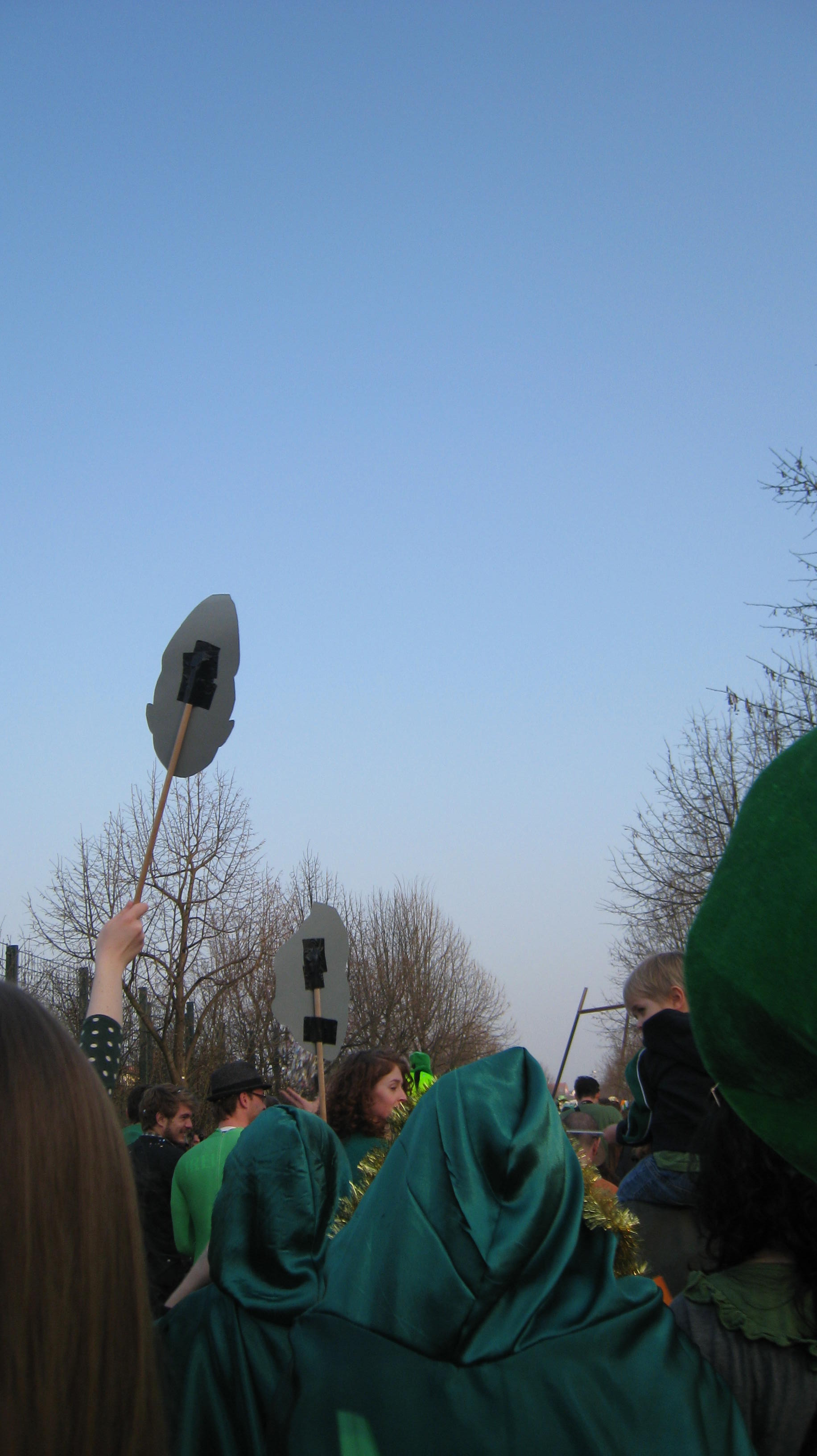
“Thanks for the bailout,” cried a girl in a leprechaun hat, holding a placard featuring Jedward.
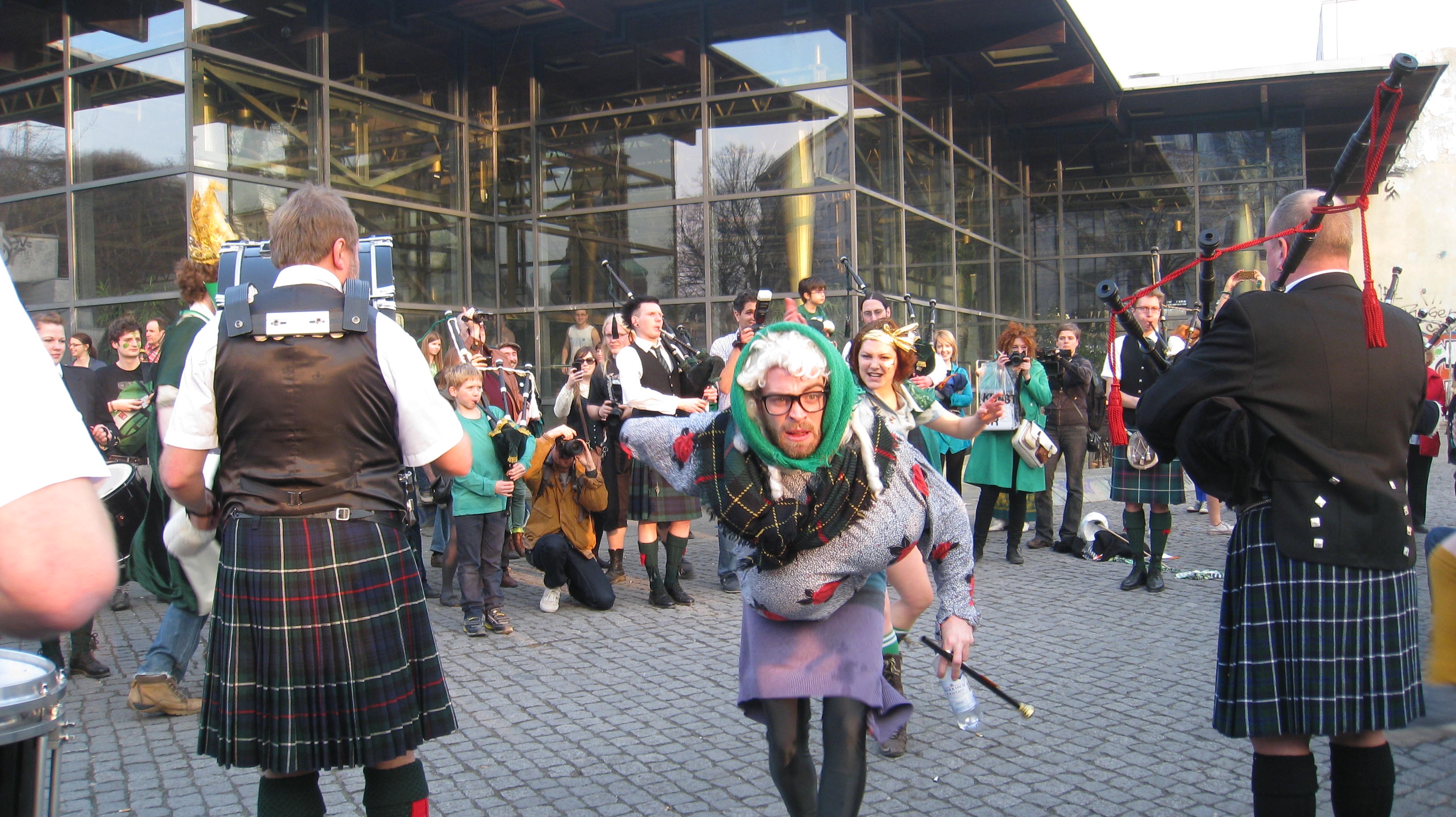
“Careful now,” yelled a boy at her, tooting his plastic horn. Ahead, the Berlin pipe band continued its drone and children dressed in Viking hats danced a jig.

It’s 4 pm in Goerlitzer Park in Kreuzberg, a district in west Berlin. The Irish “parade” is making a haphazard round of the park. “St Patrick,” tall, thin with a long brown beard and a wooden cane is in front. A paper dragon is floating beside him, held up by three girls in green felt, dressed as shamrocks.

I joined in just as the gathering entered the park. There were a few hundred Irish at least, bottles of Weissbier in one hand, and mini tricolours in the other.

Jedward featured in the parade.


Thick country accents initiated a rendition of “The Fields of Athenry,” which rippled a few rows up before it gave way to traditional songs I had never heard before.

I had no idea that there were so many Irish in Berlin. I was hoping for a similar-minded awkward loner, with which I could strike up a friendship. But it wasn’t to be. The people were already tipsy, and, dressed in leprechaun hats, moving only in large groups.

I found myself behind the Irish ambassador to Germany. Actually, when I come to think of it, thats’s just who I think he was. But, if circumstantial evidence stands, he was the only man in a suit and green tie with a well-groomed wife in an emerald outfit by his side.

Irish and Germans celebrate in Goerlitzer Park

Despite being lonesome on such a day of festivities, I went into a bar decorated with green paper shamrocks. I asked for a Berliner Weiss but they said “nicht hetute.” So I got a Guinness, for the day that was in it. It cost twice as much as the other beers, and tasted foul.

It came in a plastic cup, which I took back to Goerlitzer park.

I sat on top of a hill and watched the people around me.

Next to me was a group of six teenage boys. They were taking drugs of some sort. At one point two of them put their faces together, cupping each other’s mouths as if they were going to kiss in secret. They stayed like that for a few seconds and after, the blonde boy’s face broke into a gloriously pure smile, like that of an infant: ecstasy.

Berlin pipe band lift spirits


Lower down the hill, a couple was playing chess on a magnetic travel board. She had a long flowing skirt and three dreadlocks, and he was bald apart from a floppy green Mohawk hanging limp to one side.

A woman in a dirty black leather jacket and a face entirely obscured by scraggly hair, stumbled to the couple and asked “Hast du eine Zigarette?” The man had a bag of tobacco, which he pushed towards her. She fumbled in it and then flopped down beside the girl. The couple continued to play their game of chess. The woman in black began writhing beside them, and moving closer to the girl, until her head was resting on her lap. Every once in a while, she would raise her feet and kick the air.

When the couple had finished their game, they got up gingerly and said “tchuess” to their dosed-up friend.
She didn’t hear them, and lay alone, her head in the grass.

I finished my Guinness just as it was getting dark.

On the way home I got off at Alexander Platz, the former centre of east Berlin.

TV tower lit up in green

There I saw the iconic television tower, glowing green. I looked up at it for a while. Then I disappeared underground again and made my way home, where the cat was waiting for me.

On The “Erfolgserlebnis”

The word Erfolgserlebnis means experience of success but the usage in German is much more subtle than that.

If you win the lottery or get a great job, you don’t have an Erfolgserlebnis; you’re simply “erfolgreich”, or “successful.” But if you finish a particularly tricky Sudoku or make a delicious apple pie, you have an “erfolgserlebnis.”

My first erfolgserlebnis in Berlin was finding my hostel successfully. I am notorious for having no sense of direction. That’s still the case but because I was so anxious before I came here, I took extensive notes of the landmarks which I could expect to see when I got out of the Strassenbahn. When I then managed to find the hostel without difficulty by identifying the gigantic Fernseher Turm: the tower which was covered in mist that time I almost died while climbing the Victory Column I positively glowed with success.

My second erfolgserlebnis was finding out that there’s a marzipan flavour of Milka chocolate and that you can buy it for just 57 cent at Kaufland. I plan to stock up this weekend.

My third erfolgserlebnis was last Friday, when I had my first article published on Spiegel Online. I was convinced I would be the first intern not to have anything published so when the story came up and my ridiculous name appeared in the byline I was more than chuffed. I was smiling so stupidly on the U-Bahn on the way home that I had to hide my face in my scarf to avoid offending the other passengers.

On the way home that night I bought myself some raspberry flavour beer. Since making friends is still on my “to do” list, that evening it was just me and the cat.

Drinking beer in less challenging circumstances

After heating up some of my leftovers, I decided it was high time I settled down with some of the local brew.

Then, in one of my life’s more unfortunate epiphanies, I discovered I usually drink beer in company and often with with LSB, who is kind enough to open the bottle.

Now that I have become emancipated, I had to search helplessly for a way in to the promising brew.

I have seen cool people open beer bottles with their teeth, or by levering the edge of the lid against a counter-top.

I tried both these things. Then, remembering about the evolution of tools, I searched for a bottle opener.

I scoured the kitchen and then grabbed a little implement triumphantly from the drawer.

After several minutes, I realised that I was trying to open my bottle of beer with a garlic crusher.

This, dear readers, was not an example of an Erfolgserlebnis.

*********************************************************************************************************
For the anxious among you, I did eventually manage to find a bottle opener and savoured the raspberry beer all evening long. Would recommend.

How I missed out on visiting the Biggest Chocolate House in the World

This afternoon, a red-faced Berliner with a moustache reprimanded me for committing a traffic offense on Unter den Linden. My crime: staying put when I saw the red man.

I know that there are a lot of things I don’t understand. Many of them I have written about here before.

But of all the enigmas with which I have battled, nothing remains as clandestine as the reason for pedestrian traffic lights occurring at the same spot as a zebra crossing.

Granted I had been walking along the narrow central stretch of the beautiful tree-lined promenade, instead of the wide pavements designed for walkers, but I had good reason for it. From the middle, I had a wonderful view of both the Victory Column ahead, and the Brandenburg Gate behind.
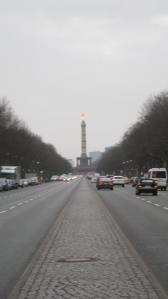
I had stopped with the intention of crossing over to have a look at the Russian war memorial. I almost pulled a muscle in my neck with all the looking left, then right, then left again I was doing. Ligaments have the right to rebel when called into use after periods of benign neglect.
It may have been a zebra crossing, but the light was red.

To be honest, I was charmed by the iconic red traffic man, with his wide hat and purposeful stance. Even if he had been green, I probably would have stopped to stare. Anyway, something about my immobility irked the balding motorist with whiskers sprouting from his nose. He beeped and growled at me as he drove past.

On I wandered down Unter den Linden anyway and turned off at the corner to have a look at the Schloss Belvue, the residence of the new Federal President, Joachim Gauck. On Monday, when I took a bus tour of the city, the lady guide quipped that it was Germany’s “White House”.
I found it pleasant to look at and unusually unguarded. You’d know it was a ceremonial role.

When I got to the end of Unter den Linden, I reached the Siegessäule or “Victory Column”. This monstrous tower was erected to celebrate defeats first against Denmark, then the Prussians and then Austria. I remembered that the guide had mentioned the number of steps to the top but I had promptly forgotten the number, which is in line with my tendency to not see the trees for the wood.

It didn’t matter. As I was climbing higher and higher up the spiral staircase, I considered the number to be infinite. With each loop, I looked upwards with expectation and to my horror found the distance yet to be conquered to be increasing.

At one point, I stopped and considered the possibility of failure. After all, if the column celebrated success over adversaries, I may as well be monument to its victory over foreign invaders.

As I was gazing upward into the infinite abyss, I embarrassingly caught the eye of a German champion who had made it and was gazing patronisingly downwards. Her laugh echoed down at me and I boomed a nervous one back.

As I climbed higher and higher I was struck powerfully by my absolute solitude. If I were to fall, nobody would know. The only people to accompany me during my last breaths would be a group of exuberant southern Germans too busy in the big smoke to care, and a Spanish couple, so visibly in love, with their linked arms and communal tickling, that my death might even pass them by.

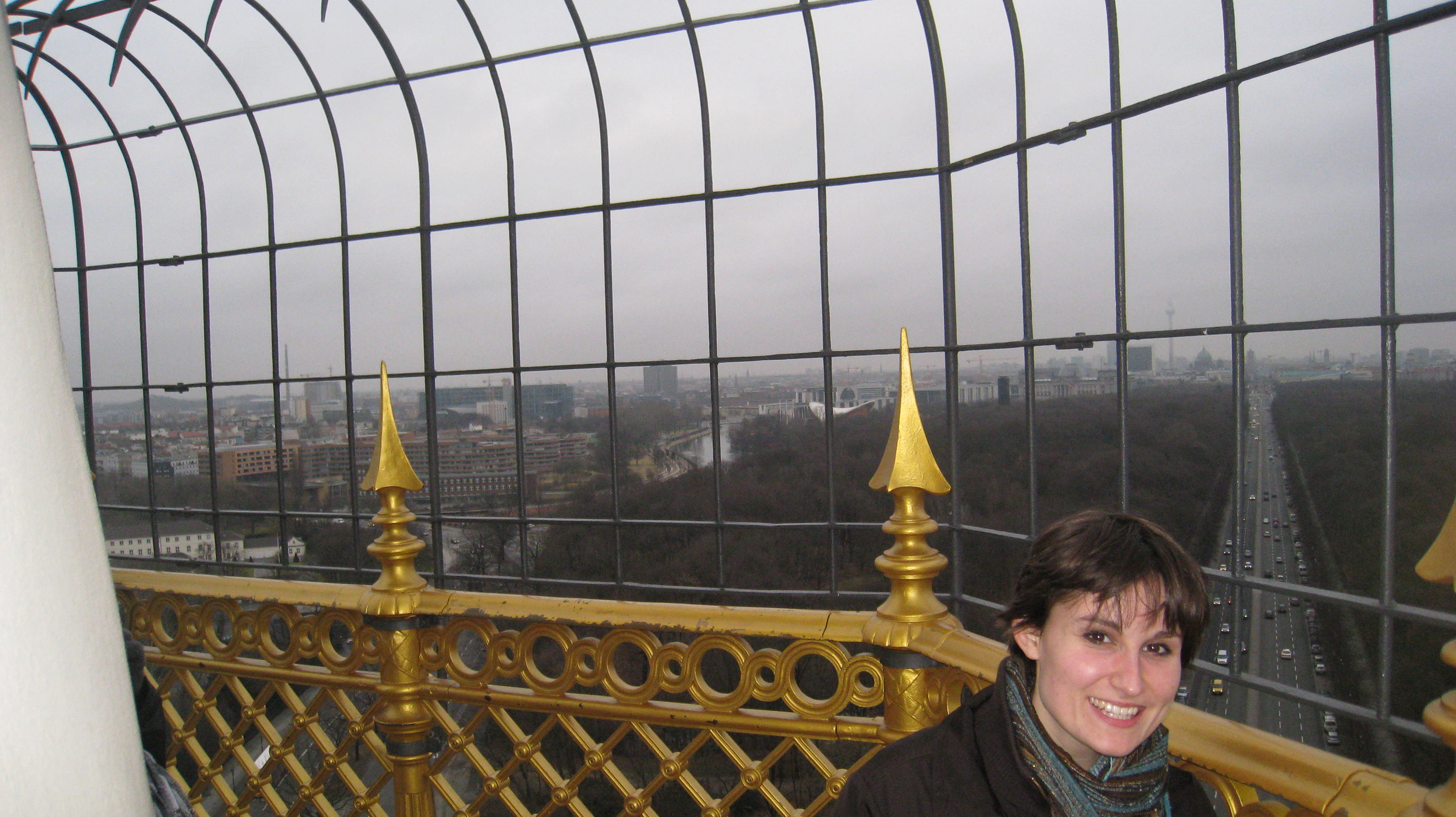
I huffed and I puffed and I made it. I had a breath-taking view of the city covered in mist. The TV tower to the east fought with the clouds and together they looked like a clumsy mass of candy floss.

Church steeples and colourful concrete blocks, and in between a glass dome, or a power station: the city’s skyline is a muddled testament to its troubled history.

I took a few photos and implored an Italian man to take my picture.
Sieger!

That’s the funny thing about travelling without companions; you’re much more forward about approaching people, even if you risk inferring that you wish to become a shareholder of Sparda bank.

After I had made it down safely, I sat at the base of the Victory Column and considered my next move. I could go to the Zoo, but I probably wouldn’t have time to see all of the 15,000 species of animals. Or I could go to the Pergamon museum, but I wouldn’t have time to look at every specimen of Athenian artefact on display.

So I thought I might as well head west back down Unter den Linden and check out the beautiful Gendarmen Square, which I had read about in my trusty guide.

Alas, that plan was destined to fail.

I had just reached Humboldt university when I spotted a bookstall set up outside. Given that I’ve a penchant for independent booksellers, I wandered over to browse the titles.

I picked up a hardback copy of Hermann Hesse’s Der Steppenwolf and a translation of Gabriel Garcua Marquez’ A Hundred Years of Lonelienss.

The vendor, a bearded man with glasses and wearing a black hat, took them from me and said: “Ich bin beeindruckt”.

I smiled. He had told me he was impressed with my selection.

This man reminded me of the type of person I thought I would miss from Ireland.

He was an unconventional and incessant talker, belligerent one moment and benign the next.

He talked to me about socialism and National Socialism, about Gunther Grass and Johann Goethe, about the student movement of the 1960’s, and about anti-Americanism; about a Japanese girl he had sworn at because she had dared haggle over a Hermann Hesse book and about a journalist at the Berliner Morgen Zeitung, who gives him hundreds of newly-released titles for free because he is inundated with copies to review.

The man was an intriguing blend of madness and intellect. His depth of knowledge on all matters of political, historical and cultural importance impressed me, his unflappable loquaciousness did not.

I was making polite one or two word responses to his tirade against anti-intellectualism, when a lady with a tight bun and pursed lips interrupted.

The direct translation of what she said was:

“Would you ever give me some attention and quit your incessant blabber about nothing?”

He didn’t so much as glance in her direction when he beamed at me and said “This lady thinks I talk too much. She’s right!”

I tried to make a dash as he was completing her transaction but he continued to speak,now about Theo Adorno, looking me directly in the eye.

It was getting dark.

“I would like to introduce you to my friend in the Berliner Morgen Zeitung”, he said. “I am absolutely certain he would fall instantly in love with you. He’s a very brilliant man; a philosopher”.

“That’s impressive”, I mumbled politely.

“He is in his sixties”, he added, by way of explanation.

After one hour and five minutes, he leaned over and shook my hand.
“You’ll come back, won’t you?”, he asked.

“Yes”, I said.

Because I feel his gift of the gab might be newsworthy.

When I returned home late this evening I told my flatmate what had delayed me.

“Why didn’t you just say you had to go?”, he asked.

“Because it was utterly impossible!”, I cried.

“Then you should have just thrown a book at him”.

To add to my woes, I saw someone on the U Bahn today with my totally unique Rittersport chocolate bag. And as if it couldn’t get any worse, I just googled Gendarmenmarkt and found that it is home to the biggest chocolate house in the world.

Banking Crisis in Berlin: A Special Report

I would like to set up a bank account in Berlin. So this morning I popped into the Sparda Bank on Georgenstrasse, where I’ll be working, and looked around for somebody to talk to. It was an odd kind of bank. There were several ATM machines and people milling about but there was an unusual formality in the air.

A man resembling a pencil caught my eye and glided over. He had a silver pen wedged into the pocket of his shirt and there wasn’t a crease to be seen in his pin-striped suit. He exuded pleasant authority.

“Hello” he said, “how can I help you?”
“Hello! 🙂 I’m new in Berlin and I’d like to open a bank account. Are you the right person to talk to about this?”
“Potentially”, he said, “though I’ll see if one of my colleagues can help you. Please take a seat”.
“Thank you!”

I sat down opposite a round-faced man with tufts of thick blonde hair. He was reading the Spiegel. My heart did a little skip.

Posters of grinning middle-aged men in flashy cars and attractive women getting massages in exotic surroundings were pinned to a display board advertising loans. A coloured graph showing the values of shares going up and down was captioned “Values always rise after a financial crisis”.

After some time, a lady came to me. “If you’re ready, Madam, I’ll take you this way”.
My Goodness, I thought. What service. You don’t get this in the Trinity Branch of Bank of Ireland.
She led me into a little chamber, pulled out a chair for me and said, “Please take a seat”.
I shuffled in and got my feet tangled in my bag.
“Could I get you something to drink?”
Something to drink? I thought. Sweet Mother.. How long does she think I’m staying?
“No thank you”, I replied brightly, compensating for my bewilderment with excessive friendliness.
“Now”, she said, “tell me about yourself”.
“Well” I started, “I’ve just moved here from Ireland and am going to do an internship with Spiegel for three months. I’m not sure how long I’ll stay after that but I would like to have access to money from a German account if it’s possible”.

Her face changed. Suddenly she looked both panicked and apologetic.
“I’ll have to check with my colleague. Please wait”.
“Sure”, I said.

I twiddled my thumbs.

She came back.

“I’ve discussed the matter with my colleague. We feel that this might not be the right bank for you”.
“Oh really?”
“Your plans are a little vague. We require our customers to hold onto an account for a minimum of one year”.
“Ah, I understand”, I replied.
“Furthermore, when you open a bank account with us, it is mandatory to become a shareholder of the company”.

I gulped and tried to smother laughter.

Had I just attended an important business meeting with an investment banker?

Yes, I had.

There was nothing for it but to head to the Brandenburger Tor.

Next stop: Brandenburger Tor

**********************************************************************************

PS – My day was very eventful so I might blog again later if I’m not being a superhero in the hostel kitchen.

Thoughts on leaving Ireland: Why emigration is my lifestyle choice

This time two weeks, if everything has gone to plan, I’ll be sipping beer alone in an east Berlin hostel.

I’m leaving Ireland for a few months to do an internship at Spiegel International, the English version of Germany’s Der Spiegel.

I’m one of the people Michael Noonan was referring to when he talked about emigration being a “Lifestyle choice”.

I intended to emigrate when I graduated in 2010 but I couldn’t afford it. After I did a TEFL course, which my parents paid for, I was lucky enough to get a job at the school where I trained.

I have loved this job and were I not young, passionate about writing and curious about the world I would do well to keep it.

I don’t agree with Eamonn Dunphy that Ireland is a dump. I agree with George Hook that this country gave him a “bloody good living”.

If we were in the middle of an economic boom I’d be in more of a rush to leave.

Because moving shakes you up, allows you to meet people that challenge how you think and forces you to define yourself within new parameters.

I’ve lived in the same house for 24 years. I know its every nook. When I come home, my father is where he is supposed to be. As I push open the gate, I look in the window and see the back of his head and his arms outstretched. From behind, it looks like he’s made a tent out of the Times newspaper and is holding it stubbornly in place because he has run out of pitching pegs. I hear clinks of plates in the kitchen. I smell his butter beans beginning to burn. I find my mother’s school-bag in the hall and hear her practising the Alto part to the piece of music she is singing in choir. When I come into the room she turns from the piano and tells me an amusing story about one of her pupils or something that she saw on the way to school.

In the mornings, I wake up and Áine Lawlor’s voice is like wind, willing me out of bed. All I can think about is how warm I am in my onesie and how early Áine must have to get up every single day. After a while I feel ashamed and curl into a foetal ball and roll out of bed.

As for the the three men that are in my life but that don’t know it they won’t miss me one bit.

I saw the man with long blonde hair and pools for eyes again today. His head was pushing down Harcourt Street, like a hound in slow motion. Last week I bought the Big Issue from a Romanian women in Rathmines, instead of from my friend outside Trinity. I haven’t seen him in a while but if I do, I will buy another copy. LSB has promised that he will buy each new issue from him while I am away. I know he will, because he always keeps his promises. And if he forgets, my face will appear on his computer screen as soon as he signs into Skype and I will ask him why he hasn’t done it yet. I am charming like that.

I’ll miss town on a Saturday. My vegetarian breakfasts at Cornucopia, where I spy on people who have nice haircuts, pretty coats and carry pocket books. I’ll miss John Gormley’s neat head and chiselled chin, which you can see in a frame hanging on the wall. I’ll miss the flea markets and co-ops which are beginning to blossom like a shy bride all over the city. I’ll miss the silent Falun Dafa-practising protesters, who stand around banners at Stephen’s Green with their eyes closed, drawing shapes in the air, uncannily in sync.

After the terrible things I have said about it, I’ll miss O’Connell Street. I’ll even miss the towering superfluous spike. Sometimes when I’m whizzing along on the U-Bahn gobbling up breaking news, I’ll think back to the times I felt sad when I passed the alcoholics who drank inside the pubs on Parnell Street at half eight in the morning. I’ll think back to Wednesday mornings, which are Dole days in the north inner city. I’ll remember the sorry queue of hunched figures in tracksuits waiting to get into the little green post office.

Sometimes, I’ll yearn for those moments when you’re waiting at a bus stop or sitting on a park bench and an old man or lady looks at you a little longer than they should and then decides that you are a safe person and talks to you about the weather or the recession or about when the bus should arrive.

I’ll miss the men and women who work in the charity shops on Camden Street and the type of lady that I overheard last week in the Cancer Society shop telling a customer that she couldn’t win an argument, let alone the National Lottery but that it doesn’t stop her from dreaming.

I will miss the -often irrational- indignation of the callers on Liveline. I will miss the ceaseless banter and inoffensive drizzle and the feeling I get of being a 1930’s maiden any time I’m in Neary’s Pub.

But I’ll be back. And I’ll have learnt how to live with a cat despite my prejudices and what it’s like to write to live instead of to live to write.

I might just have managed to see out my Quarter -Life Crisis. but I’m not promising anything.

And I’ll be blogging so that you can come to Berlin too, if you like.

*********************************************************************************************

Tomorrow is Valentine’s Day. E-mail me privately with suggestions as to how to get LSB back for last year.

If you’re on Facebook and want to join in on some chats, you can “like” Katekatharina’s page.

What septic tanks and education have in common

I’ve spent three-quarters of my life being educated and the last two years educating others.

Since I began school at the age of four, I’ve associated education with evaluation.

First it was stickers and stars and rubber stamps. These evolved into report cards with little boxes beside the words: poor, fair, good, very good and excellent. Next came the letters of the alphabet: A, B and C. Then fractions and percentages arrived and after that, points. At university, marks were converted into classes and you could be first, second or third.

Compulsory education – like the septic tank- originated in the nineteenth century. While both aged tolerably well, of late they have begun to fail us.

image source: insectapedia.com


After all, as Ken Robinson, an educational theorist points out, the current system of education was conceived in the intellectual era of the enlightenment and the economic context of the industrial revolution.

Like the septic tank, it has failed to keep up with the times, often producing impenetrable sludge before practical distillation.

(If you need proof, try understanding what on earth academics writing in humanities journals are trying to say).

It’s not that our education is of poor quality. It’s not that we have bad teachers, or unmotivated students. They never help but they’re neither unique to this period nor the cause of the problem.

The real issue is that we haven’t decided whether education is a journey focussed on itself or on its destination.

Let me explain.

Up to recently, education was a means to an end. You walked out of school and into the workplace. If you went to university and got a first class degree, you got a first class job.

Now things have changed. We have too many people educated in areas with too few jobs.

The difficulty is that we still believe that the higher your educational level, the loftier your career expectations should be.

Of course it’s a prospect that many are failing to realise.

Now, if you get a first class degree, you take your place among all the others and compete for any old job.

It’s a case of social progress outrunning institutional reform.

You could see the situation as a social leveler. Now unemployment is for everybody, not just the least privileged.

Some students spend twenty years collecting stamps and stars and letters and numbers.

And then they find that the numbers don’t add up to a job.

Their experience calls into question the very purpose of evaluation.

The transition from pupil to teacher has taught me that evaluating students is rather arbitrary. It doesn’t measure very much at all.

But we’re hooked on comparison. We get frustrated if our own evaluation can’t be backed up by a standard measurement. If we think we’re better than the person next to us, we want it neatly before us in percentage form.

I guarantee that in a secret ballot, students wouldn’t vote out tests and exams.

Science backs it up. Research has shown that the pleasure circuits are activated in advance of finding out a result.

We thrive in conditions of uncertainty.

Waiting for a test result is like waiting to see if you have won in Poker. Ultimately neither tells you how well you have played or how much you have learnt, but rather how well you have performed relative to others.

It’s time we took a step back though.

The right to education is one of the great privileges of our age. While its original and most important purpose-to lay the foundations for economic subsistence- has been eroded by the unprecedented pace of progressive reform relative to growth in employment opportunities-we must take time to remember what has been so long neglected: the timeless, immeasurable pleasure of learning for its own sake.

Could it be that indulging ourselves in constant measurement against others is doing us more harm than good?

Andrew Bird, an American folk singer condenses the possibility beautifully in the song “Measuring Cups” which opens:

Get out your measuring cups and we’ll play a new game. Come to the front of the class and we’ll measure your brain. We’ll give you a complex and we’ll give it a name.

This generation, more intensely than any other before it, has experienced education as a closed system of incessant measurement.

For many that measurement has not amounted to more than restlessness and disillusion.

Learning for its own sake has been forgotten amidst the obsession with making ‘it’ which means ‘making money’.

If teaching has taught me one thing, it’s that the responsibility to evaluate is nothing compared with the possibility to inspire. My job is to encourage before it is to instruct.

Pupils are not watering cans: we can’t fill them up without their consent. They must want to learn, not in order to get a good job or to become rich or to sound clever, but because, as Merlin in T. H. White’s The Once and Future King reminds us, “it is the only thing that never fails”.

I have the following words pinned to my bedroom wall:

“You may grow old and trembling in your anatomies, you may lie awake at night listening to the disorder of your veins, you may miss your only love, you may see the world about you devastated by evil lunatics, or know your honor trampled in the sewers of baser minds. There is only one thing for it then, to learn. Learn why the world wags and what wags it. That is the only thing which the Mind can never exhaust never alienate, never be tortured by, never fear or distrust, and never dream of regretting. Learning is the thing for you”.

Equipped with this original joy of learning, and a quieter, more humble confidence, our young people may be more inspired to carve an independent niche on the side-lines rather than enter the desperate rat-race of out-performance.

Let’s make our recovery less sludgy than a septic tank. In remembering why education matters for its own sake, we avoid throwing the baby out with the bathwater.