A Tale of Domestic Disaster

Some people seem to think that my life in Berlin is all fun and games — that if I’m not grilling Angie in the Bundestag or accompanying a world-famous TV crew, I’m at the Brandenburg Gate having a laugh on the John Murray show.

Yesterday on my way home from shopping, a large carton of vanilla and blueberry ice cream melted in my bag, trickling through a crack in the lid, onto all the other food and covering my wallet and its contents in a sweet-scented white foam.

Then, as I was unpacking my shopping, my best buy, an enormous glass of Nutella (25% extra free), slid out of my hands and smashed into scores of pieces.

Shards of glass glittered on the kitchen tiles.

I used a tea spoon to separate the Nutella from the larger pieces of glass and after a quarter of an hour, was satisfied that the majority of the chocolate spread had been salvaged. I spooned it into an old jar that I found in my Recycle heap.

Then I realised that I was bleeding profusely.

A deep, clean gash had appeared in my middle finger.

Now I had ice cream on my jumper, Nutella in my hands and hair, and my blood was trickling onto the counter-top.

I took a deep breath, cleaned myself and tripped over a loose onion.

Then I boiled some millet. I was in a TV studio last week watching a health and fitness show being filmed and the guest doctor was advocating a low sugar wholegrain diet. I resolved to reform.

The millet bubbled over.

I added tomatoes, spring onions and a yellow pepper, but the taste of blandness was poorly disguised.

I ate the modest meal on my little balcony, listening to the birds sing and with the sun in my face.

I decided to go to the cinema.

I watched a French film about a couple whose baby has a brain tumour.

On my way home, I passed a fruit market. A Turkish vendor was crying hysterically “LAST OFFER!! ONE EURO FOR A PUNNET OF STRAWBEEEEEEEEEEEEEEEEEEEEEERIES”

I bought one.

When I got home, I dropped several strawberries on the kitchen floor.

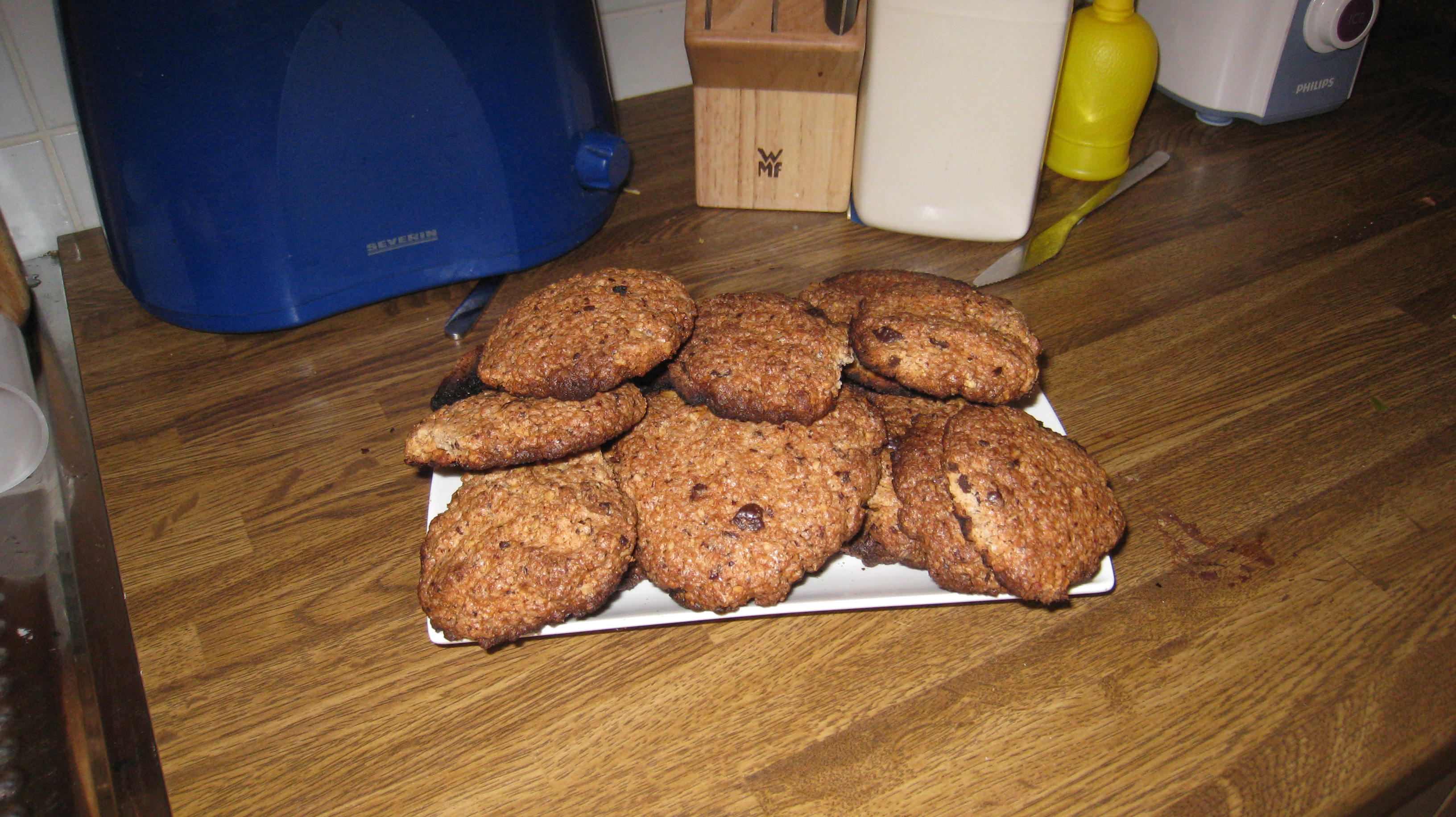
Later that evening, I decided to make German oatflake chocolate chip cookies. My father had kindly scanned an ancient page from my mum’s recipe book and I had all the ingredients to hand. I would have shown my national pride more traditionally by watching the match, but I could not figure out how to turn on my flatmate’s television.

My Mama’s Secret Recipe Revealed to the Masses

I weighed and mixed and stirred and ground and moulded the dough into little balls. I put them into the oven, cleaned the kitchen and breathed a sigh of relief.

I decided I deserved a treat.

I got out my vanilla and blueberry ice cream (all had not been lost there either), chopped up some strawberries and added a couple of scoops of Nutella.

The first mouthful was divine. Then I tasted glass and I had to spit out little shards, one at a time. This morning, I had two German oatflake chocolate chip cookies for breakfast. They were burnt.

Domestic Disaster

Burnt Biscuits

“Have you ever had a wet arse, Herr Schafner?”

The intercom on the slow train from Hof to Leipzig crackled. I slid my suitcase onto the seat next to me and took out my tattered book. A man’s voice spoke with perfect diction:

“For the attention of passengers recently boarded: Due to an act of vandalism, the lavatory at the back of the train is out of order for the foreseeable future.The damage has been caused by a blockage of material which is considered unsuitable for a toilet. Those passengers with the desire to make use of facilities must venture forth to the front of the train where an alternative lavatory is available. However, said lavatory may only be used while the train is stationary. Those with questions about this issue are advised to approach train personnel. I on behalf of Deutsche Bahn apologise for this minor inconvenience…”

The old lady across from me began to chuckle. The voice continued.

“To summarise, of the two available toilets on board, the one primarily intended for ordinary passengers is currently defective. An alternative loo may be used provided the train is not moving. Such a situation occurs at times when the train stops at stations along the route. I, on behalf of Deutsche Bahn apologise for this occurrence, which is the result of vandalism.”

Suddenly an enormous Saint Bernard, approximately the size of a small pony, bounded down the corridor. It paused briefly to greet my knee with its expansive snout.

“LOTTA,” a voice yelled behind the dog. A woman with a limp peroxide pony tail hanging from an otherwise shaven head stumbled past me. She was wearing dungarees and smelt strongly of beer.

“COME BACK, LOTTA,” she yelled. She clicked effectually and the gigantic hound returned. The woman grabbed it by the collar. Then she let out an almighty roar. “MY BEER!!!”

On the seat directly behind me, a bottle of beer had unturned. Liquid brew was seeping into the cover and a trickle of beer was making its way towards my feet.

The woman began to scream. “MY BEER. I PAID FOUR EUROS FOR THESE BOTTLES AND I’VE ALREADY LOST THREE. I FUCKING HATE DEUTSCHE BAHN. WHY ARE THEY DRIVING CRAZY LIKE THIS?I CAN’T BELIEVE THEY KNOCKED OVER MY BEER WITH THEIR CRAZY DRIVING. THOSE SONS OF BITCHES DON’T KNOW WHAT’S COMING TO THEM.”

The slow train continued gently through the rolling Franconian countryside.

Her drunken companion entered the carriage. If he had been cleaner and less intoxicated he could have passed as a hipster. He was barefoot, in blue jeans and black horned glasses. And he had a beard.

“Woah,” he said, holding on to their second dog,a kind of grey hound.

The woman with the rat’s tail stumbled to the toilet to get some tissues. A terrible scream followed.

“THIS TOILET IS BLOCKED. WHAT THE HELL? I NEED TO PISS”

This refrain (“Ich muss pissen” in the vernacular) became a recurring motif.

At this point, the old lady who had been chuckling made a tactical move which I was to envy for the next two hours.

She turned to them and said sweetly, “Would you like to sit here? My seat is nice and dry.”

They responded indecipherably in the affirmative. The old lady grabbed her bags and disappeared.

The woman with the rat’s tail sat on the wet seat and jumped up, disgusted. “MY TROUSERS ARE WET,” she yelled.

Her companion, who was bent over the more demure hound, who had managed to fall asleep, began to laugh.

“WHAT’S THERE TO LAUGH ABOUT?” she yelled, pressing her nose against his face. “DO YOU HAVE A NASSER ARSCH?” (wet arse)?”

He was silent.

“Well DO YOU?” she repeated.

He said nothing. She moved away, and summarised her plight.

“I HAVE A WET ARSE AND NO BEER AND I NEED TO PISS.” She took a breath. “Just wait until that conductor comes,” she said, seething.

For the next forty-five minutes, I pretended to read East of Eden while the intoxicated couple discussed sending a letter of complaint to Deutsche Bahn for not providing drinks holders. The woman said she would demand a reimbursement for her beer.The man said that the “welfare state” was retarded. And that the bastards were getting richer, while their welfare was going down.

“GENAU,” (“exactly”) cried the woman.

The woman said she had once been issued a handicapped pass. But that it was the System, rather than herself that was handicapped.

Image source: db-loks.de

The man blamed the System for not providing windows in the carriage that he could open. He took it personally and said “don’t they fucking trust me to open a window? That’s how far we’ve come. Germany is a joke”.

A little while later, a Schaffner with a neat haircut, a Deustche Bahn uniform and an emphatic walk made his way to our compartment. “Tickets please?” he said to the passengers down the way.

The Saint Bernard, who had been lapping up beer close to my feet bounded free again. The woman slunk away and the man said “HEY, LOTTA. Oh MANNO, Lotta not now.”

The Saint Bernard returned and the conductor pretended he had not noticed.

He approached the man with a hearty “Good Afternoon!” in the effusive manner which I too employ in an effort to mask my preconceptions.

The woman burst into the carriage and brought her red face very close to the conductor’s.

“What. the. FUCK is wrong with the toilet?” she screamed. Do you never need to TAKE A PISS?”

His lips flickered, indignantly.

“Madam. I made a clear announcement to the effect that one of our toilets was defective,” he said. “I explained that due to an act of vandalism, a blockage had occurred.”

I turned to the window to hide my laughter.

He continued.”To be more precise, some aluminium foil has been dropped down the toilet by unknown perpetrators. This led to the blockage of the system. It costs three thousand euro to get a Deustche Bahn toilet re-fitted.”

“I don’t give a shit,” said the woman. “Do you have a wet arse?”

“I believe you have a wet “arse,” as you refer to it because you have consumed an excessive amount of beer,” said the conductor, in the style of a revelation and with an accompanying satisfied smile.

The almost-hipster intervened.

“We really need to discuss the issue of drinks holders,” he said with tactful measure. “We’ve lost a lot of beer. And we spent four euro on it.”

“That seems like too much,” agreed the Schaffner.

The conversation meandered from the aggressive to the sublime. The Schaffner responded to queries about Deutsche Bahn’s “blatant discrimination” against those with invalid tickets and explained again about the aluminium foil.

The woman with the rat’s tail let out an occasional roar but was calming down, like both her hounds, who were now in a hazy stupor at her feet.

Her companion produced some kind of ticket, which the Schaffner accepted before moving on and wishing them a nice day.

Three minutes later, the intercom crackled. The Schaffner’s voice spilled once again into the carriage.

“For the attention of passengers recently boarded: Due to an act of vandalism, the lavatory at the back of the train is out of order for the foreseeable future.The damage has been caused by a blockage of material which is considered unsuitable for a toilet. Those passengers with the desire to make use of facilities must venture forth to the front of the train where an alternative lavatory is available. However, said lavatory may only be used while the train is stationary. Those with questions about this issue are advised to approach train personnel. I on behalf of Deutsche Bahn apologise for this minor inconvenience…”

“Fucking fat cats,” said the woman sleepily.
Thoughts on leaving Ireland: Why emigration is my lifestyle choice

This time two weeks, if everything has gone to plan, I’ll be sipping beer alone in an east Berlin hostel.

I’m leaving Ireland for a few months to do an internship at Spiegel International, the English version of Germany’s Der Spiegel.

I’m one of the people Michael Noonan was referring to when he talked about emigration being a “Lifestyle choice”.

I intended to emigrate when I graduated in 2010 but I couldn’t afford it. After I did a TEFL course, which my parents paid for, I was lucky enough to get a job at the school where I trained.

I have loved this job and were I not young, passionate about writing and curious about the world I would do well to keep it.

I don’t agree with Eamonn Dunphy that Ireland is a dump. I agree with George Hook that this country gave him a “bloody good living”.

If we were in the middle of an economic boom I’d be in more of a rush to leave.

Because moving shakes you up, allows you to meet people that challenge how you think and forces you to define yourself within new parameters.

I’ve lived in the same house for 24 years. I know its every nook. When I come home, my father is where he is supposed to be. As I push open the gate, I look in the window and see the back of his head and his arms outstretched. From behind, it looks like he’s made a tent out of the Times newspaper and is holding it stubbornly in place because he has run out of pitching pegs. I hear clinks of plates in the kitchen. I smell his butter beans beginning to burn. I find my mother’s school-bag in the hall and hear her practising the Alto part to the piece of music she is singing in choir. When I come into the room she turns from the piano and tells me an amusing story about one of her pupils or something that she saw on the way to school.

In the mornings, I wake up and Áine Lawlor’s voice is like wind, willing me out of bed. All I can think about is how warm I am in my onesie and how early Áine must have to get up every single day. After a while I feel ashamed and curl into a foetal ball and roll out of bed.

As for the the three men that are in my life but that don’t know it they won’t miss me one bit.

I saw the man with long blonde hair and pools for eyes again today. His head was pushing down Harcourt Street, like a hound in slow motion. Last week I bought the Big Issue from a Romanian women in Rathmines, instead of from my friend outside Trinity. I haven’t seen him in a while but if I do, I will buy another copy. LSB has promised that he will buy each new issue from him while I am away. I know he will, because he always keeps his promises. And if he forgets, my face will appear on his computer screen as soon as he signs into Skype and I will ask him why he hasn’t done it yet. I am charming like that.

I’ll miss town on a Saturday. My vegetarian breakfasts at Cornucopia, where I spy on people who have nice haircuts, pretty coats and carry pocket books. I’ll miss John Gormley’s neat head and chiselled chin, which you can see in a frame hanging on the wall. I’ll miss the flea markets and co-ops which are beginning to blossom like a shy bride all over the city. I’ll miss the silent Falun Dafa-practising protesters, who stand around banners at Stephen’s Green with their eyes closed, drawing shapes in the air, uncannily in sync.

After the terrible things I have said about it, I’ll miss O’Connell Street. I’ll even miss the towering superfluous spike. Sometimes when I’m whizzing along on the U-Bahn gobbling up breaking news, I’ll think back to the times I felt sad when I passed the alcoholics who drank inside the pubs on Parnell Street at half eight in the morning. I’ll think back to Wednesday mornings, which are Dole days in the north inner city. I’ll remember the sorry queue of hunched figures in tracksuits waiting to get into the little green post office.

Sometimes, I’ll yearn for those moments when you’re waiting at a bus stop or sitting on a park bench and an old man or lady looks at you a little longer than they should and then decides that you are a safe person and talks to you about the weather or the recession or about when the bus should arrive.

I’ll miss the men and women who work in the charity shops on Camden Street and the type of lady that I overheard last week in the Cancer Society shop telling a customer that she couldn’t win an argument, let alone the National Lottery but that it doesn’t stop her from dreaming.

I will miss the -often irrational- indignation of the callers on Liveline. I will miss the ceaseless banter and inoffensive drizzle and the feeling I get of being a 1930’s maiden any time I’m in Neary’s Pub.

But I’ll be back. And I’ll have learnt how to live with a cat despite my prejudices and what it’s like to write to live instead of to live to write.

I might just have managed to see out my Quarter -Life Crisis. but I’m not promising anything.

And I’ll be blogging so that you can come to Berlin too, if you like.

*********************************************************************************************

Tomorrow is Valentine’s Day. E-mail me privately with suggestions as to how to get LSB back for last year.

If you’re on Facebook and want to join in on some chats, you can “like” Katekatharina’s page.

“Welcome to life at The Irish Independent” – how Ireland’s best-selling newspaper embraced “L’Ethica dela New of the World”

Print journalists need three things.

First, a passion for the truth, second a concern for people and third a reasonable command of language.

For those that haven’t heard, on Wednesday Ireland’s best-selling daily newspaper The Irish Independent printed an article about a Polish lady living in Ireland.

image source: broadsheet.ie

The source of their piece was the Gazeta Wyborcza, a Polish newspaper, which had been running features about life in recessionary Europe.

In the original article, “Magda” spoke about her life in Ireland and the state benefit she has received since losing her job.

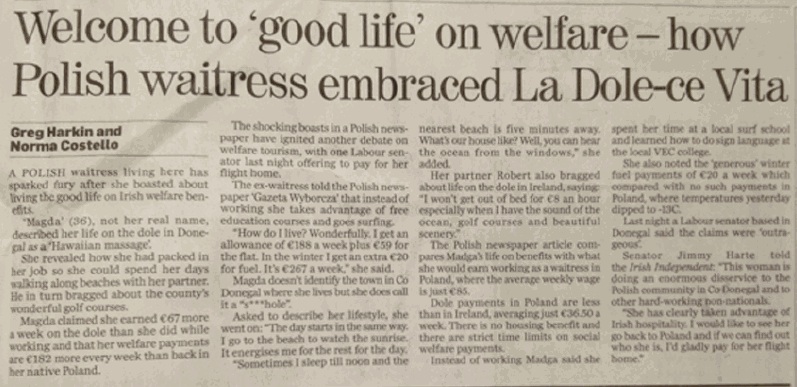
The Irish Independent titled its piece “Welcome to ‘good life’ on welfare: how Polish waitress embraced La Dol-ce Vita”.

In the original Polish article, Magda says of being on benefits: “I don’t want to live off the state, that’s why I treat the benefits as an aid, which will help me to start my own business.”

On budgeting, she says:

“Once every two months I pay for electricity, that’s around 100 euro. I cook at home, I don’t go out to restaurants. I go to the market where I can get local products cheaper than in a shop. I look for special offers in Centra – for example 6 rolls for 1.50 euro. … I buy my clothes in Penney’s … but not too many, because I don’t have the need to glam myself up. My latest buys: yoga sweatpants for a euro, trousers for 7 … I buy my shoes in TK Maxx – max 10 euro per pair. In the autumn I get a winter clothing allowance … I look for books in a charity shop. Look: ‘The Jungle Book’, ‘Robin Hood’, ‘Out of the Silent Planet’ by C.S. Lewis – all three for 2.50 euro.”

The Independent article reads “A Polish waitress living here has sparked fury after she boasted about living the good life on Irish welfare benefits”

Magda’s welfare benefits entitle her to take courses to increase her skills. According to the original article, “Magda can do a basic massage, a Hawaiian one and a hot stone one that she’s learnt at a free course organised by the social welfare office.”

The Independent’s version reads “‘Magda’ (36), not her real name, described her life on the dole in Donegal as a ‘Hawaiian massage’”. It also claims that she “revealed how she had packed in her job so she could spend her days walking along beaches with her partner” and sometimes sleeps till noon.

The original says ““I always start my days in the same way: I go down to the beach to see the sunrise. It sets me up for the rest of the day. I used to sleep until noon, but now I don’t want to waste my life.”

The Independent quotes Labour senator Jimmy Harte, who describes the claims as “outrageous” and adds that he’d “gladly pay for her flight home”.

Thanks to the John Murray Show on RTE, which commissioned an accurate translation of the text, the Irish Independent has been exposed for falsification and misrepresentation.
Its response today was tragic and even comical:

“YESTERDAY’S story about a Polish woman living on welfare payments in Ireland sparked much discussion and controversy.”

It could have been a parody on its opening from yesterday which claimed that the same story had “sparked fury”.

Its only admission of wrongdoing is the acknowledgement that “Some parts of the original interview, on which the story was based, were inaccurately translated.” It then provides a translation of the original, which it describes as “fuller”, as if its version had been missing body rather than fact.

It may seem obvious but to journalists Greg Harkin and Norma Costello it was not: the function of a newspaper is to offer responses to real events rather than elicit reactions to fabricated ones.

Even more obviously perhaps, newspapers are not storybooks. We expect them to tell the truth.

News reporting is retrospective, not prescient. It cannot claim something before it has happened.

If a Polish lady’s claims have “sparked fury” and “ignited a debate about welfare tourism”, we need evidence beyond the comments of an unfortunate local Senator who has been lied to.

Should Greg Harkin and Norma Costello fall victim to unemployment, they may do readers the courtesy of polishing up on their Polish. Perhaps Magda could recommend a good FÁS course, or better, teach them herself.

When interviewed on the radio this morning she spoke perfect English with a slight hint of a Donegal lilt.

Big Issue: Small change

The man that sells the Big Issue outside Trinity College has one brown beard, two blue-white tired eyes and five or six wrinkles folded down his cheeks.

His head and shoulders slope to the right so it seems as if he is suspended in the middle of collapsing. He never carries more than three or four copies of the magazine but the little bundle he has got he clutches tightly in his right hand, which he keeps raised in the air, like the Statue of Liberty and her torch. He has a vacant stare which usually points in the direction of Front Arch.

image source: atp.cx

I bought the December issue from him. The cover featured a photograph of a spectacled man in a Santa Claus costume and inside you could read about the origins of the song Have Yourself a Merry Little Christmas and about a day in the life of Garda Pauline Sheehan.

When I approached him, his face flashed alive, as if a switch had turned his eyes on.

“Hello, I’d like a copy please”, I began redundantly.
I had two €2 coins ready.
“Yes, love”, he replied, huskily, “yes love. Just a moment.”

I handed him the coins, adding cheerfully, “that’s four euro for you there”, to compensate for the sadness I felt for him, as a long trickle of snot began to drip from his nose.

The Big Issue costs €3. Half that goes to the vendor.

He fumbled for change in the dirty corduroy pocket of his pants. I made a pointless remark about the cover so that he would think I hadn’t noticed the large tear of snot reaching his lips.

He dug slowly inside his pocket until he found a euro among a handful of coppers.
I thanked him.
“Happy New Year, Love. Happy New Year. Happy New Year to you”.
“And to you too!”

I came back for the January issue. It contained a feature about Ireland’s only real-life pet detective.
“Hello Love. Happy New Year”, he said.
This time I had the exact change.
“God bless, love. Happy New Year to you. Happy New Year now”.

Last week I walked past him again. I was sure he was watching me as I went by. I scolded myself for self-absorption. But I could feel his eyes digging into the side of my face as I passed. The sensation overwhelmed me and I turned back.

He was looking me right in the eye.

I retraced my steps.

I was impulsively apologetic.

“I’ve got that issue already”, I said as if I were guilty of something indefensible.

He grabbed my arm. I could feel the force of his thumb on a vein through my coat.
“I love seeing you”, he said. “I love seeing you go by. It’s lovely seeing you. Happy New Year, Love. It’s so nice when you go by”.

I thought about him later that evening; standing in front of Trinity College with snot dripping down his nose searching for a euro to give me back and it came to me that it was one of the most dignified things I have ever seen.

Ireland’s Big Issue is street journalism at its best and I hope there’ll never ever be an app for it.

How the Iron Lady boils an egg: why private moments matter in politics

If I learnt just one thing from watching The Iron Lady, it’s that despite popular belief, politicians are people too. Margaret Thatcher might have sent missile ships to the Falklands and vowed never to negotiate with terrorists, but she still boils an egg, fills black sacks for Oxfam and asks her daughter to fasten the catch at the back of her dress which she can’t reach.

The snippets of Maggie’s domestic life are definitely the most moving parts of the film (which, in case you are wondering I would highly recommend). It’s impossible not to feel something as you watch the forgetful but resolute old lady plonked awkwardly on the floor in an uncomfortable cotton dress, trying to prise open a DVD case and twitching as she eavesdrops on conversations her daughter has with her carer.

It made me think that if Britain has its iron lady in ‘Maggie’, then Germany has found her equivalent in ‘Angie’.

Like Thatcher, Merkel is frequently portrayed as emotionless and inexpressive and ultimately, as Maggie was, “out of touch”.

A recent article published on Spiegel Online seeks to redress the balance. In it, journalist Dirk Kurbjuweit, who has spent many years accompanying Merkel on her trips, documents a series of moments, unrelated to the financial crisis, nuclear power, or the future of the Euro, in which Merkel shows herself as something more than a political machine.

As a Human Being in fact.

They are ordinary moments.

Once, she laughed uncontrollably and snorted while telling a story about the Lithuanian Prime Minister, who was detained by the Belarusian police while out cycling disguised as a tourist.

Another time, after her defence minister Guttenberg resigned following revelations that he had plagiarised passages of his doctoral thesis, she made an uncharacteristically emotional speech. During it, she kept tugging at a loose thread on her sleeve.

She makes her husband breakfast every morning.

Some, especially the French, might inquire as to why on earth it matters what a politician does behind closed doors. Can they not sew their buttons in peace? Have they not got the right to entertain several lovers without the world having to know about it?

The French media in particular thinks personal privacy is sacrosanct.

Back in November, at the G20 summit Obama and Sarkozy were having a chat. The Israeli Prime Minister came up in conversation.

“I can’t stand him anymore, he’s a liar”, said Sarkozy, to which Obama replied, “You may be sick of him, but me, I have to deal with him every day!”

The problem with the conversation was that their mikes were on. A couple of journalists heard the whole thing. Instead of rushing to their editor with their enormous scoop, they stayed quiet, in the belief that this was a private conversation, and would be damaging to report.

Nothing was said for a few days until the French website Arret sur Images published their remarks. As soon as international journalists got their hands on the clip, it went global and the mainstream French media reported it too.

Why is this important?

Because it reinforces the point that politics is a drama encompassing the full spectrum of human emotions.

We must never forget that it’s the behind-the-scenes conversations over strong cups of coffee and dog-eared files that end up directing events on the world stage.

Political decisions, like any other are made on the spur of the moment, and under the influence of powerful personalities. If your leader is more eager to be liked than to do what’s right, it matters. If they are impulsive or inexpressive or icy, it will affect their governance. Personality counts.

It’s one thing to believe in protecting private comments from the public glare but it’s another to detach entirely the personal from the political.

Research has shown that politicians get elected on the strength of their personality rather than on their policies.

It’s not surprising.

People are interested in people. They are less interested in policies. Policies may be more important, but ultimately it’s people, not machines that make them.

It’s futile to remove the personal from the political. We can rationalise emotions but we can’t remove them. Margaret Thatcher’s style of governance was probably affected a great deal more by the values of her stiff-upper lip upbringing than by the pages of briefs and pieces of advice she got from various channels during her premiership.

The media have a choice to make between objectifying and subjectifying. Objectifying is talking about Hillary Clinton’s bum, while subjectifying is telling us how her mouth twitched when her daughter failed a maths test.

The future of journalism is uncertain: the overwhelming speed at which news now travels has eliminated much of what the job used to entail.

There is a new opportunity though and it requires us to slow down, to reflect and to write with insight rather than haste.

Demanding of our journalists to be emotionally astute as well as politically sharp will lead to a more complex picture of what is anything but a straightforward job: making decisions that affect millions of lives and the future of our planet.

Journalism may sustain its integrity into the future by maintaining a fine balance between the personal and the political. When it comes to reporting from the private realm, it must replace sensationalism with psychological realism.

It’s what’s missing in the constantly updated, hyper-evolving virtual media landscape.

Unless we begin to privilege the mundane everyday, politicians will stay “out of touch” with it, and the public will continue to see them as little more than worn out political machines; inanimate and inept.

How Maggie boils an egg matters, but you’d really better go and see the film to find out.

Want to succeed in journalism? Photograph yourself with a tree

“Me a financial journalist?”, an Austrian lady with lively eyes exclaimed, tearing into her steak. “I thought; never!”

She was over here two years ago to report on the economic crisis and had stopped by at my house for dinner. It was the first time my parents and I had met her but she had come highly recommended by her Viennese aunt, a friend of my father’s. I was in my third year of college and still under the impression that the world was my oyster.

“How has the recession had an impact on you?” she asked between bites.
I thought. “Wealthy parents no longer want me to teach their children Irish”, I mused “and as a result I’m more conscious of the price of coffee. Coffee is my main source of expenditure”. She scribbled this down in her notebook.

I was about to explain to her that Insomnia’s €3 coffee and mufffin deal (do you remember?) was topping my list of recession busters but that were the food not so disgusting, the “Weekly Madness” deal in Londis would have come out tops, when she asked “What would you like to be?”

“I would like to write feature articles for newspapers” I said.

She poured herself some juice and sat back. “You need to be open”, she said, “and you need to stand out. I never saw myself writing about economics.. I mean, me and finance come on”..

“You need to send good photographs to editors”, she continued. “Not boring ones. Ideally you should be out in nature. The photograph I used to get this job was of me with a tree. It’s important that you be different from the crowd”.

In the days, weeks and months that followed that conversation, I considered setting the self-timer of my camera and wrapping myself originally around one of the sycamore trees in my garden, but weather and the proximity of my neighbour’s back window to my creative space did not permit.

I did however take on board her advice, and the photograph that I use in the “Who Am I” section of this blog features me with a Slovenian tree which I accosted on the shores of Lake Bled during an interrail adventure with my LSB two summers ago. Though I have been a hard-working teacher for a week now, I’m keeping the old literary passion alive and my big toe in the door by accepting the position of editor of a new literary website: www.writing.ie, which launched last night after months of hard work by a small group of driven and creative people from whom I am learning to multitask. For the “about us” section of the site, I have chosen to feature a photograph of myself beside a large sunflower, as my sycamore tree wouldn’t fit on the photograph. Who would have thought that a financial journalist could inspire such a circuitous plug. I guess her editor would agree with me that she is one hundred percent natural…