I was gazing around the room during a quiet spell at work yesterday when I was startled to see Jesus Christ pop up on O’Connell Street. He’d appeared on one of the display screens featuring rival TV stations. The channel was Al Jazeera.
The Qatar-based news channel was reporting on how the economic crisis in Ireland is affecting women seeking to travel abroad to have an abortion. The piece is 2 minutes and 57 seconds long. It begins with some black and white shots of Jesus in his plastic display case on O’Connell Street, then cuts to a church and a lady with a pram. Finally it turns colour to reveal the reporter, Laurence Lee, formerly of the BBC, standing in a park.
It is an embarrassing watch. Ireland is painted as backward and its society described as “conformist.” We’re mentioned in the same breath as Iran and Afghanistan.
Travelling for an abortion from Ireland works on the same principle of “Don’t Ask, Don’t Tell” which used to apply to gay members of the American military.
Nobody I know has told me they’ve had an abortion. Conversely, I’ve never asked if they’ve had one. But according to Lee’s report, the number of requests to a UK-based charity offering financial aid to women travelling to get an abortion has tripled in the last three years.
While I strongly support a woman’s right to choose to have an abortion, the report left me feeling slightly defensive. Do we really live in a culture of silence? Is abortion really taboo?
Sadly, yes. But things are changing. The Irish Times ran a series on abortion a few months ago which invited women to tell their own stories. It got a huge response. Scores of women who had never before shared their experience finally elected to, spurred on by the sudden knowledge that they were not alone.
I do have one concrete objection to the report. Lee says that in Ireland a woman cannot have an abortion even if the fact of her pregnancy is putting her life at risk. Following the X case ruling, that isn’t quite accurate. However, so far there has been no legislation to support that judgement. The European Court of Human Rights is on our back about that too and it’s deeply embarrassing.
Mostly the report left me dissatisfied because I thought, “What an unfortunate and reductionist view of Ireland to beam throughout the world, one which ignores the enlightened existences of my liberal-minded friends and me.”
Then I remembered that simplification and exaggeration are the hallmarks of a 3-minute news report. And that in a way, a piece like this might actually give me more of an insight into my country than my restricted and evidently unrepresentative social circle does.
I got back to writing my own three-minute international report, a little wiser about how little I know about everything.
German mega-chain Schlecker went bankrupt and closed all its stores last summer. So someone stuck a sausage over the “Sch” at my local store and was left with the word “lecker,” meaning delicious. Authorities have since removed the sausage.
I’ve got what many of you might envy: a tonne of free time in Berlin.
Just imagine: I’m at leisure in one of the most exciting cities in the world. I’ve no one to answer to, no pressing business to attend to and no miscreant alarm clock ripping me from my slumbers.
Kate Katharina: a lady of leisure? image source: store.craftsbyveronica.com
Bliss?
Not so much. The exhilaration I felt the first time I arrived in the city has dissipated. I know my way around and though I’m still impressed by the public transport, travelling on the underground no longer gives me butterflies.
My days are clumsily punctuated by grocery shopping, small errands and the quest for personal improvement.
When I go grocery shopping, I invest a lot of energy into not falling for any of the tricks I learnt about in the Psychology of Economics class I took at college. I evaluate the price of items per kilogram, I immediately avoid all products at eye level and cast my gaze downwards to where the discounted goods tend to be displayed. After all, if there’s one thing I remember from that course, it’s the mantra, “Eye level is buy level.”
Shortly before my life began to be defined by trips to my local discounters, I organised my days around navigating German bureaucracy. It was so horrifying that I considered dedicating a series of posts to it but I’ve since concluded that writing about it might trigger symptoms of post-traumatic stress. In summary, German bureaucracy is a delightful contrivance, designed to test the upper limits of patience, sanity and cognition. Now that I am officially registered extant, have been issued with a tax number and opened a bank account, I feel equipped to take on any challenge.
If only one would present itself.
Since I am unemployed (happily only temporarily), and know very few people here, I am trying desperately to channel my social deficit into intellectual pursuit.
I’ve re-ignited my passion for Arabic. I sit at my desk with a little notebook and take down the Arabic word of the day on Youtube and practise making guttural sounds when I am sure my flatmates aren’t within hearing distance. I’m getting better.
I’ve read a few books.
I’ve got out at underground stops I select on a whim to explore new parts of town.
I’ve even started running and enrolled in a yoga class. And the other day, I went on a picnic alone. I thought it would be idyllic.
My destination was a historical palace with beautiful gardens that border a colossal park. On the day of my picnic it was very warm. I packed my Pocahontas towel along with a lunch box full of grapes and a tofu sandwich.
I found a beautiful spot beside a little lake. I rolled up my hippy pants, took out my food and began to read my book. Beautiful solitude, I was thinking to myself. How lucky I am to be wedged between a palace and a lake, munching on a soggy but delicious tofu sandwich.
Suddenly I sensed a presence behind me. “Good Afternoon” said a voice.
I turned around to find a self-important middle-aged man on a bicycle pointing at me. “Sie befinden sich jetzt im Barock Garten, junge Dame!” Since I find it amusing to translate German literally and will be fired if I do it when working in TV, I’ll do so now. What the man said was “You are now situated in the Baroque garden, young Madam.”
I lost a piece of tofu in my fright. He continued. “You are not permitted to lounge in such an area.”
Since I am by nature irrationally apologetic, I said I was terribly sorry. I gathered up my stuff and made my way through the park. He nodded at me grimly and cycled away.
I set up camp on a little patch of grass beside a bench and close to the river Spree. I was there for about half and hour and I was ripping through my book. The sun was making me sleepy.
Tyres ground to a halt behind me. “Good Afternoon, young Madam.” Dread shot through me. I turned around. We recognised each other instantly. “You again!”
I nodded.
“You find yourself at this time in the Louisen Garten, officially attached to the palace of Charlottenburg. This is a restricted area, unsuited to lounging. You must move along.”
“Where to?” I asked. This time I was not as apologetic.
“Beyond that far bridge, you will find an area dedicated to the general public.”
I packed up my things and made my way to the bridge.
On the way I spotted several other people enjoying the sun. The park warden called over to me from his bicycle. “Don’t get any ideas from these loungers, young Madam. They are also in prohibited areas and will be moving along shortly.”
He cycled up to a mother feeding her baby. “Young mother, you find yourself in the Luisen Garten!”
She looked bewildered. As did the other people he approached. I was close enough to see him point at me and call out, “Follow that young lady, who will lead you to an acceptable lounging area.”
Suddenly I was leading a pack of transgressors. When I had crossed the bridge, I found the “lounging area.” The grass rose up to my knees. It was an unpromising destination for the pilgrims I was guiding but it was sanctioned by the park warden. I sighed and laid down my Pocahontas towel for a third time.
And then I thought that maybe what I’m learning here has nothing to do with Arabic, or fitness or journalism. With every empty day that passes, I’m being schooled in the art of being alone.
“Were you born in Dublin or in Baile Átha Cliath?” she asked.
“They’re the same place,” I said. “Baile Átha Cliath is the Irish word for Dublin.
She paused. “Can I just fill in Dublin?”
“Sure!”
“Thank Goodness. It’s much shorter,” she said, beginning to tap on her computer.
Earlier at the town hall, where I had gone to register with the police (it’s a blanket requirement rather than a sign of criminality here) I was seen by a woman whose sister had married a Northern Irish man.
“He comes from Coleraine,” she said. “But I still haven’t got around to visiting.”
Kate Katharina at her most patriotic
I felt compelled to tell her about the wildness of the west, the incessant drizzle and the friendliness of our people.
“Now I really want to go!” she said.
I told her she should.
Just in time for my move back to Berlin, the Irish Times is concerned this week with the relationship between the Germans and the Irish. In their aptly-titled series “A German Complex,” journalists are writing about Kerrygold and the idyllic German view of the Irish.
I was personally flattered by Heinrich Heine’s opinion, expressed in 1828, that an “amalgamation of the two elements would produce something excellent” and was strangely moved by Johann Georg Kohl’s conclusion in 1842 that “this island of misfortune and discontent, this country of so many incongruities otherwise unknown in the rest of Europe – can quite justly be called, like Prospero’s, an island of wonders.”
The observation which really stopped me in my tracks came from Philipp Andreas Nemnich in 1806, who found that “the Irish often express themselves too obligingly. They seem never to be able to turn down a request, and yet they never keep their promises, no matter how often one reminds them.”
I recognised myself immediately. Like many of my fellow Irish, I too am inflicted by a rather pleasant disposition. I find myself smiling at strangers and being very polite even to people I dislike. I make offers I expressly do not wish to be taken up and then curse myself when they are accepted.
All that wouldn’t be so bad if I simply didn’t bother to keep my promises, as Nemnich claims most Irish people fail to do. But I have inherited the unfortunate trait of reliability from my mother and invariably end up keeping the promises I did not wish to make.
I wonder what Philipp Andreas Nemnich would make of me.
I was asked earlier this year to carry out a Vox Pop in Berlin to find out what German people thought of Ireland. The old stereotypes prevailed: Guinness, green pastures and traditional music were the most common responses.
There’s a lot they know less about here though. Our wonderful writers for one. Our excellence in cultivating potatoes. Our uncomplicated kindness alongside our cynicism and repression.
The poor lady at the bank now knows about our national language though. Then again, she’ll find that out as soon as she lands at Dublin airport and is greeted by a poster of the beaming Westlife lads and a “Fáilte” signpost.
I love the Irish language, but don’t get me started on the signposting in Dublin airport…
So to all our potential German tourists, I hope you enjoy your stay as much as I enjoy recommending it.
Go n-Éirí and bóthar leat because the road signs sure won’t bring you any luck.
At 5 o’clock this morning, I found myself in a queue to get through security at Dublin airport. It was moving sluggishly, like a lazy snake. Every time it took a bend, I caught sight of a young man a few meters in front. He was nineteen or twenty and slightly lanky. He had a gentle face and blonde hair, which flopped a little to the side. He was crying.
At every bend his face grew sadder and when I saw him take out a crumpled tissue from the pocket of his jeans, I discovered tears in my eyes too. I wanted to reach over the barrier, touch his wrist and say “Skype is great, you know” but I couldn’t because the night before, when LSB had left me at my garden gate, I ran away up the stairs and to my toilet so nobody would see me crying.
I lost him after he went through security but he had a face and expression which personified every single Irish short story about grief and emigration I have read.
There were quite a few empty seats on my flight. I was on the aisle, with a space between me and a neat-looking man at the window programming things on his ipad. When the cabin lights were dimmed for take-off, I tried to turn my overhead reading light on but it was defective. The man stretched across and turned on the middle reading light for me. I thanked him and he smiled.
I’ve only been here a few hours but moving from the east of Berlin to the west is like ageing thirty-five years in a day. Gone are the punk bars and graffiti. Gone are the anarchist posters stuck to trees. It’s quieter, more leafy.
I was thinking this anyway, on my way from the S Bahn stop, on the lookout for a snack. I found a kebab joint and ordered a falafel sandwich. I sat down on a steel table outside, with my luggage wrapped around my feet.
The two men at the next table stared at me.
“Where were you on holiday?” the older one with a moustache asked.
I explained that I hadn’t been on holiday but was coming for work.
“There’s no work here,” he said.
“What are you drinking?”
“Nothing, thanks.”
“Cola?”
“No thanks.”
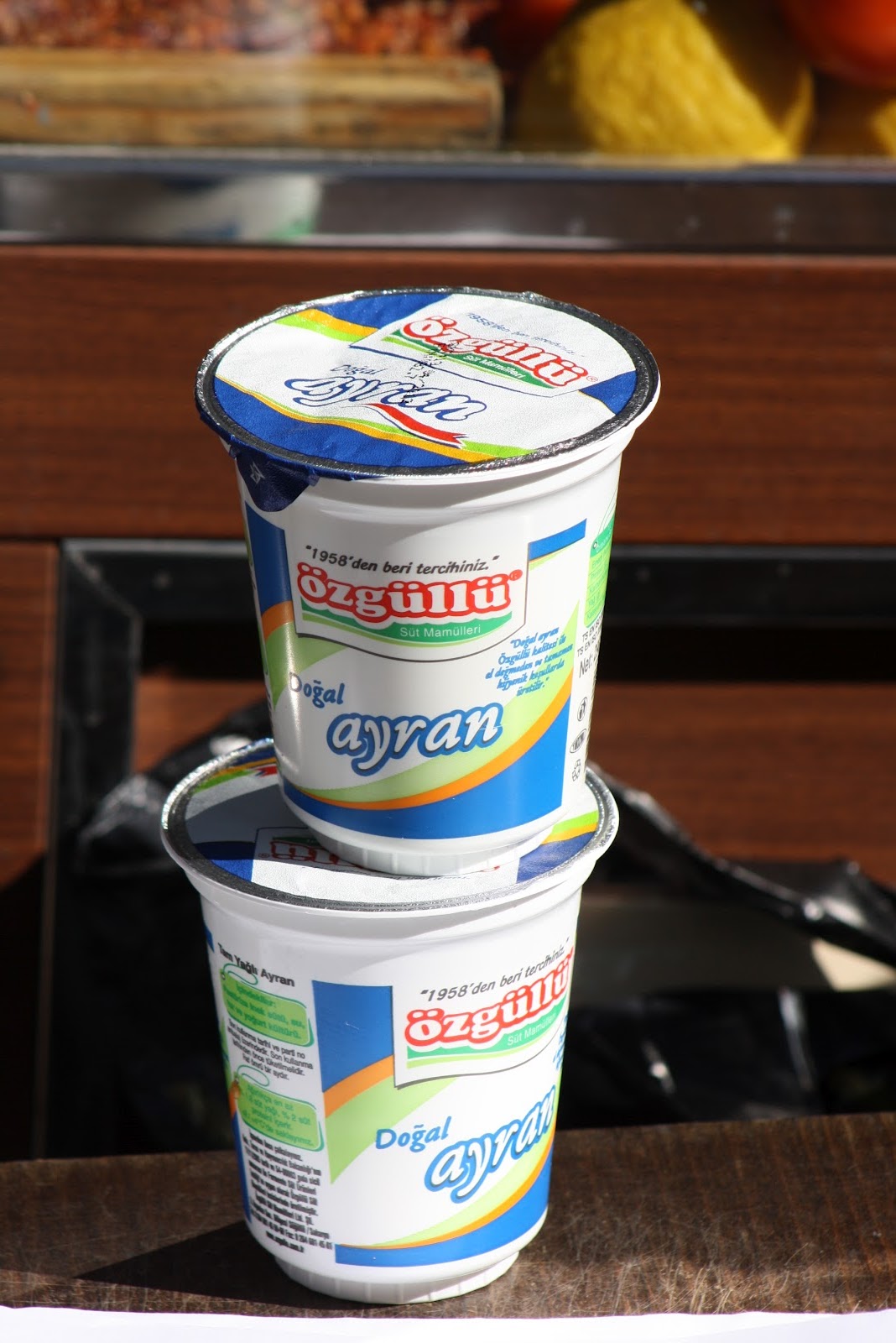
He ordered me Turkish butter milk. It came in a yoghurt container and was full of salt and bubbles.
Image source: sweettoothcraving.blogspot.com
“Ever had this?”
“No.”
“Where are you from?”
“Ireland.”
“How much is a kebab in Ireland?”
“More expensive.”
“How much?”
“€4.50.”
“Is it.”
“Yes.”
“We’re not German either. I’m Turkish and he’s Greek. We’ve been here thirty years. It’s not easy coming here new.”
They told me I would need a work visa if I didn’t want to work “Schwarz.” (The German language rather offensively refers to “schwarz” or “black” as the colour of transgression.)
I told them Ireland was in the EU.
“How much rent you paying?”
I told them.
“I could get you a flat to yourself for less.”
I gratefully declined.
“You living around here? That street there?”
I was arrested by his guess and didn’t deny it.
When he guessed the number I became frightened.
I told him I didn’t know yet.
“That street’s full of alcoholics. You could have a place to yourself for less. Who you staying with?”
I texted LSB and asked him to call me.
We spoke in Irish. I waited and waited. The Turkish man eventually got bored and left. The Greek stayed behind. I paid €2.50 for my falafel sandwich. The Turkish butter milk was on the house.
Yesterday LSB and I wandered into a little shop in Crumlin called “Better Value”. It was full of cardboard boxes and handwritten signs in black marker advertising Pringles, Chocolate Chip cookies and washing detergent. It looked like something from a feature film about Ireland in the 1980’s and I liked it very much.
image source: dublin.ratemyarea.com
The man at the counter was tall and thin and had a nice tanned face. He was being bombarded by three little boys, aged about seven. Two had freckles and similar round faces and the third had black eyes and floppy hair. They were hurling questions at the shopkeeper and he said, “Where’s your manners?”
The three boys each bought a bottle of Jones soda. “I’ve never had the blue one!!” said one. Outside, they ripped the wrappers off their bottles and dropped them on the pavement, where they curled up and quivered in the breeze.
image source: compare.productwiki.com
“Are you going to pick that up?” I asked one of the boys with freckles.
“No,” he said loudly. He was defiant and tiny.
I was wearing a black puffy jacket. In it, I was more than twice his size.
“And why not?” I asked him.
“Cause I don’t wanta,” he said.
I told him about dirty streets and the poor people that had to pick things up after litter bugs.
He talked over me to his friends.
LSB was standing a little away from the scene. The boys and I walked towards him.
LSB was wearing headphones.
“Are they beats?” one of the boys shouted at him.
image source :lovefont.blogspot.com
Apparently “beats” are the name of a pair of extortionate headphones produced by American rapper Dr Dre. Harvey Norman sell them for €299.
LSB shook his head.
The three little boys, clutching their bottles of American soda, schooled only in commercialism and brashness, brushed by us in a blur.
LSB, our friend and I took a walk in the Volkspark in Vienna last month. We came across a pretty white building, called the “Theseus Temple.” Inside it was empty except for hundreds of thousands of tiny bronze discs. First we didn’t know what to do but then some other people came in and started playing with the discs. They grabbed handfuls of them and showered each other with bronze. It wasn’t long until we did the same. Art can be anything you want it to be.
There was a delay on one of the underground lines in Berlin a few weeks ago because a homeless man had fallen asleep on the tracks. Security personnel rushed to the scene and the man was woken up. Bewildered, he growled at the passengers staring at him. He was escorted off the platform but it all took time. There was a short delay before service resumed.
Meanwhile, a public announcement had urged passengers to take alternative routes. I got on another train which would take me close to where I needed to go. Sitting opposite me were two little girls, aged about nine and eleven, who had also been waiting for the first train. We’d barely been on the second for five minutes when it was announced that “Service has now resumed on the U8.”
The smaller of the girls pursed her lips and shook her head, disgusted. “What an absolute joke,” she said. “Why didn’t they announce that it would only take five minutes to clear the line?” The other rolled her eyes and sighed. “This kind of thing is always occurring. It’s a farce.”
My jaw dropped. I couldn’t believe what I was hearing. First of all, the transport system in Berlin is the single best I have ever encountered. And second, here were two tiny German girls complaining about bad service in language so adult and earnest that it was comical.
This, I thought is the difference between the Germans and the Irish.
I imagined a similar situation in Ireland, where a conversation might have gone like this: “Jaysus, the poor fella. Did you get a look at him? Lucky somebody saw him and he wasn’t driven over … Jaysus! Sure we’ll be fashionably late. It’ll be grand sure. We’ve a story to tell.”
As our economy wilts and theirs prospers, it’s worth examining what makes the Germans German and the Irish Irish. I’m in a rather convenient position to do so, being half of each.
People here tell me that when I begin to complain habitually about everything, I can be called a “Berliner.”
Complaining in Germany, as in Ireland is a national hobby. The difference here is that complaints are taken seriously.
The reason that complaints are taken seriously is that responsibility is too. When you go to a ticket vendor or to buy a hot dog, you’re served with the same level of attention as you are in a bank or a lawyer’s office.
Some time ago, I was working on a story about low wage workers and got talking to a middle-aged woman selling hot dogs on the street. “I take my job seriously,” she told me, after she spoke perfect English while serving some American tourists. “I want people to enjoy their food.” She was earning about six euro an hour and was finding it hard to make ends meet.
Sincerity too is an integral part of the German mindset. If you say “We must meet up for a coffee. I’ll give you a call in the next couple of days,” it means that you will certainly arrange a date within three working days.
Shortly after I moved into my apartment, I made my flatmate dinner. It was vegetarian Shephard’s Pie and I was worried that it hadn’t turned out well. As we sat down to eat it, he took a few mouthfuls and said nothing. I was nervous. Perhaps it wasn’t to his taste. I waited for a while and then tentatively asked whether the food was alright.
“It’s delicious,” he said.
“Then why didn’t you say anything?” I cried.
“Well I had to wait to taste it properly,” he said. “It would have been insincere to say it was nice straightaway.”
I thought about that for a long time.
While the Germans are responsible, reliable and sincere, the Irish are compassionate, humorous and wily.
When my parents visited me recently, they were a little slow in buying their train ticket at the machine. A woman in her twenties standing behind cursed at them and shoved them out of the way. I would like to think that in Ireland, she would have given them a hand. For all its Celtic Tiger madness, Ireland has remained a place, where, as my mother so nicely puts it, “eejits and eccentrics are well tolerated.”
Before I moved to Berlin, my boyfriend made me a mix tape which included two anthems to remind me of home. One of them is the speech Enda Kenny made to welcome Barack Obama to the country and the other is the lament, with mandolin accompaniment, performed by Joe Duffy following Thiery Henri’s handball in 2009, which crushed Ireland’s dream of qualifying for the World Cup.
The latter is ridiculous and hilarious and features lines such as “Will You be Out of Favour To Sell Gillette Razors?” and “It’s a pity for the South African nation without us at their world celebration.” Enda’s speech on the other hand, is so full of passion and pride that it’s hard not to feel a pang of affection for the little nation, which despite falling to pieces, has still managed to maintain a healthy dose of national pride.
While the Irish might champion mediocrity, they do it with charm. Ireland is like the child in the psychological experiment that gobbled up the single marshmallow, despite knowing that if it had waited, it would have received two. Germany is the child that waits for the second marshmallow but wonders whether, by the same principle, it would make more sense to continue to wait rather than to enjoy the two already gained.
The Irish are wily and endearingly naive. We wouldn’t quite call ourselves dishonest but we’d settle on being creative with the truth: the stuff of brown envelopes, dodgy property deals, shifty politicians and the Catholic Church. On the other hand, it’s also the kind of opportunistic cleverness that bagged Enda a meeting with the Chinese Vice President last February, made Jedward into national icons and allows some to hold fast to the belief that we really, really, really can win the Euros.
If we could learn accountability and responsibility from the Germans and teach them to kick back and remember that everything – probably will be grand in the end – we’d both be better off. Instead, they’ll be bailing us out for decades and we’ll be telling jokes to numb the pain.
This morning, news reached Berlin that a Daniel O’Donnell museum had opened in Donegal, northern Ireland.
In an interview with the state broadcaster , Daniel said that the collection included “suits I would have worn through the years”, his “Donegal Person of the Year” trophy from 1989 and the school-bag he used 40 years ago.
I sat down on a little red plastic seat and surrounded by the buzz of Berlin commuters, I began to think about Daniel O’Donnell.
I even took some notes.
If Daniel O’Donnell were to appear in fiction I decided, I would accuse his character of lacking credibility.
And that, perhaps is exactly what lies at the heart of his success.
Daniel is softly-spoken and meanders effortlessly about attempts to get a rise out of him. His eyes have the characteristic hazy, other-wordliness of an evangelical, but none of the accompanying conviction.
He is the ultimate wish-fulfilment of Irish women of a certain generation: he is the priest that croons, the priest that can marry, the priest that doesn’t tell you off.
Last year, when Ireland’s flagship late-night chat show dedicated an entire program to celebrating his 50th birthday, I thought that in spite of the comedic value of such an event, something extraordinary was happening in my country.
The Late Late Show had become Father Ted and nobody seemed to be batting an eye.
My father has a great phrase he uses to describe someone he knew long ago: “He was known for his humour;” dad says, pausing before he adds, “some of it conscious.”
The official Daniel O’Donnell fan page features what is described as “the perfect gift”: a digitally signed and personalized photograph of Daniel. Fans can choose a message and clever technology will re-master it to look like Daniel’s handwriting. The sample photograph reads: For Bev, the best mum in the world.x
Daniel’s website, which is run by his wife Majella, features a fact file similar to the ones you’d find in the “unofficial biographies” of 90’s pop groups like Steps or Five, which are directed at the pre-teen market. It looks like this:
Name: Daniel Francis Noel O Donnell
Date of Birth: 12th December 1961
Place of Birth: Dungloe, Co Donegal, Ireland
Mother: Julia O Donnell (nee McGonagle)
Father: Francis O Donnell
Siblings: John, Margaret (Margo), Kathleen and James
Colour of Eyes: Blueish Green
Colour of Hair: Brown
Height: 5ft 10in
Weight: 12st 13lbs (Too much!)
Marital Status: Married to Majella
Children: 2 Stepchildren – Siobhan 17yrs & Michael 15yrs
Currently Residing: Kincasslagh, Co Donegal, Ireland
Favourite Colour: Yellow
Favourite Foods: Mince and Potatoes and some Chinese dishes
Best-loved Artists: Loretta Lynn, Charlie Pride and Sir Cliff Richard
All time favourite Song: There are so many but I love “Miss you nights” by Sir Cliff Richard
Worst Habit: Now, would I have any bad habits??!!!
Best Habit: Where do I begin!
Worst Asset: My growing love handles!
Best Asset: My teeth
Pet Hates: Smoking followed by gossip
Favourite Passtime: Playing Cards and Golf
Fondest Memory: The first time I met Loretta Lynn. Wow!
Worst Memory: The night I lost my voice in December 1991
Favourite Holiday Destination: Tenerife
Favourite Movie: Gandhi, The Sound of Music and Calamity Jane
Favourite Saying: Up ya boy ya!
Happiest Day of my Life: 4th November 2002 – The day I married Majella
I believe that beyond the softness of the Donegal lilt and the string of attractive clichés that bounces so effortlessly from his tongue, lurks a very shrewd man, trying to conceal his bemusement at the fact that the pile of stuff that he would otherwise have dumped into bags destined for Oxfam, will instead be displayed behind glass cases in a lucrative personal shrine. Or “visitors’ centre,” as he would have us call it.
You’ve got to hand it to Daniel: he has a fine appreciation of the ridiculous.
And as thousands rush to caress the fine silk tie that Daniel wore on tour once or queue up to marvel at the honorary MBE he was awarded in 2001, it’s fair to say that the joke’s on us.
Paul Begley is 46, Irish and until recently, had a good job. He travelled around the world, packing fruit and vegetables into big crates. Then he shipped them to Ireland and sold them to supermarkets. If you wanted a good gherkin or an organic asparagus, he was your man. It wasn’t glamorous work but it paid the bills easily and allowed him to take on a few people. He donated money to children’s charities and liked getting involved in awareness campaigns like “Kids in Action.” Now he’s going to prison, because he pretended that his bulbs of garlic were apples. He’s going to stay there for six years, just in case anybody else gets the idea to mislabel their garlic.
The tone might be facetious but the facts stand: As Judge Nolan said as he was sentencing him, Paul Begley was a “decent man.” He was probably about as honest as the next person.
It’ll cost the Irish taxpayer around half a million euro to keep him in prison. For every bit of money you earn, a little portion of it will go towards keeping Paul Begley in his cell. If, as is likely, he gets depressed you might also end up contributing to the salary of a prison psychologist.
As he said himself, what Paul Begley did was wrong. He shouldn’t have put “apple” labels on boxes of garlic. He shouldn’t have avoided paying tax, because no matter how inordinately high the tax on garlic, as opposed to say its cousin, the onion, Paul Begley was not in a position to take the law into his own hands.
He admitted it. He helped the police with their inquiry. He agreed a mode of repayment. And still, he was sentenced to six years in prison. The harsh sentence made headlines around the world.
Prison is for people who are a threat to society when free. It is a practical, rather than moral solution to society’s problems. In reality it is neither about revenge nor rehabilitation. It is a preventative strategy, and nothing more.
The chances of Paul Begley reoffending are very slim. For one, he’s bankrupt. He has €1.6 million to pay back, probably with hefty interest. He’s been humiliated. There’s not a supplier in Ireland that doesn’t know his name. At 46, he’ll probably call it a day and retire to a modest orchard somewhere, where he will consider his crime, live a quiet life and try to make ends meet.
He is not a danger to society.
The following scenario is analogous to Paul Begley’s crime. Think about it and ask yourself on a scale of 1-10 how serious the offense.
Imagine you’re in your local supermarket doing the weekly shopping. You pick up a few loose onions and pop them into a bag. Then you grab a couple of garlic bulbs and put them in another. You plop the bag with the onions onto a weighing scales and press the picture with the onions on it. You collect the little label with the price and stick it to the bag. Then you do the same with the garlic, except this time, the price is 25 times as high.
“Eh, what?” you think. “That’s ridiculous! You look at your bags again. Feeling a little bit uneasy, you scrunch up the sticker you printed out for the garlic. You put the bag back down on the weighing scales, and pause. You feel a little uncomfortable, but you think “ah, sure feck it.”
This time, you press the picture of the onion. You pick up the sticker, which shows an amount 25 times less than the previous one and attach it to the bag. Sure onions are just obese garlics, you think as you make your way to the till, where the sales assistant scans the two bags through without a second glance.
Paul Begley has already lost his reputation. Putting him behind bars means that the tax payer loses out too.
As for the argument that the purpose of the ruling is to deter others from committing the same crime, perhaps we should consider first of all, why the authorities find it so difficult to keep track of customs fraud, and second, why the tax on Chinese garlic is up to 232 % while that on onions is 9%.







 Kate Ferguson