Raising a boy in a world at war with itself

Pregnant with a boy in the wake of woke

I had a dream the other night. Two soldiers were confronting each other; one had a gun pointed at the other´s forehead. The man with the gun was whispering threats. An act of unbearable cruelty was about to take place. Then I woke up.

I`ve never had a dream like that before, at least not one I`ve remembered. But I am pregnant with a boy now. He is the size of a mango, according to the app, and I can feel him bubbling and fluttering beneath my ribs. In a corner of my unconscious mind, I am wondering how I will be able to keep his body safe, once it`s in the world.

Others are having similar thoughts. At work last week, I was getting my makeup done before I went on-air. “I`m terrified about the Wehrdienst,” (conscription) the makeup artist said, as she spread powdered foundation across my cheeks. Her son is sixteen, and delicate. Germany hasn`t yet reintroduced compulsory military service, but the conversation is shifting that way.

“You`ll have to handle puberty,” I inform my husband, outlining all the ways in which I`m unqualified: I have no idea what it feels like to have a penis; to lose control of your voice when you are still half a child, the humiliating squeaks echoing against uncompromising classroom walls. To be expected to carry the heavier box.

I understand the objectification of the female body. Walking down Grafton Street in Dublin as an eighteen-year-old with my then boyfriend, we bumped into a classmate of his. I have never forgotten the sensation of that other boy scanning me from head to toe. It happened in a nanosecond, as fleeting and subtle as a packet of ham passing through a till. I still remember the clothes I was wearing; a figure-hugging sleeveless yellow shirt and black three-quarter-lengths. I passed his test.

In the following years, I sat in college tutorials talking about the male gaze and getting cross with headline writers who used passive constructions when reporting on male violence against women.

My knowledge of the male body and experience, on the other hand, is remedial. I was stunned to learn that baby boy fetuses are often identified in ultrasounds by their tiny erections. Instances, I’ve learned, of the nervous system practising its functions.

Now I am going to mother a boy, and am thinking about the myriad ways his body will be scanned for its worth. For every novel I read growing up in which women were the objects of desire, or limited to their domestic roles, he will encounter stories of boys and men in trenches, or down mines. For every billboard I saw of women with complexions and facial symmetry I could never achieve, he will see chiseled jaws and six-packs to aspire to. For every impenetrable algorithm that has made me feel less of a woman, there will be an equivalent Internet pathway, enhanced by AI, picking at his self-esteem.

He will be born into an extraordinary cultural moment. A time when the tide of moral progress is receding. A time when the current US president – democratically elected twice – is a man who brags about “grab[bing] women by the pussy” and whose response to a female reporter asking him about his connection to a serial sexual abuser is: “quiet, piggy.

What will he make of it all, I wonder? How will our culture have evolved by the time he comes of age?

In the past decade, working in a Berlin newsroom, I experienced the sudden global awakening to women´s experiences that came with the #MeToo movement, and the resulting rush from management to introduce new directives on sexual harassment in the workplace. Even then it all seemed a little knee-jerk, as if implying that inappropriate behaviour had hitherto been acceptable, but must now be explicitly banned. When older male colleagues asked if they could still tell me I had nice hair, or a pretty dress, I responded with some version of: just use your common sense.

I think back particularly to one man, already counting down to retirement when we met. A former soldier, he´d ended up in journalism by accident. He had a reverence for the intellectual calibre of his colleagues that seemed rooted in the feeling that they came from the “right” background, and he did not. He talked to me a lot, and I listened.

He told me about a young woman in Thailand whose mortgage he was paying. “I`ll always take care of her,” he said, meaning to sound gallant, I think, but unaware of how deeply problematic it sounded to my ears. He was less interested in sex than he used to be, he clarified unprompted once – before reporting on a long-ago incident in a sauna, where a woman he knew tried to entrap him by titillating him.

Among my contemporaries, the prevailing feeling towards men like my colleague was contempt. There was no way he´d bombard a male colleague with his inappropriate anecdotes. Probably not an older woman, either. I knew all this, and still, somehow I couldn`t bring myself to tell him to stop.

The loneliness seeped out of him. I could almost see it, forming a puddle on the newsroom floor. I did not respond to his retirement email when it came. I was tired. But I wonder if he made it to Thailand, as he had dreamed, and how many mortgages and massages his pension might cover.

If I had been a slightly less empathetic person, and perhaps a little braver, a conversation with the “People” department could have seen my colleague canceled. But my total conviction in his complete lack of self-awareness made this seem like an unnecessarily cruel course of action. I thought of him as a young soldier sometimes and the reverence he had for the desk job he did now.

When I consider the regressive cultural shift we are experiencing now, what strikes me most about the form of wokeism I myself inhabited is how greatly it underestimated male fragility. It did this to such an extent that men became hysterically angry. Throughout history, we have accepted their bodies being sacrificed for the cause of nationhood, valour or economic sustenance. Finally then, a new age of reckoning arrived. But it offered neither relief nor reassurance.

Instead, it asked them to atone for crimes ranging from complimenting a haircut to committing rape. For those whose bodies were closest to the firing line, it was an unforgivable humiliation. For those whose bodies were furthest from it, like Donald Trump, it was an opportunity.

What we have got now is a dual casualty. If wokeism banished common sense, what has followed it is killing common decency. Both need to be mourned, then restored.

As a future mother to a boy, I have an interest in finding hope in the disarray.

It begins by accepting a truth which our culture has so far refused to reconcile: binaries are real, and they reside firmly on two ends of a spectrum. We can talk about male and female while accepting that most people are going to sit somewhere between the archetypal traits of both. This applies as much to politics: are you a liberal or a conservative, as it does to gender.

The boy inside of me might well be wired to prefer diggers to unicorns. He may end up physically stronger and less emotionally attuned than his older sister. But if he doesn`t, I will happily place a unicorn into his little hands. I will cradle both him and his sister close and hope that I am doing the only job that really matters: fostering decent, sensible human beings. Then I will close my eyes and hope that neither of them will end up collateral damage in a senseless culture war.

This is the little boy I`m writing about

If you like reading essays like this, please consider also subscribing to my Substack here: https://secondthoughtsbykateferguson.substack.com/
LSB Makes Berlin Debut

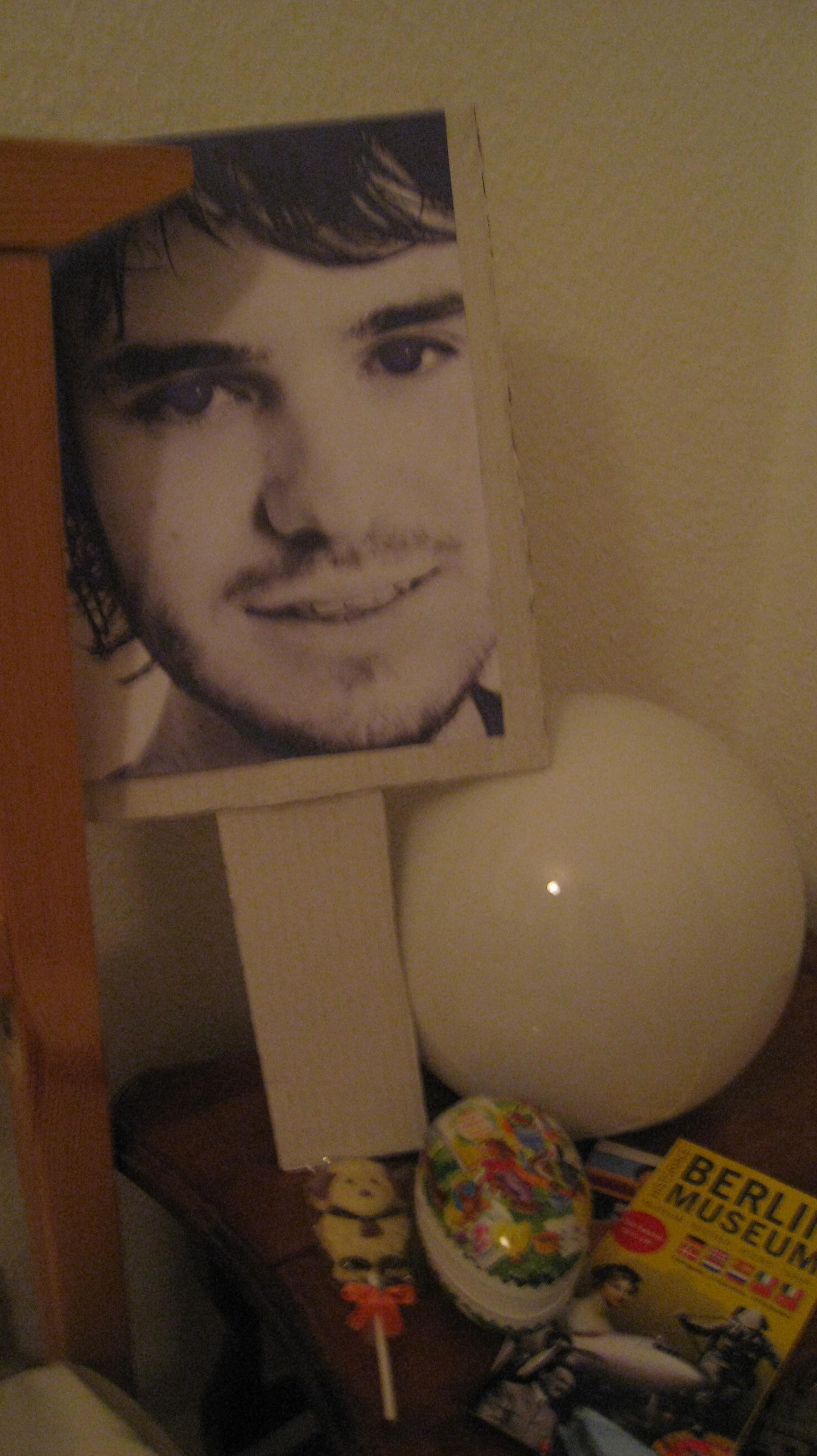
I decided to greet LSB at Schoenefeld airport with a placard featuring a blown-up picture of his own face. I had all the available equipment at hand: my flatmate’s high-quality printer, a cardboard box, which I had used to carry my groceries home, and some sellotape.

The evening of LSB’s arrival, my flatmate was welcoming friends to an “All-Male Poker evening.” Though he had included me on his invitation list, he had also apologised to his guests for my sex, adding that at least I could “make myself useful by serving beer.”

LSB placard and Easter-themed welcome gifts.

I responded by crafting a formal email during work, which I had checked and improved by a very obliging production assistant. Writing to all those included in the invitation list, I mentioned that it was with extreme regret that the Poker Evening would have to be cancelled since I had made a prior commitment to host a feminist congress at the address.

One of the advantages of being Irish and odd, is that when in a foreign country, the latter is often excused by the novelty of the first.

Unfortunately as the first guests were arriving I was in the kitchen, of all places, and even worse, cooking.

I was making LSB a potato and kidney bean bake to welcome him to my motherland. But I was doing so in a highly emancipated fashion.

Of course the scene delighted my flatmate, who ushered his friends in with insufferable smugness, pointing out that I was both a woman, and in the kitchen.

One of the guests greeted me with a smirk and said “Feminist Congress, yeah?”
I beamed at him.
“Thank you so much for coming!” I said. “The discussion topics are displayed in the room next door.”

He blinked.

“What?” he asked.
“You should have got my email,” I told him straight-faced.
“I did but I thought it was a j..”
“I really appreciate you coming,” I said. “It’s always hard to get men to agree to come to these kinds of events.”

His face dropped and I returned to the saucepan.

I left for the train station just as the “boys” were seating themselves at the “poker table.”

One of my favourite things about living in Berlin is my “Azubi” train ticket. With it, I can travel all around the city without having to tag on or off and it is valid on the weekends too, meaning I can whizz about exploring the city.

In the five weeks I have been here, I have not once been checked for a ticket.

As the train was pulling into the Shoenefeld stop, a group of four young men entered the carriage. They had chains and tattoos and shaved heads and suddenly one yelled “TICKETS, PLEASE”.

Ruffians, I thought.

Until one approached me.

I looked up at him, in his torn jeans and crumpled t-shirt and thought “Are you serious?”

But he had one of those machines.

I rummaged in my bag for my wallet and whipped out my Azubi ticket, complete with hideous photo ID.

His lip curled a little.

“Do you have an extension ticket?” he asked.

“A what now?”

“An extension ticket.”

“Em.. No?”

“The zones covered by this card were transgressed at the last stop,”he said.

“Oh! I had no idea,” I said, as the door opened and the voice announced “Last Stop.”

“I’m sorry,” I offered.

“Please show me your passport,” he said.

Mother of divine comedy, I thought.

At this point I was imagining LSB loitering forlorn in the arrivals hall, thinking I had forgotten him.

All I wanted was to get away from this most unpleasant man, and wave my placard.

“Where do you live?” he asked, still in possession of my passport.

I gave him the necessary details, and avoided the question about my “police-authorized address” by asking how I was supposed to have known that “extension tickets” existed.

I did all this in a most charming manner, hoping that he would consider me diminutive and not that bright.

He was having none of it and issued me with a €40 fine.

Clasping the little slip of paper and inwardly cursing him, I ran all the way to the arrivals hall.

I saw an elderly lady dressed in a green overall arrive and embrace her dog, who was on a lead held by her daughter, whom she ignored. Then an Irish businessman was greeted by a German Paypal employee.

And finally, LSB emerged from behind the screen.

I waved my placard madly.

He ran to me.

“Katzi!”

“Wilkommen in Berlin!”

“What on earth is this?” he gasped.

“Oh, just in case you’d forgotten what you looked like,” I murmured as I took him by the hand and led him to the ticket machine, where I bought an “extension ticket” for €1.50.

LSB reading my suggested itinerary for his first day in Berlin.

More on LSB in Berlin to come.

Armpit hair or the Eurozone crisis? The writer’s dilemma

I met a girl once who let her armpit hair grow nice and bushy so that she could weed out the guys that were more interested in her grooming habits than her intellect. I thought of her yesterday as I was killing time flicking through the bestsellers in Easons. I’d picked up Caitlin Moran’s How to be a woman and happened upon a passage outlining the importance of maintaining a fine balance between the cultivation and removal of excess pubic hair. Apparently, girls as young as 12 are now seeking full body waxes. Furthermore, young boys’ exposure to porn means that they’re unfamiliar with the follicle reality of the female anatomy, which shocks them upon their first real encounter with it.

The things you learn.

I was conscious that it had been nearly a week since my last post and even though popular science dictates that the third week in January presents the greatest statistical probability of lapsing on your New Year’s Resolutions, I was determined to buck the trend and continue blogging.

So I thought about writing about bodily hair; about how I’ll be damned if I shave my legs in the winter, or about how I got my eyebrows threaded last June and that though it was very painful and my eyes were watering like a hose, when the beautician asked me if I was alright I answered that I was doing just fine and that the streaks of mascara decorating my cheeks were intentional.

But I thought the better of it. After all, there are more important things to be worrying about than the state of the nation’s armpits. I resolved to educate myself on a more sober theme.

As a result, I spent much of today in solitary confinement; having decided that I wanted to be someone who writes about the things that matter, rather than the colonies that fester in secret under our nation’s arms.

It didn’t take me long to find a suitable treatise.

With the stealth of a long-repressed id, the Eurozone crisis reared its ugly head from the back of my mind, where I had shoved it to avoid returning to the shameful and possibly unalterable fact that I don’t understand economics.

I began by googling promising terms like “Eurozone crisis”, “structure of European banking system” and “austerity”.

I decided it would be only right to set myself a plausible-sounding essay title to focus my enquiries.

I came up with “Outline the causes of the Eurozone crisis and discuss potential outcomes of Government measures to tackle the crisis”, which I thought sounded promising.

Like most academic titles, it was embedded with the code “Write anything you know about this theme and don’t forget to reference several bizarrely named academics to make the whole process a bit more bearable”.

I skimmed through a few generalities and familiarised myself with key Eurozone celebs like Hosé Manuel Barosso, Christine Lagarde and Evangelos Venizelos. I even recorded the duller-sounding names in a notebook for future perusal.

image source: guardian.co.uk


I thought I’d hit the jackpot when I happened upon the BBC’s Crisis Jargon Buster. I rushed downstairs to make myself a cup of mint tea, took a deep breath, then spent the entire day reading the list of terms and taking notes, which I intend to copy into the desktop folder I have called “My general betterment”.

As it turns out, the crisis is not without its gratifying terms. So much so, that when LSB picked me up this evening, we whiled away a pleasant half hour making economy-related puns over our cappuccinos.

I asked him if he could guess what my new favourite cereal was. Though he’s a savant, he was stumped. He knew that it used to be Aldi’s own-brand strawberry crisp but I told him that was old news.

My morning victual of choice was now … “Credit crunch”.

His groan was nothing on the one I had let out when I reached the letter “H” in the jargon buster glossary. Wedged defiantly between “Glass-Steagall” and “Hedge fund” was the word “haircut”.

And it didn’t refer to armpits.

Such are the dilemmas I’m facing as I embark on another year of blogging. Do I write about my savant boyfriend, who generates hundreds of hits, or about the war in Iraq or the meaning of “art” , which fewer people want to read about?

Should journalists give the public what it should want, or what it does want? Is it more important to inform or to entertain?

What do you think?

On pens and penises

Meet Gilbert and Gubar; two ladies whose collaborative feminist treatise The Madwoman in the Attic opens with the question “Is the pen a metaphorical penis?”

I’ve had a long look at my black felt tip. It doesn’t appear virile- though of course that ejaculation might be premature.

For decades, academics and journalists have been considering women’s place in the world. They have been characterised as angels, whores, monsters and mothers. In the name of progress, their gift in writing has been likened to a product of the male reproductive organ.

In western society, traditional notions of a woman’s place in the home have become taboo. Of late, the idea that a woman might choose to become a fulltime mother rather than a professional has been rendered unthinkable.

The reluctance to accept that a woman may decide on motherhood over career advancement was exemplified by a New York Times article by Jack Ewing published last week, which meditated on the surprisingly small number of German women who return to fulltime work after availing of the government-paid 12-month parental leave.

The writer laments the fact that “Despite a battery of government measures … only about 14 percent of German mothers with one child resume full-time work, and only 6 percent of those with two”. He goes on to cite example after example of corporate bodies where only a tiny proportion of women have ended up at the top. Part of the problem, he muses is that “most schools still end at lunchtime, which has sustained the stay-at-home-mother image of German lore”.

While it’s worthwhile to draw attention to gender disparities in top corporate positions, the discourse that surrounds it – while well-intentioned – does a good job of enforcing the idea that women remain passive beings with little control over the course of their lives.

Ewing expresses the misgiving that “when it comes to empowering women, no Teutonic drive or deference seems to work”. Far from promoting any egalitarian cause, such speculation denies women the right to make life choices outside of a socio-political narrative, which subtly yet forcefully dictates that having a career is more worthy than caring for a child and that empowerment can only be measured in economic terms.

Germany is a good example to focus on to illustrate the point. Government measures strongly support the mother in the workplace – she is allowed 12 months parental leave with pay and is guaranteed her job back at the end of it. Although it’s probable that a larger proportion of mothers return to part-time work, the fact that only 14% go back to a fulltime career is indeed surprising.

In the absence of financial and political disincentives however, the fact that is continuously over-looked, is that women are opting not to return to work. Instead of being respected as free agents, those that make this choice are treated as victims of a social order which is portrayed as significantly less than the sum of its egalitarian parts.

For true parity to exist, the Men are from Mars and Women are from Venus mantra must be debunked. Ewing describes Germany as “one of the countries in most need of female talent” (my italics) but doesn’t define what he means by the term. If male and female talent aren’t viewed with equality, the prospect of a roughly 50:50 breakdown of gender in all sectors of professional life is unrealisable.

Furthermore, unless it’s accepted as equally scandalous that the proportion of male nurses is equivalent to that of female corporate executives, a discussion of gender can never be detached from a social weighting in favour of money.

Were society’s priorities reversed, public discussion might centre around the outrage that a man’s right to parental leave is considerably more restricted than a woman’s, that a boy’s emotional development is stunted by the expectation that he will advance up a corporate ladder and that the male body is no more than a military tool.

While you can’t spell “metaphorical penis” without pen, as I look again at my black felt tip I begin to think that Gilbert and Gubar might have been feminists equipped with rather (pardon me) fertile imaginations.

First-time Buyers

When 22-year-old Natalie Dylan who is auctioning her virginity on the internet appeared on the Adrian Kennedy phone show recently, she was unperturbed by the outraged callers that labelled her as “cheap” and “immoral”. She took it all in the stride of an enlightened feminist and responded with the confident ease of the pseudo-intellectual American. A graduate of Women’s Studies at Sacramento State University, Dylan’s aim is to use the money to further her education and to pursue a Masters degree in psychology with the ultimate intention of becoming a family and marriage therapist. Despite receiving in excess of 10,000 bids, and an offer of $3.7 million, Dylan is keen to stress that she will not necessarily offer her services to the highest bidder: “It’s not like an eBay auction…I don’t have to take the highest bidder. I’m taking time to get to know the guys.” Bids for Dylan’s virginity are being laid on www.bunnyranch.com and should a suitable buyer be found the service will be provided at the famous Nevada brothel, the Moonlite Bunny Ranch. To guarantee the authenticity of her claim, Dylan has taken two polygraph tests and is willing to undergo a gynaecological examination. Dylan cites not only her economic opportunism but also her charged intellectual drive as her inspiration. Speaking on the Tyra Banks show, she explained that she “wanted to study the dichotomous nature between virginity and prostitution. There’s (sic) really been so few case studies of it…I stumbled upon this article of a Peruvian woman who wanted to sell her virginity and she was offered an exorbitant amount of cash…$1.5 million.” In years to come, Natalie’s contribution to the intellectual world may be marked by the confirmation that our society has put money before all else: Brian Cowen and his social partners can relate. It will all be worth it however, when those privileged enough to study the dichotomous nature of virginity and prostitution are blessed with one extra case study to peruse. Feminism lives.   

Natalie Dylan is open to offers