
Meet Gilbert and Gubar; two ladies whose collaborative feminist treatise The Madwoman in the Attic opens with the question “Is the pen a metaphorical penis?”
I’ve had a long look at my black felt tip. It doesn’t appear virile- though of course that ejaculation might be premature.
For decades, academics and journalists have been considering women’s place in the world. They have been characterised as angels, whores, monsters and mothers. In the name of progress, their gift in writing has been likened to a product of the male reproductive organ.
In western society, traditional notions of a woman’s place in the home have become taboo. Of late, the idea that a woman might choose to become a fulltime mother rather than a professional has been rendered unthinkable.
The reluctance to accept that a woman may decide on motherhood over career advancement was exemplified by a New York Times article by Jack Ewing published last week, which meditated on the surprisingly small number of German women who return to fulltime work after availing of the government-paid 12-month parental leave.
The writer laments the fact that “Despite a battery of government measures … only about 14 percent of German mothers with one child resume full-time work, and only 6 percent of those with two”. He goes on to cite example after example of corporate bodies where only a tiny proportion of women have ended up at the top. Part of the problem, he muses is that “most schools still end at lunchtime, which has sustained the stay-at-home-mother image of German lore”.
While it’s worthwhile to draw attention to gender disparities in top corporate positions, the discourse that surrounds it – while well-intentioned – does a good job of enforcing the idea that women remain passive beings with little control over the course of their lives.
Ewing expresses the misgiving that “when it comes to empowering women, no Teutonic drive or deference seems to work”. Far from promoting any egalitarian cause, such speculation denies women the right to make life choices outside of a socio-political narrative, which subtly yet forcefully dictates that having a career is more worthy than caring for a child and that empowerment can only be measured in economic terms.
Germany is a good example to focus on to illustrate the point. Government measures strongly support the mother in the workplace – she is allowed 12 months parental leave with pay and is guaranteed her job back at the end of it. Although it’s probable that a larger proportion of mothers return to part-time work, the fact that only 14% go back to a fulltime career is indeed surprising.
In the absence of financial and political disincentives however, the fact that is continuously over-looked, is that women are opting not to return to work. Instead of being respected as free agents, those that make this choice are treated as victims of a social order which is portrayed as significantly less than the sum of its egalitarian parts.
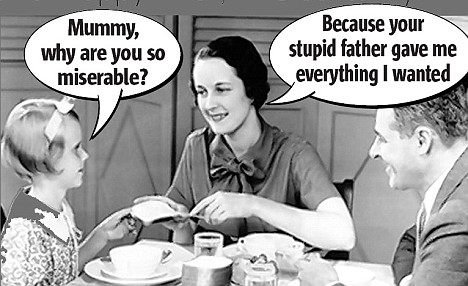
For true parity to exist, the Men are from Mars and Women are from Venus mantra must be debunked. Ewing describes Germany as “one of the countries in most need of female talent” (my italics) but doesn’t define what he means by the term. If male and female talent aren’t viewed with equality, the prospect of a roughly 50:50 breakdown of gender in all sectors of professional life is unrealisable.
Furthermore, unless it’s accepted as equally scandalous that the proportion of male nurses is equivalent to that of female corporate executives, a discussion of gender can never be detached from a social weighting in favour of money.
Were society’s priorities reversed, public discussion might centre around the outrage that a man’s right to parental leave is considerably more restricted than a woman’s, that a boy’s emotional development is stunted by the expectation that he will advance up a corporate ladder and that the male body is no more than a military tool.
While you can’t spell “metaphorical penis” without pen, as I look again at my black felt tip I begin to think that Gilbert and Gubar might have been feminists equipped with rather (pardon me) fertile imaginations.












 Kate Ferguson