Goodbye Frau Bennett

She was beautiful and wisplike.  I passed her often in the hallway of the nursing home.  She would sit in her wheelchair beside the rabbit cage. When she didn’t know you could see her, she wore an expression full of sadness and longing.

But whenever she saw me pass, her eyes lit up and she smiled. Her hearing was very poor. But that didn’t stop us communicating. I would motion to the rabbit or gesture to the window to deliver my verdict on the weather. She would always nod warmly in agreement.  We were gentle with one another – a source of mutual appreciation. She carried her melancholia with grace.

Her name was Frau Bennett. If we had been contemporaries, I think we would have been friends.

The same couldn’t be said of Frau Bienkowsi though, who was quick to dismiss her.

“Her mind’s gone,” she declared a few times. “She never says a word.”

I knew the first part wasn’t true. Frau Bennett was frail but I knew her mind to be in tact. The second observation was more plausible though. The two sat at the same table at dinner and I found it easy to believe Frau Bennett had a hard time getting a word in. She didn’t seem like the type to want to battle for floor time.

Frau Bennett had a son and grandson who lived locally. They didn’t visit much but she once confided in me that she sat in the hallway in case they came by.

I met them both at the nursing home’s Christmas party last year. They arrived late. My heart was already beginning to ache as I watched Frau Bennett sit quietly with her eyes fixed on the door.

Her son, a tall and rather strapping man, probably in his 60s, discovered  I was Irish by chance and struck up a conversation. He told me his father had been part of the British government that ruled West Berlin after the war. It confirmed my suspicion about how Frau Bennett had got her name. Many British soldiers stationed in the country ended up staying to marry German women.

Frau Bennett’s son was keen to speak English to me. It was the language of his childhood before German began to dominate. I got the impression he missed it. He seemed to have inherited some of his mother’s wistfulness.

Frau Bennett would have known my face but not my name. She was aware I was a friend of Frau Bienkowski. To my astonishment, she once asked me if I liked her. I said I did and asked her back. Gently and politely, Frau Bennett indicated they weren’t the best of friends.

I could understand that stance though it sparked some cognitive dissonance. Frau Bienkowski and I get on because we are different. I appreciate her warmth, her openness – even her outrageousness. But she is dominant and headstrong too.  She is a talker, not a listener. She is enormously kind. But she is not especially tactful.

I can imagine that quiet and perceptive Frau Bennett disliked her dinner companion’s forthright and – at times- perhaps abrasive style.

A week or two ago, as I was pushing Frau Bienkowski into the dining hall for dinner, I noticed an empty seat next to her. I didn’t think too much of it.

But during my last visit, I asked her how Frau Bennett was doing.

“She’s dead,” Frau Bienkowski said. “She went into her room and didn’t come out again.”

The rabbit has gone too. The cage disappeared around the same time Frau Bennett did.

Frau B and the elusive Christmas package

She picked up but the conversation lasted only a few seconds.

“Kätchen, can you call me back? I’m putting on my stockings.”

I gave her ten minutes.

“Okay, they’re up,” she said after just one ring. “But I’m in a right state.  Wait till I tell you.”

Frau B’s niece, Krista, had sent her a package for Christmas. Unfortunately, there’d been no one at reception to receive it, so it ended up being sent back to Hamburg. In the meantime, Krista developed thrombosis in her leg and had to be hospitalised. The package landed with a neighbour, who had no choice but to pop it right back in the post in the hope that this time, it might reach its destination.

The plight of this package had been plaguing Frau B for weeks. Now, with the first week of January drawing to a close, it had finally arrived.

But Frau B did not see a cause for celebration.

Choco stack

When it comes to Ritter Sport, I think I can handle it.

“I’m ready to cry,” she said. “It’s this wretched plastic wrapping. I’ve been trying to remove it for hours.”

“Besides,” she continued. “I don’t know what Krista was thinking. There are 12 bars of Ritter Sport in here and countless packets of biscuits. Where does she expect me to put them? I’m hardly going to eat them all!”

“Well,” I said, taken aback at her agitation. “I know I can help you with the chocolate. And, as for the wrapping, I’d just leave it until I come on Sunday and then we can sort it out together.”

“I know she meant well,” said Frau B. “But it’s ridiculous. I can’t even get to the cupboard to put anything away.”

On the surface, Frau B might be accused of lacking in graciousness. But that would be to neglect the reality of what life it like for a 96-year-old.

Unlike many of her peers, Frau B has managed to maintain the strength of spirit required to express indignation. If that were to disappear, I would know the end is near.

The tirade against her well-meaning niece managed, briefly, to deflect attention away from one or all of the following:

Her swollen, knobbly hands and the arthritis that cripples them – preventing her from carrying out the simplest of tasks, like tearing open a sheet of cellophane wrapping.

The real prospect that her last remaining blood relative might die before her.

The difficulty of mustering up the energy to get from her armchair to the shelf.

The indignity of dependence.

Bearing all this in mind, I too, chose to deflect.

“Guess what LSB suggested,” I said.

“What?”

“That we spend next New Year’s Eve with you.”

Frau B had rung in 2016 sitting alone in her room, dismayed that the nursing home hadn’t made an effort to mark the occasion. The disappointment was all the more real because last year, she’d had such a good time celebrating that she had to be escorted back to her room. The half bottle of wine she’d downed had left her giddy and unsteady on her Zimmerframe.

“I hope to goodness I’m not alive by then,” she said.

“Well if you are,” I said, “we’ll be sure to bring some champagne.”

She laughed.

“I don’t really like champagne. But I suppose you can bring me beer.”

Baking cookies with refugees

This is a follow-up to an earlier post about refugees in Germany

It was an afternoon full of surprises. For one, the Syrian teenagers loved baking Christmas biscuits. One of the boys carved the name ‘DIANA’ into his piece of dough and nodded shyly when I asked if it was the name of his girlfriend.

I met a Serbian man and his two young daughters, who looked angelic in matching owl hats. They’ve been here for six months and already the little girls speak perfect German.

When they arrived, they were entitled to free lessons. That policy has since changed to reflect the government’s intention to fast-track the applications of people with little hope of being granted asylum. Anyone from the Balkans is no longer considered worth the investment.

The father, ambitious, highly educated and fluent in English, fitted the description of ‘economic migrant.’ In Serbia, he worked as a salesman, overseeing two shopping centers. One of his ventures was into Lebanese honey, which he assured me, was the best in the world. “Even better than Manuka,” he said. He told me that no matter how hard he worked in Serbia, it remained a struggle to make ends meet. “It was different in the former Yugoslavia,” he said. “We had prosperity then. Now we can’t afford anything. And our passport is useless.”

As a fellow economic migrant, it made me sad to reflect that the accident of my birthplace entitled me, but not him, to seek a better future here.

But pragmatism, I think has to win out. There are 800 asylum-seekers arriving in Berlin every day. School gym halls are now being used to accommodate them. On the radio yesterday a mother described her son’s disappointment at finding out that his football training had been cancelled because the sports hall was now home to Syrian refugees.

The war in Syria has so dominated the conversation about refugees that it’s easy to forget the people coming from everywhere else.

As I was making to leave with another female volunteer, two young men motioned over to us. They gave off a macho, yet needy vibe, asking in a conspiratorial tone whether we used ‘Whatsapp.’ I was evasive in my answer but relented and gave them my number when they asked for it directly.

The men come from Gambia. One of them has been sending me unsolicited messages. He has been transparent, and – frankly – inappropriate in his pursuit of contact, refusing to accept that I have no romantic interest in him.

But I don’t regret giving him my number. His messages have been enlightening. It is depressing how desperate he is to attach himself to a woman from the EU. His messages are manipulative – describing his sadness at not hearing from me, demanding again and again to ‘meet me at the TV turm’ despite my clear assertion that this is not on the cards.

Sometimes the language of his messages changes, with sentences apparently copy and pasted from lyrics or inspirational quotes.

I don’t particularly pity him, as I was annoyed that his badgering continued after I asked him to stop.

But I do wonder what he left behind in Gambia and whether being married to an EU citizen really would be the utopia he imagines.

The lonely Berlin taxi driver

I get a lot of taxis in Berlin, mostly at around 4 in the morning, which is when I get off work. I like talking to the drivers. We have nearly the same conversation every night.

“Frau Ferguson?” they say as I open the door.

“Jawohl!”

We cover familiar topics like traffic diversions, whether it’s been a busy night and what the news items of the day have been.

Often we talk about where we’re from too. Most of the taxi drivers have Turkish or Middle Eastern roots. That’s led to some interesting exchanges, like recently, when a driver compared the conflict between Protestants and Catholics in Northern Ireland to Shia-Sunni sectarianism.

The other night was different though. My taxi driver had a flat Berlin accent. Instead of asking where I was from, he guessed.

“Switzerland?”

“Nope. Ireland!”

“Ah! Kerrygold!”

“Yes,” I said, only mildly surprised. “They have an excellent marketing team.”

“What do you mean?” he said. “Irish butter really is better.”

“I rest my case!” I said, laughing. “Anyway, what about you? Are you a real Berliner?”

“Yes,” he said, a little tensely. “One of the few left!”

Attribution:  Matti Blume via Creative Commons

Attribution: Matti Blume via Creative Commons

He’s right, you know. Berlin is not the place to meet Berliners. I can count the number I know on one hand.

“But where have they all gone?” I asked.

“To the outskirts of Brandenburg. I’m dying to go too. Only I’m stuck here working.”

“Why are they all leaving?”

“Because it’s no longer their city. Everything’s changed.”

“I know what you mean,” I said. “I mean, I’ve only been here three years and I can see the city change before my eyes. Often, when I go to bars or cafes, people automatically speak English to me. I mean, I can imagine that can get pretty annoying if you’re German.”

“Sure. Sometimes you forget where you are.”

“I guess that’s down to people like me, isn’t it?”

“Ach, no.”

But I could tell that he agreed.

Frau B takes on “the modern condition”

“Nice haircut, Frau B!”

She pats the sides of  her head, self-conscious and pleased. “Like it? You’re the only one who bothers to notice.”

There’s a knock on the door. A young woman, slight and dark-haired, sporting a pale green uniform, walks in.

“Julia!” says Frau B. “Now you can finally meet Katechen, my little Iren.”

Julia and I greet each other.

“Julia comes from Spain,” says Frau B. “Don’t you?”

“Yes, ” says Julia and hands us both a cup of coffee.

“She speaks very good German,” Frau B says after she’s left. “She came here because there were no jobs at home. Just like you did!”

Attribution: Bundesarchiv, Bild 102-00134 / CC-BY-SA via Wikipedia Creative Commons

Attribution: Bundesarchiv, Bild 102-00134 / CC-BY-SA via Wikipedia Creative Commons

We talk about mass unemployment and the effect it has on the political landscape of Europe. Frau B was a child when Germany was in its deepest ever financial crisis.

“1929 and 1930 were the worst years,” she says. Even my father was unemployed for nine months. People said that if he had no work, it meant there really was none.”

“What did he do?”

“He was a precision mechanic. He was very good with his hands.”

“Something you inherited!”

“I sure did. I got his feet too. He had tiny feet, for a man.”

Screen grab from Daily Telegraph article of 27 January 2012

Screen grab from Daily Telegraph article of 27 January 2012

She takes a sip of coffee and continues:

“Hitler would never have come to power were it not for unemployment. See, he re-built the army and got people back to work.”

I tell her about Ireland’s Republican party, Sinn Féín, and how they’re currently enjoying a rise in popularity.

We agree that mass unemployment and disillusionment add to the allure of extremism.

Sometime later, when we are done talking about politics, Frau B mentions her grandmother who was born in 1838.

As a child, Frau B would spend long afternoons reading the Bible in her grandmother’s rural home. But it is a detail related to her Oma’s appearance rather than any biblical verse, which has stuck most in Frau B’s mind.

“My grandmother used to be bothered by a few little hairs, which sprouted above her lips. She’d tear at them with her hands until they came out,” she says.

Now Frau B notices a few hairs growing above her lips. “It comes with age,” she says. “I pluck at them when I can’t get to sleep.”

“Some people believe vanity is unique to the modern condition,” says Frau B. “It’s really not.”

As I observe Frau B rearranging her hair-do, and think about the events which led up to the horrors of World War II, I feel both comfort and unease at how relatively small our 70-year age-gap really is.

Lá Fhéile Pádraig Shona Daoibh!

A chairde,

I’m sorry.

I’m going to resume a much more regular posting schedule soon. Expect some half-baked musings for the “Big ideas” section,an update on preparations for Frau B’s 96th birthday and hopefully some anecdotes about an upcoming trip to the island of Rügen. pat

In the meantime though, I’d like to wish you all a wonderful St Patrick’s Day. I was lucky enough to attend not one but two  events here in Berlin to mark the occasion. One took place at the top of the television tower on Alexander Platz, the other in a Kreuzberg club which defied its dingy exterior to reveal a glorious Irish haven inside. With tea and biscuits on sale, bowls of potatoes on display and a spectacular performance by Jigs and Reels, an Irish dancing school in Berlin (run by a friend of mine) I felt as if I’d been transported right back to the homeland.

As you can see from the picture, LSB and I are fully embracing our Irishness for the day that’s in it.

Slán go fóill,

KK

Merry Christmas, Frau Bienkowski

“They’ve outdone themselves with the decorations,” said Frau B.

Word had it that some of the carers in Wohnbereich 4 had been up since 4 o’clock in the morning. The dining hall had been transformed into a winter wonderland, with baubles, fir tree branches and paper stars adorning the tables and walls. Someone even had the genius idea of hanging cotton buds from the ceiling to resemble a snow scene.

Most of the residents had dressed for the occasion. Frau B had on a navy jacket she’d sewn for herself at the age of 85. On it, she’d pinned a sparkling turquoise brooch. She’d had her hair done too.niko

I complimented her style.

“Katechen,” she whispered. “Have a proper look around. Later, I want you to tell me who you think is the most attractive person here. You’d better be honest though.”

The hired entertainer, an earnest man in a questionable cloud-patterned shirt, led the Christmas carol-sing-along. I heard Frau B join in to Stille Nacht. The lady next to me, who had been whimpering in distress only moments before, began clapping her hands on the table in delight as she hummed along pitch-perfect to the music.

“She has lost her Verstand [has dementia]” Frau Bienkowski whispered. “But occasionally, she has remarkable moments of recall.”

After we had polished off our Stollen (Frau B thought it was sub-par) and the entertainer concluded his festive repertoire, it was time for the exchange of presents. A carer in a Santa costume appeared on a sleigh carting presents for the residents.

“Ho, ho, ho Frohe Weihnachten, liebe Einwohner,” he said, enlisting the help of his colleague, whom he referred to as “mein Engel,” to distribute the gifts.

From observing those around us, we figured out fairly fast that Frau B was likely to get either a large animal-shaped heat cushion or a desk calendar.

It was the latter.envylopy

We had arranged earlier that we would exchange our gifts privately. This was after all, only the nursing home party, not our own.

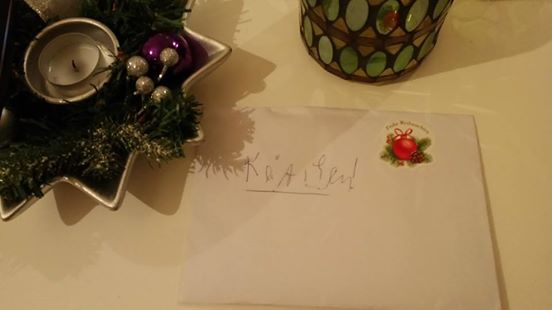
Later on, back in Frau B’s room, she handed me an envelope. On it was written, in a scrawl I have come to know well, “Katechen.”

“I can’t see what I write,” she said. “So, I was quite impressed that I got any letters down at all.”

She made me promise I wouldn’t open it until I’m back in Ireland on Christmas Eve.

I handed Frau P a bag containing an assortment of perishable gifts. The hamper included a slice of mackerel, two bottles of Berliner Kindl beer,  a box of Lindt chocolates and some organic (it is Christmas, after all) apples.

She told me to hide the beer at the back of the cupboard.

“I’m not going to drink it alone,” she said. I took that as an invitation for a beer date in the new year.

Back in the quietness of the room, I asked Frau B how she had been feeling this week.

“Terrible,” she said. “I really thought my time had come. I was convinced I was going to close my eyes one final time.”

We looked at each other for a long time.

And then it passed and she asked me who I honestly thought was the most attractive resident in Wohnbereich 4.


Want to win the World Cup? Try “Konzentration”

I meant to post this yesterday but didn’t get around to it, sorry! The story begins at the Brandenburg Gate 24 hours ago:

As I write the German football team are dancing on a stage at the Brandenburg Gate. Before their “Sieger Flieger” landed, the plane took a spin over the fan-zone, where half a million people clad in red, black and gold were waiting to welcome their heroes home.

I have no idea how half a million people have nowhere else to be on a weekday morning. But this is Berlin; they’re probably in the creative industry or have called in sick.

As I watch Berlin explode with festivities, I’m reminded of the cliché that when Germans do party, they tend to party hard.

And, come to think of it, identifying the right time to party has been key to this team’s success.

Throughout Germany’s stellar World Cup campaign, coach Joachim Löw has refused to celebrate prematurely.  Instead, he remained adamant that each team Germany faced had the potential to end their championship dream. He was right too; after his side’s spectacular 4-0 defeat of Portugal, Germany could only muster a 2-2 draw against Ghana.

And after their epic 7-1 win over Brazil, which broke social media as well as footballing records, he remained determined in his caution.

Löw’s measured style may be seen as a tactic to keep his team level-headed before the final. But it was matched, if not exceeded by Merkel’s  endearingly understated response.

Appearing at a press conference the day after her country’s  7-1 defeat of Brazil, she said: “I agree with the global opinion that it was a very good match … I think it almost merits the description ‘historic.’”

She went on to wish the team “strength and concentration for the task at hand.”

Strength and concentration, seasoned with some good old-fashioned caution,  is the German recipe for Weltmeisterschaft success. What’s yours?

Streetwalking in Schöneberg

I had some time to kill the other night, so I walked up and down Bülowstrasse. It’s in the Schöneberg area of Berlin, where Albert Einstein, Hans Fallada and David Bowie all lived at some point.

It was only 7 o’clock, so I was surprised to see prostitutes lining the streets so early. There were six of them. Two emerged linking arms from a shop before separating to take up position.

They weren’t anything like the prostitutes at Hackescher Markt who are both glamorous and absurd in their identical fishnet tights, baby-pink corsets and furry boots.

These women looked eastern European. They didn’t have a uniform, but they were all wearing  plastic strappy high-heels; the kind you’d find in a basement store in the Ilac Centre in Dublin, full of artificial light and pumping music.

The youngest of them had brown hair, very narrow shoulders and was wearing denim hot-pants. She had earphones plugged in while trying to hail down cars.

The oldest woman wasn’t bothering to show her legs. She was dressed casually in jeans and a leather jacket. She had reddish-brown hair and looked bored.

The woman whose face I can’t forgot was standing near a lamppost supporting a campaign poster for Germany’s neo-Nazi NPD party. It featured a fish-bowl picture of an old lady under the slogan: “Geld für Oma statt Sinti und Roma.” (“Money for Granny, not the Sinti and Roma”)

The woman had her hair scraped back into a ponytail. She was performing her job awkwardly – trying to hail down cars by forming a stop sign with her hand, like a police officer would do to check a driver’s insurance.

Tears were running down her cheeks.

No one stopeed but she kept on sticking her hand out at the passing cars.

World Apart

I get the U8 to work.

Berliners call it the Drogen Linie – a title it’s earned.

Men and women with drooping eyelids and sad shuffles inhabit the line.

On the platforms, people with trolleys containing their belongings shine torches into bins looking for bottles to recycle.

Once, a girl with black eyes got on my carriage. Her dark hair was pulled back loosely and she had on a flowing skirt. She was breast-feeding a big baby, who was clinging on to her very pregnant belly. The baby was playing with a copper coin.

It toppled to the carriage floor. The lady sitting opposite picked it up and handed it, almost apologetically, to the girl. She took it. Her fingernails – black with dirt. She was no more than fourteen.

I get out at Gesundbrunnen, in the middle of the line. In the eighteenth century, the area was famous for a spa dedicated to the Prussian Queen Louise.

source: Wikipedia

source: Wikipedia

When it joined the city of Berlin a century later, Gesundbrunnen became a working class district. Today, over half of its residents are people Germans describe as having a Migrationshintergrund, or “migrant background.”

The term includes people like me but in the media it’s almost synonymous with second and third generation Turks whose parents and grandparents arrived in the 1960’s and 70’s as Gastarbeiter – guest workers – to help build up post-war broken Germany.

The area is home to a sprawling mall called the “Gesundbrunnen Center.” It’s right next to the train station, which is also the starting point for tours of Berlin’s former bunkers.

The mall is always full. It is like every shopping centre, with an enormous H&M, plenty of stalls selling implausibly fragrant nuts and lots of red-faced children weeping tears of indignation as they are dragged from shop to shop.

To ease the suffering of those unfortunate children and their parents, an enterprising group has recently set up a pony-rental service on the ground floor. The ponies are life-sized stuffed animals on wheels. They come in three sizes and their prices vary accordingly.

The children glide along; their backs held straight and their expressions changing rapidly from concentration to joy. Their parents point smart phones at them to preserve the ride for posterity.

Close to the ponies-on-wheels there is a pet store. I go there to look at the guinea pigs. Earlier today, a sales assistant with pale skin and lots of piercings opened the snake cage to spray water inside. A woman wearing a headscarf looked on curiously.

“Are they poisonous?” the woman asked, pointing to two grotesque snakes coiled around each other, exposing their forked tongues every few moments.

“No. We don’t sell poisonous snakes,” the member of staff answered in a remarkable monotone.

The snakes are fed with dead white mice. I wonder if the store is supplied with dead mice or whether they simply taken them from the cages selling mice as pets. If the latter is the case, I wonder how – and where – the killing takes place.

On the street leading to my office, there is an unassuming and cheerful cake shop. It sells pieces of kiwi sponge for a euro and boasts a special blend of Arabic coffee. It’s family-run and open late. In the evenings when it’s quiet, the teenage daughters take care of the tills and bring you coffee. They seem well brought-up. One of them sports charmingly chipped red nail polish.

There are high-rise blocks of flats along the entire road. Chained absurdly to a lamppost outside one of the buildings are two plastic cars for toddlers.

None of it is my world. But sometimes I realise that being an outsider is where I feel most at home.