News Flash

I have 508 Facebook friends. One of them is a girl from Israel and another is a boy from Gaza. I met them both in the summer of 2009 when I went to study for a month at the University of Bayreuth in southern Germany.

This weekend the boy from Gaza posted pictures of destroyed homes, families covered in blood and clouds of smoke in the sky. The Israeli girl posted pictures of the sub-par bomb shelter she had been hiding in.
Some people left comments along the lines of “We stand with Israel” on the girl’s wall. She said it was the worst thing to say because Israel had “started it.”

At work, we’re following developments. The politicians are so tentative. Obama talks about Israel’s right to defend itself and neglects to mention the mounting civilian deaths. The German press secretary reminds us that Israel is firing in response to rockets from Gaza.

We showed footage of an overturned truck carrying tomatoes in Gaza. Three brothers inside were killed when it was hit by a rocket.

The screens showing agency video feeds flitted back and forth between footage of destruction and diplomacy. The UN condemns civilian deaths, western politicians don’t mention them, Egypt says it won’t tolerate them.

Image source: http://www.bbc.co.uk/news/ retrieved 19/11/2012

Polite conversation skirts around the violence. People don’t like to pass remarks on Israel. They think Hamas is dodgy so maybe there’s no other way. Not many like to defend killing children, and brothers driving trucks full of tomatoes. And when images of wailing women searching for loved ones amid destroyed buildings pops up on the screen, they don’t know where to look.

Meanwhile in Mali, Islamic militants have taken control of the north. Their leaders hold up guns and say they’re fighting with weapons, not words. Women have begun covering their hair. They might make the news tomorrow.

The Republican

We met on the platform of Berlin’s main train station early Sunday morning. He looked confused. I glanced in his direction and appeared pleasant and approachable. It worked. He came to me, pointed at the complicated travel itinerary he had printed out and asked if he was in the right place for Magdeburg.

He was. And I was going his way.

We sat in separate parts of the train. I looked out the window. Little patches of snow glistened on orange and golden bushes. Once I saw an animal I couldn’t identify squatting in a field. I guessed it might be a weasel, and then wondered if I knew what a weasel looked like.

We were scheduled to arrive in Magdeburg at 10.53. At 10.51 the display screen changed to “MAGDEBURG” and the train ground to a halt.

I disembarked. I looked around me and my heart sank. This looked nothing like the main train station to which I was headed. Then I saw the young man from before. He looked confused again. The station was otherwise deserted. “We’re wrong,” I said and suddenly sprung to action, trying to re-open the door that had closed behind me. It was too late. The train slid away.

I looked frantically at my own itinerary, which I had scribbled down on a scrap of paper.

“We need to get a taxi really quick,” I told him, as we made our way through the tiny, empty station. Our connecting train left in 7 minutes. We had landed in a station slightly outside of town. We had a choice of three taxis.

“Got off too early?” the driver asked. “Happens a lot.”
“We’ve got 7 minutes to get the next train.”
“I’ll do my best,” he said.

And so I sat in the back seat with the stranger. “Sorry I look so dishevelled,” he said. “I was out very late last night.” Four and a half minutes later we pulled up at the main train station. The driver opened the car boot and 30 seconds later I was running wildly with my suitcase and bag flying behind me and my new friend in tow.

We made it. My head was spinning with lack of sleep and the sudden exertion. That particular sensation was to become a feature of my day.

My new friend was in his early twenties. He had short brown hair and a nice face. He was polite, measured and American. He was spending some time studying in Germany while he completed his dual studies of international politics and officer training in the US army.

Over the next ten hours, we got to know each other intimately.
In Leipzig, over a steak sandwich (his) and a vegetarian kebab (mine) we talked about the responsibilities we had to our parents. He told me about his rural upbringing and how excited he was to get his first army salute. I talked about my German background and he told me about his Lithuanian one. I told him about Ireland and he told me about New Jersey.

Near Lutherstadt he said “I think I saw a fox earlier.”
“A fox?” I asked. “Where?”
“On the way to Magdeburg.”
“Was he alone?”
“Yeah, just sitting in a massive field.”
“I saw him too!” I said. “But I thought it was a weasel.”
He smiled. “I’m pretty sure it was a very small fox.”

Later still he said, “I’m not really into partying. But my friends were in town last night, and they made me stay out. That’s why I’m such a mess.” Then he paused and said “Did you say Let’s dash, earlier?”
“Yes, do yanks not say “dash?””
“No we don’t” he replied. “It’s cute though. Dash is a neat word.”

When we got to Hof he said “I hate talking about politics, especially in Europe.”

I bit my lip. This sounded interesting.

“I was talking to some French Canadians last night,” he continued, in spite of himself. “They just started attacking me. It’s so annoying. People here don’t know how American politics works.”

Ha, I thought. So I have finally met a Republican.

I was disappointed by how nice he was.

“I’m not a Republican,” he said. “I’m a libertarian. But Obama’s economics just doesn’t add up. I’ve studied it. And nationwide health insurance doesn’t make sense. This stuff has to come from individual states.”

I said the system seemed to work in Germany. “The US is a lot bigger,” he said.

We stopped there but politics hung in the air. He was right though. Along with most Europeans, I don’t really know how American politics works. I write snappy headlines about it, and I cut pictures and match them with entertaining soundbites. But do I know the numbers? Do I understand local government and the make-up of each state’s senate? No Sir, I do not.

I thought about this pleasant mild-mannered young man, with a life in the military in front of him. I thought about his girlfriend, also in the army. I thought about what he said about college boys having to be at least as fit if not fitter than the squad they lead. I thought about his mother, who has been sick. And I thought that there’s something very human that politics misses.

I hugged him when I got off the train in Regensburg and warned him that he might end up on my blog. As I was walking away, he turned in his seat and waved goodbye to me.
How Ireland looks on Al Jazeera

I was gazing around the room during a quiet spell at work yesterday when I was startled to see Jesus Christ pop up on O’Connell Street. He’d appeared on one of the display screens featuring rival TV stations. The channel was Al Jazeera.

The Qatar-based news channel was reporting on how the economic crisis in Ireland is affecting women seeking to travel abroad to have an abortion. The piece is 2 minutes and 57 seconds long. It begins with some black and white shots of Jesus in his plastic display case on O’Connell Street, then cuts to a church and a lady with a pram. Finally it turns colour to reveal the reporter, Laurence Lee, formerly of the BBC, standing in a park.

It is an embarrassing watch. Ireland is painted as backward and its society described as “conformist.” We’re mentioned in the same breath as Iran and Afghanistan.

Travelling for an abortion from Ireland works on the same principle of “Don’t Ask, Don’t Tell” which used to apply to gay members of the American military.

Nobody I know has told me they’ve had an abortion. Conversely, I’ve never asked if they’ve had one. But according to Lee’s report, the number of requests to a UK-based charity offering financial aid to women travelling to get an abortion has tripled in the last three years.

While I strongly support a woman’s right to choose to have an abortion, the report left me feeling slightly defensive. Do we really live in a culture of silence? Is abortion really taboo?

Sadly, yes. But things are changing. The Irish Times ran a series on abortion a few months ago which invited women to tell their own stories. It got a huge response. Scores of women who had never before shared their experience finally elected to, spurred on by the sudden knowledge that they were not alone.

I do have one concrete objection to the report. Lee says that in Ireland a woman cannot have an abortion even if the fact of her pregnancy is putting her life at risk. Following the X case ruling, that isn’t quite accurate. However, so far there has been no legislation to support that judgement. The European Court of Human Rights is on our back about that too and it’s deeply embarrassing.

On the same day that the Al Jazeera report ran, at least 2000 people turned up in Castlebar in Mayo to demand Fine Gael live up to their pre-election “pro-life” promise.

Mostly the report left me dissatisfied because I thought, “What an unfortunate and reductionist view of Ireland to beam throughout the world, one which ignores the enlightened existences of my liberal-minded friends and me.”

Then I remembered that simplification and exaggeration are the hallmarks of a 3-minute news report. And that in a way, a piece like this might actually give me more of an insight into my country than my restricted and evidently unrepresentative social circle does.

I got back to writing my own three-minute international report, a little wiser about how little I know about everything.

Naked Gloria

Right at this very moment, a man with grey floppy hair and a stripy woollen jumper is sitting in front of his laptop in a coffee shop in west Berlin, reading, what I suspect is his own story. It’s called “The Tutor” and begins: “Even with the fan beating her naked body, Gloria was dripping wet.”

I had to crane my neck to make that out.

I hope the person immediately behind me isn’t taking similar note of what I’m writing. That said, it would be rather nice to instigate a pretentious metafictional trail.

This coffee shop is a couple of stops away from where I live but it’s become my “local.” It’s where I went in my despair when the power failed. Since then I’ve spent hours here writing articles aimed at billionaire investors in the German real estate market, consoling myself by consuming the enormous chunks of floating ginger in my tea. It’s also where I teach English to a lovely young woman, who responded to one of the many poorly-designed posters I pasted around west Berlin.

The staff here are as attractive and cosmopolitan as the cocktails on the menu. One woman is raven-haired and French and speaks a charming nasal German. When she’s on shift with the men, they tease her about her love life. I suspect they’re looking for a way into it. Another one of the waitresses is Chinese. She wears a bemused smile. Another staff member is German but speaks fluent English with the many foreign customers. She’s got a delicate sensibility and is eager to please. One of the regulars told her today that he was homesick. She reported that to the Chinese waitress, her voice full of empathy.

Every so often when I breathe in I taste smoke. Boxed off in a glass house next to me is the Smoking Lounge. I like staring at the people inside. They always seem more anarchic. They slouch, stay longer than the people in my section and carry on as if governed by healthy resignation to their fate. I just glanced over, and as if it were scripted, a lady let out an almighty cough.

Anyway, the waiter whom I bewildered by tipping 50% on my day of need, has just placed a candle on my table. I think it’s time to go. The “fan”-fiction writer left a few paragraphs ago. If he ever Googles his opening sentence, he might find me. If that happens, just remember, I discovered you first, in your stripy jumper in west Berlin.

I can only hope that Gloria dries off in the end.

CrEDIBLE Sign Shocks West Berlin Authorities

German mega-chain Schlecker went bankrupt and closed all its stores last summer. So someone stuck a sausage over the “Sch” at my local store and was left with the word “lecker,” meaning delicious. Authorities have since removed the sausage.

An Aggressive Defence of Nice People

Someday my father and I are going to co-write a novel. We’ve been talking about it for years now. We are considering the epistolary form. The content will be largely autobiographical and we shall take a wry look at society and its conventions. Our own treatment as largely unsuccessful literary layabouts will be suitably ironic.

I have been collecting characters for our novel and I thought it was high time to write an aggressive defence of one of my most cherished prototypes: the nice person.

Since I’ve been in Berlin I’ve had the advantage of meeting lots of new people, many of whom vary substantially on a spectrum of pleasantness.

I have a “breaking news” example. I’m writing from my local library, where I am perched comfortably at a round table with my back to a radiator and a view to a study area.

Just now, my train of thought was interrupted by a booming voice. I looked up to see a large man approach a desk where two young girls, one in a floral headscarf and the other with a stripy jumper were studying.

“How DARE you talk in a library” he yelled. “This is supposed to be a QUIET area. The ImPERTINENCE. How DARE you?”

The girls’ faces were frozen with terror while his was red with vitriol.

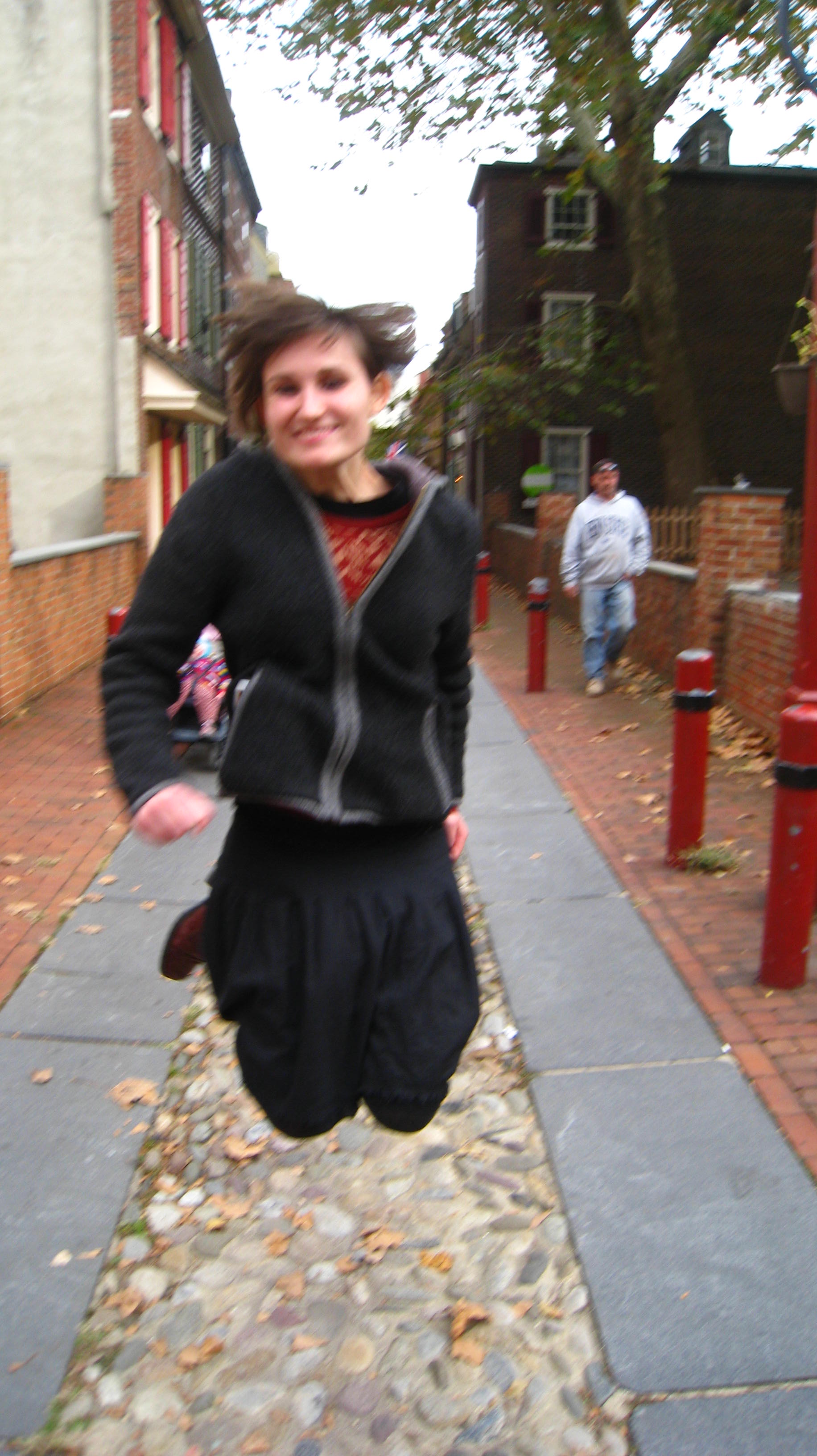
Jumping in the air in defence of nice people in Philadelphia, almost a year ago.

“HAVE I MADE MYSELF UNDERSTOOD?”

They nodded.

I had not even been aware of so much as a whisper from the girls. But I was certainly interrupted by this foul-mouthed miscreant, who had taken library discipline into his own hands.

(By the way, I take respectful behaviour in libraries very seriously and absolutely believe in regulation. But in this case the offence was minor and the intervention disproportionate and without mandate.)

Nice people, thankfully, are not in short supply. They are the ones that instinctively apologise when you step on their toe and spend hours nodding sympathetically even when confronted by a dull narrative.

They are the cashiers that give you an extra nod when you’ve completed your purchase and the reporters that say “Oh don’t worry, I was useless at the start” when you display incompetence.

They are the people that do not recoil when a foul-smelling and batty woman sits next to them on the bus and the ones that engage in mini sprints to catch up with you when you’ve dropped a mitten.

Nice people, contrary to the individualist-inspired meme, do not (necessarily) end up on welfare.

Nice people are mostly self-consciously so. They have weighed up the cost of an unpleasant smell and dull conversation against the happy after-glow of having been pleasant. It’s moral mathematics.

Nice people are not walk-overs either. Sometimes they will startle you with their outrage or righteous indignation.

Nice people are sometimes quiet but that does not mean they are taciturn or shy. They are watchful. If you adopt a scornful and derisive tone, they will greet you with a steely silence. The effect is something in between disregard and non-compliance.

In our novel, the nice people won’t end up on welfare. And if they do, it will be very generous.

“Reality” Television

I’m a “freelancer” now.

I know, doesn’t it sound exotic?

Actually, it’s a euphemism for “poor” but let’s not allow that get in the way of recording the associated advantages: staying in your pyjamas until all hours of the afternoon, leaving for work at 6 pm, and filling your head and diary with eclectic projects, many of which are yet to come into fruition.

My main job, remarkably, is in television. Would you believe, I translate and write news items, apparently watched by millions. (Don’t worry, there are lots of checks by more experienced people before my words turn into broadcasts).

I’ve only done a few shifts but I am learning rapidly how “news” works.

When I arrive at the office, I sit down at a computer and open a software programme which contains a run-down of all the news items due to be broadcast on the upcoming show.

Reports tend not to last more than about 2 and a half minutes and shorter bulletins are over within 25 seconds. So brevity and clarity are essential.

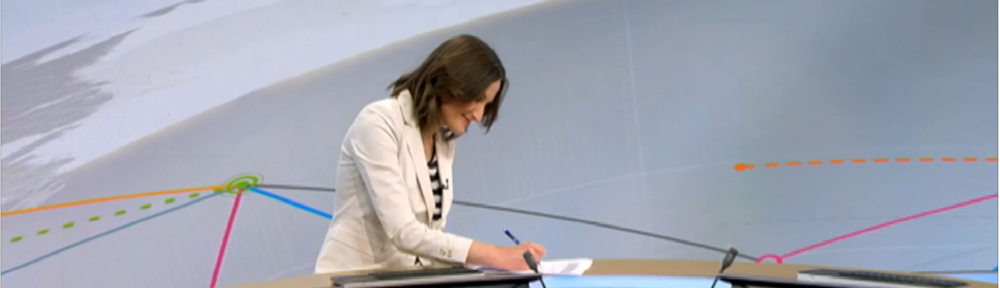
Kate Katharina reporting from Washington, with foam microphone.

So is understanding exactly what a story is about. It takes an expert to break something down into its barest form.

You have to work quickly. If a story is breaking, you need to sift through the information coming through the wires, distil it, find appropriate pictures and videos to accompany it and finally send it on to somebody who will produce it and fix any technical glitches.

It’s a huge responsibility.

And it’s that responsibility which I have been thinking about.

It’s important to remember how lucky I – and I assume most of my readers – are to live in an area of the world with an independent media and in an era in which information can go global in seconds.

More people have more access to more information than ever before.

As a result of this mass circulation and sharing of information, we can get away with having fewer sources.

And because the media now works like a web, rather than through straight lines as it used to, things can get tangled up more easily.

Since newspapers and television rely in a huge part on “wires” (=news agencies like Reuters and Associated Press) the pressure and responsibility on those reporters to be 100% accurate is enormous.

News agencies are a business. They can’t afford to send their reporters absolutely everywhere in the world, particularly not to every war-torn country with poor infrastructure and hostility to foreigners. So, our news comes from the people who happen to be stationed in certain parts of the world.

The headlines we get are a political, social and economic reflection on western life and values.

And it’s important to remember that we probably miss as many stories as we run.

Having been surrounded by extraordinarily hard-working and intelligent journalists, I’m far from disillusioned by how the media works. But I am becoming more aware of how arbitrary the selection and presentation of news has always been and will remain.

Things are moving in the right direction. Tweets fly off from the obscurest of locations, bloggers are becoming more influential, and technology is advancing in the developing world.

However, manipulation is becoming easier and more sophisticated, and misrepresentations can spread like wildfire.

I’m only starting out in the field and I am young and stupid. My main concern though is a noble one. I want to tell a truthful story well. And if that means staying small-scale and telling you about a a spindly old man and his giant dog, or about the old man who couldn’t stop falling, at least you know that these are things that I have seen with my own eyes, not images which have landed on my screen after rushing through the wires. And no matter how timid a voice I am on the blogosphere, the fact that I have one screams volumes about the democracy which we should never, ever take for granted.

Call Me Definitely

As if the “Present Box” wasn’t enough to make me smile on my way to do the grocery shopping, this mobile telephone box turned Bibliothek has just popped up a few yards away. You take a book, and if you have one spare, you leave one back. I’ve picked up a German copy of Sue Townsend’s Downing Street No. 10. I sent an over-zealous email of gratitude to the group that organises these things. Unfortunately it came back to me instantly with a notice that delivery had failed permanently. So if you’re reading, good people at Dorf Dienst, I love your telephone box-library.

The Old Man Who Couldn’t Stop Falling

I’m back: reanimated, restored, relieved! I’m still showering in the dark and when I came home from work in the early hours of this morning, I had to take care not to stumble over the enormous extension cable that snakes its way from a socket in the hallway all the way to the fridge.  But I can deal with fumbling for shampoo bottles and peeing by torchlight if I have the means to share the experience with the world.

Last week I told you about a spindly old man and his giant dog.  Today’s story is not so empowering. It’s about an old man, without a dog.

I was walking home from work the other evening.  It was dark and I was on a quiet, dimly lit road. In the distance I could make out the shadow of a figure  on the ground. Their arms were jerking and outstretched as if having a seizure.

As I got closer, I found an old man with his chin slumped to his chest, trying to hoist himself up without success. I stopped, as did the man who had been walking a few paces in front of me.

I came closer. “Is everything okay?” I asked redundantly.

The old man’s eyes slowly turned to me. They were pale blue and very round. It took him some time to register the question and when he did his expression became pained and he said slowly “Oh shit, oh shit, oh shit. What have I done now?”

I was gentle. “It happens to all of us.”

“Oh shit, oh shit. I always mess everything up. My whole life is a mess.”

I tried to find out whether he was hurt.

He couldn’t answer my question and kept saying  “I’ve messed it all up. My whole life is a misery.”

“Do you live near here?” I asked him.

“Yes.”

“Do you live in this house?” I said, pointing to number 23, which he was leaned against.

Berlin can be the loneliest of places too. I took this picture after spending St Patrick’s Day alone last year.

“Yeah.” His gaze wandered slowly around.

“Do you have a key?”

Silence.

He swayed a little.

Suddenly, with a bolt of energy that came from nowhere the old man sprung to his feet. He stumbled wildly and before I could get to him, fell forward with full force. I could hear a crack as his head hit the pavement.

Miraculously, the fall seemed not to affect him. My heart was beating very fast. I brought him over to sit on the doorstep. The old man smelt of vodka.

I called an ambulance.

The other man who’d stopped was about eighteen or nineteen. He was hovering uncomfortably and said very little. He might not have know it, but I was immensely grateful for his presence.

The old man made more wild attempts to get to his feet and fell again. While we were waiting for the ambulance to come, a young couple stopped to see if they could help. The girl was very pretty and very kind. She put her arm around the old man. Her boyfriend was more detached and said simply and without judgement, “Alcohol’s not the answer to your problems, is it?”

“You’re right,” said the old man. “You’re right.”

He sighed. “I’ve messed up my relationships. I’ve messed up my life.”

His gaze flitted intermittently to each of our faces.

“And then this happens,” he said. “And you meet people.”

The ambulance came promptly and a big man in a security vest said cheerfully,

“Now, what’s the problem here?”

It was a question which would take the sad old man years to answer.

The ambulance man hoisted him up.

The old man was so unsteady on his feet that it looked as if they were dancing all the way to the ambulance.

Katekatharina Is Offline

I’ve been sitting in a cosy café, on a brown leather sofa, ordering coffee derivatives all day. I can’t describe how grateful I am for the free Wifi they provide. A fuse blew in my flat last night and I’ve been forced to shower in the dark and to plug the kettle into one of the remaining functioning sockets in my bedroom. When the water boils, it looks like my carpet is breathing. At  least I haven’t been deprived of my last remaining comfort: a cup of tea in my Chinese mug which comes with a lid and in-built filter.

Today is a public holiday in Germany. Berliners are supposed to be celebrating national unity but I suspect they are all sleeping. The streets are eerily empty. It took me ages to find a coffee shop open. Even Starbucks has closed its doors. My plight seems all then more acute today of all days, given that a personal wall has been erected between me and the outside world.

I can do without lolcats and Youtube and even breaking news. But I find it deeply distressing to be without contact to family and friends. Katekatharina.com lives and breathes off a web of readers Googling things like “Armpit hair.” I’m yet to encounter a person who stumbles across me in real life with the same enquiry. When you begin blogging, you write to a void, but over time that develops into a small and precious collection of loyal readers who are kind enough to read your twitterings as soon as they’re posted.

I have now sat through an entire shift here. The waitress who served me my iced latté and more recently my cappuccino, has been replaced by a blonde lady with an impressive pony tail and crinkly scarf.  I am relieved because the new staff do not know for how long I’ve been here (though I suspect the waitress from before may have warned them of my infinite presence). They are tactful and haven’t asked me once to re-order. I’m going to show my gratitude by ordering a third beverage shortly.

Katekatharina in a similarly stressful situation some months ago (that time I couldn’t open a tin of tomatoes bit the sense of helpless incapacity was similar)

Anyway, on a happier note, I was delighted to find out that I’ve been chosen as a finalist in the Blog Awards Ireland. I’m terribly sorry not to be able to attend the ceremony. I wonder if the organisers would consider streaming it online.. They’d have one avid viewer in west Berlin for sure. Check out the wonderful bloggers in my category  here:  The Style Account, Wise Words, Nialler9 and Iblogfashion.

When I next get online, I will tell you about the old man for whom I called an ambulance last night. I might even tell you a little about my new job. In the meantime, do send me  a text. It’s my last remaining way to instantly communicate.