I had a dream the other night. Two soldiers were confronting each other; one had a gun pointed at the other´s forehead. The man with the gun was whispering threats. An act of unbearable cruelty was about to take place. Then I woke up.
I`ve never had a dream like that before, at least not one I`ve remembered. But I am pregnant with a boy now. He is the size of a mango, according to the app, and I can feel him bubbling and fluttering beneath my ribs. In a corner of my unconscious mind, I am wondering how I will be able to keep his body safe, once it`s in the world.
Others are having similar thoughts. At work last week, I was getting my makeup done before I went on-air. “I`m terrified about the Wehrdienst,” (conscription) the makeup artist said, as she spread powdered foundation across my cheeks. Her son is sixteen, and delicate. Germany hasn`t yet reintroduced compulsory military service, but the conversation is shifting that way.
“You`ll have to handle puberty,” I inform my husband, outlining all the ways in which I`m unqualified: I have no idea what it feels like to have a penis; to lose control of your voice when you are still half a child, the humiliating squeaks echoing against uncompromising classroom walls. To be expected to carry the heavier box.
I understand the objectification of the female body. Walking down Grafton Street in Dublin as an eighteen-year-old with my then boyfriend, we bumped into a classmate of his. I have never forgotten the sensation of that other boy scanning me from head to toe. It happened in a nanosecond, as fleeting and subtle as a packet of ham passing through a till. I still remember the clothes I was wearing; a figure-hugging sleeveless yellow shirt and black three-quarter-lengths. I passed his test.
In the following years, I sat in college tutorials talking about the male gaze and getting cross with headline writers who used passive constructions when reporting on male violence against women.
My knowledge of the male body and experience, on the other hand, is remedial. I was stunned to learn that baby boy fetuses are often identified in ultrasounds by their tiny erections. Instances, I’ve learned, of the nervous system practising its functions.
Now I am going to mother a boy, and am thinking about the myriad ways his body will be scanned for its worth. For every novel I read growing up in which women were the objects of desire, or limited to their domestic roles, he will encounter stories of boys and men in trenches, or down mines. For every billboard I saw of women with complexions and facial symmetry I could never achieve, he will see chiseled jaws and six-packs to aspire to. For every impenetrable algorithm that has made me feel less of a woman, there will be an equivalent Internet pathway, enhanced by AI, picking at his self-esteem.
He will be born into an extraordinary cultural moment. A time when the tide of moral progress is receding. A time when the current US president – democratically elected twice – is a man who brags about “grab[bing] women by the pussy” and whose response to a female reporter asking him about his connection to a serial sexual abuser is: “quiet, piggy.”
What will he make of it all, I wonder? How will our culture have evolved by the time he comes of age?
In the past decade, working in a Berlin newsroom, I experienced the sudden global awakening to women´s experiences that came with the #MeToo movement, and the resulting rush from management to introduce new directives on sexual harassment in the workplace. Even then it all seemed a little knee-jerk, as if implying that inappropriate behaviour had hitherto been acceptable, but must now be explicitly banned. When older male colleagues asked if they could still tell me I had nice hair, or a pretty dress, I responded with some version of: just use your common sense.
I think back particularly to one man, already counting down to retirement when we met. A former soldier, he´d ended up in journalism by accident. He had a reverence for the intellectual calibre of his colleagues that seemed rooted in the feeling that they came from the “right” background, and he did not. He talked to me a lot, and I listened.
He told me about a young woman in Thailand whose mortgage he was paying. “I`ll always take care of her,” he said, meaning to sound gallant, I think, but unaware of how deeply problematic it sounded to my ears. He was less interested in sex than he used to be, he clarified unprompted once – before reporting on a long-ago incident in a sauna, where a woman he knew tried to entrap him by titillating him.
Among my contemporaries, the prevailing feeling towards men like my colleague was contempt. There was no way he´d bombard a male colleague with his inappropriate anecdotes. Probably not an older woman, either. I knew all this, and still, somehow I couldn`t bring myself to tell him to stop.
The loneliness seeped out of him. I could almost see it, forming a puddle on the newsroom floor. I did not respond to his retirement email when it came. I was tired. But I wonder if he made it to Thailand, as he had dreamed, and how many mortgages and massages his pension might cover.
If I had been a slightly less empathetic person, and perhaps a little braver, a conversation with the “People” department could have seen my colleague canceled. But my total conviction in his complete lack of self-awareness made this seem like an unnecessarily cruel course of action. I thought of him as a young soldier sometimes and the reverence he had for the desk job he did now.
When I consider the regressive cultural shift we are experiencing now, what strikes me most about the form of wokeism I myself inhabited is how greatly it underestimated male fragility. It did this to such an extent that men became hysterically angry. Throughout history, we have accepted their bodies being sacrificed for the cause of nationhood, valour or economic sustenance. Finally then, a new age of reckoning arrived. But it offered neither relief nor reassurance.
Instead, it asked them to atone for crimes ranging from complimenting a haircut to committing rape. For those whose bodies were closest to the firing line, it was an unforgivable humiliation. For those whose bodies were furthest from it, like Donald Trump, it was an opportunity.
What we have got now is a dual casualty. If wokeism banished common sense, what has followed it is killing common decency. Both need to be mourned, then restored.
As a future mother to a boy, I have an interest in finding hope in the disarray.
It begins by accepting a truth which our culture has so far refused to reconcile: binaries are real, and they reside firmly on two ends of a spectrum. We can talk about male and female while accepting that most people are going to sit somewhere between the archetypal traits of both. This applies as much to politics: are you a liberal or a conservative, as it does to gender.
The boy inside of me might well be wired to prefer diggers to unicorns. He may end up physically stronger and less emotionally attuned than his older sister. But if he doesn`t, I will happily place a unicorn into his little hands. I will cradle both him and his sister close and hope that I am doing the only job that really matters: fostering decent, sensible human beings. Then I will close my eyes and hope that neither of them will end up collateral damage in a senseless culture war.
Choosing to mother again in an age of anxious ambivalence
The first time I mourned the idea of not having a second child was in the hours after the birth of my first. I was doubled over, shuffling towards the hospital toilet, in a dizzy haze after the assault of a 40-hour labour. The thought – intrusive and inappropriate – came with clarity: I can never do this again. I will never do this again. How could I? I had wanted to die.
Three months later, I took my baby to meet some friends for pizza. Some pandemic restrictions had been lifted, but the plague was not over. Bursting with pride, I passed my daughter round for cuddles. “Would you have another?” they asked. “I definitely wouldn`t rule it out,” I said. They seemed surprised.
(The fear that my daughter could have caught Covid during any of those cuddles haunted me later and until it was clear that she had not, I felt like the worst mother in the world).
Motherhood made me happier than anything in the world ever has. I had never doubted my capacity to love. But what I never expected was that in those early months, my insomnia would disappear, and I would sleep more deeply than I ever had before. That I would lay in a cocoon of duvets, breastfeeding my baby for hours on end and feel entirely fulfilled. Who would have thought, after all those agonizing years of wondering and fearing and second-guessing motherhood and how it would affect my career, that the truth was: this was better. At least, for a while. We had an unnaturally contented baby. The kind who smiled at strangers on the street and slept all night.
This was four years ago, before feminism and wokeness had been canceled. The idea that motherhood was not only more enjoyable but also more fulfilling than my job had been, felt like a thought that needed to be quashed, or at least rigorously questioned. I was mortified by the idea that my sentiment might be endorsed by some of the Internet’s vilest people. There was nothing ideological in my feelings. I didn`t care if other people wanted babies. I still wanted women in the highest positions of political and corporate power. But I was awe-struck by the little life I had created. She mattered more than anything. I couldn`t believe we all went through life paying such little attention to the mysteries and wonders of conception and childbirth.
And yes, I was definitely bored sometimes. I missed writing and feeling semi-important because I had a job on TV. I missed being alone. And I had no interest in any of the logistics of parenting: discussing pram brands or naptimes or what solids to start when. Those things left me cold. They still do.
Oh, but the love. It was intoxicating.
***
My daughter started daycare at 10 months old, early for Germany, late for other parts of the world. I went back to work and in the early weeks, found it exhilarating. Hours on end to research the decline of the liberal world order! Just for the sake of it, with no little life depending on me! Compared to parenting, it was a piece of cake. For a while anyway.
I did not realise it as it was happening but as my baby grew, I began to shrink. I was eating as heartily as ever but no amount of feasting could hold pace with the calories I was losing from breastfeeding.
I was lucky that feeding had come easily to me and that I could meet my baby`s voracious demand. I fed her before and after daycare and all night long.
The months went by. On her first birthday, I came to pick her up from daycare and found her sitting in a tiny chair at the head of a table of tiny people, wearing a paper crown. Around this time, I began to think again seriously about a second child. I had been almost 34 when she was born. I didn`t have unlimited time.
Then one day, my husband lost his job. A typical corporate layoff, it came with no warning and was executed with ruthless precision. By noon that day, a courier had arrived at our door with the letter of termination.
We live in a country with a generous social safety net. You pay in generously and when misfortune strikes, you get back what you gave. We were okay. But it was unsettling, and the economy was bad, especially for the creative industries. I put pressure on myself to work more. I fed my baby. But she wasn`t a baby anymore, she was a toddler. It was exhausting. But it was also sublime. It was both of those things, much of the time.
We didn`t own weighing scales at the time, but I did notice how loose my jeans were becoming. I bought a size down. In one of the video reports I made for work, some of the YouTube comments called me anorexic.
In the summer before my daughter turned two, we visited a friend in Austria. After our meeting she sent me a kind text. She had noticed how thin I had become and was concerned. She herself had a history of eating disorders. She was also a doctor, and had an eye for this stuff. Naturally I was defensive. I`ve never had an eating disorder. I was eating as I always had. But when I look back at pictures from that time, I can agree: I had become alarmingly gaunt. My abundant milk supply was eating away at my body fat, so incrementally that only people who hadn`t seen me for a while noticed.
***
My preternaturally “easy” baby turned into a remarkably difficult toddler, almost overnight. We were somewhat startled by the strength of will that emerged, which even the affectionate staff at her daycare conceded was off the charts.
“The world needs strong, difficult women!” my husband and I would agree – increasingly ironically – hours into trying to get her dressed in the morning, willing ourselves to believe that every time she ripped off her trousers again, a tiny layer of the patriarchy was crumbling.
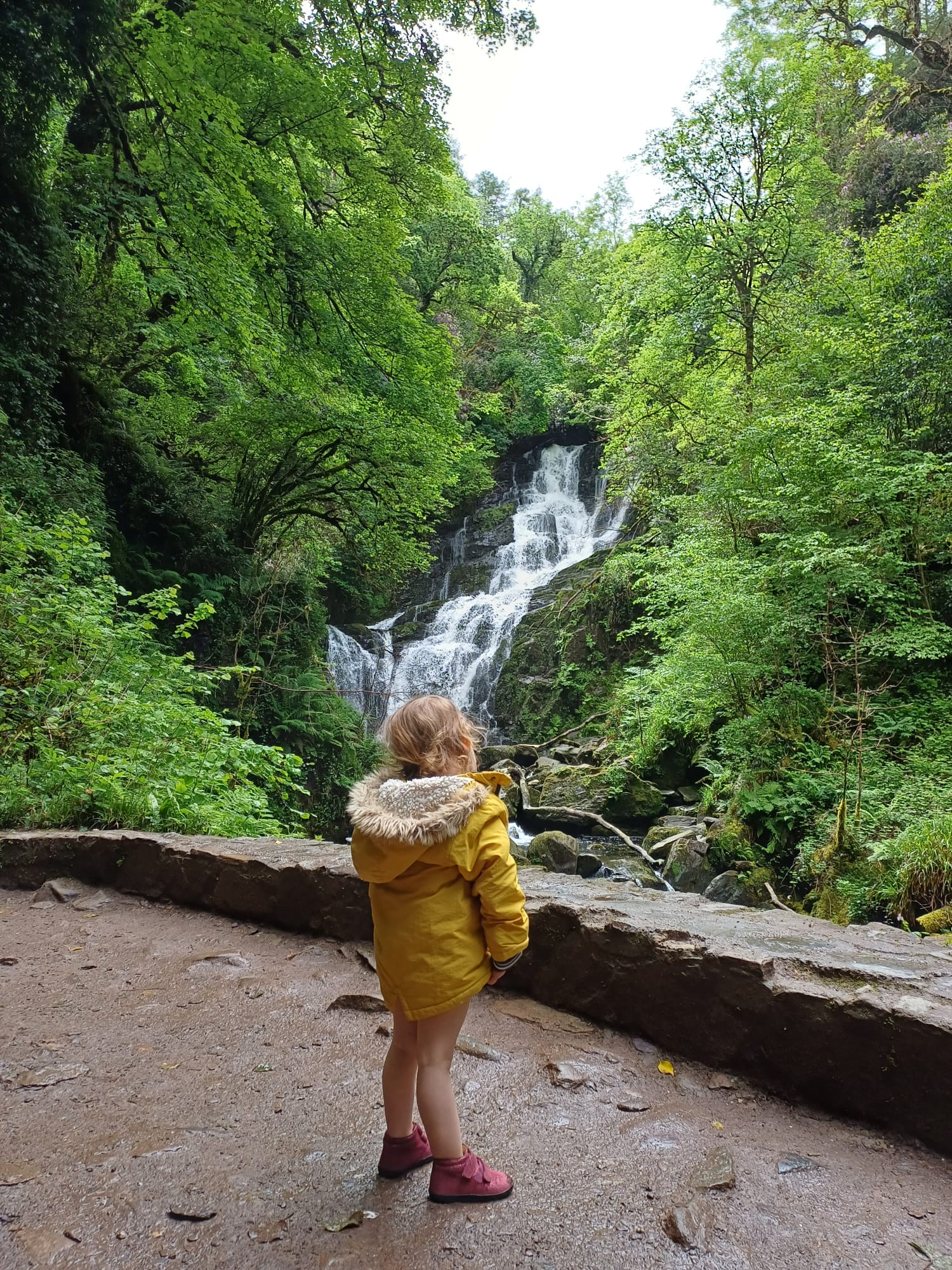
On a comically disastrous holiday to Ireland that summer, immortalized by a series of photos of my husband and me looking depleted while holding our furious, trouserless toddler at various sites throughout Killarney national park, I mourned the idea of a second child for a second time.
Our trouserless toddler
This was so hard, and we were so tired. Work no longer felt exhilarating, just exhausting. To make things more complicated, we were still coming to terms with my husband´s MS diagnosis, an illness that affects his walking and whose prognosis is unpredictable. The idea that our furious two-year-old would ever accept a sibling became laughable. It made me unbearably sad. I tried out telling people: we`re only having one. We couldn`t manage any more.
And how lucky we were to have one. Because as hard as it was, that love for our difficult, unyielding, deeply, deeply feeling, sensitive little person was only growing every day.
When she was two and a half, I had my first night away from her. The circumstances were the least restorative imaginable. Work was sending me to the industrial town of Leverkusen to interview the CEO of Bayer. I was very pleased to get the assignment, but I had to write an entire book for my daughter to prepare her for my absence. The “Leverkusen” book – bound in a purple ringbinder and featuring illustrations of domestic life juxtaposed with train travel – is still one of her favourites. The night before the interview, I didn`t sleep. Not even for a minute. I was super well-prepared, so I got through anyway. But when I watch that interview back, I see the exhaustion in my eyes, the toll of parenting and working written all over my face.
***
As much as I had mourned the second child that may never be, the truth was that I had not given up on the idea. The possibility stayed with me constantly, even in moments of great resignation. But the anxiety was great enough to mistake for ambivalence.
I scoured Reddit for stories of mothers grappling with the same question. I was searching for some kind of narrative that matched my experience entirely but never quite found what I was looking for. There were the happily “one-and-done” crew, advocating for the pleasures of a life with one child. Their arguments were highly convincing. There were those who regretted having a second. And there were those who couldn`t be happier they had taken the leap. Unfortunately, there was no one who was going to tell me what to do. My husband said it was up to me and no amount of interrogation revealed a hitherto concealed desire. He would go along with what I wanted.
I began following an account called “The Happy Caravan”, chronicling the life of Amber, a fundamentalist Christian and the mother of eleven musical children. All of them homeschooled, some have gone on to attend the prestigious Julliard music school in New York.
I became fascinated by her: eleven! From what we see online, the children all seem polite, and the atmosphere at home is reasonably calm. Of course, it`s likely that creepiness and darkness lurk beneath the surface. There are only so many hours in the day, and Amber manages to release far more videos than it would be plausible to make if you were actually looking after not only the emotional and material needs, but also the education of your eleven children. And things did fall apart, because New York prices ate them up and they had to leave in a giant trailer and move into a house in San Diego infested with termites.
But none of that erases this woman`s stunning feat: after experiencing the awesome love and responsibility and life-changing demands of having a child, she chose to do it ten more times. I studied her obsessively, trying to discern the source of her conviction. It was blind faith, obviously. But as she walked me through her gigantic Aldi hauls and chicken stew recipes, Amber, a stranger on the Internet unwittingly taught me a lesson: no amount of thinking or planning would change the fact that trying for a second child would be an enormous leap of faith.
***
I made an appointment with my gynaecologist, a tiny, 85-year-old man who frequently opens our conversations by expressing dismay at the decline of the Transatlantic relationship or with the provocative question of whether I have really read Ulysses (he knows I am a journalist and that I come from Ireland).
“We`re thinking of trying for a second child,” I told him nervously. “Machen Sie das!” (“Go for it!”) he said, without missing a beat. Then, looking right through me he added: “A child is the ultimate expression of hope for the future.”
I nearly cried when he said that.
***
My daughter had her last drink of my milk on the night before her third birthday. We had been discussing the moment for months and when it came to pass, it was seamless and beautiful. When she asked for bainne (the Irish word for “milk” my husband and I had been using as code but which she deciphered immediately because she is not only difficult but also brilliant) the following day, I reminded her that she was now three years old. “Oh,” she said giggling. “I forgot.”
I gained weight and my old jeans fit me again. As much as I had loved breastfeeding, regaining bodily autonomy was empowering. I felt freer again. The possibility of having a second child became a tiny bit less remote.
***
No one has ever told me to have children, at least not explicitly. In my industry, not having children is as common if not more than having them. I watch, sometimes enviously, as my friends travel the world, or take on exciting assignments. But I have never regretted motherhood. She is more interesting and more special than anything I have ever done at work. And because everything is both personal and political,I feel the need to add: there would be nothing wrong with it if I did have regrets. Plenty of mothers do. They might not tell you to your face, but they will confess to it in countless forums on the Internet.
It is hard to truly analyse the cultural expectations you grew up with. It requires a certain distance which by definition you do not have. As a millennial, I came of age with the arrival of social media. I know, rationally at least, that the platforms I did engage with, over years, must have held enormous sway over the formation of my identity.
When I was pregnant with my daughter nearly five years ago, I had a desire I would have denied then but can admit to now: I wanted to work and to mother performatively. I had relished the idea of displaying my big bump on air. I would post a clip on Twitter of me presenting the news with my huge belly. The implication would be that I was doing it all. I would package it into a clever humble brag.
As fate would have it, the only time I was pregnant on-air was in my first trimester, and my clearest memory of it is the genuine fear that I was going to throw up between segments. After that, I was banned from being in the studio because my workplace had a no-office policy for pregnant women during the pandemic.
***
In February of this year, I took a step that seemed momentous: I re-downloaded my period tracker app. My husband and I had decided to start trying to conceive in the summertime. I clicked the option that said “trying to conceive” and immediately my social media filled up with ads for fertility treatments.
I worried enormously that my cycles were no longer as regular as clockwork. I researched perimenopause and watched in horror as more of my hair grew grey. After all of my soul-searching, perhaps the decision had been taken away from me.
In June, the month our conception journey was to begin, my husband took a work trip. When he came back, our daughter turned into a monster, furious that the intensity of the time just with me had come to an end. We stayed inside for a whole weekend because her tantrums were so intense and her resistance to suncream so profound. It was 37 degrees outside. We sweltered inside. I imagined adding anything at all to the stress we were experiencing. Not this month, we agreed.
“Are we ever going to do this?” I asked my husband.
“Yes,” he said. “Just not right now.”
We knew this was an irrational way of going about things. But nothing about creating a new life is rational.
***
Autumn comes and it is more beautiful than ever. My daughter and I watch mesmerised as the orange leaves twirl off their branches under a clear blue sky. She scours the back yard for chestnuts, demanding I close my eyes so she can present them to me as gifts. She learns to ride a bike.
The videos on my feed change. What I see now are gender reveal parties and women speaking about miscarriages. My period app has communicated the news to the tech titans before I have to my family.
I can no longer close the button on any of my jeans and opening the fridge door is a hit-or-miss experience. I vomit when I exit the shower, a phenomenon ChatGPT tells me is likely to be due to an overactive vasovagal reflex caused by the shock of moving from hot to cold.
***
We were on holiday in Krakow when I found out. I took the test one morning in our palatial bathroom, which featured a faux-gold bathtub. The line appeared immediately. I called my husband. We took in the news quietly, and hugged. Like all life-changing moments, it felt both incredibly real and not real at all.
We went for breakfast with our daughter. Walking there, I felt a glow pass through me: I wanted this so badly and yet I could not believe it was happening. I breathed in the moment. When our food came, I insisted we take a selfie, so I would remember the hours after finding out, that secret time when your world changes and no one yet knows.
A week later, one of my favourite influencers, a woman who has been documenting her struggles with endometriosis and IVF for years, announced her pregnancy. I cried with joy for her; big, ugly messy mascara-tinted tears. Our pregnancy was only one week apart.
My daughter demands to see the video of the “woman crying and laughing with the stick in her hand.”
“Why did I not cry for us?” I ask my husband. “Why did we not cry for us?”
“It`s not our style,” he says. “We don`t scream on rollercoasters either.”
He is right. After so many years of agonizing over whether I could dare to indulge the deep and audacious desire to mother again, my joy was a quieter one, a creeping, cautious gratitude tinged still with an acute awareness that nothing can ever be taken for granted, especially not a safe pregnancy.
Our daughter, aware that something momentous is happening, is clinging to me more than ever. My fatigue is so extreme that I often fall asleep in her bed while reading her bedtime stories. When she wakes in the middle of the night and sees me there, a huge smile spreads across her face. I bundle her in my arms and kiss her hair.
“Maybe we should call our baby sheep,” she says. “Maybe,” I agree.
She lays her still tiny hand on my stomach.
“Your tummy is getting so big!” she says, adding “I also want to be a mama.”
“But also a bus driver,” I remind her.
She nods.
“You can be both,” I stress, remembering that everything is both personal and political. “How many children would you like?”
It has been eighteen months since I wrote the story below. I crafted it in a cafe one weekend, while my husband and baby daughter were at home. I have written no fiction since. The joys and demands of parenting, working and cultivating my most meaningful relationships does not allow for a fourth bedfellow. But I mourn the losses of this season less than I thought I would. Art is a wonderful thing, but it is no subsitute for life. My life is fuller now, but there are fewer words. When I wrote this story, I was thinking deeply about creativity, Artificial Intelligence, motherhood and their intersection. I hope you enjoy it, and thank you, as ever, for reading!
Caroline GPT
The first time I met Caroline was at our mutual friend Adrijana’s book launch. Adrijana had written an account of her experience traveling the world with her Hungarian hunting dog, Miksa.
It was an incredible text. The style was like nothing you would have read before. There was a haiku about an old man and a very young boy kissing in a cave in Mexico, a stream-of-consciousness narrative in the voice of a Sherpa and a series of unconventional lists, like ‘top ten personalities of the beetles Miksa stamped dead last night.’ But it wasn’t at all pretentious, like you might expect a work of that kind to be. Like everything Adrijana did, it was brilliant in an effortless, indifferent kind of way.
“I feel like a right tit whenever I’m next to you,” Caroline said as we all stood in a circle around Adrijana after the reading. “If you’re not writing books, you’re fucking climbing Mount Everest or winning codeathons.”
“You should put that in the ‘Praise for the author’ section,” I said, and everyone in the circle apart from Adrijana laughed.
The peculiar energy of the moment – I mean the way Adrijiana didn’t bother pretending to find my joke funny – reminded me of when were in college together. Adrijana and I were outside the lecture hall with our takeout coffee cups and the sun against our backs when this guy called Robin Evans asked if we were going to his birthday party that night. “Nah,” Adrijana had said. “I don’t want to.”
“No worries,” Robin Evans had said, his eyes widening in surprise before slinking away. I told my boyfriend about it later, marveling at Adrijana’s unfiltered way of speaking, and Robin Evans’ magnanimous reaction.
“I guess people respond better to the truth than we expect,” my boyfriend had said. But then he added: “Not that Adrijiana strikes me as a particularly truthful person.” I demanded to know what he meant. But he grew tired of my tedious questioning and said he couldn’t say exactly why he’d said that, and that he had only met Adrijiana a handful of times anyway. For years, I poured over this, trying to remember the times they had met prior to his sharing that observation, but the events always seemed innocuous.
It bothered me though, because it threatened a theory I was developing: that highly creative people aren’t bound by the agreeable impulses the rest of us are and that it is in fact this candor that lies at the core of their artistic brilliance.
I could think of examples from my work. As an agent for scriptwriters, I come across many talented people. But the ones that stand out all tend to have in common a disregard for platitudes. One producer in particular, a brilliant man, always takes an extra moment to decide what he thinks about what I have just said, even if it’s something unimportant. For example, I mentioned Adrijana’s book to him the other day, and how it could be creatively transformed for the screen: An indie answer to Eat Pray Love. “I don’t know what that means,” he said, and I admitted that I didn’t either.
After the book launch, we went to a bar. Adrijiana ordered a pot of herbal tea while the rest of us had wine. I thought of a passage in her book in which she takes mushrooms with an old woman in Siberia. The woman had just lost her husband to Covid. Adrijiana had been wandering around looking for accommodation when she happened upon her, howling outside her apartment block waiting for the undertakers to come. The woman was still in her slippers, which had been discolored by the dirty snow. Adrijiana described the dead husband’s gray face, and the Ziplock bag, clouded with age, that contained the mushrooms.
“I know you’re insanely talented,” Caroline was saying. “But I still can’t fathom how you manage to do so much.”
Adrijiana shrugged. “I don’t have kids.” I spotted her take in the barwoman, a slip of a girl in a plain black t-shirt, her mousy hair held up in a greasy bun.
Apart from Caroline, I had met everyone around the table before. None of them had children.
“Sure,” said Caroline. “It’s all Jack and Sarah’s fault. If only I’d stayed childless, I’d be a sensation too.”
I was glad someone was articulating the collective inadequacy of the group surrounding Adrijiana. But I was embarrassed too. This was not the kind of talk to hold the attention of a person who took mushrooms with a bereaved stranger in Siberia. Still, it seemed cruel not to acknowledge what Caroline had said.
“At least you have an excuse!”
“Thanks for letting me off the hook!” Caroline said, nudging me playfully in a way she might not have without the wine.
***
A few months later, when I was in town shopping for an outfit for my work Christmas party, I saw Caroline again. I was holding a dress up in front of me in the mirror, when I spotted her behind me in the reflection.
Her basket was full to the brim with loose underpants, a multi-pack of nylon tights and two children’s sweaters, one featuring a snowman, the other a reindeer. For the life of me, I couldn’t remember her name.
“Oh, hiiiiii!” I said. “How have you been?”
We exchanged small talk about the electric response to Adriana’s book. She was properly famous now. The New York Times had interviewed her. The article featured a lengthy description of the chatbot she was working on. Trained on a vast quantity of data, it would one day be capable of responding to prompts to create all kinds of texts, from poetry to scripts to legislation. Early tests suggested its linguistic ability was more humanlike than any other Artificial Intelligence system already in existence.
A coding genius goes on a journey of discovery was the subline.
“You know they’re making it into a film?” she said.
Maybe it was because of the harsher store light, but her face looked very different from how I remembered it from the night of the launch. It’s kind of hard to describe, but it was as if her eyes and mouth were working against each other, each telling me a different story. Strangely, as we talked, the names of her children came to me: Jack and Sarah, without whom she could have been a sensation. But hers still eluded me.
“Love the Christmas sweaters,” I said, motioning to her basket as we were parting ways.
She nodded and smiled, then burst into tears.
I returned the dress to its hanger and held her as she sobbed.
**
“I’m mortified,” she said when we got to her house.
“You’re in shock,” I said as she held the door open for me. In the hallway, a painting of a sunset caught my eye. It was a watercolor; a classic beach motif with glistening water and a pink and orange-streaked sky. In the bottom corner, signed neatly was the name Caroline Foley.
We went through to the kitchen, and she turned on the kettle.
“How are Jack and Sarah taking it?” I asked.
“Sarah’s too young to know what’s going on. Jack asked me where dad was last night and sort of accepted it when I told him he was off on a little break.”
The worst thing, she said, was the effort her husband had put into lying. Subtle things that were only now coming to her. One Friday, when he was going to see the other woman, he told her his company was making him go on a team-building weekend. Scrolling back through his Instagram feed now, months later, she was reminded that on that very morning, he had shared a cartoon from the New Yorker showing a group of people in a conference room. One of them was pointing to a chart showing a line on a downward trajectory. He had captioned the post #corporateretreat. But there had been no corporate retreat.
“Just stuff like that,” she said. “To throw me off the scent.”
He had come clean a week ago after the other woman had given him an ultimatum.
“He was sitting in the chair you’re in right now, shaking like a leaf. I actually felt sorry for him. Isn’t that ridiculous?”
Her humiliation was complete when she said she may, under certain conditions and for the sake of the children, be able to forgive him, and he replied through sobs that he simply didn’t love her, at least not in the way he needed to, and that he was so deeply sorry for it all.
All of this had happened last week.
Before I left, I asked to use the bathroom and on my way there, I peered into the children’s room, whose door was ajar. There were two paintings hanging over the beds. One was of a blue elephant, the other a pink rabbit. The elephant’s tail ended in a bow, and the rabbit was wearing a dress. They too were signed Caroline Foley.
Later, as I was making to leave, I mentioned how it would be important to have something else to focus on in the coming months, something to keep her sane. We were in the hallway at the time, and my eyes fell again on the sunset.
“Do you paint?” I asked.
“Oh,” she said, casting an embarrassed glance at the sunset. “Only by number. I don’t make anything original.”
“You made two humans.”
“I’m not sure that counts.”
We exchanged contact details and promised to be in touch. I saved her in my phone as “Caroline (Adrijiana).”
**
The walls in the clinic waiting room were pale pink and something about the way the sun was streaming in made me feel like I was in a romcom, teetering on the verge of some comedic mishap, like bumping into a boss, or dropping tampons all over the floor. I had booked a special after-work appointment in a moment of resolve but now, reading the brochures in more detail, it all seemed impossible.
My boyfriend and I had broken up the winter just gone, only a few weeks after I encountered Caroline in the shop. Nothing had happened, which was why it ended. Our relationship simply teetered out with no fanfare and neither of us mustered the energy to put up a fight. One of the last things he said was that he didn’t know why, but that there was some kind of momentum missing, that our relationship seemed shaped by an absent life force. And that even though we loved each other, it didn’t seem to be enough. I said I agreed. It was the most honest conversation we had ever had and it made me want to start over, right from the beginning on an entirely different foundation. But of course, that wasn’t possible. Eventually he moved out and I wondered where the last sixteen years had gone.
The language in the brochures was depressingly sober (probably for legal reasons) so I took out my phone in search of some uplifting testimonials. A text had come in from Caroline.
Did you see this?
There was a link to a Tweet that had been posted just under an hour ago. It was from the production company that had been turning Adrijana’s book into a film. They were backing out of the project on account of “recent revelations about the authenticity of the source material.”
An unnamed individual had taken a closer look at the text, and raised questions about how Adrijana could have traveled to the places mentioned in the book. The timing was off, they alleged. Certain attractions she had claimed to have visited would have been in lockdown. And there were no dogs allowed in the Sistema Huatla caves. Definitely no hunting dogs.
Adrijiana had retweeted the production company’s statement. Human 1 – Chatbot 0, she had written. Another act of brilliance.
I messaged Caroline back: WTF?
I know! Do you believe it?
As in, do I believe she made it up?
Yeah
Yeah
Yeah, as in you believe she made it up?
Yeah, I think she could have
But why?
Because she could, I guess
I didn’t want to get into a conversation about Generative AI with Caroline. I doubted it was on her radar – it was easy to find the time to read think pieces in The Atlantic when you had no dependents – but also because I thought she would be more dismayed by than in awe of its capabilities.
I found a story about a woman who had frozen her eggs at the age of 37. The hormones she had to take had a grueling effect. A restaurant manager who worked crazy hours, she had no time for dating. Six years later, her restaurant folded, and she became interested in the wellness scene. She set up as a coach, and finally, felt ready. She used donor sperm, and gave birth to a healthy baby girl, whom she named Pearl, after the restaurant. She was happy now, happier than she had ever been. The story appeared on the website of a fertility center in Perth, Australia. At the bottom of the testimonial, in small print, I read:
Disclosure: Ms. Thompson received remuneration for sharing her story
Minutes later, lying with my legs splayed, I listened to the doctor outlining the probabilities I had already encountered in the brochures. It was a very promising procedure, she said, which had worked for many people. But it would be dishonest to say the odds were in my favor. Ideally, I would have frozen my eggs five years ago when they were fresher. Still, it was an option that was very much open to me. And it was worth checking with my employer about financial support. Some of the bigger tech companies now included egg freezing as part of their coverage.
My phone buzzed and I waited until the doctor’s eyes returned to the monitor to read the message.
This is doing nothing to restore my faith in humanity!
We reviewed my medical history, which contained nothing that would make retrieving the eggs complicated.
“It’s up to you,” she said.
I looked down at my body, at the long, loose-fitting skirt rolled up like a napkin over my belly, at my bare feet suspended in the loops of the stirrups. The late evening sun was streaming in the window, casting a pink glow on the wall. The water cooler gurgled, like waves crashing on sand.
I thought of the old woman in the snow. The Ziplock bag clouded with age. Her slippers blackened by the dirt. The undertaker on the way.
The other day, I went to my local supermarket chain in Berlin to buy a jar of pomegranate seeds. I was on a mission to make a warm cauliflower and chickpea salad and the pomegranates seemed like an essential component.
I scanned the shelves but couldn’t find any. I was about to head home disappointed but thought: well, what’s the harm in asking?
“A jar of what?” the man asked. He was tearing off the cellophane from a huge packaging cart of yoghurts. “Pomegranates? I didn’t even know they came in jars!”
He was small and wiry, with twinkly eyes. I`d have put him past retirment age.
“Oh, well thanks anyway,” I said brightly, turning to go.
But he wasn’t finished.
“You know,” he said. “I used to work in 𝑅𝑒𝑤𝑒 [another supermarket chain] at Alexanderplatz right after the 𝑊𝑒𝑛𝑑𝑒 [the German term for reunification]. One day, someone came in looking for still water! Can you imagine?”
At this point, I need to translate something.
In German, 𝑠𝑡𝑖𝑙𝑙 means silent. You know as in 𝑆𝑡𝑖𝑙𝑙𝑒 𝑁𝑎𝑐ℎ𝑡 (Silent Night)
But it`s also used to describe non-sparkling water: 𝑆𝑡𝑖𝑙𝑙𝑒𝑠 𝑊𝑎𝑠𝑠𝑒𝑟.
“And do you know what I said to them?” he said. “I said to them: well to be honest, I`m not in the habit of conversing with water!”
He´d abandoned his packaging cart to tell me this story. He went on to describe how confusing it was suddenly to be bombarded with so many new products from the West. He kept mixing up bottles of wine with bottles of vinegar. It was a lot to deal with.
Why am I sharing this story? Couple of reasons.
For one, it made me reflect on Germany`s reunification history. About the stories that never get told. The people who`ve worked stacking supermarket shelves all their lives, first in the Communist East, where they could name all the products, and then in the West, where they were suddenly confronted with worldier customers demanding bottles of 𝑆𝑡𝑖𝑙𝑙𝑒𝑠 𝑊𝑎𝑠𝑠𝑒𝑟. Against the backdrop of so much jubilation, it must have been a difficult psychological shift.
It also made me reflect on how much our shopping baskets reveal about who we are. I live in a world of roasted cauliflower and pomegranate seeds. He most definitely does not. If I hadn`t approached him, our two worlds would never have collided.
As a journalist, it also reminded me of what sometimes happens at the end of an interview. You think you`ve asked all the important questions, your guard is down, you`re winding things up, and suddenly you find yourself in a conversation of far greater candour and depth, making the rest of the conversation feel almost irrelevant.
I call this the “pomegranate effect:” the meaningful connections that arise when we seek greater depth not in order to fulfil an agenda but to satisfy genuine curiosity.
Our everyday lives are full of them and as a business journalist, I think our coverage of the economy could do well to include more of them. What are some of your pomegranate moments?
Remember daily vlogs? Oh, I used to love them! The more mundane the better. I`m talking teeth-brushing (does the stranger on the Internet pace restlessly and dribble the way I do?) grocery shopping (what aisles do they frequent and why?) grooming (mascara every day or just on special occasions?).
They`re probably still a thing on YouTube but I`ve slipped out of that world, what with becoming a parent and being busy, exhausted and slightly sick all the time (also occasionally profoundly fulfilled and in love, but who wants to read about that?).
Anyway, the good news is that I have found the children`s version of a daily vlog, thanks to some dear friends who gifted my daughter her favourite book.
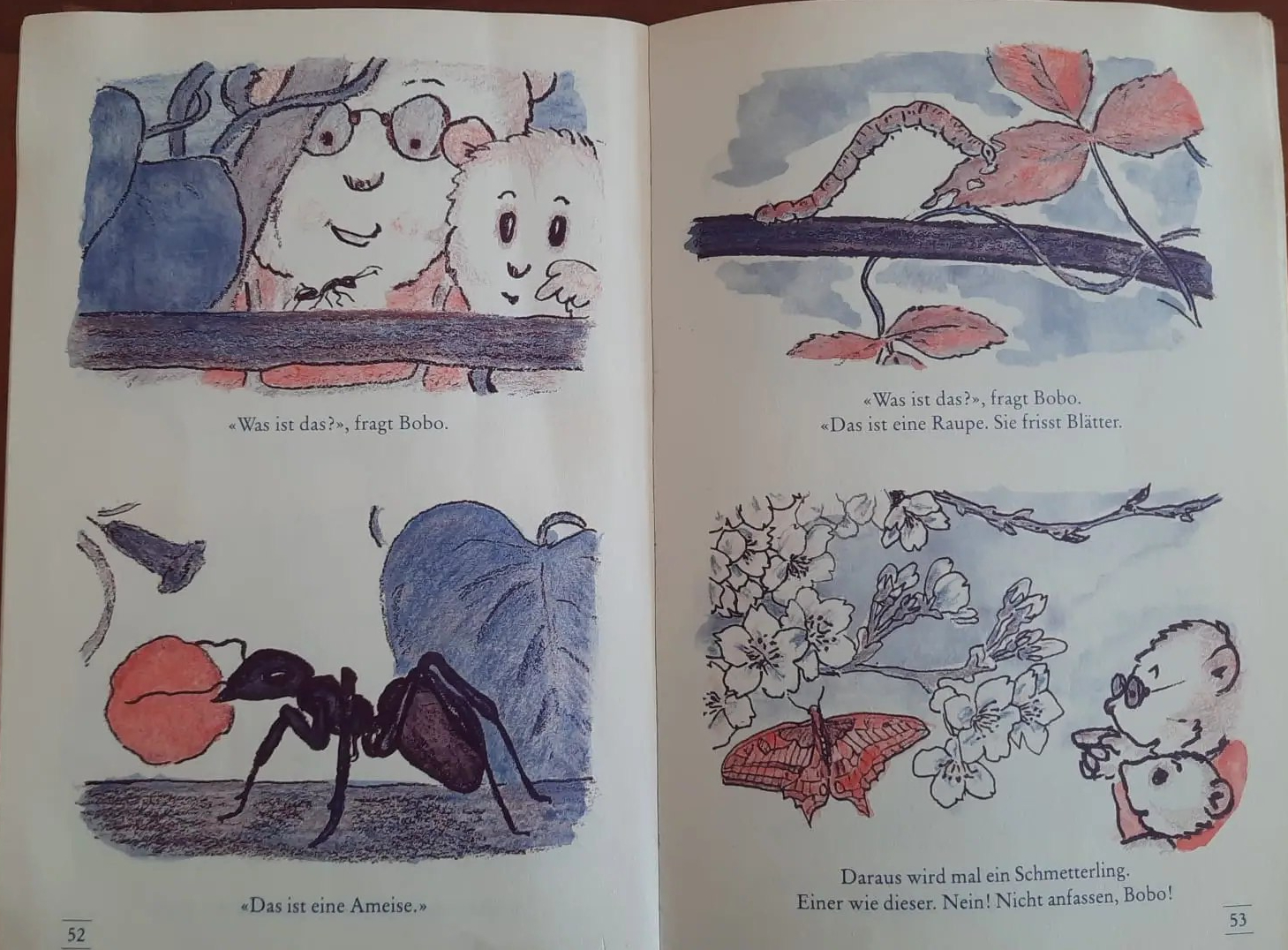
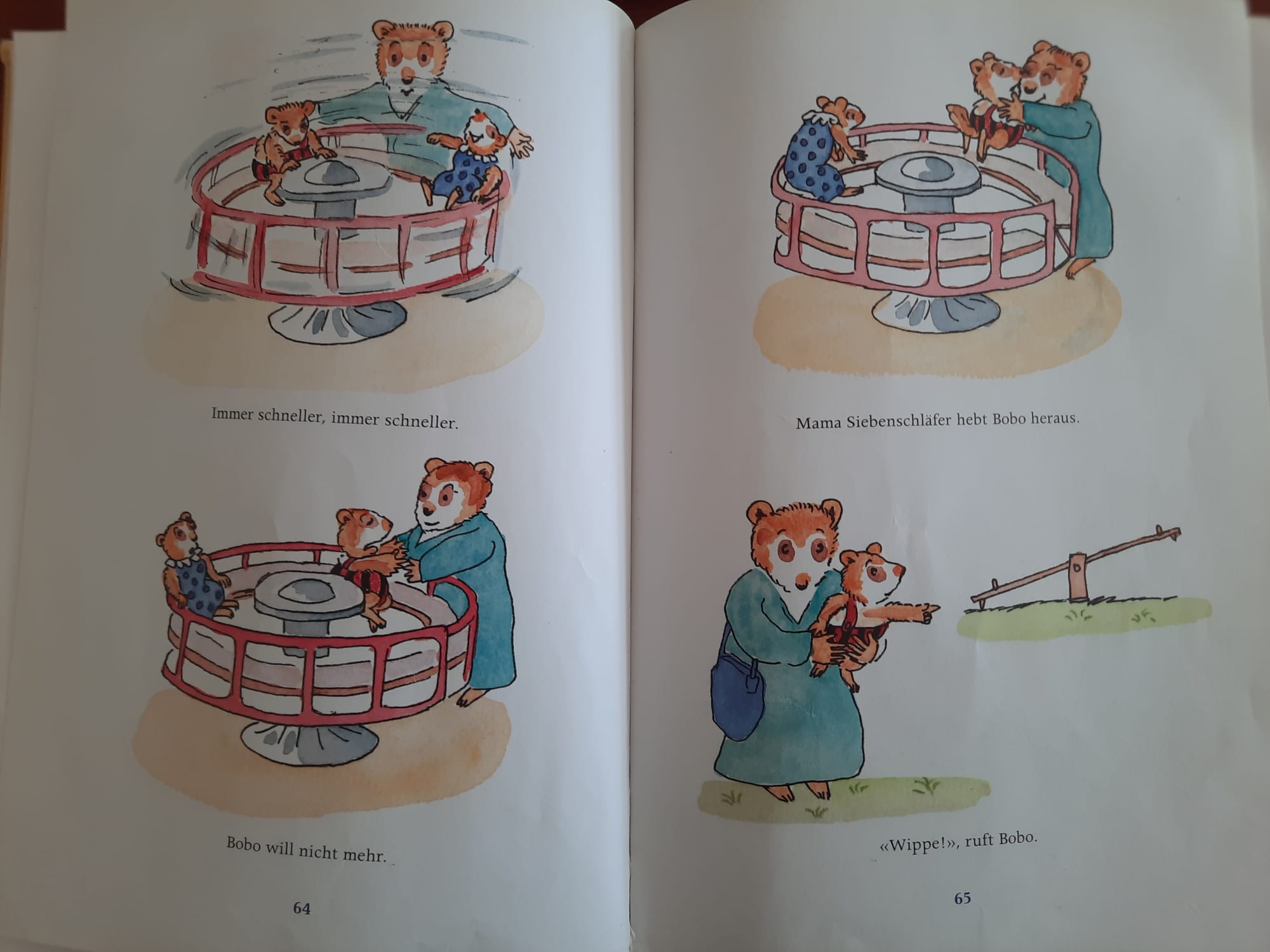
The protagonist is a dormouse called Bobo. Unlike other children’s books heroes, Bobo`s life is not one of great adventure. In fact, he does what most of us do: gets up in the morning, has his breakfast, goes out for a constitutional (often to the playground), does some grocery shopping and reluctantly goes to bed.
But it`s the small moments within Bobo´s simple life which form the heart of the story. “Uh-oh!” my daughter exclaims,when Bobo spills his cocoa at breakfast. She too has knocked over a beverage or two in her time. “NEIN!” she remarks, wagging her finger when Bobo`s grandmother shows him what a butterfly is and warns him not to touch its wings. “Ah!” she agrees when Bobo stands on a box to help him reach the door handle (alarmingly, she doesn`t need a box anymore.) “Arghaargha!” she shouts in excitement as Bobo gets on the carousel, only to decide immediately that he has had enough and wants to go on the see-saw instead (how often have I been there?).
The fact that our literary tastes align may not come as a huge surprise. But it is interesting to me that my daughter`s favourite book is not an exciting one, but one set at home, punctuated by quiet humour. In literature, I too find myself drawn towards the lives of ordinary people (or dormice) in ordinary settings. By far the best recent example I have read is “Marzahn mon Amour,” by German writer Katya Oskamp. The winner of this year´s IMPAC Dublin Literary Award, it’s the story of a writer struggling to sell her book (relatable content) who becomes a chiropodist to supplement her income and collect stories (possible idea?). It`s a wonderfully tender, funny, achingly real portrait of everyday people in the Berlin district of Marzahn and how their stories present themselves in their feet.
It was also a reminder of what I look for in a story: humanity, specificity, humor, tenderness (Bobo has it all!). With the journalism industry facing a triple assault from AI, precarious business models and public spending cuts, it also offered up a possible alternative career pathway. Could I too retrain as a chiropodist? Would the experience offer up a sellable idea for a novel?
Most likely not. Katja Oskamp`s talent is unique. So while I`ll hold out on a radical career change for now (or until I have no choice) I`ll cherish the time spent with Bobo and my daughter. And who knows? Maybe I`ll even start a daily vlog. Or re-cultivate a similarly outdated medium like this poor, neglected blog.




 Kate Ferguson