Unknown's avatar

About Kate Katharina

Kate Katharina wltm people with stories for literary fling and maybe more.

“Face of Ireland” Contest makes Farce of Ireland

Today Waterstone’s Bookshop announced the closure of its two Dublin branches and the Sunday Tribune newspaper went into receivership. I spent the day in my bear onesie; having spent an unfortunate night vomiting. The news about the Waterstone’s closure reached me via text message from my dismayed, book-selling LSB who had just finished work. Nursing a saline medicinal solution and rather cosy in bed, at the moment my phone beeped, I had just finished reading Stefan Zweig’s The Post Office Girl; a story of cultural and ideological tragedy that depicts the epic and transformative power of money.

With these thoughts at the back of my mind, I got around to researching the “Face of Ireland” beauty competition, which a friend of mine told me that she had entered last week. The contest, which I had not heard of before is now in its fourth year and promises the successful candidate “a year of glitz and glamour”.

But both come at a price. If I have understood the terms and conditions of this dubious divafest correctly, I calculate that all candidates that reach the grand finalé will have forked out €750 for the privilege. The website stipulates that: All candidates who are selected for interview will have to pay a small fee for the upkeep of the competition. I know from my friend that this “small fee” happens to be €150, a sum with which you could procure at least ten great works of literature from Waterstone’s bookshop. In an uncanny commercial coincidence it just happened that every girl selected for interview also got through to the next round. My friend opted out at this point and in an indignant text message which I sent her from Penneys in O’Connell Street I ensured her that she had done the right thing.

Should she have progressed further through the competition, she would have been required, in accordance with the terms and conditions, to sell at least 10 Tickets at a costing of €60 each for the semifinal show. This year’s Face of Ireland, Louise from Donegal blogged happily of the night of the grand finalé that Between cat walking, interesting questions and a few unexpected party pieces an entertaining night seemed to be over in a blink! I know it’s a cliché but to have made it that far, every single one of us was a winner!.

I suppose with a loose interpretation of winner, any achievement is possible. In a society which has lost its money, its bookshops and its most educated people the success of this kind of vacuous endeavour makes a farce of us all. I have a lovely memory of sitting upstairs in the coffee shop of Waterstone’s on a spring afternoon during my first year of university. Our tutor had taken us there to discuss Structuralism over a cup of hot chocolate. Soon enough the Deconstruction will begin at that site and the future Faces of Ireland and their fans will stand proud, pouting over it all.

Sunday Miscellany or “My Week in Review”

Monday: 8.45 pm Anticipating Fade Street

There have been no new Vatican scandals to report this week, and so the crusade against my mother, who likes to watch Would You Believe instead of Fade Street needs not be fought. I am walking home from Harcourt Street, where I have been instructing a group of fourteen foreign aupairs on the Third, (and hopefully ultimate) Conditional of the English language. Having survived another session, it is always a treat for me on the way home at this time to direct my thoughts from lesson planning to game theory as I analyse Louise’s next career move, due to be revealed at the later time tonight of 22.50.

Tuesday: 6.10 pm Yoga in Rathmines Town Hall

There are bits of mashed potato on my handtowel and so I lay it out near the back of this expansive yet unassuming space, just beneath the Rathmines clock tower. Around me the shapes of sleepless breathers are stretched in voiceless vertical lines. Their soft mats outlie with intuitive grace the length of their bodies. I curse my loose interpretation of BYOM (Bring Your Own Mat) and hope that my LSB enjoyed his surprise meal of potato mash during my lunchtime visit to Dundrum, from where I have come. In spite of the five layers of tinfoil which I wrapped around the bowl, some sneaky particles have managed to slither their way up toward my towel where they rest, content to be squashed but not devoured. As I inhale into my yoga cat pose, I resolve that by week two, she will have a Davina McCall mat, just like her feline contemporaries. I meeow mentally and exhale.

Tuesday: 8.05 pm Start Your Own Business in Rathmines Town Hall

“Does anybody need the terms ‘Sole Trader’ and ‘Limited Company’ explained?” the teacher; a banker with fourteen years of managerial experience across the road in Bank of Ireland asks.
A tired arm at the back creeps up; my left.

Thursday: 9.15 am “Chat about my CV” at a language school

I call in at reception and am greeted by an amiable country man in his sixties. “Just a minute”, he smiles after I have told him who I am.
Several minutes pass and finally I am escorted upstairs to a little office.
Inside a lady is sitting on a gym ball. There are scrunched up balls of paper scattered all over the floor.
“Do take a seat”, she says, “sorry about the mess, I was just tidying actually”
I recline.
“So…” she rummages on her desk. “I have just printed out your CV”
It is fresh off the presses, indeed.
She skims it and pauses.
“This is an informal chat”, she says. I sigh in relief, having interpreted the scrunched up bits of paper and the gym ball as cognitive obstacles designed to weed out the weaker candidates. We have a lovely chat and she vows to keep my details on file should a vacancy arise. I thank her and leave, relieved that I considered only for a few seconds the night before whether I should wear slacks and a jacket for the occasion.

Thursday 9.45 am: St Stephen’s Green Shopping Centre

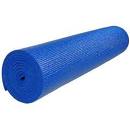
The Stephen’s Green Shopping Centre is empty, except for a few old men, who have arrived early to rest on its benches with the morning Metro. Shop shutters are beginning to lift open as bleary eyed staffmembers clock in. I rush in the direction of Argos, which beams at me with the catalogued promise of fulfilment. I leaf through its yoga mats and alight on the second cheapest one. The cheapest, at €7.00 did not advertise its potential to be rolled up and carried and as I learnt earlier this week, I am in no position to make assumptions on these matters. I am flooded with dopamine after my purchase and decide to browse the clothes section of Dunnes Stores. My beahviour becomes increasingly impulsive: I purchase a piece of rowing apparatus and a pair of grey tights.

Blue Yoga Mat with guaranteed roll-up mechanism

Friday 7.15 pm Faire le babysitting

I am waiting outside the door of the house where I babysit and so is the economics editor of The Irish Times. I am vaguely tempted to tell him who he is, but restrain myself and beam instead, announcing that I am the babysitter and so we are probably both in the right place. The door opens and we are greeted by a mad labrador and an adorable red haired and precoscious little girl. The dog makes a run for me and I grab reflexively her front paws and we dance, wildly. “Don’t mind her”, the little girl tells me, “she is pubescent”.

Saturday 10.45 pm: Fade Street

“Fuck your Honda Civic, I’ve a Horse Outside” is blaring through the bar of the Mercantile hotel. I am imagining tourists leafing wildly through their pocket dictionaries, wondering whether things really are so bad and whether this is what the commentators mean when they talk of “Irish resilience”. We end up in the Market Bar of Fade Street and as I nurse my Paulaner, I think of the pleasure that awaits me, 48 hours from now.

All that glistens is not Gold

Dún Laoghaire bay glistened pale blue and brilliant white. On my way there, on board the 46A bus, a schoolgirl sat next to me eating salt and vinegar crisps for breakfast. She was small enough, with wavy brown hair and a chequered uniform. When the bus pulled into Dún Laoghaire, I avoided gripping the point on the pole where she had smeared her greasy fingers. I was early for my appointment in the yacht club so I found a café and bought myself a hot chocolate. I felt as if I were back in London being an early-riser cosmopolitan-type enjoying the sunshine with strict purpose. I took out some books and a notepad with the intention of planning the class I was to teach later on.

Next to me two ladies sat down opposite each other. Fortyish – the two of them – I would say. The one I had a good view of was blackish-grey-haired and had that bowl-cut hairstyle known from childhood. She had an intense look on her face and told her friend and confidante that she needed to use the bathroom. Off she went. I read some more about the Third Conditional and took some notes. The lady came back and the coffees they had ordered arrived. They began to stir their drinks and what they talked about was crying. The blackish-grey-haired lady has spent her life not allowing anybody see her cry and this had to stop. She resolved to cry in front of friends and family. Her friend, or therapist nodded and added “You need to change, Margaret”.

Time up and I had to tear myself away from the scene. All kinds of backgrounds to it had danced around my head- was this an exposure session for a patient suffering from OCD who had a fear of drinking from dirty vessels shared by the general public? Or perhaps the dialogue represented no more than an unbalanced friendship. Or perhaps a marital crisis.

I came out of the yacht cub two hours later the honorary editor of a new website called http://www.writing.ie and smiled when I realised that there may be a genetic component to holding such a title: my father has been honorary editor of the historical journal, The Irish Sword, for years.

I was too timid to ask to use the facilities in the yacht club and so I went in search of a bathroom in the village. I was striding down the main street in the hope of finding a MacDonalds when an elderly man startled me. He came from nowhere and barred my path. I swerved apprehensively.
“Excuse me, love”, he said. “Do you know where I can get a box of sweets around here?”
An extraordinary request, I thought and all that popped into my head was: “I don’t know. I’m sorry, but I am new to the area”.

My mind was still bouncing with ideas from my meeting in the yacht club but my bladder was speaking with a singular urgency. I conquered a cubicle in the Bloomfield shopping centre and emerged, relieved.

On my way out, I passed a gaudy ‘Cash for Gold’ store. Inside, the salesperson was sniffing and mauling a golden chain. Before him was parked a large wheelchair where a young man lay on his side, paralysed. His father hovered above, observing with shifting resignation the sniffing Shylock.

The Jibbertalky

I have few accomplishments to recommend me; I cannot draw, my recitals on the pianoforte are clumsy at best and I have neither a talent for embroidery nor the gift of graceful movement. The one area in which, after much searching, I have found myself to excel is in the ability to produce plausible-sounding Gibberish at will.
Though it is far from my best, you may have a listen here.

I have found that the children I babysit for nextdoor can speak Gibberish fluently but that older, more refined people sometimes struggle with the language. My Long-Suffering-Boyfriend (LSB) for example, speaks only pidgeon Gibberish, but enough to get by in most situations. I can only aspire to match some day the eloquence of Charlie Chaplin, the world’s only native speaker of Gibberish as he introduced the world to Sauerkraut.

I think my good friend Stephen Pinker would have a lot to say about Gibberish. He mentions Lewis Carroll’s 1872 nonsense poem The Jabberwocky in his book The Language Instinct as appealing to our hard-wired knowledge of and acquired predictions about language. If he were to condescend to read my blog and then stoop even lower to follow its links, I imagine he would point to the patterns of intonation in my speech as consisting of a mad mishmash of the grammatical structures of the languages I have been exposed to and that he would herald subtleties in prosody as indicative of uniformity in the portrayal of emotion through language.

I believe that my penchant for Gibberish is also connected to my tendency toward deceit. Let me explain. In order to compensate for my shockingly limited general knowledge, I periodically fabricate bizarre facts and relate them to my nearest and dearest. Once, for instance, on a rather dull bus journey from York to London, I turned suddenly to my LSB and said, “Did you know that T.S.Eliot was the first known poet to use the word peanuts in a poem?” A look of intelligent surprise crept over his face. I knew he would remember it for life.
“Really?”, he asked rhetorically.
“No”, I said, “I just made it up”. He looked at me, searchingly.

On another occasion, I broke a comfortable silence with the slow, dramatic outburst: “On gelded wheatgrass glides the linnet’s wing”.
“What’s that?”, he asked.
“Oh, just Milton”, I said with the nonchalance of a pouting fish.
“Really really?”
“No. Sorry.”

Since I always confess my wrongdoing within seconds of a Gibberishish utterance, I rarely suffer the consequences of my perjury. Having pondered the matter privately at length however, I have come to the conclusion that at the root of my silly amusement lies my inability to see the trees for the wood.

Looking for the Trees in the Wood.

You see, as I’ve mentioned before, I like to take a fly’s eye of the world. I find pleasure in understanding how people work, how language works, how the brain wires itself. My ineptitude resides in my lack of interest in the details; I am perfectly content to marvel at brain plasticity, but I’d be damned if I memorise the precise nature of the neurotransmissions that allow me to type this prepostrous post at four in the morning.

I may never be afforded the opportunity to advertise my unconventional charms to Mr Darcy, as Lizzy Bennett was, but were the opportunity to arise, I would do my very best to present my bad habit as an … impediment.

A Brief Treatise on Colin Firth’s Possession of Charm

Interaction of eyes and lips to produce Charm.

Colin Firth has made me cry eleven times in the past week; once while gazing with melancholic resolution toward Elizabeth Bennett, once while strolling with her through the grounds of Longbourn, once on the occasion of his wedding day and eight times as vexed and sensitive King, battling with a speech impediment.

It’s the rare interaction of eyes and jaw that does it for me. When the subtly determined curl of his lips is softened by his lost, intelligent eyes I become an emotional wreck. In these instances, he brings to life Ezra Pound’s definition of the ‘image’ as that which presents “an intellectual and emotional complex in an instant of time”.

A Charming Metaphor

Charm twirls itself about you like a ribbon; its intellectual appeal lies in its emotional reserve; it is a tease. Natalie Portman has it as does the German political interviewer Sandra Maischberger. Bryan Dobson possesses it and so too does Alexis Bliedl, but only when she is Rory Gilmore.

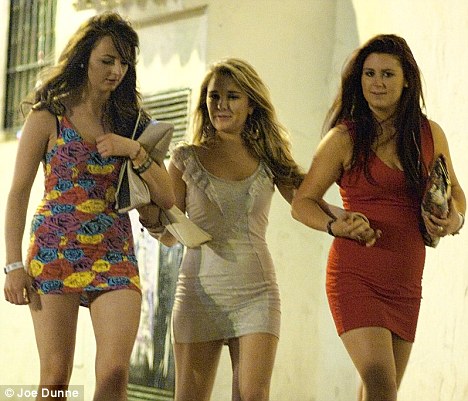
Charm, though extremely useful as a sexual tool need not take a seductive route. It’s interesting to note that when a brash young man accosts a lady at a bar with a chat-up line below her dignity she will often remark saractically “… charming” to her girlfriends after he has departed. Furthermore, it is customary for members of the general population to find scantily- clad women parading in stillettos and clutching bottles of Corrs Light as lacking in charm.

Potentially charmless girls

The perception of charm requires a little effort and as such the fruits of its identification carry an emotional value: we place worth on that in which we invest our energies. This is not to reduce charm to a mere self-serving bias but rather to highlight that intellect and emotion or “head and heart” are not always as far removed as we believe them to be.

To be charmed is one matter; to be charming another. Countless pamphlets have been penned on the latter so I thought it time to thrust open the question to the blogosphere: what charms you?

Why Plastic is Fantastic

Norman Doidge’s The Brain that Changes Itself is already inspiring me to get off farcebook and engage in mental gymnastics, and I am only on page 92. In his book, Doidge documents cases in which people have benefited from the plasticity (the ability to change) of the brain.

Let’s take the example of Cheryl Shiltz, because hers is a nice-sounding name. Because of damage to the area of her brain dealing with balance (or the vestibular apparatus), Cheryl constantly feels as if she is falling. So great is the sensation that she is unable to sustain a career or maintain a conventional daily routine. Along comes the researcher Paul Bach-y-Rita and gives her a hat, as well as a thin strip to wear on her tongue. Attached to the strip are small electrodes and inside the hat is a device called an accelerometer. The accelerometer sends signals to the electrodes and both are connected to a computer.

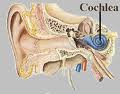
Most of us keep our balance because tiny hairs in our cochlea, or inner ear respond to movement in the fluid canals that surround them and communicate this movement successfully with a clump of neurons, whicn in turn tell our muscles which way to move in order to maintain balance. Since the tiny hairs in Cheryl’s cochlea are not working properly, the accelerometer in the hat detects movement instead and conveys this information to her tongue, which then sends the signals to the specialised clump of neurons in her brain which then advise her muscles which way to move. The journey simply changes from the conventional Hair – Neuron clump – Muscles to become Hat -Tongue- Neuron clump – Muscles. In other words, the hat and the electrodes attached to her tongue allow her to stay balanced.
Nobody wants to hang out in a construction hat and attached to electrodes though. The marvelous, wonderous thing is that with repeated wearing of the hat, Cheryl’s brain developed a residual effect of increasing time periods, until eventually she learned to balance herself without wearing the hat. What this means is that her brain managed to change itself to find new pathways to that clump of neurons. Nice one.

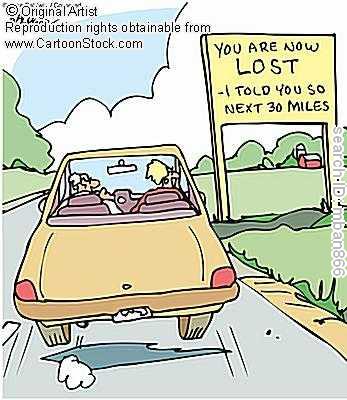
Cheryl’s case illustrates what every road-tripper knows: if you miss your turn, you can take a roundtrip and still reach your destination.

The idea of brain plasticity was long contested among neuroscientists because of their success in assigning areas of the brain to specific functions. This idea, known as localisation assumed that the areas of the brain associated with specific tasks were fixed and that once certain critical periods were passed, if certain cognitive feats had not yet been mastered, they would never be.

Now that I’m curled up, hanging out with Cheryl and many others with inspiring stories, I am thinking about the possibilities of the human mind and that maybe some day, I really will master Arabic. As soon as I get my hands on that €13 teach -yourself set my boyfriend found but did not hold on to while he was stacking books into a pyramid at work, I’m on it. I may be unemployed and not up to much, but that is no excuse not to learn to turn mental somersaults in the middle east. Never before have nerds been so plastic.

On Growing a (de)Tail

I hit my forehead against the side of a glass shelf in the Birkenstock shop at 36 Wicklow Street this afternoon. The blow inflicted a sharp pain which faded until this evening, when I absent-mindedly rubbed my forehead as I was watching Upstairs Downstairs on BBC4.

The man behind the till in the Birkenstock shop was old, with the air of an indifferent butler and if he noticed my accident, he masked his perception with perfection.

Then I met my friend Reuben at Central Bank. He had on shorts and as I approached him he was reading. There’s that way that we all stuff a book out of sight or yank earphones into a tangle when somebody we have been waiting for approaches us suddenly. A universal movement away from ourselves and into that self-governing realm of conversation.

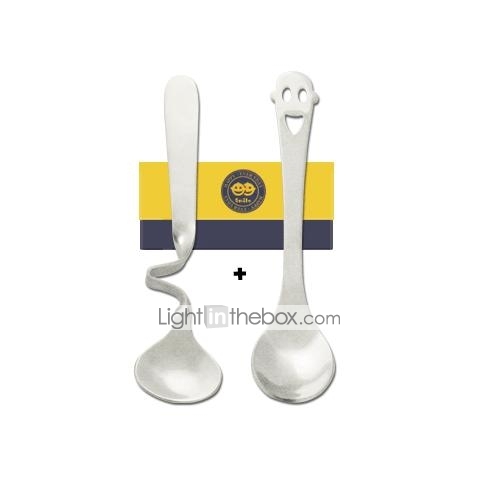
Reuben’s cup had flowers on it and contained lemon and green tea, but mine was glassy and plain. We both got bendy spoons though, which hovered over the rims of our cups and I didn’t notice until Reuben pointed it out, that the spoons were smiling. When it was time to pay, I put a tiny sum into the tip jar and took a mint. I felt bad when the waitress offered me a mint after, because that meant I had taken mine out of turn.

On the way home I crossed the road because there were boys in tracksuits on my side. In Centra, the Irish Times was sold out but there was a handful of London Times and Independents left over.

My mum read me two German Christmas stories tonight. She is the best reader in the world.

During Upstairs Downstairs my dad cupped his hands expectantly so I threw him a Malteser. After that I threw Maltesers at him without his hands being cupped.

In Avoca, a table yelled for my mum and two girls gave her effusive hugs. Grateful, smiling students of hers. It moved me strangely. I was feeling tender today, with preoccupations of an uncertain future. We met the mother again, as we were walking into Zara. She said it was ‘crazy’ in there.

There is a golden button missing from my coat. It came that way, but I have a spare because my boyfriend is magic and he went into AWear and asked for one once. They ripped a button off a faulty coat for him and I have been meaning to sew it on for seven weeks. I wondered today where that button was, but then, outside the Pound Shop in Rathmines, I felt it in the undersized pocket of my coat.

My sister and I sat beside the fire and when our feet touched by accident, her toes recoiled and danced away in disgust. She left the room to talk to her boyfriend while I listened to my mum’s stories. When she came back, we talked about epigenetics and how everything is related to everything.

I told my mum about what Ian McEwan said. That to write, is to have a detail, and not a story. That Atonement sprang from a single observation of his bossy elder daughter directing and staging a play. That a single detail can grow into love and war and betrayal and atonement and a moving masterpiece.

I’ve a lot more to gather, but this was a start.

I wish there were a fly in my eye.

If I were a fly, I would crawl up billboards and over the faces of celebrities advertising shampoo. If I got peckish I’d fly to my nearest bakery and alight on an almond bun. I’d avoid flying on my own on dull days in case I got trapped in a spider’s web that’s only visible in the sun.

I’m not a fly though and so I’m forced to navigate the world conventionally. I have to get a job to buy an almond bun. I need to battle against the forces of economic psychology to buy cheap supermarket own-brand shampoo with no promises of instant glamour and folical success. And I can crush a spider’s deathtrap with my fist.

I just finished ‘reading’ (three of the seven essays consist of a series of images with no words) John Berger’s Ways of Seeing and though there was a lot I read too superficially to grasp, the last essay, which focusses on publicity and consumerism, got me thinking about the place where I drank a whiskey and lemonade last Saturday night.

It was the basement of a nightclub on the quays called ‘Gypsy Rose’. The walls, table-tops and tshirts of the band were decorated by gothic-style roses and a backdrop of despondent-looking skulls with over-sized teeth biting into shotguns. The lighting was dim, the band playing exceptionally loud and the decor scarlet and deep purple. My flowery green dress, polo neck and snow boots flouted the dress code.

Nearly everyone there had multiple tattoos. My friend told me that it’s a familiar haunt of the ‘tattoo society’. I thought he meant to break it to me that I’d walked in on some political social, but actually he just meant that it’s full of people with tonnes of tattoos, which I could see for myself.

If they weren’t musuclar skinheads wearing band tshirts, they were charmingly nerdish-looking and in leather trenchcoats. The girls had edgy jet black hairstyles and facial piercings and next to them I looked like a ridiculous daisy sprouting from a graveyard patch of bleeding roses.

The whiskey was good and in spite of its unreasonable volume, so was the band. And yet, there I was with my eyes convincing me that I shouldn’t be there.

No biggy; just not my kinda place, I mused on the luas home.  I just like it more mellow, with pots of tea and shisha and perhaps an acoustic guitar in the background. “Damn hippy indie chick” somebody probably sighed as I took out my book.   

I think I find comfort and shame in equal measure in the personalised telescope through which I view the world. I’m comforted because by knowing through sight what I am not I can guess what I might be instead. I am ashamed because I never look through the lens for long enough to understand fully what it is that I am not.
***************************************************
PS – I would love to capture, spookily, the Zeitgeist in a piece of prose. I can’t, because I am much too busy lounging in my own world view. If I were a fly,I might get trapped in a web of images, but at least I’d have had the privilege of a bird’s eye view of the world.

Reflections On A Winter Wonderland

I trod upon this Winter Wonderland two nights ago; perhaps you can see my footprints in the snow. This is my mother’s hometown of Regensburg, Bavaria and I am seeing it for the first time in the winter. I know it from the summers of childhood and adolescence as the place where first I splashed my toes into cool drinking-water fountains and then wandered moodily into the branches of H & M and Müller in the hope of diversion from the obligations of ‘extended family’ holidays.

The German side of my family is enormous – my mother is the fourth child of nine and at last count my cousins tallied close to thirty. My memories of the summers between about 1995 and 2007 are rooted in a certain self – consciousness about the German I spoke, which I perceived as stilted in comparison to the Bavarian twang and slang with which my relatives conversed. Aware and anxious from a young age that I had but a single afternoon to persuade each branch of the German relatives of my lively personality and engaging wit, I presented invariably an image of dullness and excessive politeness which they perceived (with accuracy) as shyness and awkward sensitivity. I had an awful lot of fun in Regensburg too though – I was particularly fond of the twisty yellow waterslide at the local pool and the vast availability of playmobil and wooden dolls’ house accessories in the toy -shops. When my Grandmother moved out of the family home and into a flat nearby, she dedicated her biggest free space to a playroom for her grandchildren. There she set up a shop (or ‘Kaufladen’) which she supplied with a wooden till and weighing scales, dried apples from the garden, miniature packets of raisins and cinnamon-topped marzipan balls; all of which could be purchased in tiny cone-shaped paper bags, which she provided for her customers. It was marvellous.

Such feelings return to me as I sit on a Regensburg and Grandmother-bound train with my boyfriend, who is not a part of these memories but who has the most incredible ability to absorb and to understand information and to remain quite silent as he does so; only to amaze me with evidence of his awesome memory at appropriate points in the future.  For instance, he has recited in order the names of my mother’s brothers and sisters without ever having been formally taught, recalled anecdotes about my relatives that I don’t even remember fabricating and has learned (albeit not with great accuracy) the lyrics of the family song (yes, there is one) which is performed at the approximately bi-annual family gathering.

I would forgive you for accusing me of having notions of one day appearing on one of those ancestry-tracing television shows like ‘Who do you think you are?’ . To practise for such an occasion, I ask Andrew to take a picture of me on arrival at Regensburg train station.  I attempt to look restrained and dignified, humbled and delighted (as those minor celebrities do at important and scripted moments in the discovery of their past) but it is too much for me and I end up pointing with mock excitement at the sign above my head.

The journey begins and we battle through a blizzard along the Danube on the way to my Grandmother’s flat. We are startled by a baby rat as it darts for cover under the inches-deep layers of snow by the riverbank. When we arrive, we are heaped with white powder. I am nervous as I ring the bell – it has been three and a half years since I last saw my Grandmother and at that time I was not romantically attached. She opens the door and pops her head out. She motions us in as if we were meals on wheels. It is wonderfully reassuring. She brews a herbal tea and we sip it as the blizzard outside continues. She tells me that she misses packing Christmas parcels for her Grandchildren; it is beyond her competencies now, she tells me, as the children are looking for gadgets and games she doesn’t understand. I tell her how I loved playing shop in the playroom and how I remember her paper bags and dried apples. She smiles and tells me she has found old letters that her children wrote to the Christkind (the German equivalent of Santa Clause). I ask her eagerly if I may see them. I may. She gets up to fetch them, and I whisper a few words to Andrew, who has remained mute at the head of the table (Andrew speaks no German and my Oma no English). I leaf through the letters of my youngest aunts: they have asked for an anorak and an extendable pencil and have promised the Christkind that they have been brave Kinder all year.

Outside my Oma's flat

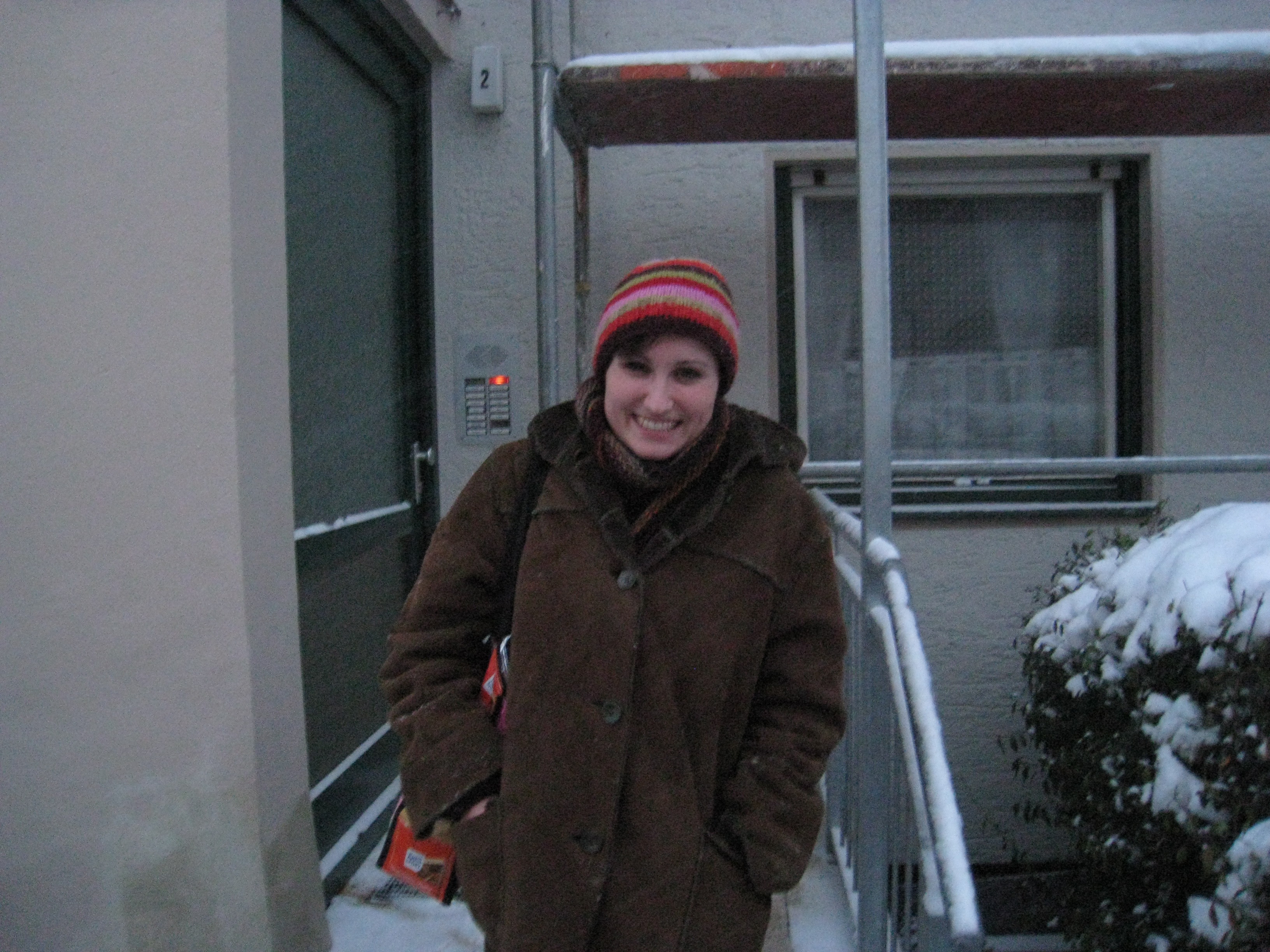
After an hour and a quarter, we shake hands goodbye and venture back out. We are station-bound again but have decided to check out the Christmas market by the Castle before we leave. We are ankle deep in glistening snow. Burning torches light our way to the courtyard, where stalls of mulled wine and gingerbread lure us through the cold. Four men play Christmas carols on old-fashioned horns. Beyond the glistening snowflakes and torch flames, the castle gleams. I buy Andrew a baked potato and he buys me a woolly hat. We leave our footprints in the snow. We miss our train and spend all evening in a Winter Wonderland I feel is part my own.


Ah Thanks Love.

I’m imagining a portly cavewoman bent over a roaring fire, gingerly carving up a slab of meat, which hours ago her bearded partner wrestled ferociously with in the depths of the surrounding forest. Hands still bloodied from the kill and with several of his children fighting for the bones, I wonder whether Caveman gives his wife a tender kiss alongside a “thanks, honey” for the lovely meal or whether Cavewoman thanks her man for providing her with the succulent flesh of an Irish boar. Perhaps they thank each other in their own, silent way.

Thinking about thanking should be natural to us, since the two words stem from the same root; the Proto Indo-European word tong meaning to feel. Thinking pre-existed thanking- a fact which matches up nicely with the intuition that gratitude should be considered rather than automatic. It is no wonder that in Stone Age times, where food, shelter and sex were the hallmarks of successful existence, thinking and thanking were relegated to a common sentience. While thinking about thanking is a sign of evolutionary progress, not thinking about thanking is yet one step more advanced. After all, automatic thanking is synonymous with the language of service transaction, which constitutes a process more sophisticated than the simple bartering of one good for another. Take a bog standard morning in the city centre of Dublin for instance. The 15 A bus arrives late and takes me in to town. I alight and thank the bus driver. As I pass the gates of Trinity College, a religious enthusiast thrusts upon me a medallion of the Virgin Mary, which she claims will protect me from everything the world may throw at me, excepting medallions themselves it seems. I thank her with a smile and hurry on. I am groggy and so I head straight to Butlers Chocolate Café, where I order a caramel machiato ‘to go’. I thank the man at the till as I hand him over my money. Without thinking, I have given thanks for a tardy service for which a driver earns his keep, for an item I would rather be without and for due receipt of a steaming cup for which I have paid ready money.

But why? A 2007 study into cultural service exchanges argues that “the use of thanks in closing conversations … reflects local concerns of conversational management, insofar as participants need to demonstrate their final alignment to a common frame of reference and a shared satisfactory role-relationship.” In other words, perhaps what I am meaning to say is “I appreciate that you’ve battled through the morning traffic to drop me into town”, “Despite my complete indifference to your cause, I respect your dedication to The Legion of Mary and the fact that you are standing here in the freezing cold offering gratuitous items to passers-by” and “I value my cup of sweet warmth and your pleasant demeanour, even if provision of both forms part of your job description”. 

Uttering thanks may have become automatic but feeling gratitude is a state much more specific to the individual and ultimately more meaningful. A child can be forced to say “thank you” for the cotton socks its Great Auntie has bestowed upon it, but in no way can the feeling of gratitude be imposed. The human brain – plastic with potential – can differentiate between uttering thanks and being grateful. Indeed, true gratitude is often exceptionally hard to articulate. A youtube video promoting gratitude to American service men and women, which has registered over two and a half million hits, describes some of the problems, which accompany the attempt to express true gratitude. One of the most common is the feeling of awkwardness. How do you tell somebody you have never met how grateful you are for their actions? How do you tell somebody you see every day how much they mean to you?

Perhaps it’s about showing and not telling. Like love and hope and fear, it’s actions that speak louder than words. Thank somebody with a look, a hug, a card, a surprise and watch the warm feeling break across their face. It is nobler to thank than to be thanked but there is nothing that replaces that affirming feeling of being appreciated.

This Thanksgiving Festival, as modern Man Matt carves the organic turkey that Marigold’s high-powered legal job has helped provide and Hannah Montana occupies the kids in the background, perhaps it will be a silent, prehistoric glance between man and wife and not a glass-tipping dedication to America that will express true thanks. “To Silent Gratitude”.