Unknown's avatar

About Kate Katharina

Kate Katharina wltm people with stories for literary fling and maybe more.

Christmas with Frau B

Willy Brandt wouldn’t really have been my type,” Frau Bienkowski says, examining the Tagesspiegel’s full-page spread in his honour.

“Nor mine” I say.

“He was a bit of a womaniser.”

“Well, just as well he’s not our type!”

Willy Brandt  source: Wiki Media

Willy Brandt
source: Wiki Media

She laughs. “Shall we get some coffee?”

“Sure!”

“So Katechen, tell me about your week.”

I tell her about my friend’s visit and our trip to Dresden. And about work and the Christmas parties I’d been to.

She tells me her niece is arranging a little Christmas party for her and that the cooks downstairs have agreed to roast them a goose.

This will be Frau B’s 95th Christmas. She has decorated her room with electric candles (real ones are deemed too hazardous in the home), a bunch of deep red flowers and a table cloth she made herself.

We agree that Christmas is an event choreographed by women and enjoyed by men.

“I remember my father standing by the fire once. It was just after Christmas and he was saying ‘Oh, it’s a wonderful time of year! I could do this all over again.’ Quick as lightening my mother piped up ‘No wonder – you didn’t have to lift a finger! ’”

Frau P smiles. “I’ll never forget that!”

I take out my gift for Frau P.

It is poorly wrapped in grey tissue paper.

She opens it gingerly and fingers the picture frame.

Because she has impeccable manners she says immediately: “Oh, it’s lovely!”

But I can tell she hasn’t seen it properly yet. I wait for a moment while she examines it more closely.

“Is that… us?” she asks.

“Yes!”

“But when..?”

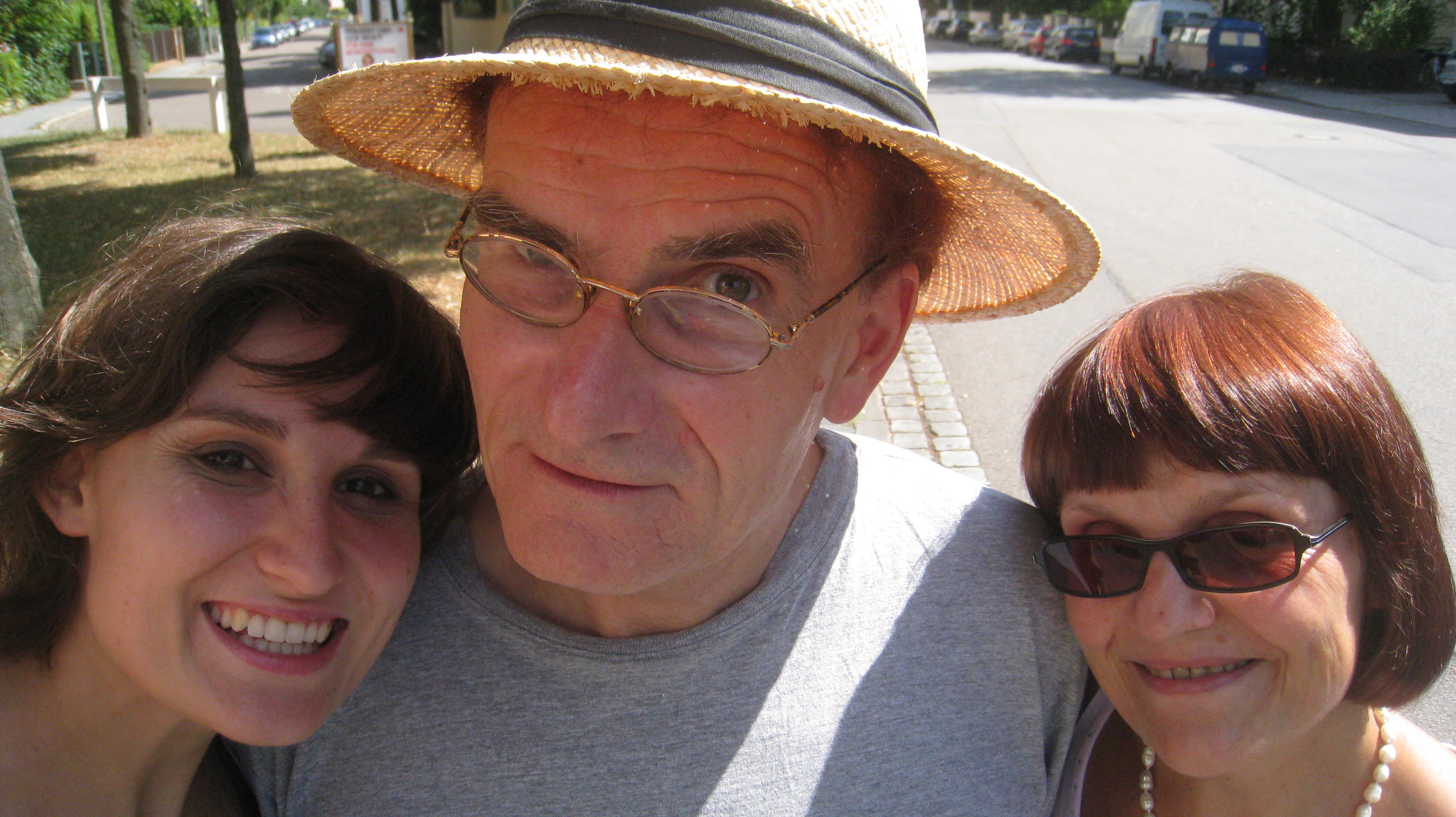
“Do you remember my parents when my parents came to visit in the summer?” I say.

“Oh yes!” she says. “Thank you, Katechen – that makes me really happy!”

“Now,” she says. “It’s my turn.”

“What? Frau B … you’re shouldn’t have.. ”

She hands me a little package wrapped in reindeer-themed paper. “It’s just five bars of chocolate,” she says. “You know I can’t get out to the shops.” Then she presses an envelope into my hand.

“Open this at home,” she says. “It’s for you and Andrew. I made an attempt at writing but you know I’m no longer capable of it.”

I stammer a thanks and tuck the envelope into my bag.

I pick up the book about the Irish nuns.

(My current fine on it is €8.75)

“It’s amazing how long we’ve been at this,” she says. “We are just so good at chatting!”

“I reckon we’ll have it done by this time next year,” I venture.

“Oh come on Katechen,” she says. “How long are you expecting me to live?”

“Oh, there’s life left in you yet!” I say – brightly because that is the only way to talk about death to a 95 year-old.

Later on at home, I open the envelope. Inside is €30.

I can’t make out much of what it says in the card inside but I can discern the word “Katechen.”

On life and death and the sanitary towels in between

“I thought that at my age I could no longer cry,” said Frau Bienkowski. “But this morning, the tears came.”

Frau B had spent the whole day trying to get hold of a packet of sanitary towels because ever since her hip operation, she has been unable to retain water.

But the person in charge of making the fortnightly order was on holiday and nobody had thought to take over his duties.

In the end, one of the volunteers popped over to the chemist’s to pick some up. They weren’t the right kind, but they would do for now.

“I’d be lost without Frau Lintz,” said Frau P of the lady in question.

The nursing home is short-staffed because there have been an unusually high number of deaths over a short space of time, leaving several rooms empty.

Frau B's egg timer. Source: www.amazon.com

Frau B’s egg timer. Source: http://www.amazon.com

Money is tight and management won’t increase the staff-patient ratio. So when a certain number of residents die without being replaced, the carers lose their jobs too.

Death at the nursing home is a small table placed outside a bedroom door. On it is a candle and a framed photograph of the deceased.

A few months ago there was a table outside the room opposite Frau B’s.

“The lady across the way died,” Frau B said, matter-of-fact.

And another time she said: “Every night when I go to sleep I pray that I won’t wake up.”

In other circumstances, the sentences might sound tragic.

But if I have learnt anything from my weekly visits, it is that welcoming death is not the same as abandoning life.

Frau B and I are seventy years apart but we talk like sisters – about boys and clothes and death and what’s in the news.

image source: centralavenuepub.wordpress.com

image source: centralavenuepub.wordpress.com

We laugh out loud at the absurd hen-shaped egg-timer she’s been given instead of an alarm clock and I bring her several packets of the sweets her doctor has told her not to eat.

We continue reading the book about the cantankerous Irish nuns, even though we get through about ten pages each week and I’ve been paying library fines for months.

Recently, we found out that we both get dressed up for my visits.

“Sure who else notices what I’m wearing?” Frau P asked with a smile and I told her I felt the same way.

So if death is a small table, life is the perm Frau B insists on getting touched up every week.

And the moments we spend laughing at silly hen-shaped egg-timers and the humiliated tears we shed about elusive sanitary towels are the beautiful and tragic bits that happen in between.

Cork: The Food Capital of Ireland

Once you have been to visit the city of Cork, it will be easy to see why the city is often referred to as the food capital of Ireland. While Cork has had its fair share of history, nowadays its vivacity and liveliness helps to blanket the city in fun, warmth and a great atmosphere.

A city break here certainly wouldn’t be out of the question either; with plenty of cheap hotels in Cork from Travelodge, you can enjoy a visit without overstretching the purse strings. There’s a reason why it’s considered to be so high up the Irish food chain – from farmers markets to fine dining meals, the culinary prowess that can be found in and around the city is extensive.

source: wiki commons

source: wiki commons

In the centre of town, just off Patrick Street, you will find a multitude of fantastic eateries, while French Church Street and Carey Lane both provide a great selection of cafes and restaurants that will suit all budgets and palates. Restaurants that certainly warrant a reservation include The Cornstore, which dishes up some top quality steaks and seafood while, if you’re up for the drive, the Michelin-starred The House in Ardmore, just across the border in County Waterford, offers up some incredible fine-dining fare which would be perfect for that special meal.

Remember that, when visiting the city of Cork, it’s not just what can be found within its city limits that will impress you – it’s what is waiting for you on the outside, too. Head west and you will find some superb gastropubs that provide a homely welcome with some excellent food on the menu. There’s nothing better than sitting down to an exceptionally prepared meal as you look out over the County Cork countryside. The Poacher’s Inn, in Innishannon (just 20 minutes away from the hubbub of the city), comes particularly recommended, enjoyed by locals and visitors alike.

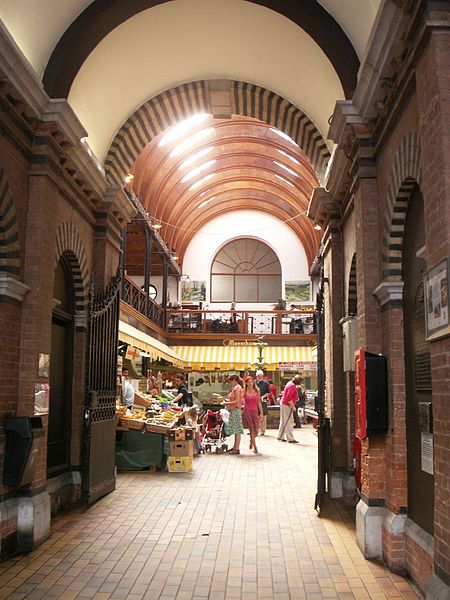
During your visit, be sure to check out the farmers markets in the city; the English Market sells a vast array of local produce, including meat, fish and artisan cheeses. Don’t forget to sample some of the local delicacies too – tripe, crubeens and drisheen are traditional savouries that should be tried at least once!

Bask in the atmosphere, the joviality and the rich heritage that this city provides with a perfectly-timed break to Cork.

This is a sponsored post

OMG finding a flat in Berlin is sooo hard (Part 1)

Some people think looking for a flat is stressful.

I don’t.

I love poking around strangers’ homes.

LSB and I have been doing a lot of it lately.

In fact, it’s turned into quite a nasty little habit.

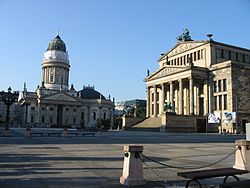
It began last month, when I developed an epistolary relationship with an English gentleman named Mr Humphreys. He was advertising an apartment just off Gendarmenmarkt, one of Berlin’s prettiest squares.

Mr Humphreys had bought the property for his daughter while she attended university. Since she had now completed her studies, he was looking to rent it out.

But poor Mr Humphreys was ill and his treatment meant he was unable to travel to Berlin. He was simply keen to rent out his beautiful, affordable apartment to a young couple just like LSB and me.

“You seem to be a very nice person,” Mr Humphreys wrote to me, adding “I can assure you we will not have any problems.”

Mr Humphreys had a formal, near-native prose style. He offered to send me the keys to his apartment. The rest, he said, would be taken care of by a letting agency.

source: wikipedia.org

source: wikipedia.org

There was just one small matter. In exchange for mailing us the keys, he required €1,340 to be transferred to his account – so we could “trust each other.”

I thought I might trust Mr Humphreys more if he agreed to Skype with me. But as well as being in poor health, Mr Humphreys suffered from shyness. Ideally, we would just transfer the money. After all, it would be immediately refunded if we decided not to take the apartment.

While I was corresponding with Mr Humphreys, LSB decided to check out our future address. It was a Chinese restaurant.

And as much as it pained me, I concluded my correspondence with Mr Humphreys.

LSB and I then narrowed our search to flats which existed.

(Part 2 coming soon!)

A stitch in time

The last time I visited Frau Bienkowski I was wearing a red cotton skirt. The pattern featured lots of identical girls and boys holding hands and strolling past apple trees.

“What lovely material,” she said, motioning for me to come over so she could have a closer look.

“Yes, I love it,” I said. “But the problem is that the elastic at the waist has come loose and I’ve got into a terrible habit of tying it into an ugly knot to stop it falling down.”

“Bring it to me next week and I’ll sew it up.”

“Oh no..”

“Do. I can’t guarantee that it’ll be pretty but it’ll do the trick.”

I called my mother on Skype. I was deeply ashamed of my elastic knot. It stood for both incompetence and laziness.

“You should let her do it, Katzi,” my mother said. “I’m sure she’d love to do something for you.”

So last Friday I went to the Turkish market. And as well as purchasing six avocados and three mangos, I bought some elastic and a little sewing kit.

“Did you bring the skirt?” Frau Bienkowski asked the moment I entered her room last Saturday.

“I did. And pears too.”

“Good. Now, let me have a look.”

I handed her the skirt and rummaged in my bag for the sewing kit and the elastic.

“Can you thread me a needle?”

I tried but Frau Bienkowski wanted a double thread.

I tried again.

“Oh but that’s a little too short, Katechen,” she said.

I tried a third time. This time Frau Bienkowski approved.

“Good,” she said. “Now, how about you either read to me or tell me about your week while I get a start on this.”

I could have told her about my week, which was rather eventful, but I got distracted.

Frau B’s hands were flying. She tore out my ugly knot of elastic and started weaving stitches furiously. The waistband was restored in minutes.

Then she asked me to put my finger and thumb on the flap where she’d placed the last stitch and told me to come over to her armchair so she could measure my waist.

Her hands moved the elastic easily about my waist.

With a few marvellous swoops, she sewed it in. She wasn’t even looking at what she was doing. When she saw how astonished I was, she said: “But Katechen, this was my job. You never lose the feel for it.”

My red cotton skirt used to live at the bottom of a large wicker basket. It shared its home with an enormous plastic nose, several berets and a pair of bee’s wings. I used to match it with ugly purple beads when I pretended to be the Queen of England.

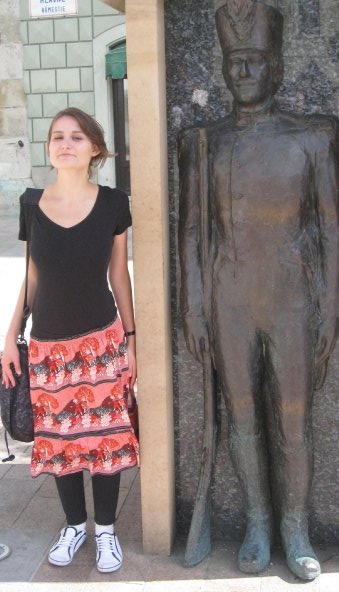
Wearing the skirt while inter-railing in the summer of 2009.

Wearing the skirt while inter-railing in the summer of 2009.

With the terrible dawn of adolescence, my dressing-up basket was cast into the bottom of a basement wardrobe.

Years later I re-discovered it and found that the skirt’s loose elastic made it a one-size fits all. The queen’s skirt had turned boho-chic.

I took it with me when I went inter-railing in 2009 because it was light and didn’t crumple easily. I also fancied myself as some kind of honorary gypsy in it; a fantasy I indulged in while gazing out the windows of the slow trains which hauled me through eastern Europe.

Frau Bienkowsi, her fingers moving like those of a master pianist across a keyboard, broke the silence.

“Katechen,” she said. “I don’t want you to say Sie to me any longer. “I’m not Frau Bienkowski any more. I am Lotta.”

LSB moves to Berlin, starts blog

LSB moved to Berlin, just like that.

One moment we were waiting for the 16A in grubby, familiar Camden Street and the next we were on the U7 to Spandau.

Berlin is different with him here.

I’ve had to stop sleeping in the shape of a large star fish.

I’ve had to allow cheese in the fridge.

And I’ve started becoming one of those people who complains when the lids of shampoo bottles aren’t replaced after use.

I used to spend my evenings munching Rittersport chocolate, scrolling through my Facebook feed and contemplating my existence.

Now we do that together.

Sometimes LSB laments the fact that he is arbeitslos.

The other day we saw a happy-looking postman in a green uniform on the subway. He was on a poster, recruiting.
I told LSB that my best ever job was being a postwoman in Rathgar in the run-up to Christmas. I got a bike and men’s overalls and everything. We noted down the number.

Today we went to an enormous Turkish market. First, I bought a sewing set, some elastic and six wooden buttons.

copyright: LSB

copyright: LSB

LSB advised me to haggle but I refused. Not for the first time that morning, I cursed my tentativeness. Instead, I slunk away from the rude man behind the stall to another whose face I preferred. He under-charged me for the buttons.

I felt completely vindicated.

I don’t need painted wooden buttons. But sometimes I fantasize about making my own dresses.

I have similar daydreams of baking apple pies and looking adorable on a bicycle.

Next I bought three mangoes, six avocados, two courgettes and a punnet of pears.

I was so pleased with my purchases that I dragged LSB into Kaiser’s so we could calculate how much we’d saved.

This evening, LSB told me gently that I hadn’t stopped talking about mangoes all day. I asked him if he understood what a bargain it was to get three mangoes for a euro and six avocados for two.

He said he did but his eyes told a different story.

They were glazed from having been at a computer for too long.

I looked at him carefully.

I might not be a doctor but I’ve often been praised for having a physician’s intuition. I knew immediately that he had joined WordPress.

As a savant, LSB naturally upstages me in most respects. But now that he’s started a hilarious photo blog, I’m more in his shadow than ever.

To make matters worse, he’s even threatened to start posting about “LSG.”

“Had he ever said he loved me?” she wondered.

“Last night I was lying awake thinking about my husband,” said Frau Bienkowski. “And I wondered whether he had ever told me that he loved me.”

“I thought back and realised he never had,” she continued. “I think he would have considered it unmanly.”

“And did you ever say it to him?” I asked.

“No. I think if I had asked him, he would have replied, ‘haven’t you noticed?’”

“Lots of men aren’t good at expressing their emotions,” I said.

“Yes,” she said. “And he did bring me flowers.”

I looked over at the windowsill. The carnations, whose longevity has astounded us, were now wilting.

“Do you think I should get rid of them?”

“I think it’s time,” I said.

source: wikimedia.org

source: wikimedia.org

Our conversation meandered.

Frau Bienkowski told me about a carer at the home who earns just €1000 a month. She is a Lithuanian law graduate in her fifties.

We talked about the possibility of Germany introducing a minimum wage, and what the outcome of Sunday’s election might be.

Frau Bienkowski follows politics closely. Last week, I sent off her postal vote.

She’s voted for the same party all her life.

Frau Bienkowski thinks Merkel is machthungrig – hungry for power- but also “ruhig” – or calm.

Even though Germany is in a good place, the poor are getting poorer.

Frau Bienkowski is anxious about LSB finding a job. He has been here for just five days. I told her that he was at home learning German.

“He’s diligent, is he?” she asked.

“He is,” I said. “He’ll find work. But for the moment, he needs to focus on learning the language.”

“Absolutely – there’s no point worrying about it this side of Christmas.”

Frau Bienkowsi says she pities young people out of work. It was the same in 1928, she told me. Unemployment was rampant.

Then Hitler rose and things changed. A man Frau Bienkowski knew had been out of work for ages. Then he got a job building a motorway. His wife was delighted.

Hitler re-built the army, even though he wasn’t allowed.

Men were kitted out in brown uniforms and had work again.

Frau Bienkowski got married just before the war broke out. She got pregnant, then her husband was conscripted. In 1940 her son was born.

“I prefer not to think of the time after the war,” she said. “It was so hard. We had no money.”

She will never forget the generosity of the Americans during the blockade.

“We gathered at Tempelhof airport,” she said. “And they dropped down packets of food for us.”

Then Frau Bienkowski wanted to talk about her winter clothes. They’re stuffed in a large box because her summer wardrobe takes up all the cupboard space.

We agreed to leave re-arranging the clothes until October in case of an Indian summer.

I told Frau Bienkowsi that LSB has complained about my many clothes taking up all the cupboard space and about how his t-shirts hang neatly, discontentedly from the top of the wardrobe door.

She laughed, her eyes lighting up with amusement, and told me to send him her love.

Merkel versus Steinbrück: the owl versus the rhinoceros

Merkel and her Social Democrat challenger face off in their first and only TV duel this evening. While there’s little chance of the debate turning the tide, it’s an opportunity to watch two very different political animals in action.

If the German election were a poster competition, the Left Party would win. Instead of presenting awkward close-ups of candidates superimposed onto blurry cityscapes, it’s opting for punchy tabloid-style headlines.IMG_7615[1]

“Sharing is fun,” one of their posters reads – below it: “Tax the millionaires!”

“Collect a guaranteed pension of €1500 instead of bottles” says another, referring to the impoverished retirees in Berlin and elsewhere who spend their days shining torches into public bins in the hope of finding bottles they can recycle for cash.

For a traditionally marginal party, polling at around seven percent, Germany’s Left is punching above its weight. But the fact that its posters stand out for addressing concrete issues shows how consensus-based German politics has become. It’s also an indicator that people not policies will determine the outcome of the election.

Peer Steinbrück, the Social Democrat opposition candidate, is all too aware of this.

He’s facing two major challenges. The first is to compete against the overwhelming personal popularity of the chancellor. The second is to convince the public that his party offers a stark contrast to hers.

Germans do not get to vote directly for their chancellor but if they did, 54 percent would choose Merkel while just 28 percent would go for Steinbrück.

Merkel, dubbed “Mutti” – or “mother” – by the German press is viewed as a competent, unflappable leader and above all an excellent crisis manager.

Steinbrück on the other hand, is considered highly excitable. He does not enjoy an easy relationship with the media. His PR blunders include suggesting that German chancellors do not get paid enough and that Merkel’s popularity is boosted by her gender. They make for good headlines, particularly when taken out of context. In the case of politicians’ pay, Steinbrück was having a dig at bankers’ salaries and in remarking on Merkel’s gender, he was attempting to compliment the chancellor on her success in a male-dominated world.

But Steinbrück, whose passion can verge on belligerence, is less self-assured than his rhetoric would suggest. At a party event in June he became lost for words and had to fight back tears when arrested by a question about his negative media treatment.

That said, Merkel’s main opponent is determined not to build up a reputation for being too sensitive. In a television interview with the Münchner Runde, he said his favourite animal was a rhinoceros, which he described as a “very thick-skinned animal.”

Merkel has not revealed whether she has a favourite animal. If one had to pick one for her though, the owl – quiet, watchful, calm, or the otter – unpretentious and resourceful – would be good options.

The chancellor’s ego-free governance has helped her to be held less personally responsible for potentially damaging issues. Allegations about close government co-operation with the NSA and a scandal involving former president Christian Wulff have not dented her approval ratings.

The unfortunate truth for Steinbrück is that is public persona is only half the battle. Most crippling to his campaign is the widespread contentment among Germans. At least, among those with the most voting power.

There is one large and significant German demographic which does not enjoy a good lot, even when compared to their European counterparts. They are low-skilled workers.

The working poor and the retired working poor were on Steinbrück’s mind when he unveiled his 100-day election plan earlier this week.

He’s vowed to introduce a nationwide minimum wage of €8.50 an hour and to put a cap on rent increases in the first 100 days of his governance.

Merkel opposes a nationwide minimum wage on the grounds that keeping wages down has kept people in work. At present, those earning less than a so-called “Existenzminimum,” –a working wage receive a boost from the state to cover their employers’ shortfall. Critics say this encourages bad employers and gives them a competitive boost over those offering a decent wage.

But it was Gerhard Schröder – Merkel’s Social Democrat predecessor – who brought in the labour reforms which expanded the low-wage sector. His “Agenda 2010” plan offered businesses the chance to hire “mini-jobbers” and temporary workers. That cut unemployment and caused a boom in low-skilled, low-paid work. The policies got people back to work but increased the number of working poor and those taking on second and third jobs to make ends meet.

Steinbrück’s plan has boosted his approval ratings slightly but he is still trailing far behind the chancellor.IMG_7618[1]

Those struggling to make ends meet might be more convinced by the Left Party’s confident promise of: “Enough with the waffle!€10 minimum wage now!” which they see plastered on their local lampposts.

Tonight’s television debate might not be one to turn the tides but it’ll be an interesting face-off between two very different political species: the owl and the rhinoceros.

When life and art collide

I went to see a one-man show at the Edinburgh Fringe festival this week. The performer’s name was Alain English and his show was advertised in a slim booklet which listed all the events you could go to free-of-charge.

The three-line blurb mentioned that English had Asperger’s Syndrome and had written a book about his experiences.

As I was entering the little venue at Cowgatehead, a man loitering outside handed me a flyer. It was for the show I was about to see.

“Thanks!” I said. “This is the one I’m here for.”

The man looked sideways past me. It was his face on the flyer.

I took a seat in the third row of the theatre and for a while I was alone. Then a middle-aged couple arrived and sat across from me. They were followed by two men, one of whom was tall with bleached blonde hair and had red-painted fingernails.

image source: myspace

image source: myspace

And that was it. An audience of five.

Alain English, who has a wide forehead and bulbous eyes, entered the room and headed straight for the back corner of the stage, where he turned his back to the audience, raised his shoulders and took a deep, audible breath.

Then he whipped around, charged to the centre of the stage and began to shout poetically. Mostly about what it felt like to be overwhelmed by conversations. They were like blisters bursting in his brain, he said.

Then he cut off his poetry and began talking conversationally. It was still scripted but the effect was almost off-the-cuff. He said that as a child he lived entirely in his imagination, where he resided as a superhero. When he started school he categorised his male classmates as either heroes or villains. The little girls became princesses or damsels in distress. He was – he admitted- both bullied and a bully himself. He just didn’t quite get the world. Or maybe it didn’t get him.

Then he launched back into poetic language.

English continued the show like this – performing dramatic bursts of poetry punctuated by what was essentially his own biography.

Alain the awkward child grew into Alain the frustrated, isolated adolescent. But he had a solicitous mother who – having seen her son transformed while playing a role in an amateur dramatic production- enrolled him in theatre school.

There he met his teacher and long-time mentor, Annie Inglis, who believed in him. At theatre school he felt free, yet outside he remained constrained and unhappy.

Receiving a diagnosis of Asperger’s Syndrome changed little and he was amazed to find that his beloved Annie Inglis knew about it before he did. I’m a professional, dear she said simply.

Alain dreamt of achieving fame and fortune as an actor. But people advised him to study something useful at university. Something he could “fall back on.”

So he did – and performed in plays in his spare time. But things still weren’t right. He discovered alcohol, then depression. On the closing night of one of his performances, he got drunk, came on to another actor’s girlfriend, almost got into a fight and spent the rest of the evening crying in the toilet.

He worked in boring temp jobs and kept getting fired for being odd.

He went on the dole but had to fight to keep his benefits. His father retired and with it went Alain’s financial back-up.

Then his beloved Annie Inglis died and the hole in his life became yet bigger.

Life, he seemed to be telling the five of us who had now been with him for an hour, was rather disappointing.

And he was running out of things to fall back on.

But then he began to roar again. And this time it was poetry.

“There’s this myth about being an artist created by the media. It’s that either you are famous or you are nothing. That unless you’re a celebrity, you don’t count for anything.”

“That’s a fallacy, a distortion,” he spat.

I shifted in my chair.

“This is the truth of a real artist’s situation. It’s not the fame but the process of artistic creation. That’s the real reason we do what we do. This is how we connect with the world around us. THIS is how we live.”

The tiny theatre was suddenly electric.

“Fall FORWARD on your failures, as well as your successes .. Fall forward on your own terms and no one else’s!””

“Don’t fall back, fall FORWARD. …” he yelled at the five of us.

Silence. And then we clapped like mad.

“Thank you. Thank you. Thanks so much for coming,” he said. “I, er, don’t have a hat to pass around. But I am selling some of my CDs with my poetry.”

The man with the red-painted fingernails was first out the door to buy the CD and have a chat.

I was still inside the theatre as I heard him say, “That was the best show I’ve seen at the Fringe.”

“WHAT?!” Alain roared from outside the door.

The couple across from me and I exchanged a smile.

“I’m serious mate, you made me cry,” said the red-nailed man.

Alain may not be the best poet in the world but that day, he sold five CDs to an audience that had been treated to something rarely authentic.

Familienfest 2013 Part 1

The train journey to Familienfest 2013 was hot and sticky. I got a seat in the bicycle carriage opposite a large dog with a sad, deformed paw.

My mother met me at the platform in Regensburg. She was so tanned that earlier, when she was in the health-food store buying vegetable spread, the cashier had asked her where she’d been.

“Ireland,” she’d said.

We ate mini dumplings for dinner and then my mother said, “Kate, we really need to rehearse.”

We darted into the next room and she took out some pages from a plastic pocket.

“These are yours,” she said, handing me three sheets containing typed verses. Beside every second one she’d written K, which stood for me.

We began to recite.

“You must speak slowly and dramatically,” my mother said.

I did.

“Excellent,” she said.

After all, it’s not every day you deliver the gift of Bavarian citizenship to your husband and father through rhyme.

Then we practised singing the Bavarian anthem in harmony.

In just a few hours, Familienfest 2013 would officially open and there would be no excuse for tumbling over words or singing off-key.

My father had been due to arrive any minute. But then I checked my phone to find he had texted to say his plane had failed to take off.

My mother’s faced dropped as the unspeakable possibility sunk in that he might not make it.

But all was well. It was just some technical fault. They changed planes. All going well, he would be in Regensburg by midnight.

We killed time by examining our props.

image:www.katekatharina.com

image:www.katekatharina.com