I had a dream the other night. Two soldiers were confronting each other; one had a gun pointed at the other´s forehead. The man with the gun was whispering threats. An act of unbearable cruelty was about to take place. Then I woke up.
I`ve never had a dream like that before, at least not one I`ve remembered. But I am pregnant with a boy now. He is the size of a mango, according to the app, and I can feel him bubbling and fluttering beneath my ribs. In a corner of my unconscious mind, I am wondering how I will be able to keep his body safe, once it`s in the world.
Others are having similar thoughts. At work last week, I was getting my makeup done before I went on-air. “I`m terrified about the Wehrdienst,” (conscription) the makeup artist said, as she spread powdered foundation across my cheeks. Her son is sixteen, and delicate. Germany hasn`t yet reintroduced compulsory military service, but the conversation is shifting that way.
“You`ll have to handle puberty,” I inform my husband, outlining all the ways in which I`m unqualified: I have no idea what it feels like to have a penis; to lose control of your voice when you are still half a child, the humiliating squeaks echoing against uncompromising classroom walls. To be expected to carry the heavier box.
I understand the objectification of the female body. Walking down Grafton Street in Dublin as an eighteen-year-old with my then boyfriend, we bumped into a classmate of his. I have never forgotten the sensation of that other boy scanning me from head to toe. It happened in a nanosecond, as fleeting and subtle as a packet of ham passing through a till. I still remember the clothes I was wearing; a figure-hugging sleeveless yellow shirt and black three-quarter-lengths. I passed his test.
In the following years, I sat in college tutorials talking about the male gaze and getting cross with headline writers who used passive constructions when reporting on male violence against women.
My knowledge of the male body and experience, on the other hand, is remedial. I was stunned to learn that baby boy fetuses are often identified in ultrasounds by their tiny erections. Instances, I’ve learned, of the nervous system practising its functions.
Now I am going to mother a boy, and am thinking about the myriad ways his body will be scanned for its worth. For every novel I read growing up in which women were the objects of desire, or limited to their domestic roles, he will encounter stories of boys and men in trenches, or down mines. For every billboard I saw of women with complexions and facial symmetry I could never achieve, he will see chiseled jaws and six-packs to aspire to. For every impenetrable algorithm that has made me feel less of a woman, there will be an equivalent Internet pathway, enhanced by AI, picking at his self-esteem.
He will be born into an extraordinary cultural moment. A time when the tide of moral progress is receding. A time when the current US president – democratically elected twice – is a man who brags about “grab[bing] women by the pussy” and whose response to a female reporter asking him about his connection to a serial sexual abuser is: “quiet, piggy.”
What will he make of it all, I wonder? How will our culture have evolved by the time he comes of age?
In the past decade, working in a Berlin newsroom, I experienced the sudden global awakening to women´s experiences that came with the #MeToo movement, and the resulting rush from management to introduce new directives on sexual harassment in the workplace. Even then it all seemed a little knee-jerk, as if implying that inappropriate behaviour had hitherto been acceptable, but must now be explicitly banned. When older male colleagues asked if they could still tell me I had nice hair, or a pretty dress, I responded with some version of: just use your common sense.
I think back particularly to one man, already counting down to retirement when we met. A former soldier, he´d ended up in journalism by accident. He had a reverence for the intellectual calibre of his colleagues that seemed rooted in the feeling that they came from the “right” background, and he did not. He talked to me a lot, and I listened.
He told me about a young woman in Thailand whose mortgage he was paying. “I`ll always take care of her,” he said, meaning to sound gallant, I think, but unaware of how deeply problematic it sounded to my ears. He was less interested in sex than he used to be, he clarified unprompted once – before reporting on a long-ago incident in a sauna, where a woman he knew tried to entrap him by titillating him.
Among my contemporaries, the prevailing feeling towards men like my colleague was contempt. There was no way he´d bombard a male colleague with his inappropriate anecdotes. Probably not an older woman, either. I knew all this, and still, somehow I couldn`t bring myself to tell him to stop.
The loneliness seeped out of him. I could almost see it, forming a puddle on the newsroom floor. I did not respond to his retirement email when it came. I was tired. But I wonder if he made it to Thailand, as he had dreamed, and how many mortgages and massages his pension might cover.
If I had been a slightly less empathetic person, and perhaps a little braver, a conversation with the “People” department could have seen my colleague canceled. But my total conviction in his complete lack of self-awareness made this seem like an unnecessarily cruel course of action. I thought of him as a young soldier sometimes and the reverence he had for the desk job he did now.
When I consider the regressive cultural shift we are experiencing now, what strikes me most about the form of wokeism I myself inhabited is how greatly it underestimated male fragility. It did this to such an extent that men became hysterically angry. Throughout history, we have accepted their bodies being sacrificed for the cause of nationhood, valour or economic sustenance. Finally then, a new age of reckoning arrived. But it offered neither relief nor reassurance.
Instead, it asked them to atone for crimes ranging from complimenting a haircut to committing rape. For those whose bodies were closest to the firing line, it was an unforgivable humiliation. For those whose bodies were furthest from it, like Donald Trump, it was an opportunity.
What we have got now is a dual casualty. If wokeism banished common sense, what has followed it is killing common decency. Both need to be mourned, then restored.
As a future mother to a boy, I have an interest in finding hope in the disarray.
It begins by accepting a truth which our culture has so far refused to reconcile: binaries are real, and they reside firmly on two ends of a spectrum. We can talk about male and female while accepting that most people are going to sit somewhere between the archetypal traits of both. This applies as much to politics: are you a liberal or a conservative, as it does to gender.
The boy inside of me might well be wired to prefer diggers to unicorns. He may end up physically stronger and less emotionally attuned than his older sister. But if he doesn`t, I will happily place a unicorn into his little hands. I will cradle both him and his sister close and hope that I am doing the only job that really matters: fostering decent, sensible human beings. Then I will close my eyes and hope that neither of them will end up collateral damage in a senseless culture war.
Choosing to mother again in an age of anxious ambivalence
The first time I mourned the idea of not having a second child was in the hours after the birth of my first. I was doubled over, shuffling towards the hospital toilet, in a dizzy haze after the assault of a 40-hour labour. The thought – intrusive and inappropriate – came with clarity: I can never do this again. I will never do this again. How could I? I had wanted to die.
Three months later, I took my baby to meet some friends for pizza. Some pandemic restrictions had been lifted, but the plague was not over. Bursting with pride, I passed my daughter round for cuddles. “Would you have another?” they asked. “I definitely wouldn`t rule it out,” I said. They seemed surprised.
(The fear that my daughter could have caught Covid during any of those cuddles haunted me later and until it was clear that she had not, I felt like the worst mother in the world).
Motherhood made me happier than anything in the world ever has. I had never doubted my capacity to love. But what I never expected was that in those early months, my insomnia would disappear, and I would sleep more deeply than I ever had before. That I would lay in a cocoon of duvets, breastfeeding my baby for hours on end and feel entirely fulfilled. Who would have thought, after all those agonizing years of wondering and fearing and second-guessing motherhood and how it would affect my career, that the truth was: this was better. At least, for a while. We had an unnaturally contented baby. The kind who smiled at strangers on the street and slept all night.
This was four years ago, before feminism and wokeness had been canceled. The idea that motherhood was not only more enjoyable but also more fulfilling than my job had been, felt like a thought that needed to be quashed, or at least rigorously questioned. I was mortified by the idea that my sentiment might be endorsed by some of the Internet’s vilest people. There was nothing ideological in my feelings. I didn`t care if other people wanted babies. I still wanted women in the highest positions of political and corporate power. But I was awe-struck by the little life I had created. She mattered more than anything. I couldn`t believe we all went through life paying such little attention to the mysteries and wonders of conception and childbirth.
And yes, I was definitely bored sometimes. I missed writing and feeling semi-important because I had a job on TV. I missed being alone. And I had no interest in any of the logistics of parenting: discussing pram brands or naptimes or what solids to start when. Those things left me cold. They still do.
Oh, but the love. It was intoxicating.
***
My daughter started daycare at 10 months old, early for Germany, late for other parts of the world. I went back to work and in the early weeks, found it exhilarating. Hours on end to research the decline of the liberal world order! Just for the sake of it, with no little life depending on me! Compared to parenting, it was a piece of cake. For a while anyway.
I did not realise it as it was happening but as my baby grew, I began to shrink. I was eating as heartily as ever but no amount of feasting could hold pace with the calories I was losing from breastfeeding.
I was lucky that feeding had come easily to me and that I could meet my baby`s voracious demand. I fed her before and after daycare and all night long.
The months went by. On her first birthday, I came to pick her up from daycare and found her sitting in a tiny chair at the head of a table of tiny people, wearing a paper crown. Around this time, I began to think again seriously about a second child. I had been almost 34 when she was born. I didn`t have unlimited time.
Then one day, my husband lost his job. A typical corporate layoff, it came with no warning and was executed with ruthless precision. By noon that day, a courier had arrived at our door with the letter of termination.
We live in a country with a generous social safety net. You pay in generously and when misfortune strikes, you get back what you gave. We were okay. But it was unsettling, and the economy was bad, especially for the creative industries. I put pressure on myself to work more. I fed my baby. But she wasn`t a baby anymore, she was a toddler. It was exhausting. But it was also sublime. It was both of those things, much of the time.
We didn`t own weighing scales at the time, but I did notice how loose my jeans were becoming. I bought a size down. In one of the video reports I made for work, some of the YouTube comments called me anorexic.
In the summer before my daughter turned two, we visited a friend in Austria. After our meeting she sent me a kind text. She had noticed how thin I had become and was concerned. She herself had a history of eating disorders. She was also a doctor, and had an eye for this stuff. Naturally I was defensive. I`ve never had an eating disorder. I was eating as I always had. But when I look back at pictures from that time, I can agree: I had become alarmingly gaunt. My abundant milk supply was eating away at my body fat, so incrementally that only people who hadn`t seen me for a while noticed.
***
My preternaturally “easy” baby turned into a remarkably difficult toddler, almost overnight. We were somewhat startled by the strength of will that emerged, which even the affectionate staff at her daycare conceded was off the charts.
“The world needs strong, difficult women!” my husband and I would agree – increasingly ironically – hours into trying to get her dressed in the morning, willing ourselves to believe that every time she ripped off her trousers again, a tiny layer of the patriarchy was crumbling.
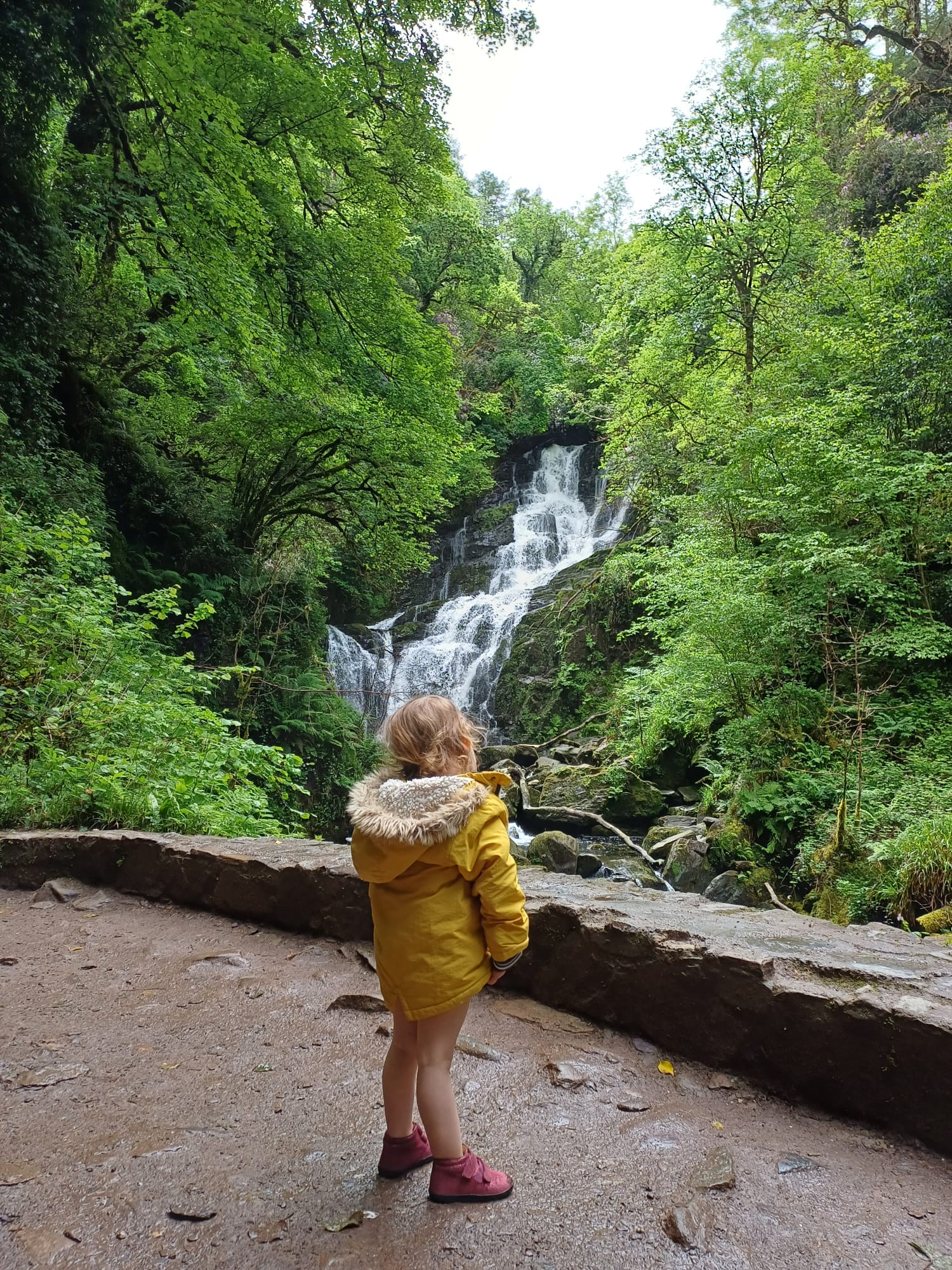
On a comically disastrous holiday to Ireland that summer, immortalized by a series of photos of my husband and me looking depleted while holding our furious, trouserless toddler at various sites throughout Killarney national park, I mourned the idea of a second child for a second time.
Our trouserless toddler
This was so hard, and we were so tired. Work no longer felt exhilarating, just exhausting. To make things more complicated, we were still coming to terms with my husband´s MS diagnosis, an illness that affects his walking and whose prognosis is unpredictable. The idea that our furious two-year-old would ever accept a sibling became laughable. It made me unbearably sad. I tried out telling people: we`re only having one. We couldn`t manage any more.
And how lucky we were to have one. Because as hard as it was, that love for our difficult, unyielding, deeply, deeply feeling, sensitive little person was only growing every day.
When she was two and a half, I had my first night away from her. The circumstances were the least restorative imaginable. Work was sending me to the industrial town of Leverkusen to interview the CEO of Bayer. I was very pleased to get the assignment, but I had to write an entire book for my daughter to prepare her for my absence. The “Leverkusen” book – bound in a purple ringbinder and featuring illustrations of domestic life juxtaposed with train travel – is still one of her favourites. The night before the interview, I didn`t sleep. Not even for a minute. I was super well-prepared, so I got through anyway. But when I watch that interview back, I see the exhaustion in my eyes, the toll of parenting and working written all over my face.
***
As much as I had mourned the second child that may never be, the truth was that I had not given up on the idea. The possibility stayed with me constantly, even in moments of great resignation. But the anxiety was great enough to mistake for ambivalence.
I scoured Reddit for stories of mothers grappling with the same question. I was searching for some kind of narrative that matched my experience entirely but never quite found what I was looking for. There were the happily “one-and-done” crew, advocating for the pleasures of a life with one child. Their arguments were highly convincing. There were those who regretted having a second. And there were those who couldn`t be happier they had taken the leap. Unfortunately, there was no one who was going to tell me what to do. My husband said it was up to me and no amount of interrogation revealed a hitherto concealed desire. He would go along with what I wanted.
I began following an account called “The Happy Caravan”, chronicling the life of Amber, a fundamentalist Christian and the mother of eleven musical children. All of them homeschooled, some have gone on to attend the prestigious Julliard music school in New York.
I became fascinated by her: eleven! From what we see online, the children all seem polite, and the atmosphere at home is reasonably calm. Of course, it`s likely that creepiness and darkness lurk beneath the surface. There are only so many hours in the day, and Amber manages to release far more videos than it would be plausible to make if you were actually looking after not only the emotional and material needs, but also the education of your eleven children. And things did fall apart, because New York prices ate them up and they had to leave in a giant trailer and move into a house in San Diego infested with termites.
But none of that erases this woman`s stunning feat: after experiencing the awesome love and responsibility and life-changing demands of having a child, she chose to do it ten more times. I studied her obsessively, trying to discern the source of her conviction. It was blind faith, obviously. But as she walked me through her gigantic Aldi hauls and chicken stew recipes, Amber, a stranger on the Internet unwittingly taught me a lesson: no amount of thinking or planning would change the fact that trying for a second child would be an enormous leap of faith.
***
I made an appointment with my gynaecologist, a tiny, 85-year-old man who frequently opens our conversations by expressing dismay at the decline of the Transatlantic relationship or with the provocative question of whether I have really read Ulysses (he knows I am a journalist and that I come from Ireland).
“We`re thinking of trying for a second child,” I told him nervously. “Machen Sie das!” (“Go for it!”) he said, without missing a beat. Then, looking right through me he added: “A child is the ultimate expression of hope for the future.”
I nearly cried when he said that.
***
My daughter had her last drink of my milk on the night before her third birthday. We had been discussing the moment for months and when it came to pass, it was seamless and beautiful. When she asked for bainne (the Irish word for “milk” my husband and I had been using as code but which she deciphered immediately because she is not only difficult but also brilliant) the following day, I reminded her that she was now three years old. “Oh,” she said giggling. “I forgot.”
I gained weight and my old jeans fit me again. As much as I had loved breastfeeding, regaining bodily autonomy was empowering. I felt freer again. The possibility of having a second child became a tiny bit less remote.
***
No one has ever told me to have children, at least not explicitly. In my industry, not having children is as common if not more than having them. I watch, sometimes enviously, as my friends travel the world, or take on exciting assignments. But I have never regretted motherhood. She is more interesting and more special than anything I have ever done at work. And because everything is both personal and political,I feel the need to add: there would be nothing wrong with it if I did have regrets. Plenty of mothers do. They might not tell you to your face, but they will confess to it in countless forums on the Internet.
It is hard to truly analyse the cultural expectations you grew up with. It requires a certain distance which by definition you do not have. As a millennial, I came of age with the arrival of social media. I know, rationally at least, that the platforms I did engage with, over years, must have held enormous sway over the formation of my identity.
When I was pregnant with my daughter nearly five years ago, I had a desire I would have denied then but can admit to now: I wanted to work and to mother performatively. I had relished the idea of displaying my big bump on air. I would post a clip on Twitter of me presenting the news with my huge belly. The implication would be that I was doing it all. I would package it into a clever humble brag.
As fate would have it, the only time I was pregnant on-air was in my first trimester, and my clearest memory of it is the genuine fear that I was going to throw up between segments. After that, I was banned from being in the studio because my workplace had a no-office policy for pregnant women during the pandemic.
***
In February of this year, I took a step that seemed momentous: I re-downloaded my period tracker app. My husband and I had decided to start trying to conceive in the summertime. I clicked the option that said “trying to conceive” and immediately my social media filled up with ads for fertility treatments.
I worried enormously that my cycles were no longer as regular as clockwork. I researched perimenopause and watched in horror as more of my hair grew grey. After all of my soul-searching, perhaps the decision had been taken away from me.
In June, the month our conception journey was to begin, my husband took a work trip. When he came back, our daughter turned into a monster, furious that the intensity of the time just with me had come to an end. We stayed inside for a whole weekend because her tantrums were so intense and her resistance to suncream so profound. It was 37 degrees outside. We sweltered inside. I imagined adding anything at all to the stress we were experiencing. Not this month, we agreed.
“Are we ever going to do this?” I asked my husband.
“Yes,” he said. “Just not right now.”
We knew this was an irrational way of going about things. But nothing about creating a new life is rational.
***
Autumn comes and it is more beautiful than ever. My daughter and I watch mesmerised as the orange leaves twirl off their branches under a clear blue sky. She scours the back yard for chestnuts, demanding I close my eyes so she can present them to me as gifts. She learns to ride a bike.
The videos on my feed change. What I see now are gender reveal parties and women speaking about miscarriages. My period app has communicated the news to the tech titans before I have to my family.
I can no longer close the button on any of my jeans and opening the fridge door is a hit-or-miss experience. I vomit when I exit the shower, a phenomenon ChatGPT tells me is likely to be due to an overactive vasovagal reflex caused by the shock of moving from hot to cold.
***
We were on holiday in Krakow when I found out. I took the test one morning in our palatial bathroom, which featured a faux-gold bathtub. The line appeared immediately. I called my husband. We took in the news quietly, and hugged. Like all life-changing moments, it felt both incredibly real and not real at all.
We went for breakfast with our daughter. Walking there, I felt a glow pass through me: I wanted this so badly and yet I could not believe it was happening. I breathed in the moment. When our food came, I insisted we take a selfie, so I would remember the hours after finding out, that secret time when your world changes and no one yet knows.
A week later, one of my favourite influencers, a woman who has been documenting her struggles with endometriosis and IVF for years, announced her pregnancy. I cried with joy for her; big, ugly messy mascara-tinted tears. Our pregnancy was only one week apart.
My daughter demands to see the video of the “woman crying and laughing with the stick in her hand.”
“Why did I not cry for us?” I ask my husband. “Why did we not cry for us?”
“It`s not our style,” he says. “We don`t scream on rollercoasters either.”
He is right. After so many years of agonizing over whether I could dare to indulge the deep and audacious desire to mother again, my joy was a quieter one, a creeping, cautious gratitude tinged still with an acute awareness that nothing can ever be taken for granted, especially not a safe pregnancy.
Our daughter, aware that something momentous is happening, is clinging to me more than ever. My fatigue is so extreme that I often fall asleep in her bed while reading her bedtime stories. When she wakes in the middle of the night and sees me there, a huge smile spreads across her face. I bundle her in my arms and kiss her hair.
“Maybe we should call our baby sheep,” she says. “Maybe,” I agree.
She lays her still tiny hand on my stomach.
“Your tummy is getting so big!” she says, adding “I also want to be a mama.”
“But also a bus driver,” I remind her.
She nods.
“You can be both,” I stress, remembering that everything is both personal and political. “How many children would you like?”


 Kate Ferguson