“Have you ever had a wet arse, Herr Schafner?”

The intercom on the slow train from Hof to Leipzig crackled. I slid my suitcase onto the seat next to me and took out my tattered book. A man’s voice spoke with perfect diction:

“For the attention of passengers recently boarded: Due to an act of vandalism, the lavatory at the back of the train is out of order for the foreseeable future.The damage has been caused by a blockage of material which is considered unsuitable for a toilet. Those passengers with the desire to make use of facilities must venture forth to the front of the train where an alternative lavatory is available. However, said lavatory may only be used while the train is stationary. Those with questions about this issue are advised to approach train personnel. I on behalf of Deutsche Bahn apologise for this minor inconvenience…”

The old lady across from me began to chuckle. The voice continued.

“To summarise, of the two available toilets on board, the one primarily intended for ordinary passengers is currently defective. An alternative loo may be used provided the train is not moving. Such a situation occurs at times when the train stops at stations along the route. I, on behalf of Deutsche Bahn apologise for this occurrence, which is the result of vandalism.”

Suddenly an enormous Saint Bernard, approximately the size of a small pony, bounded down the corridor. It paused briefly to greet my knee with its expansive snout.

“LOTTA,” a voice yelled behind the dog. A woman with a limp peroxide pony tail hanging from an otherwise shaven head stumbled past me. She was wearing dungarees and smelt strongly of beer.

“COME BACK, LOTTA,” she yelled. She clicked effectually and the gigantic hound returned. The woman grabbed it by the collar. Then she let out an almighty roar. “MY BEER!!!”

On the seat directly behind me, a bottle of beer had unturned. Liquid brew was seeping into the cover and a trickle of beer was making its way towards my feet.

The woman began to scream. “MY BEER. I PAID FOUR EUROS FOR THESE BOTTLES AND I’VE ALREADY LOST THREE. I FUCKING HATE DEUTSCHE BAHN. WHY ARE THEY DRIVING CRAZY LIKE THIS?I CAN’T BELIEVE THEY KNOCKED OVER MY BEER WITH THEIR CRAZY DRIVING. THOSE SONS OF BITCHES DON’T KNOW WHAT’S COMING TO THEM.”

The slow train continued gently through the rolling Franconian countryside.

Her drunken companion entered the carriage. If he had been cleaner and less intoxicated he could have passed as a hipster. He was barefoot, in blue jeans and black horned glasses. And he had a beard.

“Woah,” he said, holding on to their second dog,a kind of grey hound.

The woman with the rat’s tail stumbled to the toilet to get some tissues. A terrible scream followed.

“THIS TOILET IS BLOCKED. WHAT THE HELL? I NEED TO PISS”

This refrain (“Ich muss pissen” in the vernacular) became a recurring motif.

At this point, the old lady who had been chuckling made a tactical move which I was to envy for the next two hours.

She turned to them and said sweetly, “Would you like to sit here? My seat is nice and dry.”

They responded indecipherably in the affirmative. The old lady grabbed her bags and disappeared.

The woman with the rat’s tail sat on the wet seat and jumped up, disgusted. “MY TROUSERS ARE WET,” she yelled.

Her companion, who was bent over the more demure hound, who had managed to fall asleep, began to laugh.

“WHAT’S THERE TO LAUGH ABOUT?” she yelled, pressing her nose against his face. “DO YOU HAVE A NASSER ARSCH?” (wet arse)?”

He was silent.

“Well DO YOU?” she repeated.

He said nothing. She moved away, and summarised her plight.

“I HAVE A WET ARSE AND NO BEER AND I NEED TO PISS.” She took a breath. “Just wait until that conductor comes,” she said, seething.

For the next forty-five minutes, I pretended to read East of Eden while the intoxicated couple discussed sending a letter of complaint to Deutsche Bahn for not providing drinks holders. The woman said she would demand a reimbursement for her beer.The man said that the “welfare state” was retarded. And that the bastards were getting richer, while their welfare was going down.

“GENAU,” (“exactly”) cried the woman.

The woman said she had once been issued a handicapped pass. But that it was the System, rather than herself that was handicapped.

Image source: db-loks.de

The man blamed the System for not providing windows in the carriage that he could open. He took it personally and said “don’t they fucking trust me to open a window? That’s how far we’ve come. Germany is a joke”.

A little while later, a Schaffner with a neat haircut, a Deustche Bahn uniform and an emphatic walk made his way to our compartment. “Tickets please?” he said to the passengers down the way.

The Saint Bernard, who had been lapping up beer close to my feet bounded free again. The woman slunk away and the man said “HEY, LOTTA. Oh MANNO, Lotta not now.”

The Saint Bernard returned and the conductor pretended he had not noticed.

He approached the man with a hearty “Good Afternoon!” in the effusive manner which I too employ in an effort to mask my preconceptions.

The woman burst into the carriage and brought her red face very close to the conductor’s.

“What. the. FUCK is wrong with the toilet?” she screamed. Do you never need to TAKE A PISS?”

His lips flickered, indignantly.

“Madam. I made a clear announcement to the effect that one of our toilets was defective,” he said. “I explained that due to an act of vandalism, a blockage had occurred.”

I turned to the window to hide my laughter.

He continued.”To be more precise, some aluminium foil has been dropped down the toilet by unknown perpetrators. This led to the blockage of the system. It costs three thousand euro to get a Deustche Bahn toilet re-fitted.”

“I don’t give a shit,” said the woman. “Do you have a wet arse?”

“I believe you have a wet “arse,” as you refer to it because you have consumed an excessive amount of beer,” said the conductor, in the style of a revelation and with an accompanying satisfied smile.

The almost-hipster intervened.

“We really need to discuss the issue of drinks holders,” he said with tactful measure. “We’ve lost a lot of beer. And we spent four euro on it.”

“That seems like too much,” agreed the Schaffner.

The conversation meandered from the aggressive to the sublime. The Schaffner responded to queries about Deutsche Bahn’s “blatant discrimination” against those with invalid tickets and explained again about the aluminium foil.

The woman with the rat’s tail let out an occasional roar but was calming down, like both her hounds, who were now in a hazy stupor at her feet.

Her companion produced some kind of ticket, which the Schaffner accepted before moving on and wishing them a nice day.

Three minutes later, the intercom crackled. The Schaffner’s voice spilled once again into the carriage.

“For the attention of passengers recently boarded: Due to an act of vandalism, the lavatory at the back of the train is out of order for the foreseeable future.The damage has been caused by a blockage of material which is considered unsuitable for a toilet. Those passengers with the desire to make use of facilities must venture forth to the front of the train where an alternative lavatory is available. However, said lavatory may only be used while the train is stationary. Those with questions about this issue are advised to approach train personnel. I on behalf of Deutsche Bahn apologise for this minor inconvenience…”

“Fucking fat cats,” said the woman sleepily.

Banking Crisis in Berlin: A Special Report

I would like to set up a bank account in Berlin. So this morning I popped into the Sparda Bank on Georgenstrasse, where I’ll be working, and looked around for somebody to talk to. It was an odd kind of bank. There were several ATM machines and people milling about but there was an unusual formality in the air.

A man resembling a pencil caught my eye and glided over. He had a silver pen wedged into the pocket of his shirt and there wasn’t a crease to be seen in his pin-striped suit. He exuded pleasant authority.

“Hello” he said, “how can I help you?”
“Hello! 🙂 I’m new in Berlin and I’d like to open a bank account. Are you the right person to talk to about this?”
“Potentially”, he said, “though I’ll see if one of my colleagues can help you. Please take a seat”.
“Thank you!”

I sat down opposite a round-faced man with tufts of thick blonde hair. He was reading the Spiegel. My heart did a little skip.

Posters of grinning middle-aged men in flashy cars and attractive women getting massages in exotic surroundings were pinned to a display board advertising loans. A coloured graph showing the values of shares going up and down was captioned “Values always rise after a financial crisis”.

After some time, a lady came to me. “If you’re ready, Madam, I’ll take you this way”.
My Goodness, I thought. What service. You don’t get this in the Trinity Branch of Bank of Ireland.
She led me into a little chamber, pulled out a chair for me and said, “Please take a seat”.
I shuffled in and got my feet tangled in my bag.
“Could I get you something to drink?”
Something to drink? I thought. Sweet Mother.. How long does she think I’m staying?
“No thank you”, I replied brightly, compensating for my bewilderment with excessive friendliness.
“Now”, she said, “tell me about yourself”.
“Well” I started, “I’ve just moved here from Ireland and am going to do an internship with Spiegel for three months. I’m not sure how long I’ll stay after that but I would like to have access to money from a German account if it’s possible”.

Her face changed. Suddenly she looked both panicked and apologetic.
“I’ll have to check with my colleague. Please wait”.
“Sure”, I said.

I twiddled my thumbs.

She came back.

“I’ve discussed the matter with my colleague. We feel that this might not be the right bank for you”.
“Oh really?”
“Your plans are a little vague. We require our customers to hold onto an account for a minimum of one year”.
“Ah, I understand”, I replied.
“Furthermore, when you open a bank account with us, it is mandatory to become a shareholder of the company”.

I gulped and tried to smother laughter.

Had I just attended an important business meeting with an investment banker?

Yes, I had.

There was nothing for it but to head to the Brandenburger Tor.

Next stop: Brandenburger Tor

**********************************************************************************

PS – My day was very eventful so I might blog again later if I’m not being a superhero in the hostel kitchen.

On pens and penises

Meet Gilbert and Gubar; two ladies whose collaborative feminist treatise The Madwoman in the Attic opens with the question “Is the pen a metaphorical penis?”

I’ve had a long look at my black felt tip. It doesn’t appear virile- though of course that ejaculation might be premature.

For decades, academics and journalists have been considering women’s place in the world. They have been characterised as angels, whores, monsters and mothers. In the name of progress, their gift in writing has been likened to a product of the male reproductive organ.

In western society, traditional notions of a woman’s place in the home have become taboo. Of late, the idea that a woman might choose to become a fulltime mother rather than a professional has been rendered unthinkable.

The reluctance to accept that a woman may decide on motherhood over career advancement was exemplified by a New York Times article by Jack Ewing published last week, which meditated on the surprisingly small number of German women who return to fulltime work after availing of the government-paid 12-month parental leave.

The writer laments the fact that “Despite a battery of government measures … only about 14 percent of German mothers with one child resume full-time work, and only 6 percent of those with two”. He goes on to cite example after example of corporate bodies where only a tiny proportion of women have ended up at the top. Part of the problem, he muses is that “most schools still end at lunchtime, which has sustained the stay-at-home-mother image of German lore”.

While it’s worthwhile to draw attention to gender disparities in top corporate positions, the discourse that surrounds it – while well-intentioned – does a good job of enforcing the idea that women remain passive beings with little control over the course of their lives.

Ewing expresses the misgiving that “when it comes to empowering women, no Teutonic drive or deference seems to work”. Far from promoting any egalitarian cause, such speculation denies women the right to make life choices outside of a socio-political narrative, which subtly yet forcefully dictates that having a career is more worthy than caring for a child and that empowerment can only be measured in economic terms.

Germany is a good example to focus on to illustrate the point. Government measures strongly support the mother in the workplace – she is allowed 12 months parental leave with pay and is guaranteed her job back at the end of it. Although it’s probable that a larger proportion of mothers return to part-time work, the fact that only 14% go back to a fulltime career is indeed surprising.

In the absence of financial and political disincentives however, the fact that is continuously over-looked, is that women are opting not to return to work. Instead of being respected as free agents, those that make this choice are treated as victims of a social order which is portrayed as significantly less than the sum of its egalitarian parts.

For true parity to exist, the Men are from Mars and Women are from Venus mantra must be debunked. Ewing describes Germany as “one of the countries in most need of female talent” (my italics) but doesn’t define what he means by the term. If male and female talent aren’t viewed with equality, the prospect of a roughly 50:50 breakdown of gender in all sectors of professional life is unrealisable.

Furthermore, unless it’s accepted as equally scandalous that the proportion of male nurses is equivalent to that of female corporate executives, a discussion of gender can never be detached from a social weighting in favour of money.

Were society’s priorities reversed, public discussion might centre around the outrage that a man’s right to parental leave is considerably more restricted than a woman’s, that a boy’s emotional development is stunted by the expectation that he will advance up a corporate ladder and that the male body is no more than a military tool.

While you can’t spell “metaphorical penis” without pen, as I look again at my black felt tip I begin to think that Gilbert and Gubar might have been feminists equipped with rather (pardon me) fertile imaginations.

Reflections On A Winter Wonderland

I trod upon this Winter Wonderland two nights ago; perhaps you can see my footprints in the snow. This is my mother’s hometown of Regensburg, Bavaria and I am seeing it for the first time in the winter. I know it from the summers of childhood and adolescence as the place where first I splashed my toes into cool drinking-water fountains and then wandered moodily into the branches of H & M and Müller in the hope of diversion from the obligations of ‘extended family’ holidays.

The German side of my family is enormous – my mother is the fourth child of nine and at last count my cousins tallied close to thirty. My memories of the summers between about 1995 and 2007 are rooted in a certain self – consciousness about the German I spoke, which I perceived as stilted in comparison to the Bavarian twang and slang with which my relatives conversed. Aware and anxious from a young age that I had but a single afternoon to persuade each branch of the German relatives of my lively personality and engaging wit, I presented invariably an image of dullness and excessive politeness which they perceived (with accuracy) as shyness and awkward sensitivity. I had an awful lot of fun in Regensburg too though – I was particularly fond of the twisty yellow waterslide at the local pool and the vast availability of playmobil and wooden dolls’ house accessories in the toy -shops. When my Grandmother moved out of the family home and into a flat nearby, she dedicated her biggest free space to a playroom for her grandchildren. There she set up a shop (or ‘Kaufladen’) which she supplied with a wooden till and weighing scales, dried apples from the garden, miniature packets of raisins and cinnamon-topped marzipan balls; all of which could be purchased in tiny cone-shaped paper bags, which she provided for her customers. It was marvellous.

Such feelings return to me as I sit on a Regensburg and Grandmother-bound train with my boyfriend, who is not a part of these memories but who has the most incredible ability to absorb and to understand information and to remain quite silent as he does so; only to amaze me with evidence of his awesome memory at appropriate points in the future.  For instance, he has recited in order the names of my mother’s brothers and sisters without ever having been formally taught, recalled anecdotes about my relatives that I don’t even remember fabricating and has learned (albeit not with great accuracy) the lyrics of the family song (yes, there is one) which is performed at the approximately bi-annual family gathering.

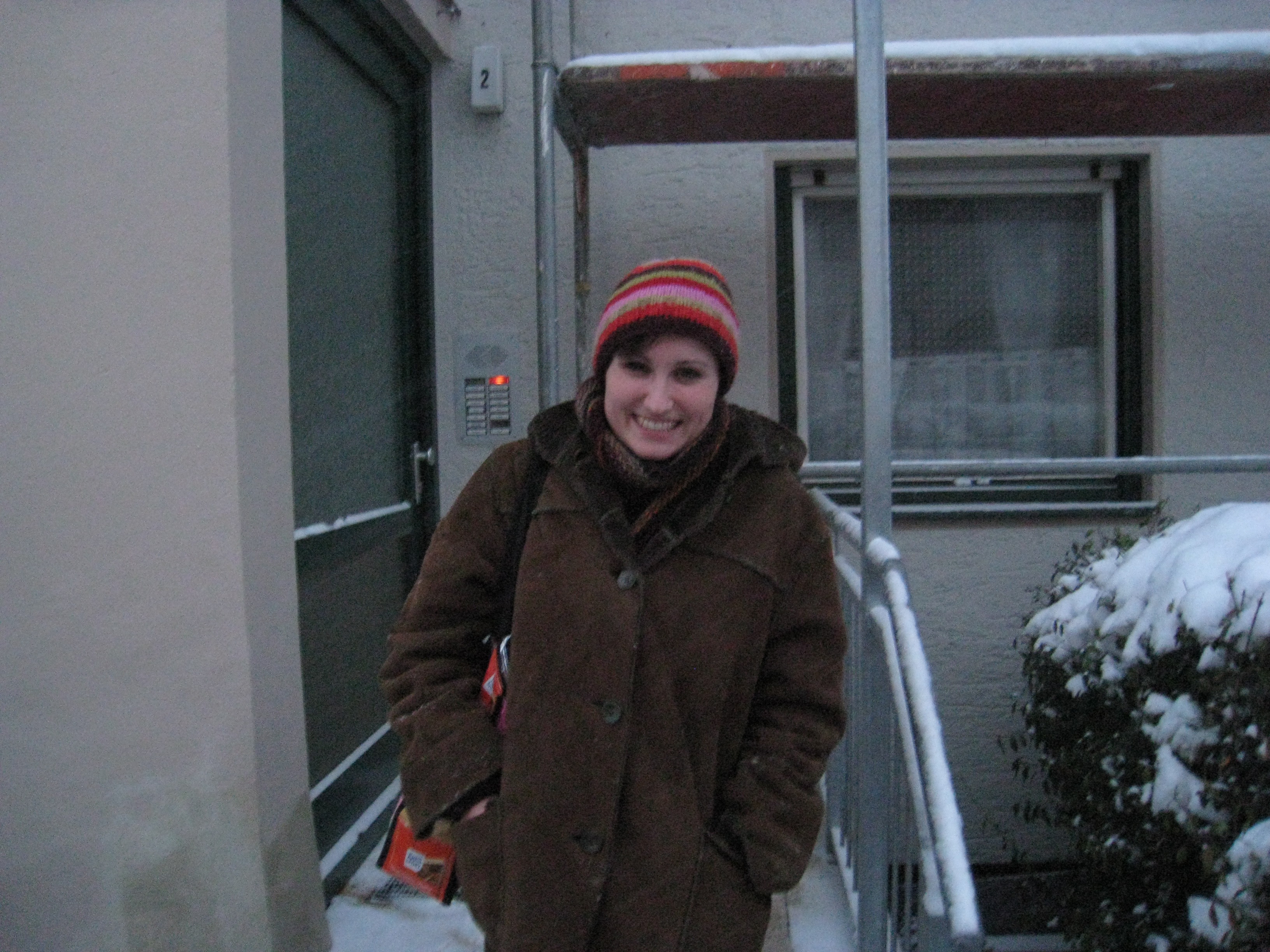
I would forgive you for accusing me of having notions of one day appearing on one of those ancestry-tracing television shows like ‘Who do you think you are?’ . To practise for such an occasion, I ask Andrew to take a picture of me on arrival at Regensburg train station.  I attempt to look restrained and dignified, humbled and delighted (as those minor celebrities do at important and scripted moments in the discovery of their past) but it is too much for me and I end up pointing with mock excitement at the sign above my head.

The journey begins and we battle through a blizzard along the Danube on the way to my Grandmother’s flat. We are startled by a baby rat as it darts for cover under the inches-deep layers of snow by the riverbank. When we arrive, we are heaped with white powder. I am nervous as I ring the bell – it has been three and a half years since I last saw my Grandmother and at that time I was not romantically attached. She opens the door and pops her head out. She motions us in as if we were meals on wheels. It is wonderfully reassuring. She brews a herbal tea and we sip it as the blizzard outside continues. She tells me that she misses packing Christmas parcels for her Grandchildren; it is beyond her competencies now, she tells me, as the children are looking for gadgets and games she doesn’t understand. I tell her how I loved playing shop in the playroom and how I remember her paper bags and dried apples. She smiles and tells me she has found old letters that her children wrote to the Christkind (the German equivalent of Santa Clause). I ask her eagerly if I may see them. I may. She gets up to fetch them, and I whisper a few words to Andrew, who has remained mute at the head of the table (Andrew speaks no German and my Oma no English). I leaf through the letters of my youngest aunts: they have asked for an anorak and an extendable pencil and have promised the Christkind that they have been brave Kinder all year.

Outside my Oma's flat

After an hour and a quarter, we shake hands goodbye and venture back out. We are station-bound again but have decided to check out the Christmas market by the Castle before we leave. We are ankle deep in glistening snow. Burning torches light our way to the courtyard, where stalls of mulled wine and gingerbread lure us through the cold. Four men play Christmas carols on old-fashioned horns. Beyond the glistening snowflakes and torch flames, the castle gleams. I buy Andrew a baked potato and he buys me a woolly hat. We leave our footprints in the snow. We miss our train and spend all evening in a Winter Wonderland I feel is part my own.