Frau Bienkowski and the Irish Convent

Frau Bienkowski was sitting by an open window, soaking in the sunlight. She gave me a faint smile. It was not her usual welcome. She was in pain.

“Every limb hurts,” she said.

We had been planning to venture outside the moment we got some sun. I asked Frau Bienkowski whether she thought she could manage.

Ten minutes later she was pushing her stroller around the grounds, naming flowers and telling me about the people she knew living in the neighbouring buildings.

Every so often she stopped and sat on the ledge of her stroller.

“Am I slower than you thought?” she asked.

“Not at all,” I said. “I’ve only ever seen you in your armchair.”

We passed two caretakers smoking at a back entrance to the canteen. Frau Bienkowski called over to them. “I was faster last year!” They nodded sympathetically and one of them, a young woman with a scraped-back pony tail and jet black hair said, “oh, the curse of biology.”

Frau Bienkowski told me she remembered what flowers were blooming when the Russians came. “You don’t forget a time like that,” she said.

After our walk we went for coffee. I ordered a latte. “What’s that?” she asked.

I told her it was a mixture of espresso and steamed milk. She said she’d try it next time.

We chatted about parents disapproving of mixed marriages. She said it happened lots after the war and I said that in Ireland in the past, a Catholic-Protestant marriage could divide a family forever.

“You know, you’re only supposed to stay an hour,” Frau Bienkowski said after two.

“Do you have something you need to do?” I asked.

“I don’t want you to feel obliged, that’s all,” she said.

“Frau Bienkowski, we have discussed this before. This is a pleasure.”

“Oh, very well.”

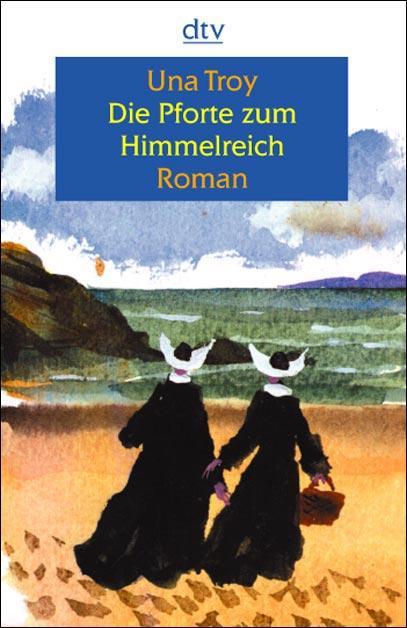
Back upstairs, Frau Bienkowski asked me to read from “Die Pforte zum Himelreich,” the book by Irish writer Una Troy which I brought her last week.

“I started it,” she said. “And it is very good. But my eyes became swimmy and I couldn’t read on.”

The scene I read was a dialogue between an eager 23 year-old upstart journalist and a 100 year-old woman in a convent. She was Ireland’s oldest person and he was vying for the scoop on how she’d managed to live so long. She gave smart-ass, wry responses.

I put on my best crotchety voice for the old woman and an effeminate whine for the young man. Frau Bienkowski laughed out loud three times.

“You should be a professional reader!” she said. “I can completely imagine that nun!”

When I left, Frau Bienkowski said, “You bring me such joy.” This time her smile was real. It made my day.

Watching the snow with Frau Bienkowski

“You should always avail of the free coffee here,” Frau Bienkowski said. “Sure, why wouldn’t you?”

“I did,” I assured her. “I had a latte downstairs. It was delicious.”

The dress Frau Bienkowski admired

The dress Frau Bienkowski admired

“Good,” she said, looking at me closely. “Now, this is a dress I haven’t seen before! It’s lovely!”

“Thank you!” I said and admired her pastel-coloured floral two-piece.

Outside, thick snowflakes were swirling in the air. “It’s such a shame about the weather,” said Frau Bienkowski.”I still have to give you a tour of the grounds.”

“And you promised to tell me the story behind the funny little statue outside,” I said.

“Don’t worry, I haven’t forgotten!”

“How have you been sleeping?”

“Not well,” said Frau Bienkowski. “The other night I was awake the whole night. When the alarm went off at 7 o’clock I just couldn’t face getting up. So when the first lady came in, I had to think of some reason to stay in bed, so I told her I had a headache.”

“She asked me where,” Frau Bienkowski continued, smiling wickedly. “So I waved my hand about and said from front to back. Of course they got the doctor to check up on me. Then they took my blood. And of course I’d a perfect reading.”

I laughed. “Would you not tell them you’ve trouble sleeping?”

“Ach, I told you before, I haven’t been able to sleep since my husband died. And that was a long time ago.”

“Do you listen to the radio or watch TV in the evenings?” I asked.

“Oh yes,” said Frau Bienkowski. “I only watch television in the evenings. But listen to this; the other day a message to turn down my TV came from a lady all the way down the corridor. There was no way she could have heard it. I even asked my next-door neighbours if they could hear my TV. They couldn’t. Sure we are all hard of hearing here.”

“Difficult neighbours can be found everywhere!” I said.

“That they can,” she said. “Now, tell me about these CD players.”

“Well, I did a price check,” I told her. “And the ones with the decent speakers are about €50. The smaller ones with low quality speakers are around €30, but you wouldn’t be able to hear from bed if we plug it in over there.”

“We’ll have to wait so” said Frau Bienkowski. “I spent €12.50 on that coffee jug last week,” so I can’t afford to spend any more money for a while.”

Frau Bienkowski looked at the clock. “Be careful you’re not late for your night shift!”

“Don’t worry, I’ve my eye on the time,” I told her.

“How long are you working tonight?” she asked.

“Until 2.30 in the morning,” I said. “When I’m on my way home, you’ll be awake in bed, hopefully with the radio on.”

“Yes,” she said.

Another cup with Frau Bienkowski

When I arrived at the nursing home earlier this afternoon, I passed a group of ladies pushing Zimmer frames and wearing feathered masks. Before I went up to Frau Bienkowski, I ordered a coffee downstairs. I was served by a lady with whiskers and a tail.

Frau Bienkowski said she would prefer to forgo the carnival celebrations downstairs, but we turned on the TV and watched an enormous red float make its way through the centre of Duesseldorf.

“When I was young,” Frau Bienkowski said, “we didn’t dress up that much for Carnival. But we had a masquerade ball.”

masq

“At midnight, you would take off your mask to reveal your face to your dancing partner.. Of course it wasn’t always a surprise. You knew some people by their hands, or the way they moved.”

She paused. “You aren’t wearing that beautiful pattern today,” she said, studying me carefully. “But that skirt is nice too.”

I complimented Frau Bienkowski on her green two-piece suit.

Then I emptied out my bag. “I brought something for you,” I said.

“Oh?”

“Well, since you said you liked reading, but that your eyes were no longer quite up to it, I took out some audio books from the library.”

“Audio books?”

“Yes, here have a look.”

“I didn’t know there was a such thing as audio books,” she said. “And you can take these out of the library?”

“You can! And you can even borrow films too,” I said. “Now, if you’ll excuse me, I have to go and borrow a CD player.”

“Will it be big?” asked Frau Buenkowski.

“It might be,” I said.

“Here, take this,” she said, pushing her Zimmer frame over to me. “And would you mind picking up some coffee too?”

I made my way down the hallway to the communal sitting room. Five ladies in wheelchairs were seated around a table, eating cake and drinking coffee.

“Did you hear the Pope has resigned?” said one.

“Oh, I knew that already!” replied another.

“On grounds of age,” chirped in a third.

I unplugged the CD player and popped it inside the basket of my Zimmer frame. I filled up two cups of coffee and balanced them precariously on top.

Frau Bienkowski and I listened to a few minutes of a German novel, read by the author himself.

“Do you think you might like this?” I asked.

Frau Bienkowski nodded. She looked happy.

“Which library did you go to?” she asked.

I told her. “Did you know that the building used to be a Sparkasse bank?” she asked.

I didn’t. “It was a vault, which the Russians plundered after the war. Back in the day, people had less jewellery, and they used to bring it there for safekeeping. One of my friends never saw her necklace again.”

My eyes were becoming wider. “Anyway,” Frau Bienkowski continued. “Tell me about what you’ve been up to.”

I told her I’d worked a rather uneventful night shift last night. Frau Bienkowski laughed. “It’s not every day the Pope resigns, is it? I don’t know why they picked someone so old in the first place.”

Frau Bienkowski, like me, suffers from insomnia. Hers is much worse. “I haven’t been able to sleep since my husband died,” she said. “Last night I was awake until 5 o’clock, but I got up again at 7. Routine is important.”

I asked her if she was plagued by racing thoughts.

“No,” she said. “My husband and I used to have wonderful times together. We went to the museum a lot. I have a wonderful talent to recall these happy thoughts. Some other people are riddled with anxiety at night, but I simply think of these good times with my husband.”

We talked for two more hours and I said I would call Frau Bienkowski later that week. She looked at me. “I never want you to feel obliged to come see me,” she said.

Frau Bienkowski, forgive me my bluntness but you could not be further from the mark. And this week, I am going to buy you a little CD player from Medienmarkt.

The Spindly Old Man and his Giant Dog

Yesterday an old and spindly man carrying a canvas rucksack got on the S42 train. By his side, ranging far beyond his hip, was the largest dog I have ever seen. The animal’s expansive snout was curved into an unmissable expression of contentment and its panting caused a pleasant breeze to waft in my direction. The pair captured the attention of the entire carriage. One lady  gasped and another simply pointed and shook her head.

The considerate hound immediately dove under a row of seats and stretched out its gargantuan mass. The  old man plonked himself down nearby. I chose the seat next to him. I had to keep my legs dangled in the air because a portion of the canine was jutting out far  beyond the area beneath the seat. The old man took out a newspaper and  I opened my book.Shortly after I felt him abandon the paper and read over my shoulder. I hoped my leisurely reading pace suited his. The book was The Diving Bell and The Butterfly. Its author, Jean-Dominique Bauby, a French journalist, became paralysed after a stroke and could only communicate by blinking. He died at the age of forty-four.

The man and his enormous dog stayed on the train for five stops. As he was getting ready to disembark, one of the ladies, who had been staring unashamedly the whole time, blurted out, “How much does he weigh?”

“Sixty seven kilos,” the old man replied in a flash and added, “He’s not a Saint Bernard either; he just looks like one.”

The lady nodded earnestly. “And how old is he?”

“Seven.”

The doors slid open and the old man stepped forward. Then he hesitated and turned around again.

He looked the lady in the eye.

“He’s the best thing ever to happen to me,” he said.

Then the doors closed and they were gone.