Coming soon!!
Familienfest The Finale
1
Coming soon!!
Coming soon!!
I was 16 and practically the same but for a hideous mane of long, straggly brown hair with orange highlights. I had just finished struggling through The Satanic Verses. I’d taken it to Germany where I spent many a journey on slow trains, puff-puff-puffing their way through the Bavarian countryside, with the battered book on my knee, trying to make sense of it all. Bizarrely-named angels, and evil and the Muslims didn’t like it: it went something like that. Still though, I used torn up bits of receipts from purchases of Puffreiss Schokolade in Müller to mark interesting passages, which I later transcribed into a notebook, in case I ever decided to emulate Rushdie’s descriptive style, which I must have assumed would be a piece of cake.

My literary aspirations began early in life; in fact they were very much present before I could read and write. At the age of three, I was inspired by numerous attempted break-ins to our home to compose my first work of non-fiction, which I titled “The Book of Burglars”. It was a no-nonsense guide to local criminals, which I penned with help from the local Gardaí, who had shown me an enormous, hard-bound book with an austere brown cover full of photographs of known criminals in the Rathmines area. I illustrated the book interpretively and filled its pages with line after line of elaborate pencil swirls, which I supposed represented the words I was imagining writing. In hindsight, it was rather a reasonable conclusion to draw, given that I had witnessed countless adults sign their name with a scribble that bore no resemblance to the letters of the alphabet of which I had by then become cognisant.
When I subsequently added literacy to my repertoire, I concentrated my efforts on the story of Spook, a castle-dwelling ghost-child, who gets separated from his parents only to be re-united with them at a banquet, where he enjoys (what in my 6-year-old eyes was) the ultimate consolation prize after an agonising ordeal: a drink of 7Up.
As I turned nine and became politically aware, (where such consciousness has since departed is anybody’s guess) my literary efforts were directed to a novella on the subject of the war in Kosovo. Alina’s Story told the tale of a girl and her family struggling to come to terms with the effects of ethnic cleansing in her village. It was written as part of a class project and my older sister of 13 kindly agreed to be my editor. Her decisions and re-writings may have been difficult to reconcile with my original vision, but I was convinced of her sagacity and the finished work is testament to her editorial skill.

Alina's Story, First Edition
When I turned 16, my hairstyle and literary interests took a new direction. I became immersed in the realm of the hypothetical and was in no small part inspired by Rushdie to create an unintelligible literary landscape of my own. It was my solipsistic phase, you see. I considered the predominant preoccupations of my life: self-loathing and the feeling of inadequacy and decided, delightedly that I would transmute these singular insights into a mytho-historical landscape. I imagined a people and land far away from mine and outside of the inconvenience of an established historical timeframe. These people lived in a country that looked precisely how I had pictured Rushdie’s India to be. They had inherited self-loathing, which was rooted somewhere in a bitter historical event (possibly a world war) which had generated, across generations, a learned guilt. I wrote 26 words of that epic work. I have lost the original to a large mainframe Pakard Bell computer but I had enough foresight to commit the 26-word opening line to memory. Here I admit it, for the first time to public view. It went like this:
The self-hatred of the Rahadan race was not ancient, but had existed long enough for the Purkhan family of four generations not to know anything else.
That line concluded my Juvenilia. Little did I know then to what my literary aspirations would amount: a paltry offering of my miscellaneous adventures to the blogosphere. Should have stayed in the genre of mythic-realism. Glad the orange highlights grew out though.
 Psychofelinology is a discipline waiting for the right moment to pounce onto a field of unsuspecting, mousy-haired academics. The research journal Behavioral Processes is ahead of the trend though. Its researchers have recently observed that:
Cats … seem to remember kindness and return favors later. If owners comply with their feline’s wishes to interact, then the cat will often comply with the owner’s wishes at other times. The cat may also “have an edge in this negotiation,” since owners are usually already motivated to establish social contact.
This analysis has wide-ranging implications. For one, it dismisses as empirically unsound my own experience of cats as sefish creatures with little motivation to engage in co-operative interaction without the prospect of being either fed or housed. Furthermore, it indicates that cats have a rather sophisticated emotional memory system. I had always assumed that their disproprtionately large cerebellums – responsible for their extraordinary balance and super-felxibility as well as their ability to remember the way home in the dark-was countered by an impaired capacity for empathy.
However, it also vindicates my intuition that non-human animals can engage in a considerable degree of introspection and planning. I remember reading an article a while back about a chimpanzee in a zoo that collected and stored stones in order to hurl at ogling visitors at a later date. This was reported as a breakthrough discovery because the chimp was engaging in planned behavior. I thought this a rather primitive (you forgive the pun) conclusion to draw given that all hunting requires at least a degree of strategy, be it “instinctive” or not.
The finding that cats “may have an edge in negotiation” is in line with my prejudiced expectations however. Given that the Feline appears to have a capcity to understand emotional interaction, I am not at all surprised that it possesses an innate distaste for engaging in spontaneous displays of affection without at least the pleasure of adhering to the principle of reciprocal determinism, better known as “You scratch my back, I’ll scratch yours”.
I believe that cats are divisive creatures for the very reason that their shrewdness taps into the deepest analysis of our own identity. I for one experience in the cat’s talents a stark reminder of my own shortcomings; unlike the feline fiend, I have a very poor sense of direction, impaired flexibility (as evidenced in my continued struggle in Beginner’s yoga) and am over-sensitive. Not quite a pushover, but I’m a bit of a ‘Yes Katzi’ when it comes to facilitating people against my more selfish – even catty – judgement. Furthermore, since I am still under my parent’s roof, I respect and envy in equal measure the self-sufficiency of the cat which house-hops for the best meals.
As I was apt to conclude in the final paragraph of all my undergraduate Psychology essays: further research is needed.
There was once a raven-haired fortune teller who, tracing her forefinger over my palm, told me that I would live to be in my nineties. I was alarmed when I realised some time ago that I had reached quarter age in spite of her promise of longevity. This realisation, coupled with acute post-graduation panic (PGP) has propelled me to a life crisis.

LSB and his birthday treats
“Me a financial journalist?”, an Austrian lady with lively eyes exclaimed, tearing into her steak. “I thought; never!”

She was over here two years ago to report on the economic crisis and had stopped by at my house for dinner. It was the first time my parents and I had met her but she had come highly recommended by her Viennese aunt, a friend of my father’s. I was in my third year of college and still under the impression that the world was my oyster.
“How has the recession had an impact on you?” she asked between bites.
I thought. “Wealthy parents no longer want me to teach their children Irish”, I mused “and as a result I’m more conscious of the price of coffee. Coffee is my main source of expenditure”. She scribbled this down in her notebook.
I was about to explain to her that Insomnia’s €3 coffee and mufffin deal (do you remember?) was topping my list of recession busters but that were the food not so disgusting, the “Weekly Madness” deal in Londis would have come out tops, when she asked “What would you like to be?”
“I would like to write feature articles for newspapers” I said.
She poured herself some juice and sat back. “You need to be open”, she said, “and you need to stand out. I never saw myself writing about economics.. I mean, me and finance come on”..
“You need to send good photographs to editors”, she continued. “Not boring ones. Ideally you should be out in nature. The photograph I used to get this job was of me with a tree. It’s important that you be different from the crowd”. 
In the days, weeks and months that followed that conversation, I considered setting the self-timer of my camera and wrapping myself originally around one of the sycamore trees in my garden, but weather and the proximity of my neighbour’s back window to my creative space did not permit.
I did however take on board her advice, and the photograph that I use in the “Who Am I” section of this blog features me with a Slovenian tree which I accosted on the shores of Lake Bled during an interrail adventure with my LSB two summers ago. Though I have been a hard-working teacher for a week now, I’m keeping the old literary passion alive and my big toe in the door by accepting the position of editor of a new literary website: www.writing.ie, which launched last night after months of hard work by a small group of driven and creative people from whom I am learning to multitask. For the “about us” section of the site, I have chosen to feature a photograph of myself beside a large sunflower, as my sycamore tree wouldn’t fit on the photograph. Who would have thought that a financial journalist could inspire such a circuitous plug. I guess her editor would agree with me that she is one hundred percent natural…
 Today Waterstone’s Bookshop announced the closure of its two Dublin branches and the Sunday Tribune newspaper went into receivership. I spent the day in my bear onesie; having spent an unfortunate night vomiting. The news about the Waterstone’s closure reached me via text message from my dismayed, book-selling LSB who had just finished work. Nursing a saline medicinal solution and rather cosy in bed, at the moment my phone beeped, I had just finished reading Stefan Zweig’s The Post Office Girl; a story of cultural and ideological tragedy that depicts the epic and transformative power of money.
With these thoughts at the back of my mind, I got around to researching the “Face of Ireland” beauty competition, which a friend of mine told me that she had entered last week. The contest, which I had not heard of before is now in its fourth year and promises the successful candidate “a year of glitz and glamour”.
But both come at a price. If I have understood the terms and conditions of this dubious divafest correctly, I calculate that all candidates that reach the grand finalé will have forked out €750 for the privilege. The website stipulates that: All candidates who are selected for interview will have to pay a small fee for the upkeep of the competition. I know from my friend that this “small fee” happens to be €150, a sum with which you could procure at least ten great works of literature from Waterstone’s bookshop. In an uncanny commercial coincidence it just happened that every girl selected for interview also got through to the next round. My friend opted out at this point and in an indignant text message which I sent her from Penneys in O’Connell Street I ensured her that she had done the right thing.
Should she have progressed further through the competition, she would have been required, in accordance with the terms and conditions, to sell at least 10 Tickets at a costing of €60 each for the semifinal show. This year’s Face of Ireland, Louise from Donegal blogged happily of the night of the grand finalé that Between cat walking, interesting questions and a few unexpected party pieces an entertaining night seemed to be over in a blink! I know it’s a cliché but to have made it that far, every single one of us was a winner!.

I suppose with a loose interpretation of winner, any achievement is possible. In a society which has lost its money, its bookshops and its most educated people the success of this kind of vacuous endeavour makes a farce of us all. I have a lovely memory of sitting upstairs in the coffee shop of Waterstone’s on a spring afternoon during my first year of university. Our tutor had taken us there to discuss Structuralism over a cup of hot chocolate. Soon enough the Deconstruction will begin at that site and the future Faces of Ireland and their fans will stand proud, pouting over it all.
If I were a fly, I would crawl up billboards and over the faces of celebrities advertising shampoo. If I got peckish I’d fly to my nearest bakery and alight on an almond bun. I’d avoid flying on my own on dull days in case I got trapped in a spider’s web that’s only visible in the sun. 
I’m not a fly though and so I’m forced to navigate the world conventionally. I have to get a job to buy an almond bun. I need to battle against the forces of economic psychology to buy cheap supermarket own-brand shampoo with no promises of instant glamour and folical success. And I can crush a spider’s deathtrap with my fist.
I just finished ‘reading’ (three of the seven essays consist of a series of images with no words) John Berger’s Ways of Seeing and though there was a lot I read too superficially to grasp, the last essay, which focusses on publicity and consumerism, got me thinking about the place where I drank a whiskey and lemonade last Saturday night.
 It was the basement of a nightclub on the quays called ‘Gypsy Rose’. The walls, table-tops and tshirts of the band were decorated by gothic-style roses and a backdrop of despondent-looking skulls with over-sized teeth biting into shotguns. The lighting was dim, the band playing exceptionally loud and the decor scarlet and deep purple. My flowery green dress, polo neck and snow boots flouted the dress code.
Nearly everyone there had multiple tattoos. My friend told me that it’s a familiar haunt of the ‘tattoo society’. I thought he meant to break it to me that I’d walked in on some political social, but actually he just meant that it’s full of people with tonnes of tattoos, which I could see for myself.
If they weren’t musuclar skinheads wearing band tshirts, they were charmingly nerdish-looking and in leather trenchcoats. The girls had edgy jet black hairstyles and facial piercings and next to them I looked like a ridiculous daisy sprouting from a graveyard patch of bleeding roses.
The whiskey was good and in spite of its unreasonable volume, so was the band. And yet, there I was with my eyes convincing me that I shouldn’t be there.
No biggy; just not my kinda place, I mused on the luas home. I just like it more mellow, with pots of tea and shisha and perhaps an acoustic guitar in the background. “Damn hippy indie chick” somebody probably sighed as I took out my book.
I think I find comfort and shame in equal measure in the personalised telescope through which I view the world. I’m comforted because by knowing through sight what I am not I can guess what I might be instead. I am ashamed because I never look through the lens for long enough to understand fully what it is that I am not.
***************************************************
PS – I would love to capture, spookily, the Zeitgeist in a piece of prose. I can’t, because I am much too busy lounging in my own world view. If I were a fly,I might get trapped in a web of images, but at least I’d have had the privilege of a bird’s eye view of the world.
A copy of the London Times is folded on his lap and he’s at the intersection of Grafton Street and Johnson’s Court Alley, the narrow passage that connects it with South William Street. The sign he leans against advertises affordable antiques in the Collectors’ Haven in the Powerscourt centre. Armando, a Brazilian who came here some months ago to study English now works seven days a week. He will remain in Dublin until December working on his English and holding on to his job. He’s in the middle of a group of signpost holders, all of them Brazilian. I ask him why only he has a stool. He motions to the man beside him with the Jackpot sign, ‘My friend is new.. he has only been working a few days.. We think it is a little too early to ask..’. There is not a trace of resentment in his voice. In fact, he seems to enjoy his work- ‘There is always something different’ he smiles. His friend of the Jackpot sign nods in assent ‘No day is the same’. I ask whether the signs are effective; ‘Oh yes’ he is quick to reply, ‘many people stop and ask us about the shop’. Armando is one of many whose livelihood exists on the streets of the city centre. What is unusual is that he answers to an employer at all.
Take a walk through town and you will be arrested by a fire-eating juggler or the statue of a golden lady, who disturbs her motionlessness only to execute a graceful twist and present you with a rose. Just try to avoid intruding on the arc of an audience surrounding a charismatic eastern European string quartet or a local guitar duo. We humble pedestrians are the closest these performers get to an employer.
Working independently is something that Marc, a 35-year old silver-painted Parisian artist knows a lot about. When I approach him he is busy thanking a woman profusely for dropping money into his beret. He blows her a kiss. ‘Merci beaucoup’ he calls after her. On the ground beside him is an enormous, multi-coloured, textured collage with reels of photographic film draped over it. ‘I’m a survivor’, he tells me and he has the resumé to back it up. He has ‘done’ London and New York and his next stop is Ontario. He is a little sick of Europe, he tells me but that is not my impression. He has sold 18 paintings in the nine months he has spent in Dublin and he has even sold a painting to Björk. His are the characteristics of every artist before they have achieved their break; the breadth of travel, the creative malleability and the life experience. Behind his silver veneer is an intelligent, chiselled face, confirmed later as I check out his myspace art profile and encounter his face untarnished by the metallic hue he sports on the streets. Art is his life, he says. He doesn’t like galleries, although he admits that perhaps that is because he is not yet a part of one. When I implore him to revisit Ireland he pauses before telling me that there is a chance he will stay as he has a friend who knows ‘a rich man who is interested in new artists.’ He admits that he is looking for a ‘real job’. ‘I am 35’, he tells me ‘and I will do this until I am 40’. I take it that by this he means travelling through the world’s cities and charming its pedestrians with the extremely flamboyant manner that matches his artwork. We are mid conversation when a beautiful Romanian girl of no more than 6 years taps his leg and looks up at him expectantly. He shakes his head with a smile and she continues quickly down the street. ‘Every day she asks me for a lollipop’, he explains. ‘Most days I have one but not today’. He goes on to tell me that he is lucky with his situation here. ‘I pay only €50 a week for a hostel in Upper Gardiner Street, ‘and so I can live from my art’.
As self sufficient as these performers are, each of them works in a non-regulated, open-plan office environment where the maxim location, location, location stands firmer than on any property ladder. Respect is the overarching principle, I am told again and again. For ten years, Duggy, who speaks with a charming English accent and who resembles somewhat Bert the chimney sweep from Mary Poppins, has been deftly twisting balloons into shapes opposite Karen Millen in Grafton Street. He has been there longer than the pole to which he attaches his balloons, he laughs. There is an unofficial code of manners among artists, he tells me, although ‘this’, he says, indicating the hair braiders who have set up right beside him, ‘wouldn’t have happened in the past.’ He talks while twisting me a sword with a heart-shaped handle. Not that he restricts himself to balloon bending though. Having spent time in Italy and Spain, he can cite many factors that affect success on the streets. Working afternoons in the heat is fruitless. Balloon twisting just doesn’t work everywhere. ‘Mime is the international language. It works everywhere’.
Like many artists I have spoken to, Duggy has performed on the streets of Barcelona but he has noticed a change in the city; ‘It has become paranoid’. Packing up after an afternoon of playing guitar, a local busker attributes Barcelona’s loss of appeal to the introduction of licensing. He has spent the last eight years making a living playing music in Dublin. For him, it’s the best place. While Stokholm is ‘okay’, in many cities the people ‘just don’t get the concept of giving money to street musicians’.
Travel is a dominant feature of the life of every performer that I speak to. As I gaze in awe at the sculpted sand dog that Czech man Libor has created on the pavement in Henry Street, I am preparing to ask him where he learned to sculpt when I am sidetracked by his question ‘Surely you are not Irish?’ I admit that I have a German mother. He smiles ‘Ach, du sprichst Deutsch’. We carry on the conversation in German. He hasn’t spoken it for ten years since he had a Viennese girlfriend. He is, despite his protestations, a fluent speaker. For him, travel is natural. ‘I have no family around me. I have only a father, brother and aunt and they all live in different cities’. He asks me if I study sociology and we wind up discussing my college course and the relative merits of my TSM subjects. He gives me his website address and I see that, among others, he has also sculpted squirrels, lions and crabs.
In case of rain, the internet provides an all-weather platform for performers to promote and share their work. This level of networking leads to easy publicity but also to scrupulous comparisons. A single thread entry evaluating four street acts in Seattle runs to 669 words. Rapid, worldwide communication has made the organisation of events and festivals of street performance feasible. The annual hosting of the world championships of Street performance in Merrion Square in Dublin and the success of the street performers at the Dún Laoghaire Festival of World Cultures is testimony to the fact that the Irish are rightly being credited as a generous, busker-friendly nation. Coins are tossed into music cases and hats with recession-defying casualness. Passers-by smile at the clown that pounds them with his sponge sword and feel for the lady who has spent months learning recorder at the side of the street. Street acts are about more than entertainment; they provide one half of a dialogue of goodwill among strangers. The level of education that many of these performers have achieved is striking and their willingness to share, in sometimes very broken English, their story is humbling. I pass by Armando a few days later. His friend is still standing and they are both smiling. There isn’t a hat at his feet to fill but his contentment is contagious.
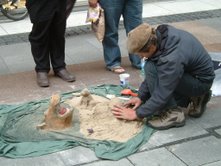
Libor at work on his sculpture
 Kate Ferguson