We Just Clicked: Why Internet Dating is a Hit and Miss Afair

KJKJ2 wishes there were more women like me in the world and Makemyday tells me I look amazing and adds, “you defo must be run off your feet here big time”. Having joined the dating site plentyoffish.com a few hours ago, I’m already navigating a swarming inbox of amorous epistles. I am one of 11 million users of the world’s largest free online dating website and as I write there are 101,482 of us online. My details have been cybernetically ordered so that my profile appears primarily to local gentleman. The number of Dubliners that have already contacted me is startling. 

Preconceptions are dispelled when I meet Anthony: a sandy-haired 22 year-old graduate of Business at DIT. He joined two online dating communities in November 2007 after the break-up of a relationship. “Initially, it was a reaction to that”, he tells me, “but now it’s just a way of putting myself out there”. ‘Putting himself out there’ is evidently not something Anthony has difficulty with. We meet on a Friday afternoon and he’s craving a night in after being out socializing every other night of the past week. “I need an evening off”, he says and laughs when I suggest curling up to Ryan Tubbers with a tubbers of Ben&Jerrys best cookie dough.

“It’s not a case of not being able to meet girls” Anthony elaborates, “it’s more the matter of finding it difficult to gauge what they’re looking for”. On a dating site, intentions are selected from a drop-down menu. In person, you need to attend a traffic light ball for the boundaries between stop and go to be established. Anthony refuses all communication from those looking for the euphemistically-described “intimate encounter”. “I’ve no interest in people seeking casual sex… I’m looking for dating that leads to a relationship” he tells me.

Looking for dating was seemingly also Dippy_Duck who contacted Anthony about a year ago. Their first encounter was “a really quick conversation as I had to go out-we swapped numbers quickly so we could keep chatting”. After exchanging texts and phonecalls, Anthony and Dippy_Duck decided to meet in person: “From her pictures, I thought she was cute, but to be honest, her photos were a bit different from what she looked like in reality”. Anthony (nice guy) is quick to qualify “I don’t mean that in a bad way, she just literally looked a bit different in real life!”

So how was Dippy_Duck in real life? “I’m sorry to say it”, Anthony says “but she was an absolute nutjob”. “She only met people online”, he recalls “and she was just looking to hook up casually…she had extraordinarily low self esteem and I was uncomfortable with her calling me seven or eight times a day”. Needless to say, they did not meet again.

The duck’s approach of Anthony is uncharacteristic of the politics of dating sites: “these places very much follow the rules of engagement.. it’s up to the man to make the first move, that is to send the first message”.   In line with expectation therefore, the gentlemen writing to me make their advances with varying degrees of charm and evidence of good character:

hi…

was just wondering around on website search looking for online people. and i saw you online so just wanted to throw hi….

ya can read about me in my profile.. it aint that bad neither am i. so hope you will consider messaging me back and that really would be more than appreciated.

peace to you

cuteypie3

Hello Anna,

My Name is William, and I too enjoy the poetry of Milton. I haven’t been on this site for too long, but I suspect that there aren’t too many others out there that read metaphysical poetry.

I’m also someone who enjoys writing, even if I never fully seem to get the time. So what sort of stuff do you write?

Dreamman14

Just browsin, haven’t been on here in a while but saw your pic and..well just have to say hi. And what’s the bets you’re cuter in person J go on say hi J

Durlangon

It’s never easy to know how to begin. Anthony usually picks up on something that was listed as an interest or hobby (kudos, Dreamman14) and makes a comment on it. It’s also important not to sound too dull: “hello, how are you?” is a bit boring, muses Anthony, “you don’t want to sound like everyone else”.

Flattered as I am by these poetic pursuits, what are the chances that cuteypie3 is in fact pseudosuitor72, creating a fraudulent identity à la ‘Anna’ (who does, incidentally, share many of my interests and personality traits)? According to Anthony, it’s quite easy to identify the scammers: “pictures that are very obviously photo-shopped and very general descriptions are a sure sign that you’re not dealing with a genuine person”.

Regardless of genuine people, there is genuine money to be made. The Online Publishers Association (OPA) reports that cyber dating comes second only to pornography as the largest segment of ‘paid content’ on the internet. In 2005, Americans paid in excess of $500 million to become members of online dating communities. In Ireland, users are split between paid services such as maybefriends.com and match.com and the free global sites financed exclusively by advertising such as okcupid.com and plentyoffish.com. According to a 2002 Wired Magazine article, finding a partner online is akin to a searching a library catalogue for a book rather than hoping the perfect title will fly off the shelves and into your hands: “Serendipity is the hallmark of inefficient markets”, they say and the marketplace of love, like it or not, is becoming more efficient. It’s no wonder that Anthony’s business acumen and openness combine to put him ahead of the crowd. Searching for a soulmate online beats naval gazing and it takes resolve to make your intentions be known. 

With more and more envelopes appearing in my inbox for “Anna”, I begin to feel uneasy. I consider myself a conscientious correspondent and I feel a pang of guilt at each unanswered missive. It’s all about passion though and to Dreamman14, if you are reading, this is the kind of thing I like to write.

Working the Streets: Part 2 – The Night Shift

Ranelagh Luas Stop

Vodka swishes in their Evian bottles and amidst ‘Is Jack coming?’…. ‘Yeah I texted Alice but she’s babysitting or something’ their phones buzz incessantly. Their toes point to the carriage floor: their heels hoist them far above me. They smell honey sweet. It’s post pre-drinks and The Palace is free in. They hop off at Harcourt and I lose their trail.

Sailing down Harcourt Street

There is a group of English girls and they are dressed as sailors who would freeze at sea. Having built up an enormous appetite crossing the Irish channel, they lean into the Chinese man behind the counter of a hot dog van. Intimately and with an air of confession they seek from him a double cheese burger. He obliges as they navigate their way through foreign currency, stumbling and biting, excited and raring to explore unchartered waters.

I approach him with caution and request the price of a hot chocolate. It is extortionate and so I buy a 7 Up. I stay there watching. ‘Do you like your work? I ask him finally. ‘Not much’, he mutters. ‘I just saw those girls’ I offer. The insinuation is lost in his worldliness and he replies, ‘at this time it is still okay, later on, people are even drunker and then they become difficult and break things’. One preagnant pause later he walks away to the corner of his van where he talks to a co-worker. I wander away.

The Rickshaw Driver: Grafton Street

He’s got a UCD hoodie and a cart. Before I give him a proper look, I have begun my spiel: ‘Hi… I’m writing a feature on people that work at night…I would love to know what it’s like pulling a rickshaw’. ‘No problem, Kate’, he grins. Scarlet, I recognize him as a former colleague. (Memories are context dependent). Redeeming myself I offer him a take-out coffee in exchange for a chat: ‘No, no, you’re grand’ is his gallant reply.  

 King of Security: Grafton Street

He’s enormous in his reflector jacket and he won’t let me into Burger King with my can of 7 Up. I stop at the entrance and explain that I’m a student, from just over there who would love to ask him about his job. He regards me a moment: ‘You understand, I get paid to work, to protect this place and not to have chats’. He has a point and so I apologize. He looks at me quite kindly as I make to walk away.

The Rickshaw Driver

Our paths cross again. It’s a handy student job’, he tells me. ‘I’m employed by a company from which I effectively ‘rent’ the rickshaw. When times were good, you could earn €300-400 a night, but that’s gone down recently. Still, the money’s not bad’. But what about the stories? ‘There are too many to tell’ he laughs. ‘Once I ended up hoisted up with my rickshaw into the garden of somebody’s party.’ Is it not dangerous? ‘I only take direct routes. Generally I stay around the city centre. I don’t go down back roads and lanes. There’s enough work around here not to make it worth it’. Apropos enough work to be getting on with, I leave him and tell him to look out for the sailor girls.

The Ladies in Doyles

I drain the can and bin it outside Doyles.  Inside, a hand assembles a row of deodorant spray cans behind the wash-hand basin. A mass of Chubachubs and gums are piled already in a little wicker basket: sweet and fresh. I emerge from the toilet cubicle and she hands me a paper towel. I take it, awkwardly. ‘It’s getting cold’ she says remarking on my purple winter coat. I smile in agreement ‘Yes, it’s that time of year again’. ‘It’s still quiet here’ she says. ‘It’ll pick up in an hour or two’ I reply and imagine heels and lollipops and deodorant and tissue paper on the floor. I wonder if she knows winter from home and whether her family waits up for her.

The Rickshaw Driver

He’s sure doing his rounds. We wave and he’s kind enough to stop, again. What’s the relationship with the other rickshaw drivers like? I want to know. ‘It’s great fun’, he tells me ‘we know each other and greet one another on the way’. The problems we have had are with the horse and cart drivers. They feel we’re taking their business away and so they have tried to run us off the streets. At one point, the Guards had to come and sort out the trouble. It’s quite competitive out here. There’s a lot of money to be made from this kind of thing.’

Temple Bar

A can of Bavaria bathes in a pool of vomit and an entrepreneur challenges punters to ride a colourful bicycle past a line of white selotape. They queue in an orderly fashion and fall off, one by one. ‘Come on now, four gos for a fiver to win 20 quid if you pass the line’: ‘oye could do da. Gissa shot!”.  ‘It looks easier than it is: the handlebars are reversed’ remarks a shewd young woman: ‘that’s why it’s so hard!’. A bronze blond in a puffy red jacket hands out fliers for a lap-dancing club. It pays the rent.

 The Rickshaw Driver

He’s just dropped off another group of satisfied customers. ‘You must be exhausted’. ‘Ah, I’m okay’. Are you sure you won’t have that coffee?’ Ah, go on so’. A Maccy D’s muffin and a double espresso later, he’s stoically avoiding the 1 am slump and we’re discussing how to pimp his ride.

I’m back at the hot dog van in Harcourt Street. An intoxicated passer-by bashes in the door and leaves the vendor pick up the pieces: he has seen it all before. The night is only getting started but I toddle soberly home.

Still Lives

Abbey street is busy on a chilly autumn afternoon and the two euro shop is selling its last pair of fairy wings. A little girl waits for a luas. She is standing alone and dressed in a wine-coloured pinafore. She has an enormous pair of hazel eyes and a face entirely covered with freckles. There’s an incongruence in her features that is really beautiful. I’m thinking that she should play the lead role in a French art-house movie, when she sees me looking and says ‘What the fuck are you looking at you fucking bitch?’

I am so taken aback that I turn and walk away but I sense her youthful venom following me. She’s about eight.

A few weeks later I’m at the bus stop opposite my house when the hooded figure of a man pulling a bin bag shuffles towards me. It’s dark and the street is quiet. Instinct prevails. I move away to the corner of the road pretending I am looking out for taxis. His eyes are fixed on me. I can feel it. The two pedestrians I was counting on have passed on by. I fumble for my keys. He’s on to me. I make to cross the road and he erupts, calling after me in language he learnt from the lead role in an art house movie. I don’t excuse his French. I rush up my steps and let myself in, missing the bus that he is too drunk to hail.

I wasn’t always like this. Once I was walking along the canal coming up to Ranelagh and four cider-drinking, tracky-clad boys were having a laugh. Few cans, a bit of banter – a little mock fighting: nothing serious. I forced myself not to cross the road. After all, it was a summer’s afternoon in a leafy suburb and I was at one with the world. I strolled by, listening happily to my sunny- day music when two of them pounced out at me, blocking my way and pulling at the cord of my earphones  ‘Oy gissus yer oipod will ya?’, they laughed as I dodged under their arms. They released the earphones and guffawed at my reaction. Scurrying away sheepishly, I conceded that I almost deserved their farcical affront. Almost. They had smelt out my political correctness.

Sensory perception is an enormous area of research in psychology. They’ve labelled the occipital lobe, explored haptic contact, identified the primary auditory cortex, stimulated the taste buds and developed expensive machinery to produce odours. When it comes to how we see into ourselves, smell out dangerous people, touch on a delicate issue and describe those around us as having ‘taste’ however, the issue becomes blurred and resistant to empirical research.

Social perceptions are in the way we speak, look, move, socialise, perceive and educate. It’s hoopy earrings, whether your money comes from your builder dad or your doctor mum, luminous boob tubes, gym membership, your use of the habitual present tense and whether Lillie’s Bordello makes you puke before or after your visit. It is so blatant that it achieves subtlety in mature discourse. It is ingrained and chemically mapped. It is a system of immediate classification that occurs largely unconsciously. It’s what conjured up images of an abusive family life in a small and dirty flat when the little angel girl spat venom. It’s what makes me want and not want to cross roads.

Lawyers can become experts in questions of boundaries, engineers can construct bridges and teachers can convey principles of respect. Neuroscientists can breed impulsive rodents, geneticists can link genes to personality traits and social psychologists can construct an ABC model of attitude. Somewhere along the way we all know to learn or learn to know not to look everybody in the eye.

Working the Streets: Part One – The Day Job

A copy of the London Times is folded on his lap and he’s at the intersection of Grafton Street and Johnson’s Court Alley, the narrow passage that connects it with South William Street. The sign he leans against advertises affordable antiques in the Collectors’ Haven in the Powerscourt centre. Armando, a Brazilian who came here some months ago to study English now works seven days a week. He will remain in Dublin until December working on his English and holding on to his job. He’s in the middle of a group of signpost holders, all of them Brazilian. I ask him why only he has a stool. He motions to the man beside him with the Jackpot sign, ‘My friend is new.. he has only been working a few days.. We think it is a little too early to ask..’. There is not a trace of resentment in his voice. In fact, he seems to enjoy his work- ‘There is always something different’ he smiles. His friend of the Jackpot sign nods in assent ‘No day is the same’. I ask whether the signs are effective; ‘Oh yes’ he is quick to reply, ‘many people stop and ask us about the shop’.  Armando is one of many whose livelihood exists on the streets of the city centre. What is unusual is that he answers to an employer at all.

Take a walk through town and you will be arrested by a fire-eating juggler or the statue of a golden lady, who disturbs her motionlessness only to execute a graceful twist and present you with a rose. Just try to avoid intruding on the arc of an audience surrounding a charismatic eastern European string quartet or a local guitar duo. We humble pedestrians are the closest these performers get to an employer.

Working independently is something that Marc, a 35-year old silver-painted Parisian artist knows a lot about. When I approach him he is busy thanking a woman profusely for dropping money into his beret. He blows her a kiss. ‘Merci beaucoup’ he calls after her. On the ground beside him is an enormous, multi-coloured, textured collage with reels of photographic film draped over it. ‘I’m a survivor’, he tells me and he has the resumé to back it up. He has ‘done’ London and New York and his next stop is Ontario. He is a little sick of Europe, he tells me but that is not my impression. He has sold 18 paintings in the nine months he has spent in Dublin and he has even sold a painting to Björk. His are the characteristics of every artist before they have achieved their break; the breadth of travel, the creative malleability and the life experience. Behind his silver veneer is an intelligent, chiselled face, confirmed later as I check out his myspace art profile and encounter his face untarnished by the metallic hue he sports on the streets. Art is his life, he says. He doesn’t like galleries, although he admits that perhaps that is because he is not yet a part of one. When I implore him to revisit Ireland he pauses before telling me that there is a chance he will stay as he has a friend who knows ‘a rich man who is interested in new artists.’ He admits that he is looking for a ‘real job’. ‘I am 35’, he tells me ‘and I will do this until I am 40’. I take it that by this he means travelling through the world’s cities and charming its pedestrians with the extremely flamboyant manner that matches his artwork. We are mid conversation when a beautiful Romanian girl of no more than 6 years taps his leg and looks up at him expectantly. He shakes his head with a smile and she continues quickly down the street. ‘Every day she asks me for a lollipop’, he explains. ‘Most days I have one but not today’. He goes on to tell me that he is lucky with his situation here. ‘I pay only €50 a week for a hostel in Upper Gardiner Street, ‘and so I can live from my art’.

As self sufficient as these performers are, each of them works in a non-regulated, open-plan office environment where the maxim location, location, location stands firmer than on any property ladder. Respect is the overarching principle, I am told again and again. For ten years, Duggy, who speaks with a charming English accent and who resembles somewhat Bert the chimney sweep from Mary Poppins, has been deftly twisting balloons into shapes opposite Karen Millen in Grafton Street. He has been there longer than the pole to which he attaches his balloons, he laughs. There is an unofficial code of manners among artists, he tells me, although ‘this’, he says, indicating the hair braiders who have set up right beside him, ‘wouldn’t have happened in the past.’ He talks while twisting me a sword with a heart-shaped handle. Not that he restricts himself to balloon bending though. Having spent time in Italy and Spain, he can cite many factors that affect success on the streets. Working afternoons in the heat is fruitless. Balloon twisting just doesn’t work everywhere. ‘Mime is the international language. It works everywhere’.

Like many artists I have spoken to, Duggy has performed on the streets of Barcelona but he has noticed a change in the city; ‘It has become paranoid’. Packing up after an afternoon of playing guitar, a local busker attributes Barcelona’s loss of appeal to the introduction of licensing. He has spent the last eight years making a living playing music in Dublin. For him, it’s the best place. While Stokholm is ‘okay’, in many cities the people ‘just don’t get the concept of giving money to street musicians’.  

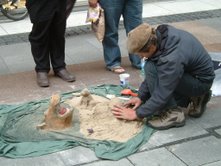
Travel is a dominant feature of the life of every performer that I speak to. As I gaze in awe at the sculpted sand dog that Czech man Libor has created on the pavement in Henry Street, I am preparing to ask him where he learned to sculpt when I am sidetracked by his question ‘Surely you are not Irish?’ I admit that I have a German mother. He smiles ‘Ach, du sprichst Deutsch’. We carry on the conversation in German. He hasn’t spoken it for ten years since he had a Viennese girlfriend. He is, despite his protestations, a fluent speaker. For him, travel is natural. ‘I have no family around me. I have only a father, brother and aunt and they all live in different cities’. He asks me if I study sociology and we wind up discussing my college course and the relative merits of my TSM subjects. He gives me his website address and I see that, among others, he has also sculpted squirrels, lions and crabs.

In case of rain, the internet provides an all-weather platform for performers to promote and share their work. This level of networking leads to easy publicity but also to scrupulous comparisons. A single thread entry evaluating four street acts in Seattle runs to 669 words. Rapid, worldwide communication has made the organisation of events and festivals of street performance feasible. The annual hosting of the world championships of Street performance in Merrion Square in Dublin and the success of the street performers at the Dún Laoghaire Festival of World Cultures is testimony to the fact that the Irish are rightly being credited as a generous, busker-friendly nation. Coins are tossed into music cases and hats with recession-defying casualness. Passers-by smile at the clown that pounds them with his sponge sword and feel for the lady who has spent months learning recorder at the side of the street. Street acts are about more than entertainment; they provide one half of a dialogue of goodwill among strangers. The level of education that many of these performers have achieved is striking and their willingness to share, in sometimes very broken English, their story is humbling. I pass by Armando a few days later. His friend is still standing and they are both smiling. There isn’t a hat at his feet to fill but his contentment is contagious.  

Libor at work on his sculpture

Nun The Wiser

A google image search of ‘nun’ reveals a plethora of results: some humorous, some sordid and some artistic. After all, the ‘veiled’ has a tendency to appeal to the imagination. A veiled remark can cause consternation and when an identity is unveiled its suggestive power is lost. Ireland may not experience the image of a nun as pervasively as it once did but she remains a solid presence in the consciousness of the population. Maeve Binchy who was educated at the Convent of the Holy Child in Killarney realised that “nuns are great box office material” and added that “people are very entertained by nuns’ stories and we all make them much more horrific than they were”. The inclination is to view nuns as characters in costume rather than women in a lifelong habit.

I bear this in mind as I climb the steps into a grand Georgian Convent House where I am to meet Sister Bernadette who entered the sisterhood 48 years ago, at the tender age of 18.

She exudes an extraordinary dignity and is not dressed in a veil, or any form of religious garment. She welcomes me with unconditional warmth and I sense only the smallest trace of guardedness. I am surprised by the surroundings of the convent house. There are no dark corners and no hard wooden benches. All is bright, colourful, cosy. She leads me downstairs to a beautiful basement sitting room where she has prepared a tray of tea and muffins. I sit down and we talk. Not as a prying journalist to a religious instructor but as a young woman to an older and wiser one.

Sister Bernadette had known from the age of 13 that she wanted to become a nun. But what effect did this decision have on her family- especially her brother and two sisters? “I suppose they would have missed me a bit”, she considers modestly. There were four or five from her class who took the same route. “It was an option”, she says simply.

It is an extraordinary decision to make at 18 and one that puts today’s drama of filling out the CAO form into perspective. She agrees that the present-day 18 year-old is far ‘younger’ than it was in generations past. Nevertheless she muses, “It is a time of searching”. Hers was a life-changing decision. Was she not scared? When she made her final vow: yes, a little bit.

Having trained as a primary school teacher, she spent many years teaching at the school attached to the convent. She would encourage all incoming sisters to pursue some form of study or training before entering an order. Her approach is both practical and honest and she doesn’t shroud her life in a religious mystique. I ask her if she would encourage a young woman today to become a nun. She pauses. “It’s a question we ask ourselves constantly”.

The honesty of the response hits hard. I consider the religious outlook of my contemporaries. Would there be any candidates for the religious life? Of the young people I associate with, some are born-again Christians that believe the world was created in seven days somewhere around 6000 years ago. Others are atheists, ardent in their non- belief. Most are just not sure. In our media-driven, western world, we have the opportunity to challenge the meta-narratives in which the generations before us were steeped. At least, we like to think so.

The conversation moves to the place of religion in global politics. I mention Tony Blair’s recent conversion to Roman Catholicism and the constant reference to God in the rhetoric of the candidates in the American election. Is it dangerous for the world’s leaders to bring God into politics? “It’s hard to know”, she says. “On one hand, it is good that they stand up for what they believe”. She points out that Americans have a much more public outlook to faith: “In Ireland, faith is a more private matter”.

However ‘private’ faith may be, the convent setting surely organises its routine around it. So what does the daily life of a nun entail? Sister Maura, a Belfast-based nun with whom I speak on the phone explains that “it varies from convent to convent”. She rises at around 6.30 and engages in “some light exercise before meditating for an hour”. The sisters then pray and have breakfast together. She is a trained teacher and counsellor and spends two days a week working with the community. There is regular communication with their sisters in England and America and at the end of each month regional assemblies are held where themes such as communication and leadership are discussed. She and others are interested in broadening the idea of ‘vocation’ to include the secular professions.

I ask her whether her order has any new incumbents. “There is a young woman about to join us”, she tells me. What must she do to become a nun?

First she must pursue a period of candidacy that can last anything from 9 months to 2 years. Interestingly, she must also pass a medical and psychological assessment.

As a ‘novitiate’ she spends two years living in a convent after which she makes her first professions. The final profession usually takes place a year or two after the first profession. She stresses that the woman may pursue training for other qualifications during this time.

The idea of experiencing life beyond the convent walls was fuelled by Vatican II, Sister Bernadette tells me. With greater emphasis on free- thinking in the Roman Catholic Church, a spirit of independence among its followers was incited. Herself far from single-minded, Sister Bernadette has certainly not been shielded from the world. She speaks of her experience as a missionary in Georgia after the collapse of the Iron Curtain. There she had to cope with a language barrier and the reality that there already existed the well-established Orthodox religion. She cites the appeal of music in establishing congregations. “The organ was one of the biggest appeals to new members”. For her, there are no limits to the art forms that should be executed in the expression of faith- so long as rituals are maintained.

After an hour’s chat and still comfortable in my squishy armchair in the convent house, I finish my tea and thank Sister Bernadette for her time. As I am leaving, she offers me an impromptu tour of the building. In the room next to the magnificent drawing room is a chapel. She opens the door tentatively. We poke our heads inside, only to retract them quickly as we find a nun sitting there in contemplative silence. walk home in the crisp autumnal air and look back at the convent house with a new, unveiled reverence.

The Art of Patronage

It takes but a single person. Next thing your stickman sketch is profound, your missing cat’s a celebrity and your last name’s being used in literary circles. Most people wish at some point in their life to ‘make it’. What they mean, is that they are waiting patiently to be discovered. It’s one, wonderful thing to have talent. With it, you can complete tasks with easy pleasure and float about in the knowledge that you are innately brilliant. “Making it” is different. Making it is about being recognized.

I had an incredible English teacher at school.            He made words do things that they don’t do when you read them by yourself. He just had this unbounded, raw love of language and literature and transmitted it with a humour and tenderness that inspired. And then it occurred to me. He was more brilliant than his subject.

It came in a flash and I was reminded of my introduction, in Junior Cert. History to the Renaissance and the concept of a patron of the arts. It’s not the artist or the piece of art that has that certain je ne sais quoi – it’s the guy that encounters it and shivers. It’s in the way he says to his friends: “You HAVE to read this line”, “Wow! Look at that single, tiny bit of blue in the top left-hand corner” and “Oh my God the sustained violin in the bridge passage makes me cry”.

Some call it a response to beauty. I call it a beautiful response. There is an immense selflessness in patronage of the arts that goes oft unnoticed – we buy the picture, admire the artist and ignore whoever encouraged it to be framed. The pretentious and the sublime are two such antagonistic concepts that a university education must necessarily merge them into common ground. In general if you’ve become conscious of the latter you’re more likely to practice discourse than to discuss practically. 

It’s not enough to be told that you are unique. As the t-shirts say, so is everybody else. Making it is when somebody reveals to the world why you are more distinctive than most. It’s when people begin to argue about your influences and your direction. It’s when you become an object. It’s when you make money.

Real patronage runs outside of literary circles and arty cliques. It’s as much inside each one of us as is the emerging artist. It’s in the sublime quotidian: it’s taking a walk. It’s the chemistry of a smile. It’s when you make eye contact with a stranger on the luas and realize that you are not alone. It’s receiving a hand-made card from the least artistic person you know. It’s when the sky is that beautiful pale blue and the sun blinds you and you’re with somebody you love. It’s when you have good enough friends to help you put up missing cat posters.

First-time Buyers

When 22-year-old Natalie Dylan who is auctioning her virginity on the internet appeared on the Adrian Kennedy phone show recently, she was unperturbed by the outraged callers that labelled her as “cheap” and “immoral”. She took it all in the stride of an enlightened feminist and responded with the confident ease of the pseudo-intellectual American. A graduate of Women’s Studies at Sacramento State University, Dylan’s aim is to use the money to further her education and to pursue a Masters degree in psychology with the ultimate intention of becoming a family and marriage therapist. Despite receiving in excess of 10,000 bids, and an offer of $3.7 million, Dylan is keen to stress that she will not necessarily offer her services to the highest bidder: “It’s not like an eBay auction…I don’t have to take the highest bidder. I’m taking time to get to know the guys.” Bids for Dylan’s virginity are being laid on www.bunnyranch.com and should a suitable buyer be found the service will be provided at the famous Nevada brothel, the Moonlite Bunny Ranch. To guarantee the authenticity of her claim, Dylan has taken two polygraph tests and is willing to undergo a gynaecological examination. Dylan cites not only her economic opportunism but also her charged intellectual drive as her inspiration. Speaking on the Tyra Banks show, she explained that she “wanted to study the dichotomous nature between virginity and prostitution. There’s (sic) really been so few case studies of it…I stumbled upon this article of a Peruvian woman who wanted to sell her virginity and she was offered an exorbitant amount of cash…$1.5 million.” In years to come, Natalie’s contribution to the intellectual world may be marked by the confirmation that our society has put money before all else: Brian Cowen and his social partners can relate. It will all be worth it however, when those privileged enough to study the dichotomous nature of virginity and prostitution are blessed with one extra case study to peruse. Feminism lives.   

Natalie Dylan is open to offers

A Last Resort

“Maybe we are snobbish and judgemental”, I say to my boyfriend as we walk into the foyer of our apart-hotel in Salou in the northeast of Spain. It is the last night of our weeklong package holiday and we have spent a considerable portion of it complaining. I wasn’t impressed with the puddle of hair that greeted us on opening the door of our apartment, and even less so with the used tissue we found behind the bed. He became fixated one evening by a quest to procure a plunger to unblock our onion skin-filled sink and I refused to take off my flip-flops in case I was infected by the maladies of the previous occupants.

We agreed: Salou is a place characterised by an unforgivable tackiness. ‘Locals’ do not exist there. It is a town dedicated to the English-speaking world – a culture of drinking and cheap entertainment.

Dotted by the seafront are identical shops selling playboy beach towels and offering hair-braiding services. Restaurants advertise ‘real’ fish and chips and Yorkshire pudding while the supermarkets are painted with the colours of the British flag, luring customers in with their sign-posted promise of ‘REAL BRITISH FOOD’.

On our way home one night we stroll into a dingy market stall posing as a tattoo parlour. There an English woman leafs absent-mindedly through the design catalogue picking out a tattoo while a little boy swings around her leg as if attached to a totem pole. Continuing home, we become distracted by a disturbance on the side of the road. In the exposed entrance area of an apartment block, two women are attacking each other in the lift. We arrive as the doors open and the scene explodes out onto the reception, where the rhythmic beating of the hands that accompanies the terrible screaming of their children sends a chill down my spine. Eventually, the two are separated and sent off with their respective set of children in tow.

Looking beyond the pile of vomit on the pavement, the incessant hum of a bad Kylie interpreter and the call for audience participation in singing The Fields of Athenry however, Salou has something to offer. Clean, golden beaches. Proximity to Barcelona. A fantastic theme park within walking distance. Cheap accommodation.

Perhaps our oh-so-middle-class attitude represents no more than an unpleasant and bitter superiority complex. While other people enjoy themselves, we spend our time cringing and as they dance the night away- intoxicated by their home beverages at discount, ‘international’ prices, we stay in and talk about literature.

So, on this our last night, we think ‘Let’s give this place and its people the benefit of the doubt’.

We walk into the foyer and past the reception desk, freezing at the scene before us. At the top of a crowded bar, a loud lady with a microphone faces a captivated audience. Four men stand in a row: they are rivals. ‘WHICH OF THESE MEN IS THE FI-EST, MOST MANLY FELLOW HERE TONIGHT?’, she bellows. This is to be determined by a series of ‘rounds’. Round one sees the four desperate men rush around the room kissing strange women for points. We hold our breath for round two. She pauses and then asks  ‘WHICH MAN CAN COLLECT THE MOST BRAS FROM THE LADIES IN THE AUDIENCE?’.A group of grannies shields their chests in girlish delight as around them, women rip off their undergarments and hand them to their candidate of choice. At the top of the room, as the candidates are lining up to be counted, a little boy plays with the bras his father has collected.

Before round three, I turn to my boyfriend.  “Maybe we are snobbish and judgemental”, I say as we walk away to pack our bags.

Our Apart-Hotel in Salou